In part 1 of my comprehensive book review of preeminent paleoanthropologist, Ian Tattersall’s book, Masters of the Planet – The Search For Our Human Origins, we discussed many of the blind assumptions and uncertainty that attempted to fill the gaps in his lack of evidence for human evolution. As we pick up in Chapter 6, we’ll see much of the same speculation and story-telling
Chapter 6 – Life on the Savanna
He continues in his evaluation of Homo Ergaster
And in the absence of substantial evidence of technological change, we have to fall back on physical and other indirect indicators…these indicators are highly suggestive even though we are hard put to draw specific conclusions
The uncertainty and speculation persists. He’s staying true to the evolutionary story even with the absence of substantial evidence
There is no shortage of ideas; and although there is little evidence to substantiate any of them, a circumstantial case can be built
So much religion. Not so much evidence
Perhaps
may have been more important than the material evidence indicates
suggested
may have been
so it seems likely
Whatever their origin
would have
would not have been
would also have necessitated
possible
It is impossible to know for sure
is thought to have been
seems to be
the assumption
estimate
begs a number of important questions
as to leave lots of room for doubt
in which case there should be more and better evidence of it
almost entirely circumstantial
could have
may have
may have been
and if you are prepared to pile on a few more assumptions
probably
may
we are unable to say much more than this with any confidence
probably
probably
purely hypothetical
has to remain a guess
perhaps
we can’t be entirely sure
fairly sure
only indirectly reflected in the material record
must have
probably
Uncertainty. Assumptions. Speculation
Backing up a little to pages 110 and 111 we see
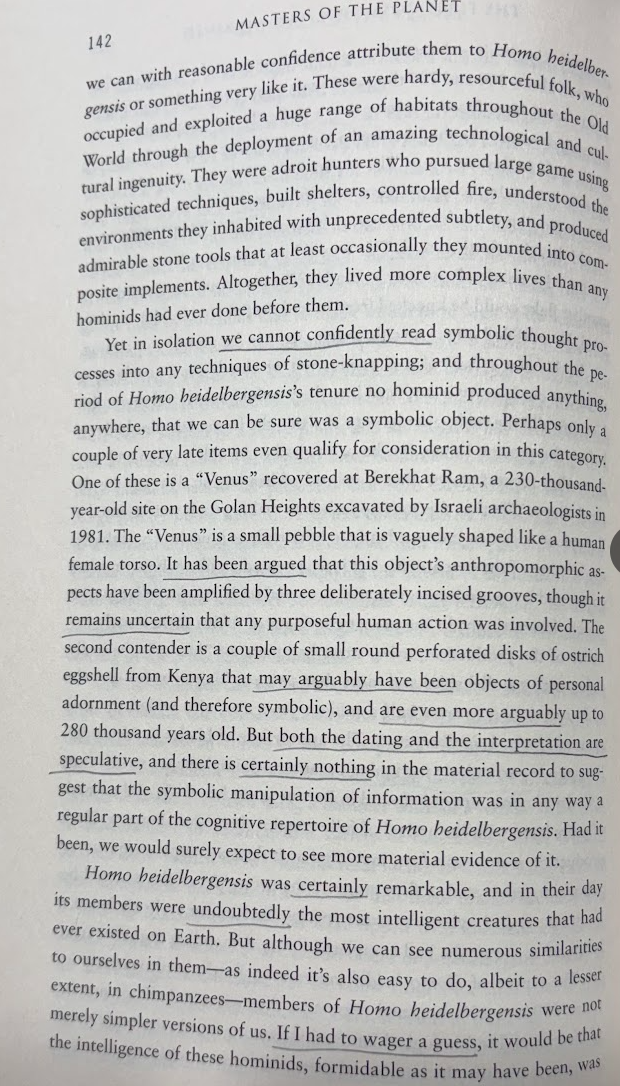
And we can’t take absence of evidence as evidence of absence. Beyond this, it is fair to point out that there is nothing we know or can reasonably infer about Homo ergaster cognition that would rule out the possibility that these creatures used simple containers
The absence of evidence for evolution is the norm. Evolutionists are excellent story-tellers, and they fill the gaps of this missing evidence with wonderful stories. I’m just not persuaded by their stories
Chapter 7 – Out of Africa and Back
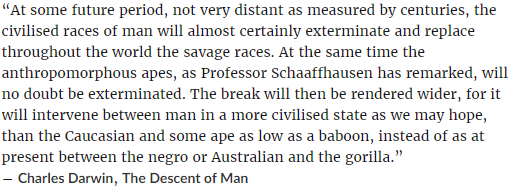
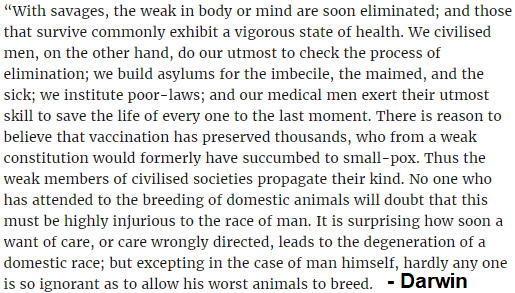
Many people may not know that the “Out of Africa” theory was concocted in an effort to hide the inherent historical racism of Darwin’s theory of evolution. When Darwin fabricated his theory he lived in a time when it was perfectly acceptable to be openly racist. He had nothing to hide by presenting his new theory as praising the white race for being more evolved and pointing out that he thought the darker-skinned people were less evolved. From his work Descent of Man:
Sadly this kind of thinking had real and dire consequences built into the foundation of the theory of evolution. People have chosen to be racist for millennia, but with the advent of the new evolutionary paradigm that was deemed scientifically advanced, people felt they had a scientific justification for mistreating people of different ethnicities. The scientific racism went so far as to actually display an African in a zoo as if he were an animal
As the 20th century progressed, racism (thankfully) fell out of favor among the scientific elite, but because evolution had vise-like grip on academia, a new story was needed to hide the racism. Enter the “Out of Africa” model. The idea is that since humans were now said to have evolved in Africa first, Africans now had the GREATER claim to being the MOST human of all. Dr. Marvin Lubenow exposes the fabrication in his book, Bones of Contention
Now, what does Tattersall have to say about “Out of Africa”?
The human family was born in Africa, and many millions of years passed before we have any evidence that hominids had managed to escape the continents confines. For a long time it was believed…now though, things are looking a lot more murky; for the initial dispersal out of Africa appears to have occurred as early as 1.8 million years ago, or possibly more
Claims and murkiness. No science there. He follows with “suddenly” “it was felt” and “suggested” before throwing out this beauty:
Shortly before the early age of the Dmanisi was verified in 2000 and 2002, dates had been published from Java that hinted at the very early (1.8-to1.6 million-year) presence of Homo erectus in eastern Asia; together, these dates placed beyond dispute that the hominid exodus from Africa had begun almost immediately following the appearance there of the new hominid body form-vastly earlier than anyone had previously suspected.
“Beyond dispute“…please! Dates from evolutionists are presented as SET IN STONE when they speak to detractors, but as time goes by, the dates are as pliable as jello on a trampoline. New evidence requires evolutionists to constantly revise dates to keep the story from falsification as evidenced by the last line: “vastly earlier than anyone had previously suspected.” Because prior to that point, the evolutionists would have expelled anyone for suggesting the the dates that Tattersall says are “beyond dispute”. This book was published in 2012. As of the time of this blog post, the proposed (Darwinian) dates for the Dmanisi fossils have changed 3 times since 2012. There’s nothing to prevent future discoveries from forcing evolutionists to change these “beyond dispute” dates yet again to keep the theory from extinction
On page 127 he continues
Limited as our speculations have to be, however, the conclusion is inescapable that the invention of the handaxe must be represented-or at least have reflected-a cognitive leap of some kind
Unfortunately for Tattersall, the argument from his entire book hinges on this phrase, which we will see again: “a cognitive leap of some kind”. No evidence of natural selection acting on random mutations to produce cognition…just an interpretation of bones and stones to fabricate a story. This story includes (not science) but ever-increasing speculation:
Must have been
if for no better reason than there was nowhere else for them to iccur
must have been
remains a bit hazy
we have no idea
especially since there is no evidence that more than 1 hominid grade was involved
strongly suggests
suggestion
quite controversial
remains pure speculation
but it is possible
it is quite possible
we have so little supporting evidence
how we interpret it
suggestive
is at least highly suggestive
regrettably unknown to us
just as likely
a scenario
suggests
maybe about a quarter million years ago
perhaps most bizarrely of all
enormous controversy
Chapter 8 The First Cosmopolitan Hominid
Scattered throughout this chapter, we see the continued howls from Tattersall that the fossil record of human evolution is deficient
The systematic picture among fossil hominids of the period around a million years ago remains rather unclear, because relevant fossils in the African center of innovation are few and far between and widely scattered“
On its own the Mauer jaw was a bit puzzling
Dating is rather poor for most of these fossils
we can’t say much about the body structure of Homo heidelbergensis, since bones of the body skeleton are few and far between.
Some 380 thousand years ago the terrace on which Terra Amata lies was an ancient beach, to which a small group of hunters repeatedly returned (alas, without leaving any evidence of themselves)
Notice the speculation, uncertainty, arguing, and wagering of guesses on which paleoanthropology is built. Yet, when anyone questions the evolutionary narrative, the rebuttal is inevitably “you’re a science-denier!!!!” In their books and papers, to their evolutionary audiences, they drop their filter and expose the tentative nature of their view. Evolution isn’t built upon mountains of evidence; it’s built upon the predetermined ideology that natural selection acting on random mutations can produce all biological traits.
Chapter 9 Ice Ages and Early Europeans
In chapter 9 Tattersall tells the terrifying tale of intrepid travelers traversing frosty terrain as they transformed from Tanzanian apes into tempered Turks. It’s a great fable, with lots of conjecture.
There is thus no way in which we can realistically think of hominid evolution during the Pleistocene as a matter of steady adaptation. Instead, the story is a much more dramatic one
Ice Age conditions were often tough for the hominid individuals concerned; but never had circumstances been more propitious for meaningful evolutionary change than among our highly mobile, adaptable, and resourceful Pleistocene ancestors. Taken together, this combination of internal and external factors may well account for the amazing rapidity with which hominids evolved during the Pleistocene…rapid evolution…rapidly…quite unexpected…may have been
Propitious?!? You mean lucky? What exactly he means by evolutionary change, he never really says, but the implication is that “change happened, therefore evolution did it! Praise evolution almighty!” Again we see that Tattersall is proposing this strange and unnatural view of ‘rapid evolution’. We’ll see in chapter 14 why he’s pushing so hard for this idea that is so far outside the orthodox teachings of evolution: slow & gradual accumulation of mutations filtered over millions of years by natural selection
And very recent findings have also pointed to something quite unexpected: the possibility that, under fluctuating Pleistocene conditions, new genes may have been introduced into hominid populations by occasional intermixing between closely related and poorly differentiated hominid species
He’s saying that beastiality built humanity. Yuck! Too bad we didn’t end up with the monkey’s prehensile tail or the Orangutang’s strength.
But the problem was that each glacial advance scoured away much of the evidence left behind by its predecessors, and the resulting observations were a nightmare to interpret
No kidding. Your modified theory of evolution has staved off extinction despite the scouring away of much of the evidence. How convenient that the evidence is missing.
chronology is based on modern geochronological and geochemical analyses of long cores drilled through sea-floor sediments, or through the Greenland or Antarctic ice caps.
It is not easy to date a pile of bones at the bottom of a pit
Chapter 9 ends with lots of open questions and plenty of room for open skepticism about the story that we are forced to swallow despite the lack of evidence.
Chapter 10 Who Were the Neanderthals
Maybe we’ll get more answers in chapter 10
we know so little about it due to the effects of repeated glaciation and deglaciation in the region
Again, evolutionists know so little because the evidence is missing…supposedly and conveniently by glaciers. Funny how today, the progressive left (which would undoubtedly include evolutionists) pray to, fight for, and weep for glaciers.
As far as we can tell from a less-than-perfect postcranial fossil record
More lamentations at the dearth of evidence
evolutionary time
What is evolutionary time? How is it different from regular time? The pervasive use of ‘evolutionary’ as an adjective shows how religious is their devotion to the theory. They use evolution as a noun, a verb, an adjective, and adverb…it’s just evolutionary evolution of evolution-like evolvement. And if you’re skeptical of the evolutionary evolutionism by evolutionists, you’re deemed to be a “science-denier”.
Perhaps…appeared to have been…suggested…might have been…might have been…probably too early to know what to make of observations…it is not out of the question…may have had
All of these words of ambiguity appear in the same paragraph
Chapter 11 Archaic and Modern
In this chapter Tattersall talks about evidence of artwork and tools. He tries to build a distinction between what he considers to be archaic fossils and modern fossils. Not much to critique in this chapter
Chapter 12 Enigmatic Arrival
In ch 12, Tattersall intends to build the case that Homo Neanderthalensis is distinct from modern humans – not in phenotype, but only in cognition. He admits several times that the fossils are virtually indistinguishable, but because of the different layers in which the fossils are found, he calls 1 fossil Neanderthal, and the other human. Let’s review
Homo sapiens was emerging
This again is the common lingo among evolutionists. They don’t want to say that it was magic, but their justification for these emergent changes sounds very much like an appeal to magic
Still, this is not the whole story, for as far as Homo sapiens is concerned it appears that the body for was one thing, while the symbolic cognitive system that distinguishes us to greatly from all other creatures was entirely another. The two were not acquired at the same time, and the earliest anatomical Homo sapiens appear right now to have been cognitively indistinguishable from the Neanderthals and other contemporaries
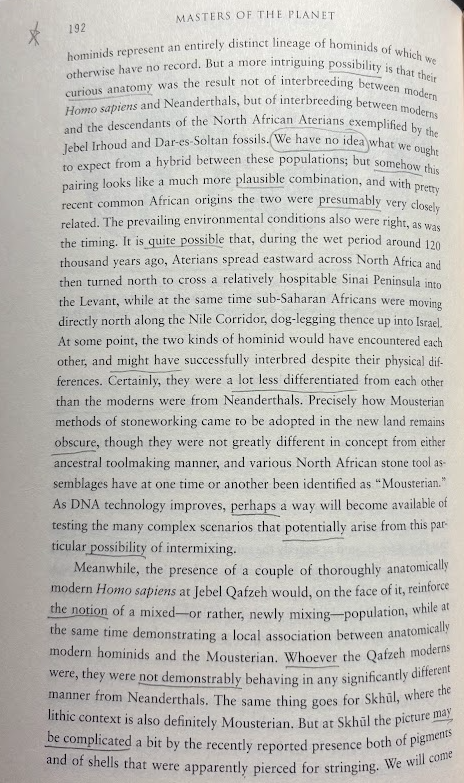
Recognizing species from their bones is often a tough proposition among close relatives: in some cases, much physical diversity may accumulate within a population without speciation occurring, while in others, the bones of members of two species descended from the same ancestor may be virtually indistinguishable. In the absence of a good morphological yardstick we thus can’t be absolutely sure that Aterians or the Jebel Irhoud people would not have been able to exchange genes with anatomically mainstream Homo sapiens.
If nothing else from this book, we see that “recognizing species from their bones is often a tough proposition”, and then when evolutionists cancel/expel/dismiss anyone, who is skeptical of evolution, we see that they are simply protecting their religion. Those presuppositionalists, who read my blog, will recognize the Tattersall’s lament of not having a standard when he says “in the absence of a good morphological yardstick”. By What Standard indeed? Evolutionists can NEVER have absolute surety because some new discovery can (and almost always does) change their whole paradigm.
Chapter 12 finishes out with an overabundance of “maybe”
These tools were more or less identical
probably
spectacularly obscure
One possibility
there is no independent reason to believe that they were around at exactly the same time
other possibilities
Notice from the screenshot of pg 192 how many underlined words leave the reader with the idea that there’s no reason to hold tightly to the evolutionary beliefs. The following page includes these gems
in light of the frustratingly little we know, it seems reasonable to see the initial excursion of anatomical Homo sapiens out of Africa and into the neighboring Levant as the fortuitous product of circumstance, facilitated or even spurred by a benevolent change in climate…quite likely…But whatever the ultimate identity…tantalizing hints…we have no evidence
Speculation based on fortuitous circumstance (luck). And “benevolent change”?!!? Are you kidding me? There’s no reason to take this paragraph seriously when he proposes that the climate was “benevolent” to the proto-humans. Let’s move on to chapter 13
Chapter 13 The Origin of Symbolic Behavior
In 2013 Living Waters ministries released a documentary titled ‘Evolution vs. God’, and at about the 33 minute mark UCLA professor, Dr. Gail Kennedy remarked “You know the problem with those who are unable to see evolution, I think, is they don’t have imaginations.” Indeed. To believe in evolution, you must have a vivid imagination. Tattersall agrees:
Our ancestors made an almost unimaginable transition from a non-symbolic, nonlinguistic way of processing and communicating…it is a qualitative leap in cognitive state unparalleled in history. Indeed, as I’ve said, the only reason we have for believing that such a leap could ever have been made, is that it was made.
He states that the ONLY reason to believe that humans evolved from their indistinguishable contemporaries is that humans are here. No evidence of this event. No prediction by evolutionists that it could have happened. No other reason whatsoever other than: humans are here. That’s nearly exact wording for an example of the Post Hoc Fallacy.
Some scholars have suggested that the dazzling Cro-Magnon art represented such a break with the past that a recent genetic modification must have been acquired in the Cro-Magnons’ lineage to make all this creativity possible: a modification whose effects were confined to their neural information processing, and were not reflected in the fossil bones which are all the physical evidence we have of them.
Suggestions…must have been. These evolutionary beliefs are thrown into the conclusions without demonstrative evidence. And regarding the evidence, notice from the last highlighted sentence that the EVIDENCE IS MISSING!
Chapter 14 In the Beginning Was the Word
The reason I bought and reviewed this book was the quote just below. When I heard Dr. Christopher Rupe (who himself is a paleoanthropologist) read this quote during his presentation, I had to see it for myself. You can see the whole video from Dr. Rupe here. He reads the quote at about 58 minutes in. I found it on page 207 in Tattersall’s book:
Evolutionists teach that numerous successive slight modifications over millions of years allow creatures to gain new traits to outcompete their unfit counterparts in the struggle for survival. Slow and steady accumulations. But Tattersall is admitting that this kind of evolutions is not supported in the fossil record. He has to invent NEW evolution, and while he doesn’t use the word, notice how easily you could plug in the word miracle as a synonym for each green word below
As I have already observed, this suggests that the physical origin of our species lay in a short-term event of major developmental organization, even if that event was likely driven by a rather minor structural innovation at the DNA level. Such an occurrence is made more plausible by the fact that genetic innovations of the kind that probably produced us are most likely to become “fixed” (i.e., the norm) in small and genetically isolated populations…In other words, conditions in the late Pleistocene would have been as propitious as you could imagine for the kind of event that would necessarily have had to underwrite the appearance of a creature as unusual as ourselves.
Evolutionists say they don’t believe in miracles. They only believe in science…
But notice how they just avoid the word “miracle” with synonyms…and it continues
But the results of this acquisition were revolutionary: in today’s jargon, they were “emergent,” whereby an adventitiouschange or addition to a pre-existing structure led to a whole new level of complexity and function. Exactly when our amazing capability was initially acquired is something we cannot read directly from the fossil record: the paleoneurologists, those specialists who specialize in the form of fossil brains as determined from the impressions they leave inside the cranial vault, cannot even agree in principle if there us any functional significance to the minor external shape differences
Emergent = miracle
adventitious = miracle
Tattersall admits that the fossil evidence is missing…and his field of expertise is looking at fossils. He assumes that SOMEONE SOMEWHERE MUST have the evidence for evolution, it’s just not in his field
some believe
speculation
sometimes it seems like a miracle
The specifics still evade us, and we as yet have no idea what the genetic rearrangement was that gave rise to the unique anatomy of Homo sapiens. All we know for sure is that this event did indeed occur. But it seems overwhelmingly likely that….our new cognitive ability was acquired as a byproduct of the hugely ramifying genetic accident…Happily for us
The speculation and miracles continue. I don’t see any reason to accept the idea that humans evolved by means of natural selection acting on random mutations…the theory of evolution, which is what this book was an attempt to explain
The story-telling continues
I’ve already briefly mentioned the classic example of feathers, which were possessed by the ancestors of birds many millions of years before these modified dermal follicles were ever recruited as essential components of the flight mechanism. Similarly, the ancestors of terrestrial vertebrates had already acquired the rudiments of legs while they were still fully aquatic, and a terrestrial existence was still far in the future. You simply wouldn’t have predicted their future function when they first appeared. What is more, evolutionary novelties often persist if they don’t actively get in the way; and in the case of Homo sapiens the potential symbolic thought evidently just lurked there, undetected, until it was “released” by a stimulus that must necessarily have been a cultural one-the biology, after all, was already in place.
If you read that paragraph and know anything about evolution, you will declare: “That’s not how evolution works!” Evolution is said to work by reproductive fitness. Essentially, this means that whatever new traits that random mutations can provide, natural selection can judge whether or not to preserve that trait by how well it improves the ability to produce more offspring. Partially formed feathers can’t be preserved because there’s no evidence that they provide any increased fitness. It’s not just that these proto-feathers had to improve fitness in a single individual. These non-flight (what evolutionists think were broken dermal follicles) proto-feathers had to get fixed in an entire population of non-flying reptiles (as the story goes) and after millions of years get converted to the supremely well-designed flight feathers that we see today. Remember, there is no evidence that feather-like broken dermal follicles ever existed. But even if we grant that they did, they could not be preserved by natural selection if they didn’t provide a reproductive advantage for an entire population of reptiles! Same with rudimentary legs (stumps). Their wild assertions of stumps and follicles surviving millions of years of natural selection ruthlessly streamlining the phenotypes is absurd and definitely NOT evolution. They are appending a NEW story onto evolution in an attempt to explain the inexplicable. Now Tattersall invents the idea that “symbolic thought” just emerged miraculously even though the components were supposedly there all along too. In their attempt to prove evolution, they have to redefine evolution to include non-evolutionary (or in this case anti-evolutionary) mechanisms
believe
sparking speculation
has done nothing to quell the argument
suggestion
We can expect debate
notion
It’s anybody’s guess
Maybe
maybe
will require a lot more information than we have at present
suggests
almost unimaginable
remains a subject of pure speculation
If you asked an assortment of scientists interested in this question what that stimulus might have been, two clear frontrunners would probably emerge
we can guess
Some scientists believe
This is an attractive idea momentous event
Maybe. Maybe. Maybe
But this has proved a tricky endeavor, for individual words change quite rapidly over time: so rapidly that beyond a time depth of about five thousand years, or ten at the very most, it turns out to be fairly hopeless to look for substantial traces of relationship
5000-10000 years ago? Sounds very much like a biblical timeframe. At least I agree with Tattersall above
In figuring out just what it is that makes our brains special, we always have to keep in mind that our controlling organ is a rather untidy structure that, from very simple beginnings, has accreted rather opportunistically over an enormous period of time. So perhaps we shouldn’t be looking for one single major “keystone” acquisition. Instead, the extraordinary properties of the human brain are likely emergent, resulting from a relatively tiny-and altogether accidental-addition or modification to a complex structure that was already , and exaptively, almost prepared for symbolic thought.
As Darwin admitted in his autobiography: “Can the mind of man, which has, as I fully believe, been developed from a mind as low as that possessed by the lowest animals, be trusted when it draws such grand conclusions?”, Tattersall too is left admitting his belief that the human brain accreted accidentally. Why should an accidental accretion of neurons be trusted to provide reasonable conclusions? Would you trust the results of a calculator that was accidentally thrown together? I wouldn’t, and neither should you.
To sum up, Tattersall is a talented writer, and he is an excellent apologist for evolution. I’m sure he does a great job digging up bones. But I find that his attempt to convince critical thinkers that humans evolved (natural selection acting on random mutations) from lower animals is based – not on evidence – but on a religious commitment to naturalism. Evolution fails to explain the origin of humans.
For other areas where evolution has failed to explain the origin of:
3 thoughts on “Can Evolution Explain Human Origins – Part 2”
Yes!
“To sum up, Tattersall is a talented writer, and he is an excellent apologist for evolution. I’m sure he does a great job digging up bones. But I find that his attempt to convince critical thinkers that humans evolved (natural selection acting on random mutations) from lower animals is based – not on evidence – but on a religious commitment to naturalism. Evolution fails to explain the origin of humans.”
 ApoloJedi
Yes!
“To sum up, Tattersall is a talented writer, and he is an excellent apologist for evolution. I’m sure he does a great job digging up bones. But I find that his attempt to convince critical thinkers that humans evolved (natural selection acting on random mutations) from lower animals is based – not on evidence – but on a religious commitment to naturalism. Evolution fails to explain the origin of humans.”
Blessings.
LikeLiked by 2 people
Thanks!
LikeLiked by 1 person
Pingback: Presuppositional Apologetics’ Round Up: Second and Third Week of February 2026 | The Domain for Truth