
Debate: The Bible Teaches that Animals Died Before the Fall

In this debate, my Christian friend @CuriousChristianity attempted to argue the positive for this case, and I took the much easier (and biblical) case for the negative

Opening

Americans on average go through 12 years of public school indoctrination in evolution. Those, who go to college and those who get advanced degrees get 4, 6 or 8 more years of deeper indoctrination into the ideas that animals have been dying for millions of years. Even those who don’t get advanced degrees are saturated with movies and tv shows and news bulletins and flyers and conversations among work associates that bloodshed and death are pervasive for the assumed millions of years of evolutionary development. Some would call this science, but it is at the very least a philosophical idea that is deeply ingrained in 21st century thinking. It takes courage and discernment not to drink in and believe the worldly philosophy of evolutionism as a basic assumption. My friend may or may not believe in evolution, but the influence of the philosophies of death for millions of years is both pervasive and assumed in this culture. Many Christians who have been indoctrinated in the philosophy of death for millions of years search for holes in the text of the Bible to see if there is room to insert these outside ideas of death and suffering before the fall into sin. See if in this debate, you can discern how the assumptions of death have influenced the arguments of my friend rather than starting instead with the eternal word of God.

My case will have 3 points: Good, Food and Blood

Good

My friend has the very unenviable task of building the case that the Bible teaches that animals died before the fall of mankind. It is particularly difficult since no where in the Bible will you find death before the fall. He might make some assumptions and you’ll likely hear him try to talk about how good death really is, but please pray for my friend: his case is hopeless

During the creation account in Genesis 1 God declares his creation to be good 7 times and the 7th time, He declared it to be very good. What does the Hebrew word (tove) mean? Those, who hold to the temple inauguration view (like my opponent) will say it means “functional” or “ready”. Does this hold up to a textual analysis from Moses, in the same context to the same audience?

Gen 1:31 “God saw all that He had made, and it was very functional”

Gen 2:17 “But you must not eat from the tree of the knowledge of functional and dysfunctional”

Gen 3:22 “Then the LORD God said, “Behold, the man has become like one of us in knowing functionality and dysfunction”

Of course, this does not make any sense, but this is what the guru, John Walton, would have us believe from p50 of his book The Lost World of Genesis, where he says: “the meaning of the repeated formula ‘it was good’, which I propose refers to functioning properly…functional readiness”

This is the trendy tactic for Walton’s followers to get around the serious problem of animal death. If they can redefine good to have nothing to do with sin/morality or the fall, then they can accept the modern paradigm’s view that animal death has been happening for millions of years (or as they might say “for an unknown amount of time). But if good has to do with the absence of evil or the antithesis of evil/harm/destruction, then those who hold to this view have a serious theological problem.

This word good H2896 tove (tob) is used to describe God Himself at least 27 times in the old testament. Are we to believe Walton’s definition that the Almighty is functional? 40 times in the old testament tove is paired with ra (evil) H7451 as its inverse. And we clearly see from Isa 11:6-9 that the destruction caused by the fall includes predatory destruction. The Apostle Pual picks up this seamless theme in scripture that during creation week there was an absence of corruption but because of the curse of sin “For the creation was subjected to futility, not willingly, but because of him who subjected it, in hope that the creation itself will be set free from its bondage to corruption and obtain the freedom of the glory of the children of God For we know that the whole creation has been groaning together in the pains of childbirth until now.”

If my friend’s case is true, then suffering, cancer, and death are “very good”. But I Cor 15:26 tells us that “the final to be destroyed is death”.

If good is to have any meaning at all, then it cannot include suffering, harm, destruction and death as would be necessary for my friend’s case

Food

Genesis 1:28-29 has 5 commands

  • Be fruitful
  • Fill the earth
  • Subdue it
  • Have dominion over the animals
  • You shall have them (green plants) for good

Gen 1:30 relates the 5th command of God to “every beast of the field, every bird of the heavens & everything that creeps on the earth – everything that has the breath of life”

Predation is shown to be forbidden. Humans SHALL eat the green plants for food & those under man’s dominion shall eat green plants. Why would we assume that those under Adam’s jurisdiction be granted a freedom to consume meat that was denied to humanity?

If you doubt that the Genesis 1 command to eat only the green plants is NOT a command, we can look to the recreation language of God after the global flood in Genesis 9

Gen 9:1-3 “And God blessed Noah and his sons and said to them, “Be fruitful and multiply and fill the earth. The fear and dread of you shall be upon every beast of the earth and upon every bird of the heavens, upon everything that creeps on the ground amd all the fish of the seas. Into your hand they are now delivered. Every moving thing that lives shall be food for you. And as I gave you the green plants, I give you everything. But you shall not eat flesh with its life, that is, its blood”

Again we see the commands of God to be fruitful, fill the earth, subdue it and have dominion over animals. But the 5th command is freed of the restriction of animal consumption. This pattern at the creation and recreation is apparent and even if not in words, is logically denied by my friend. There’s every reason to believe Gen 1:29 is also a command for humans because this command is reversed in Genesis 9. And by deduction, we see that the animals are subject to God’s pre-fall dietary commands as well – to be vegetarian

Blood

The 1st recorded bloodshed in the Bible is the penal substitutionary atoning sacrifice of an animal in the garden by God Himself to cover the sins of Adam and Eve. The skin of this animal was used to cover their nakedness. This picture of the eventual bloodshed of Jesus was represented in the garden by the 1st recorded death of an animal. Without the shedding of blood there can be no forgiveness

Before the fall, God’s creation was very good – completely absent of evil/harm/destruction/predation and God promises that his creation will be restored to a state that is absent of evil/harm/destruction/predation through the redemptive work of Jesus. There was no room for animal death suffering or predation in God’s very good creation prior to the fall. As the writer of Hebrews tells us “Without the shedding of blood there is no forgiveness”. Has there been millions of years of needless suffering, bloodshed, and death in a world that God called very good as Walton tells us? Or as Romans 8 tells us, did the whole of creation become subjected to its bondage to corruption and groaning because of the sin of mankind?

It would be unexpected (according to my friend’s view) for something as meaningless as the bloodshed and death of animals to represent the atoning bloodshed of the Savior. It’s discordant with all of scripture to assume that there was some unknown epoch of meaningless bloodshed/death of animals that suddenly became the picture of Jesus’s redemptive sacrifice. But it is perfectly aligned with the teaching of the Bible that no bloodshed occurred until mankind sinned. The Spirit revealed to the writer of Hebrews how animal death isn’t meaningless as would be the logical result of my friend’s view.

Hebrews 9:13-22 “For if the blood of goats and bulls, and the sprinkling of defiled persons with the ashes of a heifer, sanctify for the purification of the flesh, how much more will the blood of Christ, who through the eternal Spirit offered himself without blemish to God, purify our conscience from dead works to serve the living God. Therefore he is the mediator of a new covenant, so that those who are called may receive the promised eternal inheritance, since a death has occurred that redeems them from the transgressions committed under the first covenant. For where a will is involved, the death of the one who made it must be established. For a will takes effect only at death, since it is not in force as long as the one who made it is alive. Therefore not even the first covenant was inaugurated without blood. For when every commandment of the law had been declared by Moses to all the people, he took the blood of calves and goats, with water and scarlet wool and hyssop, and sprinkled both the book itself and all the people, saying, “This is the blood of the covenant that God commanded for you.” And in the same way he sprinkled with the blood both the tent and all the vessels used in worship. Indeed, under the law almost everything is purified with blood, and without the shedding of blood there is no forgiveness of sins.”

All of the Bible is about Jesus as seen in Luke 24:44-45. The picture of the bloodshed of Jesus was represented in the bloodshed of animals as recorded for the 1st time after Adam/Eve had sinned. There is a gaping theological hole in the argument that rather than there being representative significance to the bloodshed of animals, the bloodshed and death of animals is meaningless because it happened for millions of years prior to the curse of sin. It is an unwitting diminution of the blood sacrifice of Jesus

Closing

As you can see from the video, the Bible does NOT teach that animals died before the fall. You have to appreciate the effort by my friend, but he had an impossible task. The assumptions and speculations he has made are just not found in the text itself.

There is great symmetry between the old and new creation. The Bible has a clear chiastic structure which we can see when looked at as a whole. God’s original good creation was cursed by bondage to corruption and death because of man’s sin. But because of what Jesus has done as the prophets & Revelation reveal, God will restore creation to a state that will be absent of evil and harm. This redemptive plan brings glory to Jesus. The resurrection of Jesus has power to redeem all of creation from its bondage to suffering, corruption and to defeat the last enemy: death.

Be brave and discerning dear Christians. Though the dominant paradigm is saturated with worldly philosophies like evolution and deep time, we need not be captive to this kind of thinking. We have the mind of Christ, and out thinking should be shaped according to Christ’s revelation and for His glory

The Bible tells us that humans are made in the image of God. As image bearers, humans were empowered to uphold God’s dominion over all of his lovely creation. Genesis tells us that the curses for sin were thorns, suffering, and death. Jesus took each of these curses upon Himself at the cross. Denying that the curses for sin had no effect on the creation over which mankind had dominion, limits both the universally destructive power of sin AND the redemptive work of Jesus, whose power is even greater than that of sin. His death and resurrection heals not just the hearts of the repentant, but restores the relationships of the wolf and the lamb, the leopard with the goat, the calf and the lion. There will no longer be harm and destruction that has pervaded this sin-cursed creation.

Post Debate Discussion

During the debate, Adam said, “We should let God define good”. And I heartily agree. When we let scripture speak for itself, goodness is clearly an absence of evil/harm/death. God uses the Hebrew word for good (tob, H2896) to describe Himself at least 27 times in the old testament. And at least 45 times in the old testament God contrasts good (tob) with evil (ra, H7451). The Hebrew word ra means evil, harm or destruction. The definition of good is the absence of evil, harm, & destruction. So, Adam’s entire case is discordant with what the Bible teaches. So, yes – Let God define what is good

While the argument about the tree of life is a good one, it is easily shown to be insufficient to overcome the teaching from scripture that everything in creation was very good before the fall. And since the Bible (Rev 22:2) tells us that the tree of life is for the *healing* of the nations. This healing is easily inferred to be from the mortal wound of sin. Without sin, there would be no need for healing.

What about plants or bacteria or spiders (as Adam brought up several times in the debate? Plants, while categorized as alive today, are really just a self-replicating food source. As for the others, see the article here.

If you are unfamiliar with the misery, suffering, bloodshed, and harm that animals deal with, follow these accounts on X. These are the behaviors that old earthers think are part of a “very good” creation for millions of years prior to the sin of mankind

  • @TheBrutalNature
  • @BrutaINature1
  • @TheeDarkCircle

Some more thoughts about how God views blood as important, check out these passages:

  • Leviticus 17:10-14 atonement comes from the shedding of blood
  • Acts 15:29 abstain from eating blood

So animal blood, while much less valuable than the blood of Christ, is shown to be valuable for covering sins. The shedding of animal blood is the picture of Christ’s blood, so it is not insignificant as would be necessary in the views of old earthism. Predation and death of animals would not be expected from a biblical view. It is only the worldly philosophies that bring in the ideas of perpetual predation and animal death prior to the sin of mankind

Don’t overlook the effects of the cultural saturation of evolution in the arguments of my friend. The myth millions of years of death and suffering are so engrained in the cultural milieu, that Adam just assumes death has been a part of history for that long. It’s definitely not a biblical teaching. It comes from outside the Bible. So, we can say with certainty that the Bible teaches that animals did NOT die before the fall

From the Beginning of Creation

In response to the Pharisees question of whether a man can lawfully divorce his wife, Jesus responded that divorce was only permitted because of the hardness of their heart. It is recorded in Mark 10:6 that Jesus said: “But from the beginning of creation God made them male and female.” (bold added by me)

This phrase comes up from time to time in discussions about young earth vs. old earth. Young earth creationists say that this is proof that Jesus was a young earth creationist. Old earth creationists have said things like:

  • “This is just the beginning of mankind”
  • “This is just the beginning of marriage”
  • “Mankind wasn’t made at the beginning – Adam was made at some unknown time after creation”
  • “Jesus didn’t really know the science”

All of those responses do not take the words themselves into account. Jesus said “the beginning of creation”. He did NOT say “the beginning of mankind” or “the beginning of marriage”.

But what about the 3rd bullet point: “Mankind wasn’t made at the beginning. Adam was made at some unknown time after creation” ? In this point, the old earther mischaracterizes the word “beginning” as if it can only mean the initial picosecond (what’s smaller than a picosecond?) of creation. Let’s look at a couple of analogies to show that the old earther demands a hypocritical and draconian misunderstanding of the word: beginning.

Consider the four year term of a president. The 47th president of the United States will be inaugurated in a few months. Would it be reasonable to say that the ‘beginning’ of his term includes only the first breath after taking the oath of office and nothing else? No, of course not. Would it be reasonable to say that the ‘beginning’ of the 47th president’s term included January 21st? 22nd? the first 100 days? Yes. Yes. Yes. The old earther makes an unreasonable demand of the word.

How about the 100m dash? The fastest reaction time allowed for starting a 100m race after the starting notification is 1/10 of a second. If it takes approximately 10 seconds for the finest athletes to run the 100 meter race, then the part of the race where the runner has not even responded to the starting signal is about 1/100 of the race. Commentators speak of the sprinter’s start as the first 10 meters (the beginning) of the race. After the starter’s gun goes off, sprinter’s cannot even begin to move until a 100 billion picoseconds have passed. Certainly, the beginning of the race can include 100 billion picoseconds before the athlete can even move. Yes?

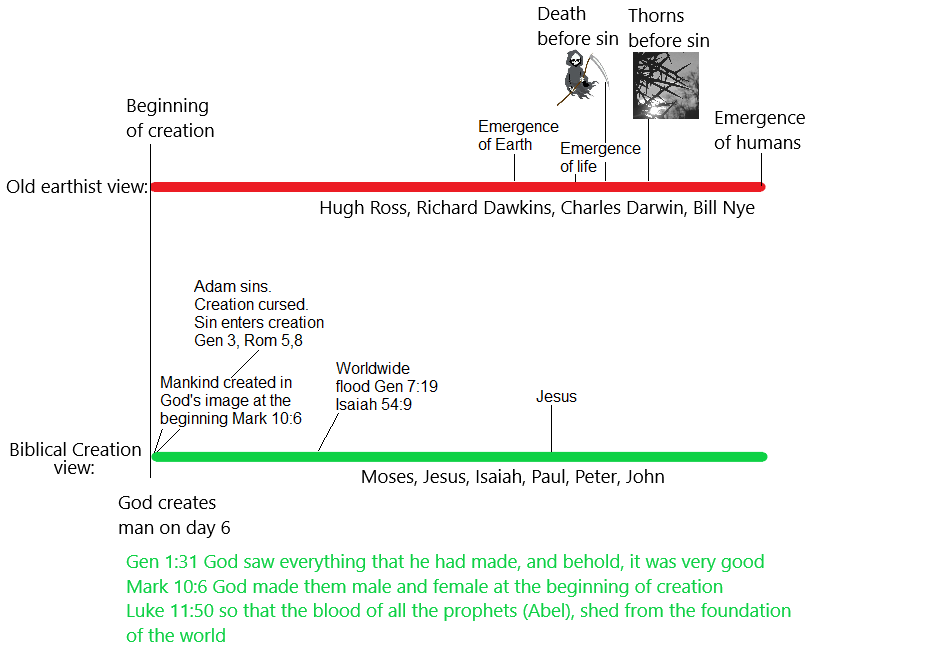
Using our 100m dash analogy, if we limit ‘the beginning’ to just the 1/10 of the second before the sprinters even moved, it would still be more than 2000 times greater than the passage of time relative to the length of the race from the creation week of Genesis 1 to 4000 years later when Jesus said “at the beginning of creation”. In other words when Jesus was speaking about the beginning of creation 4000 years after mankind was formed from the dirt, that length of time is 2,000 times smaller than the 1/10 of a second when a sprinter has not even begun to move out of the starting blocks in his 100m race. Certainly it could be said that within the meaning of the word “beginning” we can reasonably include the 1st week – just as Jesus said. If we put Jesus’s words and the beginning of creation on comparative timelines, things come into sharp focus. The green line shows accurately the beginning of creation that correctly accounts for the words of Jesus.

Conversely, if the old earth view (the red line above) were true and mankind was made 13.7 billion years after creation, it would be as though the runners in a 100 meter race were the same distance as the diameter of 3 water molecules from the finish line. This renders the word “beginning” to be meaningless because in all views other than YEC, the beginning can mean all of history. It destroys the very meaning of the word “beginning”.

You can see clearly that the old earther is faced with the dilemma of either putting false words in the mouth of Jesus, declaring Jesus to be ignorant of his own creation, or destroying language. If you want to be in accordance with scripture, you’ll accept YEC. It’s the only view that is consistent with scripture. The young earth creationist from above is right – Jesus is a young earth creationist.

Does the Bible Teach That The Earth is Young?

Yes…clearly. Here’s the definitive debate and some post debate thoughts to help clarify some things that didn’t get full discussion during our allotted time

Here are my notes for my opening:

The word ‘Trinity’ does not appear anywhere in the Bible, but we know from reading the Bible that the Father is God, the Son is God, and the Spirit is God. And we know that God is One. Anyone who denies the trinity is not a Christian. The biblical teaching of a young earth is more clear than the trinity. While people can deny a young earth and still be a Christian, we must wonder why denial of a young earth is so pervasive. For 18 centuries Christians have universally accepted the biblical account that the earth is young. But with the advent of the modern scientific paradigm of deep time at the end of the 18th century, some in the church began to look for ways to bring the biblical account into concordance with that deep time paradigm. It’s a trendy fad with many different ideas on how to do so. From postulating that days actually mean eons to inventing a billions of years gap between Genesis 1:1 and 1:2, the ideas have been creative. The trendiest of ideas that is hyperbolically 15 minutes old, is that Genesis is agnostic to ideas of age and does not deal with “material” creation; just its functional ordering due to the influence of the writings of the Hittites, Sumerians, and other ancient near eastern people groups that were judged with destruction for their wickedness. ALL of these trendy ideas have one thing in common – a specialized guru who tells you that the words don’t mean what they are commonly understood to mean. They mean something unique that only the guru with his secret knowledge can reveal. They say that it is the text of scripture that must be redefined so that the Bible can be brought into alignment with the emergent dominant paradigm.

Is it valid to consider trendy ideas to make the Bible concordant with the worldly philosophies, or should we as Christians uphold the authority of scripture as the magisterial principium? If words have meaning at all, then accepting the Bible’s clear teaching of what we now call young earth creation is self-evident. It is at the expense of denying language itself that fellow brothers in Christ deny that the Bible teaches what I will defend tonight (Does the Bible teach that the earth is young?)

  1. The earth, the universe and everything in it was created in 6 calendar days as the Bible says
  2. The earth was created about 6000 years ago because of the ages given in the corresponding accounts of the unbroken royal lineage of the Seed from Adam -> Abram in Genesis/Chronicles and from Abram to Jesus (Luke) as the Bible says
  3. Jesus confirms that mankind was made at the beginning of creation as the Bible says in Mark 10:6

As Christians, we do not want to hold onto things that are demonstrably false. Genesis and the rest of scripture very clearly tells us that God created in 6 calendar days about 6000 years ago. Most of God’s word was passed to us from the Spirit inspiring the prophets and apostles, but part of the case for young earth was literally written by the hand of God in stone. This was completely undisputed but for the rarest of outliers for about 1800 years until the end of the 19th century. Suddenly when Darwin’s idea of evolution took hold of academia more time was needed to explain his biological theory, so it became trendy to see if the words in the Bible could be stretched to accommodate these naturalistic ideas.

Text: Genesis 1 

  1. “In the beginning” – This may come up later as we identify that one of the trendy tactics today is to stretch the word beginning far beyond all recognition. Hebrew grammar and narrative structure of Genesis 1 doesn’t permit a time gap between verses 1 and 2. The waw consecutive (“and”) at the beginning of verse 2 in Hebrew implies a direct sequence of events
    • Use of the word yom (meaning day) and it’s literally defined there in Genesis 1
    • Why did God not use any of the deep time words like:
      • Yamim (plural of yom) – Not used
    • Qedem (days of old) – Not used
    • Olam (days of old) – Not used
    • Some might object and say that Moses didn’t understand large numbers like billions of years, so God had to speak to the simpleton with simpleton language, but this objection would be ignorant of the covenant from Gen 22:17 “I will surely bless you and make your descendants as numerous as the stars in the sky and as the sand on the seashore”, yet God did not communicate to Moses about his creation in this way
    • The only reason that God would withhold using large words to describe the time it took for Him to create is because it took only 6 calendar days – just as He said
  2. “Sequential days” are confirmed by the ordinal usage of the text. Had God wished to communicate non-sequential days, it would have been quite easy for Him to say something like “some time later” or “many years later” or “as things developed over time”. Instead, He used language that we all understand to mean sequential consecutive days. The point is clear: God was not giving some ambiguous myth. The words of Genesis have meaning of sequential consecutive calendar days
  3. The days are bounded by evening/morning patterns to separate the days. Not eons. Not years. Not months…but only days are bounded by evenings/mornings. God was being very clear that yom means a calendar day in this context
  4. But Matt! Can’t yom mean a time period like in Genesis 2:4?” Yes! Notice how they always choose Genesis 2:4. No one ever chooses Genesis 1 because the context shows us that the usage of “yom” in Genesis 2:4 is COMPLETELY different than the usage of “yom” in Genesis 1. But I do agree that Yom has flexibility of usage. As faithful Christians we should look to scripture rather than some outside false authority like the scientific paradigm or modern culture or ancient near eastern cultures. Where can we look within scripture to find a usage of “yom” in the context described in Genesis 1 to give us the correct boundary? Ex 20:9-11 and Ex 31:17
    1. “6 days you shall labor and do your work…for in 6 days the LORD made heaven and earth, the sea and all that is in them”
    2. In the same way that God’s people are expected to work each week, we can be certain that it took God the same amount of time to create the entire universe because of what the Bible says
  5. Here’s the meat of the matter: Genesis 5 and 11 record the ages when those in the unbroken royal lineage of Jesus fathered their children. The summation of these ages confirm that the earth is indeed young. For those who would object that there may be gaps in the lineage, I ask “Who is missing? How do you know?” For those who would object that it doesn’t necessarily mean they fathered the direct descendant because the Hebrew word Yalad might just mean “was an ancestor of” I reply “it doesn’t matter because the age of the patriarch is mentioned whether it be father or grandfather”. To those who object “why does it have to be an unbroken lineage?” Seed of the woman vs. the seed of the serpent. Genesis tracks the unbroken royal line of the Seed of the woman as each generation looked for healing of the curses of sin. We know that the Matthew lineage has purposeful omissions for purposes of symmetry, but the other lineages (with their ages) show that Jesus is indeed the promised Kinsman Redeemer, who would crush the head of the serpent. Those, who would assume that there are genealogical omissions in Genesis/Chronicles/Luke are faced with the unenviable task of trying to show WHO is missing, how they know it, and how the line of kings remains verifiable in Jesus
  6. Lastly: Mark 10:6 “for at the beginning of creation God made them male and female” Jesus is confirming that it was the beginning when He created everything else that He made mankind. Remember, Jesus is the Creator: He would know. Those who have fallen prey to the lure of the modern scientific paradigm may say “That passage is just about marriage”, but this objection ignores the actual words that Jesus said. Would you contend with Him, that the very specific words that He used are unimportant? If beginning has any meaning at all, then it must be referring to the creation week and not as old earthers claim 13.787 billion years after creation. To say that “the beginning” can mean anything from 14 dozen hours to 13.787 billion years ago renders the word as meaningless. It literally destroys language

Consistency

If fellow brothers who deny YEC would apply the same level of skepticism they do against Genesis 1 and Exodus 20 to other parts of scripture, you might hear:

  • Of course the plagues against Egypt were just symbolic. There’s no way that an entire river turned to blood. God was just saying metaphorically that it’s the blood of Jesus that saves you. Besides there’s no record of the Nile turning to blood in Egyptian writings
  • When we look at ancient near eastern writings like the Sumerians, there are many stories like that of Samson, who had superhuman strength, so the Bible’s account of a man whose strength relied on the length of his hair is figurative in nature. Samson, while interesting, is hyperbolic of a leader, who probably existed but never pushed over a building with his hands
  • Jesus didn’t calm a literal storm. If you look at the Greek, you can reasonably surmise that Jesus comforted the storm in the hearts of his disciples. The storm was just a picture of the trauma that his disciples felt in knowing that their teacher would face persecution. Jesus’s words calmed the storm within them

But it’s inconsistent for YEC deniers to declare “God could not have created the earth/universe in 6 days in the recent past…but it’s totally possible for a virgin to bear a child

The text demonstrates that the earth (even though it is the oldest entity in the universe) is young, and Christians should not hold beliefs that are demonstrably false.

History

While the biblical text is the ultimate authority, is it worthwhile to see how Christians from the past have understood the text? Of course. If in my reading of the text, I ‘discover’ something that no one else in history ever thought or saw, I should question my own interpretation. To my knowledge, no Christian before the 18th century is recorded to have believed in what we would today call an old earth. To confirm the young earth consensus of the time from the earliest Christians to just over a century ago (a span of about 1800 years), let’s look back at some of those, who wrote about it (I’ll link the work of Ben Kissling in the show notes):

  • Irenaeus 165 AD – Earth is less than 8000 years old
  • Theophilus 180 AD – “All the years from the creation of the world amount to a total of 5698 years”
  • Julius Africanus 221AD – From the creation to 221 is 5499 years
  • Origen 248 AD identified his old earth atheist opponent with the implication that those who would deny the biblical age of less than 10,000 years are “assailants of the Christian faith”
  • Augustine 426 AD who wrote: “reckoning by the sacred writings (the Bible), not 6000 years have passed”
  • Johannes Kepler 1619 – Earth was created in 4997BC, so was less than 6800 years at the time of Kepler’s writing
  • James Ussher 1650 Annals of the World – Earth was created in 4004BC, less than 6100 years old
  • All Reformers accepted young earth (Did God Create in 6 Days? – Pipa)
  • Charles Lyell in the late 1800s (while not a Christian, recognized the hold that Christianity and thus the dominant paradigm of his time had on scientific studies) in his writings he wished to “free the science from Moses” which as we all know is Genesis
  • Jack Repcheck wrote a biography of James Hutton called The Man Who Found Time: “The age of the earth is the wedge that shattered the biblically rooted picture of Earth and separated science from theology”

As Christians, which we both are, we should want to interpret scripture consistently and rightly. Consistently by offering the same level of scrutiny to the passages that conflict with modern sensibilities (like Genesis) as those passages deemed crucial to Christian orthodoxy (like the miracles of Jesus). We’ve established that throughout all of church history before the dark times, everyone understood that the earth is young because of what the Bible tells us. And we have clearly established that the Bible teaches that the earth is young. The language demands it and we do not want to hold to teachings that are demonstrably false – especially the clear teachings of God’s Holy Word.

Closing

Thank you Keith for hosting this debate. You’re an above average timekeeper. Thank you Adam for a brotherly conversation on this important topic. Why is this topic important? I’m a Christian. Adam is a Christian. I love God’s Word and Adam loves God’s word. It is a matter both of authority and meaning. Dear Christians, if words have meaning, if language can communicate ideas, and since God has revealed history in his word, then we must hold to young earth creation. In Today’s culture redefining words to accommodate formerly abnormal views has become pervasive and acceptable:

  • Abortion is healthcare
  • Trespassing is an armed insurrection
  • Sexual perversion is normalized by asserting love is love
  • Anything certain parties don’t like is now defined as racism
  • Woman is whatever a person feels in their mind
  • Weird was used to describe the nuclear family

Sadly, this kind of thinking has leaked into the church when the foundations of scripture are compromised:

  • Day has been redefined as billions of years
  • Good has been redefined by John Walton as “functional ordering”
  • God’s creation of the universe in Genesis 1 has been redefined as temple inauguration
  • Death/suffering/thorns have been redefined as being very good
  • The beginning has been redefined to be some mysterious eon of time in which virtually all of the supposed billions of years of history have been hidden

As shown tonight, the plain reading of the Bible in its context…what some call the young earth understanding of God’s revelation in the Bible is the correct understanding. Young earth creation has been clearly understood since Moses penned those words and in Christendom until the dark times, until it became fashionable to reinterpret the meanings of words to accommodate modern sensibilities. If you need a guru like John Walton or Hugh Ross to give new definitions to words that no one in Christian history has ever before believed simply to accommodate modern scientific and cultural paradigms, take caution brothers. As Paul warned the Colossians “See to it that no one takes you captive by philosophy and empty deceit, according to human tradition, according to the elemental spirits of the world, and not according to Christ”. If you start with the human traditions of evolution or ancient near east hermeneutics, it will never lead you to Christ as that is not their purpose. But the purpose of God’s word is to lead us to Jesus. Just as the Bereans were called honorable for “searching the scriptures to see if what Paul said was true”, we too should test ideas by what is demonstrably true in God’s word. The Bible tells us that God created the universe very good (completely absent of evil/harm/destruction), but sin affected all of creation – and right there in the garden after the fall, God promised a Redeemer to heal that bondage to corruption against which we still groan today. But because the Bible can be trusted about God’s revelation of the past, we can trust his revelation about the future as we eagerly await the redemption of our bodies and the end of harm & destruction when the knowledge of the LORD fills the earth as the waters cover the sea. As Christians we do not want to have views of demonstrably false things, and it is demonstrably false that the Bible is agnostic to the age of the earth because of text of the Bible itself says. And it says that the earth is young

Post Debate Thoughts

The debate was effectively over when during the cross-examination, asked Adam:

“To accommodate something other than YEC, I can think of dozens of changes that would need to be made to the Bible. Conversely, if God actually did intend to communicate to us that the earth is young, what changes to the text of scripture would need to be made?”‘

His reply was “If he eliminated the 1st two verses of Genesis.” We can deduce from his statement that all of scripture supports the view that the earth is young if you do not hold Adam’s presuppositions. Now Adam has presupposed that Genesis 1:1 and 1:2 refer to God’s assembly of preexisting materials into the planet we see today and there are eons of time hidden in those verses that prevent us from knowing how old the earth is. In order to hold this presupposition, Adam has to ignore Exodus 20:9-11 and Mark 10:6, which if you watch the debate, this is exactly what he did. He tried very hard to dismiss the obvious connections of the creation of the waters and the earth in Exodus 20:9-11 and even laughed off the words of Jesus as referring to “the beginning”. Adam’s presuppositions are also at odds with the biblical text itself. No English translation supports his view, and if you say “well, but the original Hebrew…”, then you must conclude that you know Hebrew better than the 1000s of Hebrew scholars that have translated the text for hundreds of years.

Another of Adam’s dismissals is the idea of what the church has taught exclusively for thousands of years: the earth is young. He said in the debate that it’s “irrelevant” to this debate. While it is not authoritative, it is certainly relevant. Adam and I are both Christians and we both agree that the Bible is the authority, so our difference is over interpretation. If this debate had some different opinions over the course of church history prior to the dominant and oppressive modern paradigm, he might have a point. But the young earth view is exclusive from the beginning to hyperbolically 15 minutes ago.

I’ll repeat my contention from the opening: If in my reading of the text, I ‘discover’ something that no one else in history ever thought or saw, I should question my own interpretation. YOU should question my new and exciting interpretations that no one has ever seen before. And this is what we see with Adam’s interpretation: no one has ever seen his view in all of church history.

Lastly, because there is a strong cultural pull to be in alignment with what “science” teaches, we will look to see what some of Adam’s underlying assumptions are. The allure of being concordant with the dominant modern paradigm can be enticing. You can see this enticement from Adam in his other interviews with/about young earth creationists:

“I would be all too happy to see young earth creationism to be proven correctly scientifically…The Bible is the driving force for pretty much all of this (YEC view) And not that the Bible shouldn’t be our authority…”

“The only reason that I don’t believe that (sun stood still in the sky) is because of modern day science

“I’m willing to leave more of those discussions (age of the earth) up to the scientists

“If I’m going to say that the earth is billions of years old, that’s clearly a scientific question. Unless someone can show me a passage in scripture, it’s a scientific question”

In matters of history, historical documentation is the primary and authoritative source for answering those questions. The Bible IS that historical documentation and Christians have abdicated the authority of the Bible in favor of the dominant modern paradigm. Adam is simply incorrect about history being a scientific question. Questions of history should be answered – not by extrapolations – but by historical documentation