
In these series of posts: “Can Evolution Explain…” we have seen that the LOUD and TRIVIAL mantra: “there are mountains of evidence for evolution” rings hollow. What the internet evolutionists believe as gospel because it has passed through the peer-review process, is really just an accumulation of assumptions and artwork. The links to all of my review articles in this series are at the end of this post
Who would know the story of human evolution best? Dr. Ian Tattersall is regarded as one of the top 5 paleoanthropologists of the last 100 years and has served as the Curator Emeritus in the Division of Anthropology of the American Museum of Natural History. Surely, if the evidence strongly supports the belief that humans are the result of natural selection acting on random mutations from creatures that were not human, we should be able to learn this information from his book, Masters of the Planet – The Search For Our Human Origins. So I bought the book and read it.
Writing a book is a monumental task, and Tattersall is an excellent writer. He has done a great job in his research, and I was never bored reading through his book. Tattersall attempts to make the case that the emergence of language is the defining trait that led to humanity.
As you will see, my contention is with his assumptions, his supposed evidence, and his conclusions. As with the other reviews, Tattersall’s comments will appear in red with my comments in the default black. Any bold or italics in his quotes are added by me to highlight many of his problems. Let’s get to it
perceived in the apes a bestial savagery that served as an unwelcome reminder of humanity’s feared and (usually) repressed dark side
This is the 2nd sentence of the prologue. Right from the beginning, we see the assumption of common ancestry tied to chimpanzees. It is his right to make and state his assumptions, but as we will see, there’s no reason to be persuaded by his assumptions
Most importantly we have learned a great deal about the diversity and behaviors of our precursors on this Earth: certainly enough to allow us to begin speculating with some confidence about how, when, and in what context humankinds acquired its extraordinary habits of mind and communication
This is a common theme. There is speculation based on Tattersall’s basic assumption throughout the book.
Again from the Prologue, Tattersall proposes the idea that instead of natural selection (evolution) designing an “optimal” and predictable brain:
the long and untidy process that gave rise to the human brain…it is the very messiness and adventitiousness of our brains that makes them-and us-the intellectually fertile, creative, emotional, and interesting entities that they and we are
This perspective conflicts with the view of evolution that most of us were taught in school-where. if it was mentioned at all, this most fundamental of biological processes was usually presented as a matter of slow, inexorable refinement, constantly tending toward achieving the perfect.
Tattersall takes the view that instead of the typical evolutionary story of natural selection bending the human brain to be more rational and more optimized, the untidy and random nature of evolution that produced human thought. It’s similar to what Charles Darwin himself said in his autobiography as to why human reasoning (if the result of evolution) ultimately has no logical reason to produce trustworthy thought:

Incredibly, Tattersall inadvertently recognizes the case that Dr. John Sanford made in his magnificent book, Genetic Entropy and the Mystery of the Genome, that natural selection CANNOT preserve or remove traits at the genetic level. Natural selection can theoretically only act against the phenotype, which is why degratory mutations accumulate in the slippery slope towards extinction. Devolution is the norm.
In the end, natural selection can only vote up or down on the entire individual, which is a real mash-up of genes and of the characteristics they promote. It cannot single out specific features to favor or disfavor
Evolution is a myth
And there are yet other reasons for not expecting that evolution should produce tidy perfection. As I’ve already suggested, change can only build on what is there already, because there is no way that evolution can conjure up de novo solutions to whatever environmental or social problems may present themselves
If you didn’t know better, you’d have thought a creationist wrote that paragraph. This is true! Evolution CANNOT conjure up novel traits by means of natural selection acting on random mutations. It was very fulfilling to read this admission from a staunch evolutionist. They DO rely on the idea of miracles to produce new traits and human reasoning, but they have to imagine that nature can benevolently give them these miracles. He gives voice to this in this next section
Of course, it’s also true that not all mutations are equal. Some will have little or no effect on the adult organisms; but a few may have a radical influence on the developmental processes…for all of these reasons we should not expect significant evolutionary change in physical form to happen always, or even usually, in tiny and incremental steps. As we will see, sometimes a very small change in the genome itself can have extensive and ramifying developmental results, producing an anatomical or behavioral gap between highly distinct alternative adult states.
He can’t call them miracles, and he can’t point to any evidence, but he imagines a mutation to have been the magical step from brutish to cognitive ape. There’s no evidence for this, but for his worldview to be true, he has to imagine it. Notice too how to dismisses the standard evolutionary story of “tiny and incremental steps”, which undergirds to the whole theory of evolution in order to make his case for a fantastical unscientific leap in human development. It’s not evolution or science…it’s pure imagination
chapter 1 Ancient Origins
There is much speculation in this chapter, and I’ll list some of the many examples
- luckily
- as fate would have it
- most remarkable
- probably
- may actually have
- Given this reality, it is hardly realistic to expect that we’ll ever find an anatomical “silver bullet” that will by itself tell us infallibly if an ancient fossil is a hominid or not
- there’s always an element of human judgment involved
- the materials attributed to Orrorin are fragmentary, consisting of some bits of jaw and teeth and several limb bones believed (but not demonstrated) to have belonged to members of the same species
- might be
- Ar. kadabba is represented only by miscellaneous materials from sites scattered in time and space, and their association in the same species is even less secure than in the case of Orrorin
- a lot of subjective judgment
- Ardi is a mysterious beast
- are not hugely obvious
- These elements all add up to a great story, and they may well have been important individually
- Presumably
- must have
- But exactly how and in what precise context the in-line terrestrial foot was acquired remains tantalizingly obscure
- This deficit in our knowledge is hugely unfortunate because, given that everything that happened later was dependent on the fateful transition from the trees to the forest floor, it presents us with one of the most fundamental mysteries on all of paleoanthropology
- host of questions
- Most of the known fossils of this species are teeth and bits of jaws
- acquired
- acquired
- plausible
- potential
- would have
- probable
- point to
After the 24 pages of chapter 1, Tattersall has build only a foundation of speculation and story-telling to fill in the canyon-sized gaps. He uses the verb “acquired” several times without any explanation. Just acquired as if the protohuman creatures got a Prime delivery from Amazon. As I have contended from the beginning, chapter 1 was simply a collection of assumptions; no evidence for evolution
Chapter 2 The Rise of the Bipedal Apes
There’s no improvement for the case for evolution in the second stanza
It’s interesting to speculate how differently we might interpret hominid evolutionary history today had the older fossils been discovered first…the order of discovery of our fossil relatives has deeply influenced their interpretations
So often in discussions about evolution, advocates claim that “evolution is science”, but Tattersall – in preaching to the choir – drops the facade to reveal that what is commonly claimed to be evidence is really speculation based on interpretations
But it should never be forgotten that everything we believe today is conditioned in some important way by what we thought yesterday; and some current controversies are caused, or at least stoked, by a reluctance to abandon received ideas that may well have outlived their usefulness
If for 150 years, academia has solely and tyrannically taught evolution as true, it’s no wonder that the last 4 generations of professors believe evolution to be true…and since any evolution dissenters are vehemently removed from academia, there’s no reason to believe that evolutionism will be challenged in the next few generations. Only the most steel-spined critical thinkers do not cave to the pressure from the evolutionists
So, a tolerably complete skeleton from this incredibly remote period in time was an almost unimaginable piece of luck
Given the evolutionary view – millions of years of slow and gradual natural processes – there should be practically no fossils at all. Dead creatures would be exposed to scavenging and decay as they wait for slow accumulation of sediments to protect them such that no creatures should be expected to be preserved as fossils. In any case, the key fossils that should have been available to show the smooth transition of 1 kind of creature to another (the mountains of evidence for evolution) are certainly “missing”. Conversely, since the Bible is true, and there was a global flood about 4500 years ago, we would expect to find billions of dead creatures, buried in water-sorted rock layers all over the Earth. The evidence strongly affirms the Bible, while the evolutionists call the finding of fossils to be “an almost unimaginable piece of luck”
Regarding the Laetoli footprints found in layers which evolutionists believe to be 3.8 million years old (about 3 million years too early to be human footprints)
seems to reflect the way we walk…The feet that made the prints were structured essentially like ours…strikingly modern…remarkably humanlike bipedality
Because of evolutionary assumptions, the Laetoli footprints, although exactly like humans, were dismissed as human ancestors because of the layers in which they were found. Evolutionists did NOT follow the evidence where it leads but have let their preconceived biases color their conclusions. Regarding the A. afarensis fossils from Hadar, Tattersall had this to say:
Frustratingly, it has no foot bones, leaving lots of room for speculation
Speculation indeed
But you need to know that all interpretation of the Middle Awash materials by their discoverers has been conditioned by the underlying belief that the story of human evolution has essentially been a linear one. The idea is that a central lineage gradually transformed under natural selection from one species into the next, until the primitive Ardipithecus had been transmuted into the finely burnished Homo Sapiens
Whether the underlying belief in evolution of some group of evolutionists or the “new” underlying belief in evolution from Tattersall, the underlying belief is clearly just a story. A story that dismisses the revelation of God in the Bible in favor of a naturalistic novel.
Our (human) hands, with their broad palms, long thumbs, and the ability to oppose the thumb to the tips of all the other fingers, are ideally structured to manipulate objects
“Ideally structured”?!!? You mean designed perfectly for their intended purpose by the Creator of the universe.
Chapter 3 Early Hominid Lifestyles and the Interior World
Going through this chapter, I’m again going to point out the ubiquitousness of uncertainty
- would have been
- would not have been
- possibility
- unlikely
- must have
- must have been
- possibility
- no good evidence
- some authorities think
- have been made possible
- must have been
- might well have
- while this story…
- possibilities
- may well have been
- may have
- may have
- possibility
- would have been
- possibility
- suggests
- might have been
- not at all a sure bet
- might have become
- if they did
- would be
- would have
- might have
- of some kind
- Sadly, at present there is much less to say about these ancient precursors than we’d like, although it’s a good bet
- Perhaps
- probably
- would have been
- hazy and incomplete
- is not something we can hazard with any confidence at this point
- seem to
- There is no way to answer this question
- approximate
- presumably
- The temptation is to assume…Yet the truth is that we simply cannot know
- seemed to indicate
- as far as one can tell
- plausible
- suggest
You can see from this chapter that there is little science going on, but lots of assumption and story-telling. And EVERY chapter is filled with these speculations and story-telling. Where’s the evidence?
Chapter 4 Australopith Variety
In this chapter, Tattersall builds that case in which he believes there is a great deal of variety among creatures that he thinks are not human ancestors. Just a few lines from this chapter that solidify the guessing game that goes into the story of human evolution based on rare and fragmentary fossils
nobody knew…Neither did anybody know exactly how old these early hominids were, although from the accompanying faunas is was guessed…the ankle joint looked fresh…perhaps…This fits nicely with the interpretation…Despite their strikingly different histories of interpretation…early biped species were actively experimenting with ways to exploit their hominid heritage…The unfortunate truth, however, is that this specimen also is so poorly preserved that it is difficult to know what to do with it…The hominid stage was packed with actors, all pushing and shoving for the limelight
Interpreting fossils is just that. Interpretation. To get an evolutionary interpretation of the fossils, one must first believe in evolution and that evolution by means of natural selection acting on random mutations can produce functional cohesive interrelated interdependent systems first. Anyone, who recognizes the truth that evolution cannot do produce systems is not persuaded by the interpretations of the “experts”. Regarding the last sentence of the above quote, these paleoanthropologists don’t actually produce anything that generates income. They rely on the donations of others in the forms of academic grants or benevolence to dig up fossil bones. What better way to generate interest in your work than to claim that you have discovered a human ancestor fossil? Whether the claim turns out self-aggrandizing or ultimately rejected doesn’t matter as long as there is enough interest to fund the next digging season.
Chapter 5 Striding Out
In this chapter, Tattersall tries to build the case that non-human human ancestors are related because of skull shape and bipedality. He focuses mainly on some fossils that have been named Homo Erectus and Homo Ergaster.
People have referred themselves to human since long before anyone had the faintest idea that our species is connected to the rest of the natural world by an extended series of long-vanished intermediate forms
“long-vanished” indeed. And the fossils are STILL missing. It’s why this we all use the term ‘Missing Link’. And notice how evolution by means of common ancestry is ALREADY assumed to be true. He’s made no case for the idea that humans are related to minerals, plants, and fish…just assumed it.
there is not one fossil among all those known in the period before about two million years ago that presents itself as a compelling candidate for the position of direct progenitor of the new hominids to come…This uncertainty is partly due to the fragmentary nature of the evidence…it is difficult to make sense of the abundant but frustratingly incomplete evidence that we have at our disposal
Not one. So, it’s not just a single link that is missing…but hundreds. Thousands. Millions of missing links. It takes critical thinkers (like Christians) to hold the overwhelming proselytizing of the evolutionists at bay long enough to dig deep into their literature like this to uncover their uncertainty and admissions of wild speculation
under the guiding hand of natural selection
I know that Tattersall does not believe in a literal hand of natural selection, but this is the ultimate conclusion of evolutionists. They believe that evolution was unguided. They see the necessity of guidance in forming functional cohesive interrelated interdependent systems, so they reify natural selection as if it is a prescriptive “divine” force rather than just the description of creatures without certain traits being culled. Evolution is inherently religious even though evolutionists despise being reminded of their religious-in-nature claims
Some of you might not believe that evolutionists would be so frank with their admissions with the problems of evolution, but Tattersall clearly thinks he’s ‘preaching to the choir’, and he willingly lets down the facade.
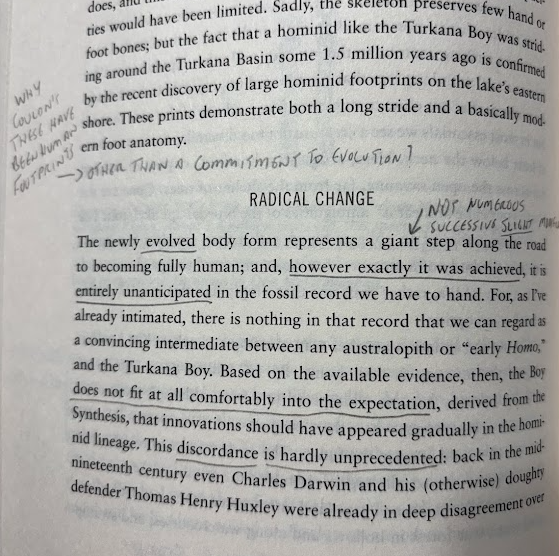
…whether or not “Nature makes jumps.” Darwin focused on slow, incremental change, while Huxley was worried by the many discontinuities he saw in the fossil record-and in nature in general-that were inconsistent with this pattern…as well as in a host of other apparent discontinuities.
Evolutionists teach their theory as if it is the slow and incremental change over time. Single, successive, slight modifications, but Tattersall recognizes the problem with the theory because the fossils don’t show this. The fossils instead show abrupt appearance and then stasis. The Theory of Evolution MUST be slow and gradual, but the evidence is inconsistent with this pattern because of a HOST of discontinuities. So much for the “mountains of evidence for evolution”.
Tattersall released this book in 2012 when almost every evolutionist believed in Junk DNA. He spends a few pages talking about how Junk DNA is what evolutionists would expect if evolution were true. Unfortunately for him (and all evolutionists), the ENCODE project was released between 2013-2015, and completely buried this argument for them.
Strange though: why would a paleoanthropologist spend any time on genetics if his expertise is in fossils? I’ve found this is often the case amongst evolutionists. They believe that since the theory of evolution has staved off extinction this long then SOMEBODY must have the evidence since there’s none in their own field.
On pg 97 he does reveal some evidence, but it’s not for evolution; it’s for devolution
subtle genetic modifications might produce large phenotypic differences…As a result the bottom-livers have lost the spines…The modification is not trivial, involving as it does the elimination of an important part of a complex structure…a small stretch of regulatory DNA has been deleted. This left the basic gene intact to do its essential task, but it has eradicated the development of spines by reducing its activity in a specific area of the body…Most changes on this scale will actually be disadvantageous
You can’t get from bacteria to Bach with this kind of deleterious evolution. He does return to fossils shortly thereafter…sorta
Perhaps the Turkana Boy’s radically new bodily conformation can be attributed to a genetic event of a similar kind…So maybe…Perhaps there simply weren’t any such intermediates-or at least none that we could reasonably expect to find on the coarse time scale that the fossil record represents. Something routine and unremarkable on the genomic level had occurred…it just happened to change the course of hominid history
No fossils. No evidence to record this monumental event that they need to make their case. It’s a grand story filled with ‘maybes’ and ‘perhaps’, but what’s missing is the actual mountains of evidence for evolution
This post has gotten pretty long. Check back next week for Part 2 of the book review
- Can Evolution Explain Altruism?
- Can Evolution Explain Reason?
- Can Evolution Explain Software?
- Can Evolution Explain Software 2.0?
- Can Evolution Explain The Indonesian Mimicry Octopus?
- Can Evolution Explain the Eye?
- Can Evolution Explain Empathy?
- Can Evolution Explain Morality?
- Can Evolution Explain the Human Brain?
- Can Evolution Explain the Origin of Information?
- Can Evolution Explain the Origin of Minds?
- Can Evolution Explain the Origin of Lungs?
- Can Evolution Explain the Origin of Eyes 2.0?
- Can Evolution Explain the Origin of Sex?
- Can Evolution Explain the Origin of Snake Venom?
- Can Evolution Explain the Origin of Multicellularity?
 ApoloJedi