The discussion over whether the earth is young or old is an argument that has sparked many discussions for more than 150 years. It’s likely that this discussion will continue long after I’m gone. But while I can, I will continue to encourage Christians to uphold the Bible as the magisterial authority, and the hope is that when you’ve read this post, you too will accept a young earth model.
The plain reading of the Bible would indicate that a young earth model is the correct understanding, but I’ve been told by Dr. Hugh Ross and his old earth disciples that Psalm 104 is a passage that teaches old earthism. If you search their website, reason.org, you will find 126 articles. This is how their argument for old earthism progresses:
The “days” in Genesis 1 are really just long periods of indefinite time
God used natural processes to form stars, galaxies, chemicals, and planets billions of years before creating humans
When God created life billions years ago, death, suffering and predation were part of creation
The geologic layers are accumulations of eons of dirt over billions of years. The geologic record is a record of death and suffering across history
Since they believe that the geologic layers were formed over billions of years, they choose to argue that the flood of Genesis 6-9 is a regional flood
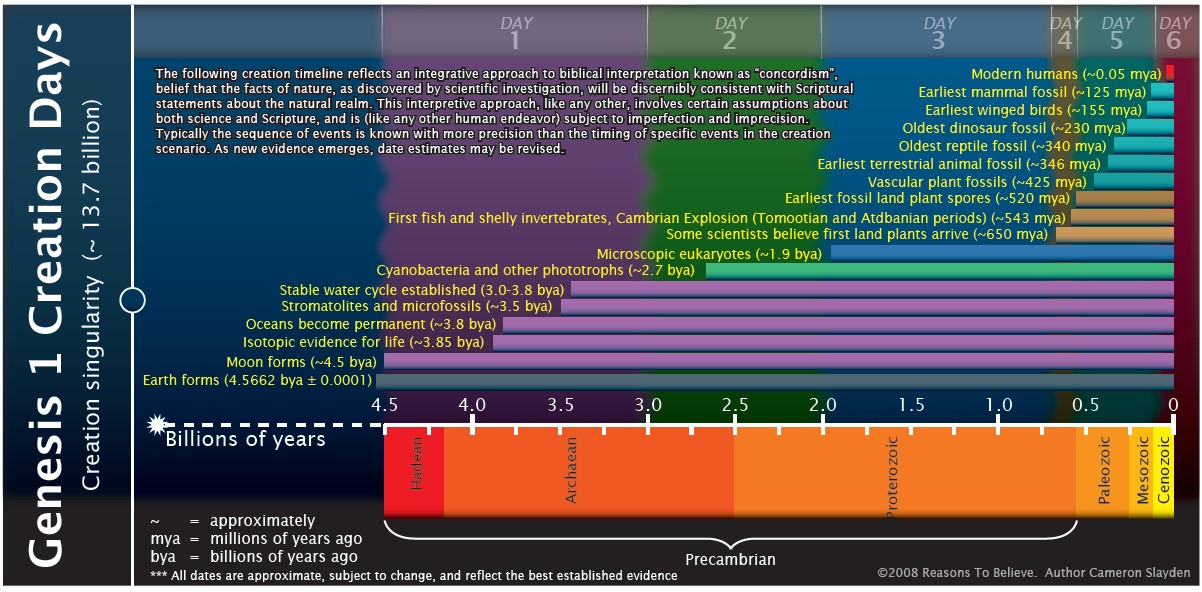
Below is the Timeline of history from Reasons.org. Due to their presupposition that the biblical account must be subject to the modern academic paradigm (which some conflate as science), their understanding of the history of the Bible must also change as secular timelines are constantly evolving. NOTE: Because of this, it will be difficult for you to find this timeline on their website since the secular timelines have changed so much.
Reason.org Timeline of history
So, how does Psalm 104 teach that the earth is old as Bill Nye, Neal DeGrass Tyson and Richard Dawkins think? Dr. Ross says:
Psalm 104 is the longest of the creation psalms. It complements Genesis 1 in providing the scientific details of God’s creation works. Psalm 104:6–8 refers to creation day 3 in Genesis 1 when God transformed Earth from possessing only water on its surface to possessing both oceans and landmasses. Psalm 104:9 states that once landmasses appear on Earth’s surface, the newly formed landmasses will “set a boundary they [Earth’s surface waters] cannot cross; they will never cover the earth again.” This statement in Psalm 104 explicitly rules out the possibility that Noah’s Flood could be global in extent.
So Dr. Ross assumes that Psalm 104 is a poetic text about the creation week. Since he thinks that when Ps 104 says the waters could no longer cover the earth as stated in verse 9 he thinks that is Genesis 1 rather than Genesis 7, and he concludes that the flood must have been a regional flood. He further assumes that animals have been engaging in predation from the beginning due to verse 21 that says “The young lions roar for their prey, seeking their food from God.”
As faithful Christians, we should test Dr. Ross’s assertion that Psalm 104 is solely about the creation week. Let’s look at his assumption in Psalm 104 and see if we can find confirming evidence of the phrasing in Genesis 1-3 or if there’s possibly a better explanation. Below, there are 2 charts. Figure 1 shows how Psalm 104 compares to Genesis 1. If it is tied directly to the creation account as Dr. Ross asserts, there should be green checkmarks ✅ on each row of the table.
Figure 1
Dr. Ross’s argument hinges entirely on the hope that Psalm 104 teaches a local flood and perfectly reflects the creation account of Genesis 1. As you can see from the comparison above, the connection between Psalm 104 as a creation account in Genesis 1 is spurious at best. What if we consider a second chart that compares the Psalm 104 passage to the flood account of Genesis 6-10? Figure 2 does just that.
Figure 2
As you can see from the 2 charts, Dr. Ross’s assertions are not nearly as affirming to his view as he would like us to believe. From Figure 2, we see that Psalm 104 confirms the young earth view (just as everything else in scripture does).
We can trust the Bible since it was revealed by God, the One who knows everything. There’s no need to inject the modern paradigm into one’s interpretive framework
In software designer circles, a “bug” isn’t an insect; it’s a problem in the code that keeps the software from performing as expected. It’s a well-known joke amongst the programmers that when a problem is discovered during the quality control (QC) process that the problem is a “feature, not a bug”. When the software breaks unexpectedly, and QC send the code back to the coders for repairs, the laughs about the “feature” devolve quickly to groans as the coders begin tracing through the code to exterminate the “bug”. It’s a tale as old as Y2K.
God-deniers have a similar bug in their thinking, but they sometimes refer to it as a feature. What am I talking about? Knowledge! What is knowledge? Knowledge is most accurately desribed as “that which corresponds to the mind of God”, but in this article and for most people the definition of “justified true beliefs” will suffice. How do we know things? Epistemology is the theory of how something can be known. Now the article I wanted to write about epistemology has already been written by Dr. Jason Lisle. He describes below the “bug” in the thinking of God-deniers:
So we are left with three equally unsatisfying options. (1) The chain of reasoning goes on forever and can therefore never be completed – making knowledge impossible. (2) The chain of reasoning terminates in an ultimate standard that cannot be justified, meaning all other beliefs (which are based on it) are ultimately unjustified – making knowledge impossible. (3) The chain of reasoning terminates in one or more ultimate standards that rely upon themselves for justification – a circular argument, which is ultimately arbitrary and unjustified – making knowledge impossible. This perplexing problem is known as the Münchhausen trilemma.
If the Münchhausen trilemma is correct, then we can demonstrate that knowledge is impossible. But, of course, this is instantly self-refuting. If we know that knowledge is impossible, then we do know something and hence knowledge is possible.
Knowledge itself is only provisional for the God-denier, because either that knowledge is reliant upon some other element of provisional knowledge into infinity or it could be refuted based on some future discovery. The bug in the thinking of God-deniers is that they can never know anything for certain. They put on a brave face by calling it a “feature” that their thinking is self-correcting upon the discovery of new evidence. But you can see that whatever they assert to know *now* is not knowledge at all. It is only provisional. It is a serious bug. It is bluster for them to claim that their enormous epistemic deficiency is a feature. This is demonstrable as anyone familiar with the history of science knows. The dominant paradigm from these time periods has been replaced by new paradigms, but if you lived in one of the time periods shown below, the gatekeepers of the dominant paradigm would try to silence dissenters the same way that those, who have faith in today’s dominant paradigm (materialistic biological evolution) censor dissenters
Prior to the 1500s, scientists believed and modeled that the earth was the center of the solar system. – Falsified
Prior to the 1600s, scientists believed in alchemy and phlogiston– Falsified
Prior to the 1700s, scientists believed that bloodletting and leeches removed bad blood from sick patients. – Falsified
Prior to the 1900s, scientists taught that the universe eternal (steady state theory) – Falsified
In the 1970s, scientists taught impending contradictory catastrophes would destroy humanity in the subsequent decades: ice age and unstoppable heat wave. – Falsified
In the 1980s, scientists taught that eating mostly carbs was the healthiest way to live in a failed marketing campaign called the food pyramid – Falsified
In the early 2000s, scientists taught that the ice sheets at the poles would be completely melted due to global warming by the 2013 – Falsified
The problem with the unbeliever is not that he cannot justify any of his beliefs. Rather, the problem is that he cannot justify any of his beliefs within his professed worldview. If evolution were true, then knowledge would be impossible. But evolution is not true. Since the Bible is true, evolutionists are able to have knowledge. Their beliefs in sensory experience and rationality are ultimately justified because the Bible is true.
Because Christians and non-Christians have different epistemologies, Christians are not saddled with such a crushing burden. Christians have a revelational epistemology meaning that we accept God’s revelation in creation, in the Bible and through the incarnation. The omniscient God knows everything, and He has revealed some of his knowledge to us so that we can be certain of those things which God has revealed. So, a Christian has a sufficient grounding for knowledge. From this grounding, a Christian can reasonably engage in scientific research, engineering, hospitality, altruism, programming,
Because Non-Christians have rejected the One, who knows everything (the only Source of justifiable knowledge) he can never be (justifiably) certain of anything. An honest non-Christian can only hold a provisional level of understanding since some future discovery or new bit of evidence might change everything they think they know. The apostle Paul is right when he writes to Timothy:
In many of my discussions with skeptics online, I’ve had the skeptics tell me, “it’s a feature, not a bug”. This is usually after we have talked about someone’s ability to justify knowledge.
As a final elaboration upon the Christian revelational epistemology, I turn to Dr. Lisle again in a long quote from his third article. Please take the time to read each article as all three are worth the time it takes to read them :
Truth is that which corresponds to the mind of God. But unbelievers sometimes scoff at this definition and attempt to refute it by asking, “How can you possibly know what God thinks?” But, of course, this question is easy to answer: revelation. God has revealed some of His thoughts to us and He has done this in numerous ways. Most specifically, God used men to write a book that expresses His thoughts, namely, the Bible. Do you want to know what God thinks about something? Read the Bible!
But there are other ways God has revealed Himself. God has placed knowledge into the core of our being from our conception. For example, God’s moral requirements – His laws – have been placed into the minds of all people. Thus, even people who have never read the Bible have some knowledge of the law of God (Romans 2:14-15). We are able to have some knowledge of right and wrong even without reading the Bible because God has “written” His law on the hearts of all people. This is a type of revelation.
God has designed sensory organs, such as eyes and ears, that allow us to have knowledge of the external world. Furthermore, God has placed knowledge within us that our senses are basically reliable; so, we can have confidence that what we see and hear is a good map of reality. By our senses, we can learn true things about the world, such as “the sun is very bright.” Consider the contrary. If God had not designed our senses to be basically reliable, or if God had not given us knowledge that our senses are basically reliable, then we could never learn anything about the external world. Sure, we might see that the sun is bright. But we would have no reason to trust that what we see corresponds to the real universe.
God has also placed some knowledge of logic within us. Logic is the principles of correct reasoning – a reflection of the way God thinks. God created mankind after His image/likeness. And this includes the ability to think – to some extent – in a way that is consistent with God’s character. Thus, we are born with some degree of rationality. (It is possible to prove that some laws of logic are known without ever being learned; hence God has “hardwired” them into our being.)[3] Furthermore, God has given us the ability to improve our reasoning skills through careful contemplation using our mind and from education using our sensory organs.
In addition, God has placed some knowledge of Himself inside all people such that when we look at the natural world, we instantly recognize it as the work of God. Romans 1:19-20 states, “because that which is known about God is evident within them; for God made it evident to them. For since the creation of the world His invisible attributes, His eternal power and divine nature, have been clearly seen, being understood through what has been made, so that they are without excuse.” Thus, all people have knowledge of God.
This fact should have a profound impact on the way we do apologetics. If indeed all people have knowledge of God, then they do not require additional evidence for God. Many Christians proceed as if the unbeliever is genuinely ignorant of God. Under this mistaken belief, the Christian urges the unbeliever to trust in God by presenting new evidence for God. But according to Romans 1:18-20, all unbelievers already know God but they “suppress the truth in unrighteousness.” The presuppositional apologist therefore aims to expose the unbelievers suppressed knowledge of God.
Since all knowledge is ultimately from God, it follows that anything we know has been revealed to us by God in some way. We can know things by sensory experience, but only because God designed our senses to be basically reliable. We can know things through rational reasoning, but only because God designed our minds and has given us access to His laws of logic. Hence, the biblical God is the ultimate justification for all truth claims.
Of course, even people who have never read the Bible do have knowledge. But this is because the Bible is true. Unbelievers learn things through sensory experience and rational reasoning just like believers. But in order for their beliefs to be justified, they would require some reason to trust their sensory organs, and their thinking process. If the Bible were not true, there would be no reason to trust in such things.[4] Hence, all beliefs based on those assumptions would lack justification.
We can have knowledge only because God exists and has revealed Himself in exactly the way the Bible teaches. God, as revealed in the Bible, is the ultimate foundation for all human knowledge. If the Bible were not true, we could know nothing. We might have beliefs, and some of them might even be true, but they could never be justified apart from the biblical worldview.




 ApoloJedi