

- “The mind is a terrible thing to waste” – Frederick Douglass Patterson
- “… a mind needs books as a sword needs a whetstone, if it is to keep its edge.” – G. Martin
- “I will not let anyone walk through my mind with their dirty feet.” – Gandhi
- “The mind is not a vessel to be filled, but a fire to be kindled.” – Plutarch
- “Mind over matter” – Unknown
- “I must have a prodigious amount of mind; it takes me as much as a week, sometimes, to make it up!” – Mark Twain
Minds are indeed amazing! But how did we, as humans, get our minds? From where do minds arise? Did God give us minds in order to praise Him, contemplate/discover the mysteries of his creation, and be creative…or did the natural forces of evolution cobble together particles such that these particles could comprehend the cosmos and even itself?
Now I’ve been told that natural selection acting on random mutations has enough power to produce everything in biology. I’ve put these claims to the test several times:
- Can Evolution Explain Altruism?
- Can Evolution Explain Reason?
- Can Evolution Explain Software?
- Can Evolution Explain Software 2.0?
- Can Evolution Explain The Indonesian Mimicry Octopus?
- Can Evolution Explain the Eye?
- Can Evolution Explain Empathy?
- Can Evolution Explain Morality?
- Can Evolution Explain the Human Brain?
- Can Evolution Explain the Origin of Information?
After posting these “Can Evolution Explain…articles, I inevitably hear evolutionists respond with some form of: “get your paper peer-reviewed and only then can you get your Nobel Prize for disproving evolution. Until then STFU!”
To be clear, these “Can Evolution Explain…” articles are NOT intended to disprove evolution. They are simply meant to analyze the assertions of evolutionists to see whether the subject matter is actually evidence for evolution by their own standards. It’s an internal critique. What I find in all of these articles is that what’s been proclaimed as “mOuntAinS oF eVidenCe” for evolution is really just story-telling and assumptions. We’ll see if Dennett’s book is more of the same bluster or actual evidence.
Another objection that I anticipate from the faithful evolutionists is “Dennett is a philosopher…not a scientist. If you want to prove creationism, you need to address the scholarly works.” I refer you to the last paragraph AND Dennett cites the latest of the scientific works that address this topic. AND Dennett’s own Wikipedia page calls him a “cognitive scientist”. There will be no shortage of “papers” that the devout evolutionists will propose that I must analyze. I don’t have the time or the desire to expose EVERY single article, but I do analyze the top authors and the articles that evolutionists THINK is actually evidence as shown above. Hopefully, given the example of my analysis, other Christians will be motivated to expose how the “mOuntAinS oF eVidenCe” for evolution are really massive canyons. These articles are not intended to prove creationism or anything else. They are meant to push back against the dominant paradigm rather than just blindly accepting what is being taught. If these works of evolution can survive scrutiny, then so be it, but so far, I’m finding that their claims are impotent.
Let’s see if the powers of evolution can explain the origins of mind. In objections to some of my previous articles, some skeptics have erroneously claimed that I did not review the most eminent authorities on the subjects, but what will they say of Daniel Dennett? From the Wikipedia article, Dr. Dennett “is an American philosopher, writer, and cognitive scientist whose research centers on the philosophy of mind, philosophy of science, and philosophy of biology, particularly as those fields relate to evolutionary biology and cognitive science.” In 2017 he wrote “From Bacteria to Bach and Back – The Evolution of Minds” which is his case for how evolution can produce minds. I’ll review this book below to see if the case for evolution being able to explain minds is in fact airtight
Here’s how this works: I will post the quotes from the book in red and then just below the quote, I’ll post my analysis in the default black font. I have added bold to key words from Dennett throughout, so this is just a note to say that the bold does not appear in the original work.
How come there are minds? And how is it possible for minds to ask and answer this question? The short answer is that minds evolved and created thinking tools that eventually enabled minds to know how minds evolved, and even to know how these tools enabled them to know what minds are.
It is a difficult question for naturalists to answer. If the cosmos were just a collection of particles, then by what mechanism or principle do aggregated particles perceive themselves or something outside themselves? Perhaps Dennett will explain more than just his wild assertion: “eVolUtiOn dUn iT!” as the book progresses.
p7
Then an amazing thing happened: two different prokaryotes…collided. Collisions of this sort presumably happened countless numbers of times, but on (at least) one occasion, one cell engulfed the other, and instead of destroying the other and using the parts as fuel or building materials…it let is go on living, and, by dumb luck, found itself fitter
An amazing thing as Dennett put it is a synonym for magic. God-deniers think that it’s a pejorative to attribute God’s amazing works in creation to magic, but they too require unexplainable magic/miracles for their view. I highlighted the word “presumably” above and throughout the book we see this words and its synonyms ubiquitously. The evolutionists have no evidence for their view that nature can produce life or multi-cellular life or consciousness or minds or morality but since all of these things exist now, they are FORCED to assume that nature somehow “presumably” did it. Need I even make a comment about Dennett’s use of the phrase “by dumb luck” in his comprehensive book explaining how evolution produced minds?
Also on pg7
We read almost every day of Google or Amazon or General Motors gobbling up some little start-up company…but the original exploitation of this tactic gave evolution its first great boost
There are three items in this short paragraph worth discussing because Dennett makes use of these fallacies throughout his book:
- Dennett recognizes how intelligent entities (Google, Amazon, GM) make decisions based on foresight, purpose, and profit. The processes of evolution have access to NONE of these tools. Dennett’s use of applying intelligent agency and intelligent design as if evolution can do the same things, is a fallacy that persists throughout his book
- Tactic: “A plan or action for achieving a goal; a maneuver.” – American Heritage Dictionary of the English Language. The processes of evolution does not plan, has no goals, and has no purpose. Yet throughout his book Dennett imbues evolution with these powers. It’s a shame that a philosopher of his caliber would lazily write his book on the powers of evolution using such specious reasoning
- Reification Fallacy: “a fallacy of ambiguity, when an abstraction (abstract belief or hypothetical construct) is treated as if it were a concrete real event or physical entity.” Another of Dennett’s common fallacies is his ubiquitous use of the reification fallacy. He gives the abstract concept of evolution anthropomorphous and sometimes divine powers. This fallacy appears so often in his book that during my reading & annotating, I started writing an RF with a circle around it to denote the prevailing use of the reification fallacy
If at this point, you’ve run out of time and cannot read this tome of a post, you’ve got the substance of Dennett’s book. Nowhere is Dennett able to provide evidence for or verification of Evolution’s ability to produce minds. While his book is well-written and Dennett is both well-read and a skillful writer, his book fell drastically short of his intended purpose. But there’s plenty more review if you have the stamina.
“Over time these eukaryotes grew much larger, more complex, more competent, better.”
What mechanism increases size, complexity and competence? Dennett leaves the answers to these questions to the imagination and the ambiguous nature of the word “evolve”
So, it is claimed, evolution cannot get started without a helping hand from an Intelligent Designer. This is a defective argument, a combination of misdirection and a failure of imagination as we shall see.
For Dennett to rely on imagination for evolution to create minds rather than evidence, lets us know right away that he will wish his views into existence throughout.
In a highly influential essay, Stephen Jay Gould and Richard Lewontin (1979) coined the phrase “Panglossian paradigm” as a deliberately abusive term for the brand of biology-adaptationism-that relies on the methodological principle of assuming, until proven otherwise, that all parts of an organism are good for something.
This concept is completely at odds with one of the primary assumptions of materialism: purposelessness. How can purposelessness produce “good for something” (purpose) let alone ALL parts of an organism being good for something? It’s essentially, “assume nature did it unless proven otherwise.” This is a core doctrine of naturalism.

P31 was a particularly juicy use of fallacies, incompatible ideas, and guesses
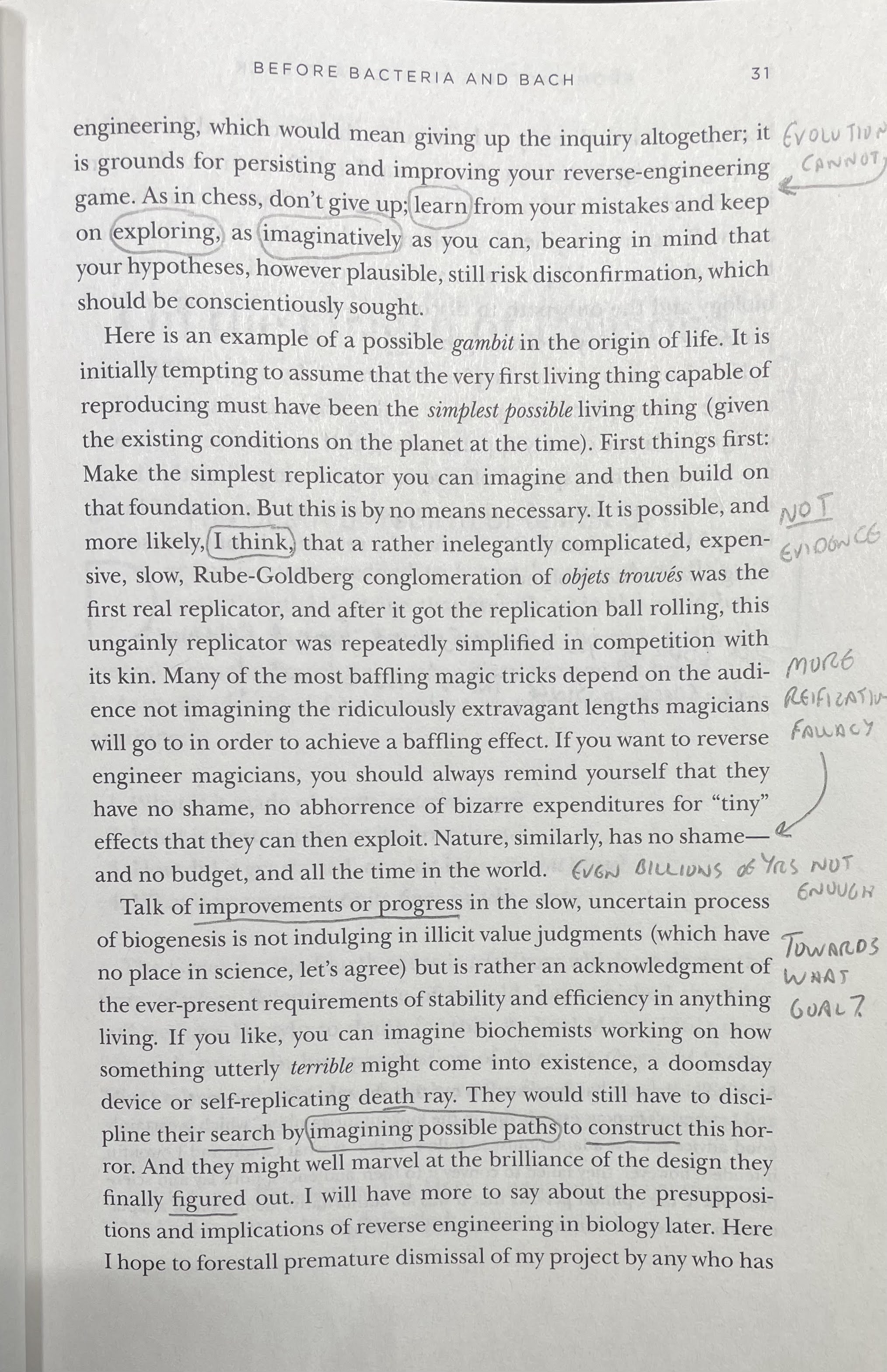
I went into this book looking for evidence of the evolution of minds. What I found between the covers was Dennett’s temporal subjective opinion, fallacies, and imaginations of evolutionary powers. No evidence was forthcoming
The space of reasons is bound by norms, by mutual recognition of how things ought to go-the right way, not the wrong way, to play the reason-giving game.
God-deniers have a penchant for stealing moral language from Christians although their worldview cannot account for them. How do you know what is “right”? What is the “wrong way”? How do you get an “ought” from what is? “Norms”?!?!?? How did an amoral purposeless blind pitiless indifferent cosmos produce “norms”?
P43
Nature has endowed us with…
This is isn’t just the reification fallacy, this is the divination fallacy. Dennett gives nature divine powers several times throughout the book.
Some of you may think I’m making this stuff up at this point, which is why I’m sprinkling in a few screenshots of his book
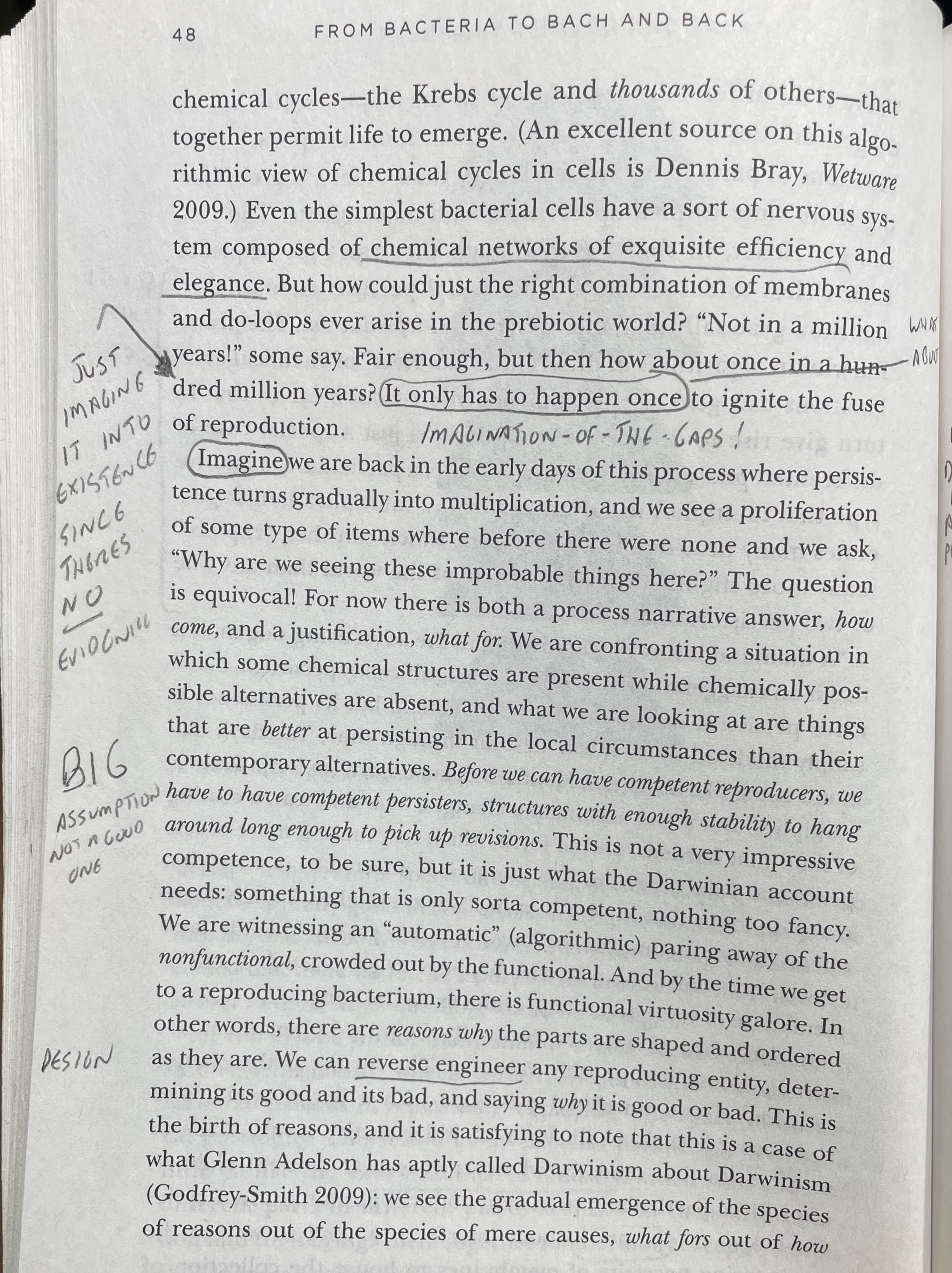
On pg 48 Dennett employs the imagination-of-the-gaps in an effort to build his case for the evolution of minds, and on page 49, he invokes the phrases “dumb luck” , “just lucky” and “lucky-to-be-gifted” in place of scientific evidence for his case.
On p55 Dennett introduces his readers to the Turing machine. He talks knowledgably about Alan Turing’s computer, which deciphered the German code, developed during WW2. Turing’s machine had no comprehension of the code that was developed, so Dennett felt it reasonable to apply this concept to biology. He writes on pg 57
What Darwin and Turing did was envisage the most extreme version of this point: all the brilliance and comprehension in the world arises ultimately out of uncomprehending competences compounded over time into ever more competent-and hence comprehending-systems.
It’s an embarrassing conflation for Dennett. He’s essentially claiming that because Turing could intelligently design & engineer uncomprehending machines, then nature can too. All Dennett is doing is building up the overwhelming case for intelligent design. Unfortunately, for Dennett, he builds his case on the Turing machine and references throughout the rest of the book how nature just does whatever intelligent designers do…just without the intelligence. It’s lazy and an unjustified attribution to nature.
Another unfortunate (for evolutionists) analogy the Dennett proposes is the way that elevators can travel from the bottom floors to the top without comprehension, so nature can uncomprehendingly grow in complexity. Again, he builds his case on intelligently designed machines. This whole time, I thought he was going to describe how purposeless, unguided forces could construct reasoning minds from numerous successive slight modifications, but Dennett continually invokes intelligence as the source. And he rationalizes this writing by just adding in the disclaimer (p52) “their excellent designs are not products of an intelligent designer” as if his disclaimer carries weight.
p74 is filled with more equivocation of intelligently designed tools with natural forces. Dennett compares the programming of artificial intelligence, the accumulation of knowledge in encyclopedias, and the internet to things that he feels that nature can do although he offers no actual evidence for these assertions…just empty comparisons.

On the following page, Dennett invokes the sciency-sounding phrase: “emergent effect” rather than providing evidence of the evolution of minds. You may have heard evolutionists and naturalists employ “emergent properties” or “emergent effect” when trying to explain logic, or life, or consciousness, or minds, or morality with the dismissive quip: “Well, an aggregation of sand particles produces sand dunes, so an aggregation of stardust produces minds”. It’s a monumental and illogical leap, but they present it as if it’s factual. Don’t let their bluster distract from the fact that there is no evidence for particles producing minds. Dennett would have been more persuasive in his case had he demonstrated step-by-step how natural selection acting on random mutations (actual evolution) could have produced minds rather than relying on intelligent design analogies
Could something as intellectually sophisticated as a digital computer, for instance, ever evolve by bottom-up natural selection?
- A consistent evolutionist must believe Yes as the answer to that question. They believe that humans are the result of natural selection, so the ultimate source of computers, smart phones, and all technology was ultimately brought about by natural selection.
- If an evolutionist is inconsistent and like Dennett, dismisses the idea outright, that natural selection can produce something as intellectually sophisticated as a computer, they are being ignorant of the fact that the simplest biological cell is far more sophisticated than a computer.
- Lastly, natural selection is a destructive force. Natural selection never produces anything. It can only thin the population of the unfit. Several times throughout the book, Dennett incorrectly describes natural selection as some sort of creative force.
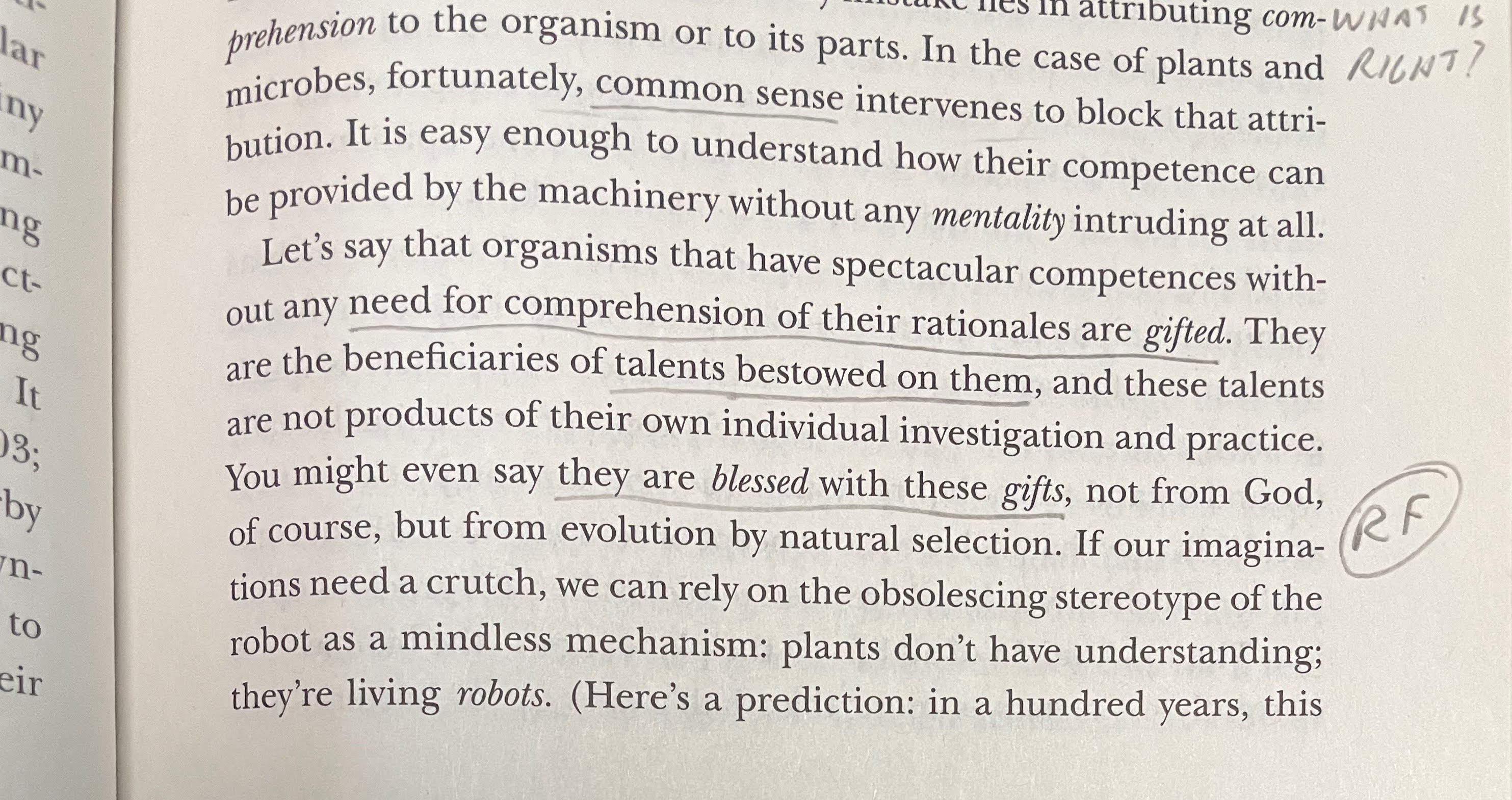
It’s not just the reification fallacy – Dennett give deification powers to nature as he uses words like “gifted…bestowed…blessed.” Naturalism literally uses religious worship language when talking about nature. He capitalizes Nature several times in his book. Paul’s letter to the Roman church couldn’t be anymore prescient than when he wrote “claiming to be wise, they became fools, and exchanged the glory of the immortal God for images resembling moral man and birds and animals and creeping things…they exchanged the truth of God for a lie and worshiped and served the creature rather than the Creator.”
P98-99
Next come the Skinnerian creatures, who have, in addition to their hard-wired dispositions, the key disposition to adjust their behavior in reaction to ‘reinforcements’; they more or less randomly generate new behaviors to test the in the world…The merely Darwinian creature is ‘hard-wired‘, the beneficiary of clever designs it has no need to understand…it has been designed by evolution…learns by trial-and-error…and is hard-wired to favor forays that have ‘reinforcing’ outcomes. It doesn’t have to understand why it prefers these trial-and-error behaviors when it does; it is the beneficiary of this simple design-improvement ratchet
Notice all of the ‘design’ words from above. It sounds like a computer manual. Dennett gives nature the power to design with a wave of his pen. These creatures just “have” foundationally necessary features?!?!? Where did they get them? Where did these “hard-wired dispositions” come from? He never explains, but he builds on these unjustified foundations. I expected more evidence and fewer unjustified assumptions, but Dennett’s assertion game is strong!
Interestingly, Dennett’s chapter 6 is titled “What is Information?” The absolutely weakest link in the evolutionary chain garners a whole chapter that reinforces the theory of intelligent design. Dennett refers to DNA, JPEG digital photo compression technology, exquisite paintings, Mathematical modeling, economic analysis, poker, & empiricism, but you’ll notice that the key element to all of these is intelligence…not unguided numerous successive slight modifications. If nature could produce design without a Designer, why did he use intelligent design analogies as his foundation?
But ch6 is an important chapter for Dennett as he tries to build a key concept in his theory, Memes, as abstract progenitors of information. Dennett doesn’t tie information to memes until chapter 10, but it’s important to see how he recognizes the foundational nature of information…even though he is never able to hide the fact that information always comes from minds and (even though he never says it) from the eternal Mind. Dennett defines a meme from the Oxford English Dictionary as “an element of culture that may be considered to be passed on by non-genetic means.”
As noted earlier, <reification fallacy next> evolution by natural selection is astonishingly good at finding needles in haystacks, almost invisible patterns that, when adventitiously responded to, yield a benefit to the responder. Just as the origin of life depends on getting the right “feedstock” molecules in the right place at the right time, there has to be raw material in the variation in the population that includes, by coincidence) some heretofore functionless (or underutilized or redundant or vestigial) feature that happens to be heritable and that covaries with the potentially useful information in the world.
You can see above that Dennett both reifies natural selection and then grants power to that abstract concept that it outside the scope of its supposed abilities. We’ve been told that natural selection can preserve that which assists in reproductive fitness and culls organisms without the fittest traits. But Dennett claims that natural selection can preserve “potentially useful information” as if there is somehow foresight and planning for future use of this potential information. And he does it again on the very next page: 121

Natural selection cannot preserve traits that have no effect on reproductive fitness.
This may be the most important question that Dennett asks in the whole book. Sadly, his answer is sorely lacking:
Evolution is all about turning bugs into features, turning noise into signal and the fuzzy boundaries between these categories are not optional; the opportunistic open-endedness of natural selection depends on them. This is in fact the key to Darwin’s strange inversion of reasoning: creationists ask, rhetorically, “where does all the information in the DNA come from?” and Darwin’s answer is simple: it comes from the gradual, purposeless, nonmiraculous transformation of noise into signal, over billions of years.
It makes a cool bumper sticker for someone to claim that evolution can turn bugs into features, but the knowledge claims of empiricism is a bug, not a feature. Several things to note about this paragraph:
- If it were true that minds could be constructed by natural selection acting on numerous successive slight modifications (random mutations), there would be evidence and Dennett would have demonstrated this evidence. But he never does. The book is empty of demonstrable evidence. It has only just-so-stories with reification fallacies and assumptions built on intelligent design analogies
- Charles Darwin did not have an answer for information or genes of DNA because he lives in a time before the discoveries of genetic information.
- Perhaps Dennett intended to speak for the all Darwinists when he claimed “Darwin’s answer”. Gradual keystrokes cannot be preserved by natural selection since the accumulated code would be too slow. Purposeless keystrokes could not be preserved because they do not create functional code, and functionless code cannot be preserved. The assertion that gradual, purposeless keystrokes can create instruction code that has greater complexity than mobile phone operating systems is both undemonstrable and unreasonable.
P125-126
Even the loss of organs and their functions counts as improvement when the cost of maintaining them is factored in. The famous cave fish that have abandoned vision are engaged in cost cutting, which any company executive will tell you is design improvement.
But that’s not what we’re here for. We’re here to hear Dennett herald the powers of evolution to produce NEW traits…specifically the mind. Sure, continual losses of information, organs, and functionality can count as “improvement” in the same way that taking the doors off, stripping out the air conditioning system and removing all of the seats in a car will improve gas mileage. But you can’t get from an automobile to a starship will continual losses. You can’t get from bacteria to Bach with loss after loss after loss. Dennett is supposed to be explaining the opposite of loss. Where’s the evidence for the massive gains of information that would permit a bacteria to produce beautiful music????
Chapter 7 had some interesting figures regarding “Darwinian Spaces”. There’s no evidence presented, but it does help to see the way that evolutionists think

P149
There is much more to be explored in this evolution of cultural evolution and its role in creating our minds, but first we should look more closely at how it got started. Like the origin of life, this is an unsolved problem, and a very difficult one.
This is a stunning admission from the man who was supposed to be telling us how minds evolved. Like the origin of life problem for naturalists, the evolution of minds is an unsolved and very difficult problem. I agree, and there is a vast list of problems for which naturalism has no answers.
P151-153
An oviparous fish has not time for swimming lessons in it youth and has no parents to teach it; it has to have a swimming “instinct” built in…One way or another, brains develop competences…The glory of programming language is that once you get your design clearly written in the language of choice-Java or C++ or Python-you can count on the compiler program to take it from there, creating a file in machine language that can be executed. Computer programming is thus not so much top-down design as top-halfway-down design; the grubby details of the “bottom” of the design (the engine room if you like) is something you can ignore, unless the program you are writing is a new compiler.
Exactly. The information has to come from somewhere. Dennett never does demonstrate the origin of the built in instincts of the oviparous fish, but he knows that this information is needed, so he assumes nature must have done it sometime in the past and then preserved it.
I couldn’t help adding Dennett’s continual use of intelligent design as an analogy for evolution. Even compilers were written by intelligent programmers. There’s just no evidence for him to draw from in his attempt to build a case for evolution producing minds, so he gives the analogy of intelligent computer programmers working hard writing thousands of lines of code, and just expects his readers to imagine evolution doing the same thing…just without intelligence. It’s dreadful science, but it’s humorous reading
P164-165
Top-down intelligent designs depend on foresight, which evolution utterly lacks…Foresightless, backward-“looking” evolution by natural selection is not intelligent design but still powerful R&D, sufficiently discerning so that the general division of labor in the brain can be laid down in the genetic recipes that have been accumulated and refined over the billion years or so of mobile life.
True, evolution lacks foresight. But he goes from something that is true, right into the reification fallacy by attributing discernment to the abstract concept of evolution. This is a common theme in Dennett’s work.
P195-200
Perhaps…Perhaps…might…might be…somehow…perhaps…perhaps…it is possible…perhaps…in any case…probably…Almost certainly…we can imagine…may be…perhaps…probably…probably…possible
You may have thought you were reading a science book where Dennett will show demonstrations of his claims, but you can see from the caveats, it’s not really very compelling. It’s just “maybe/perhaps” all the way down

P239
“Genetic evolution (“instincts”) can’t operate fast enough to do the job, leaving a yawning gap to be filled by memetics”
The evolution-of-the-gaps has been attempted to be filled with memes. As we saw earlier, Dennett defined memes as essentially carriers of information. So, at the base of his argument is the contention that information can be created by an aggregation of random mutations or the purposeless interactions of particles from a blind, pitiless indifferent cosmos. It not only strains credulity, it has no demonstrable empirical support.
P262-263
According to Bickerton, “The cognitive gap between humans and nonhuman animals is evolution’s Achilles heel” (p.5), and it cannot be explained, in his opinion, by any account of the straightforward natural selection of increasingly powerful communication behaviors leading eventually to language…this is reminiscent of the familiar creationist arguments that until the eye, say, or the wing, or the bacterial flagellum is fully designed it is useless and hence will not be sustained over generations, a you-can’t-get-here-from-there challenge to the evolutionist. But Bickerton is no creationist…he provides his solution to the “paradox of cognition” (p.79) “If we rule out selective processes and magical versions of evolution, what’s left? The answer is just two things: words and their neural consequences. The invention-for it can only have been an invention albeit it not a conscious or even an intentional one-of symbolic units had crucial consequences for the brain.” I relish the irony of the passage, with its dichotomy between evolution and invention, and its postulation of an unconscious Promethean leap of creativity”
Both Derek Bickerton (in his book “More Than Nature Needs: Language, Mind, and Evolution”) and Dennett recognize the unfathomably massive gap in reasoning/cognition between animals and humans for which evolution must account. They strip away the things they see won’t work: natural selection, and have to propose something for which the purposeless universe is incapable: purposeful invention.
Regarding this same paragraph, notice Dennett’s use of the phrase “Promethean leap“. This is in reference to the Greek mythology of the god of fire, Prometheus, defying the Olympian gods by stealing fire from them and bestowing it to man. This provided a huge leap in technological advancement for humanity for which humanity (according to Greek mythology) could not possibly have solved on their own. Just 11 pages prior, Dennett admits that the evidence for the evolution of minds could not have been preserved in the fossil record (and I agree), so to solve the paradox, he must speculate a giant leap forward…a miracle of invention. But he cannot call it a miracle. He must just call it irony and a dichotomy…a paradox and a Promethean leap. It’s reminiscent of the problem that paleontologists encountered when searching for missing transitional fossils that would confirm evolution. Since those fossils were completely missing, they proposed a rescue device called Punctuated Equilibrium, which asserts that evolution goes through cycles of short periods of “lightning fast” change, which don’t get preserved in the fossil record – and all of the confirming fossils just didn’t get preserved, because evolution happened too fast. The evidence for evolution remains missing, but it is (they claim) really just more evidence for evolution, because it’s got a sciency-sounding moniker: punctuated equilibrium. Don’t fall for the bluster of fancy monikers.
On P264 Dennett continues this discussion with Bickerton’s book where he says “must-have…probably…must have…Somehow” leading to the hinge point of this review and the final death-knell admission for Dennett’s case on p265. I had to include a screenshot of the page, because you might not believe me if you don’t see it with your own eyes:
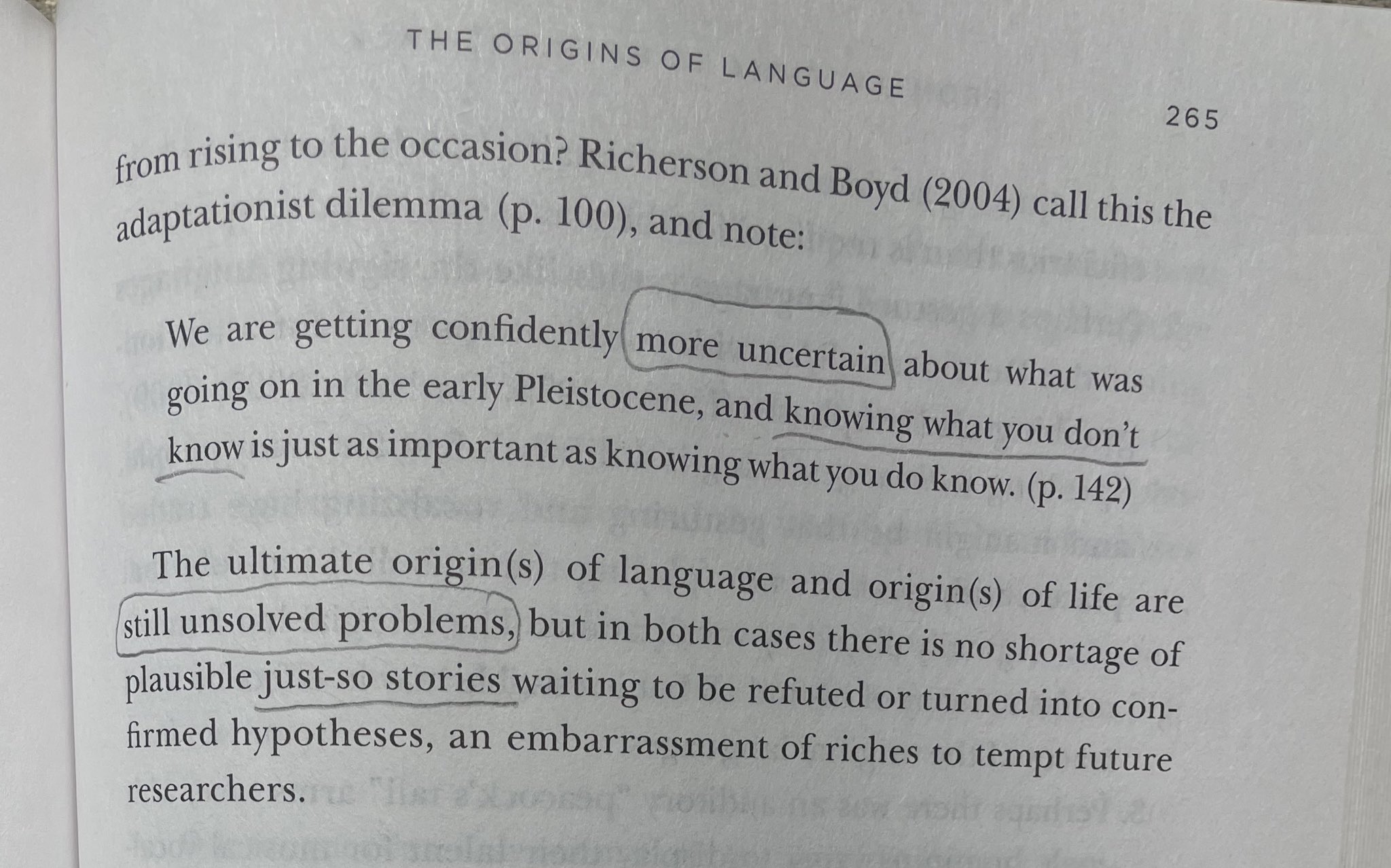
It is indeed a dilemma, but more than that, as Dennett admits, his foundation for the origin of humans minds (language) is still an “unsolved problem”, and the proposed solutions have been and continue to be “just-so stories”.
When I read this paragraph above, I literally laughed out loud. Did you catch what he said? “We are getting confidently more uncertain” and Dennett says of this confident uncertainty: it’s “an embarrassment of riches” for researchers to find a solution. It would be comedy at its finest if Dennett didn’t believe that knowing nothing is an embarrassment of riches. It is an embarrassment for them, but there are no riches; it’s the-emperor-has-no-clothes of evolutionary evidence. What else need be said? The case is closed. Evolution cannot solve the unsolvable.
One final screenshot to reinforce Dennett’s misuse of language and understanding of evolution. On P339, he again reifies evolution as if it has special powers:

But as we all know, natural selection is a culling force. It destroys the information of the unfit, and this descriptive ‘force” has no inherent creative powers to generate anything.
There are many more pages that could have been included in this review, but none of them solve the evolutionist’s problem. The case presented by the leading evolutionary philosopher, while entertaining & including the latest scientific searching, included grand story-telling but no evidence.
Evolution is false because it is in conflict with God’s eternal Word. And as we have seen, from even their top word-smiths, evolution cannot account for minds or anything else in reality BY THEIR OWN STANDARDS.




 ApoloJedi