Can Evolution Explain the Origin of Information?

I’ve been told that natural selection acting on random mutations has enough power to produce everything in biology. I’ve put these claims to the test several times

Photo by Olena Bohovyk on Pexels.com

Well, I got a new challenge from a Christian, who has faith in both old earthism and evolutionism. Sadly, he has joined the scoffers in rejecting the Biblical account of the worldwide flood during the days of Noah. It’s doubtful that he will even read this article, since he has a personal distaste for reading anything that hasn’t gone through the Peer-Review™️ process. He holds Peer-review as his sacred text, but I will proceed in the hopes that others will be encouraged in their faith in God’s revealed word rather than the modern academic paradigm. And although the article that we will analyze is not peer-reviewed, our Christian interlocutor will rationalize his inconsistency by saying, “Well, it contains citations to peer-reviewed articles.” Alrighty-then.

After posting these “Can Evolution Explain…articles, I inevitably hear evolutionists respond with some form of: “get your paper peer-reviewed and only then can you get your Nobel Prize for disproving evolution. Until then STFU!”

To be clear, these “Can Evolution Explain…” articles are not intended to disprove evolution. They are simply meant to analyze the assertions of evolutionists to see whether the subject matter is actually evidence for evolution. What I find in all of these articles is that what’s been proclaimed as “mOuntAinS oF eVidenCe” for evolution is really just story-telling and assumptions. We’ll see if the article below is more of the same bluster or actual evidence.

So I will be analyzing this article from Biologos written by astrobiologist, Stephen Freeland. But before I do, we must make a few notes, lest the skeptics shriek in horror. For purposes of our discussion, we will grant that the Last Universal Common Ancestor (LUCA) already has the base quantity of information necessary for life in its genetic code. This post will not address the impossibility of life emerging from non-life as this is done elsewhere. So the question at hand in THIS post is simply to address the massive amounts of information that would be necessary to have the expression of traits seen in today’s observations (eyes, wings, lungs, coherent interrelated interdependent systems…) that were not available to LUCA. We’ve been told that evolution (natural selection acting on random mutations) can explain the total amount of this information, and Dr. Freeland wrote his article to elucidate how evolution can explain its origins

Dr. Freeland’s quotes are in red italics. Any bold or underline in his quotes are not in the original but are added by me for emphasis.

From the opening paragraph of the article, it sounds like bad news for the prevaricators of evolution. To repeat him in my own words: There’s no demonstrable evidence that evolution can produce information, but I’m going to give you my theory of how it might have happened. In all of my previous posts in the “Can Evolution Explain…” series, it’s the same bluster: Undeniable explanation in the title of the article and caveats, assumptions, artwork and story-telling in the article below. And Freeland’s article starts out just the same

This is NOT the typical definition of evolution. And his definition burdens the readers with more questions than it answers. Where did the information that is stored in the local environment come from? What is the process that stores information in the local environment? Did the need or the desire or the ability or the availability to transfer information from the local environment to DNA arise first? Without the others, how could it have been preserved until the others arrived? What tools perform the transfer of information from a local environment to DNA? What is the process that transfers information from a local environment to DNA?

Regarding the last question, my profession as a database administrator will have some insight. When transferring data from one data format to another data format like from a marketing firm to a state entity for tax purposes, several parameters must be considered:

  • Format – the data must be in an arrangement that both the sender and the receiver understand. For instance, the credit amount from the sender must be in the same column that the receiver expects it to be.
  • Timing – the transfer cannot take place if the sender does not transmit at the time when the receiver is expecting it. If the receiver is not listening when the sender transmits the information, the data is lost
  • Protocol – transmission method, authentication, and data integrity confirmation must all be considered when passing data to a new source
  • Ability to send
  • Ability to recieve
  • The ability to send and receive must correspond

So while Freeland might have casually assumed that information can be transferred from a local environment to DNA, he’s left unanswered how the unguided, purposeless process of evolution can solve these monumental problems

Imagine indeed! That’s not really the explanation I was looking for

That assertion would be more compelling if it had a citation with it. As is, it looks like an extraordinary assertion without any evidence. Besides if true, the expectation would be (since the vast majority of mutations are neutral or deleterious) that the “large changes” about which Freeland alludes would be destructive and degenerative…not new information

Again Freeland does not cite or provide any evidence for this assertion. The reader is just expected to believe what he’s asserted without evidence

Does evolution have requirements? The THEORY does. Yes, the theory of evolution does require that new information must have been formed, but this is just another assertion by Freeland. Notice from the underlined section above, Freeland employs the reification fallacy as if science has its own mind and can believe something. This is common among old earthers to reify the abstract concept of science (pursuit of knowledge) as if science were a living anthropomorphic entity that has a voice and beliefs and censorship powers. We also see in Freeland’s quote the implication that duplications of information are an actual increase in information. There are at least 3 problems with this line of thinking

  • duplicate duplicate duplicate duplicate duplicate duplicate duplicate duplicate
  • Duplications provide a means for more degenerative problems to arise
  • Due to the work of geneticist Dr. John Sanford, we know that only deleterious mutations are able to be removed/preserved by natural selection. Neutral or legendary beneficial mutations are well inside the “no-selection” zone and cannot be removed/preserved by natural selection. p104 Genetic Entropy, Dr. John Sanford

Freeland’s assertions veer unexpectedly into confirming the creation model

This is exactly what the creation model says. God created kinds of plants and animals with the full variability they would need to survive and thrive in different conditions as they filled the earth’s disparate environments. This is exactly what we find. As the world became subject to the effects of the fall, geographic isolation, natural selection & other factors have splintered and destroyed much of the original information, but we see incredible variability being expressed in the different kinds that God created. Freeland rejects the biblical view in favor of the naturalistic one, where he assumes that all genetic information (after LUCA) had to be constructed by natural unguided forces over time. We’re just waiting for him to provide evidence for this. Maybe we’ll find it further down in his paper

This is true. The individual nucleotides also have no chemical or physical force that would cause them to be arranged in a particular order (specified complexity). The nucleotides are similar to the children’s letters with a magnet on the back for refrigerators. They are attracted to the refrigerator but this does not arrange the individual letters in an order that would spell a message “Good morning mom I luv u” (misspellings intended since all the o’s got used up). But notice what Freeland does below

Rather than showing us how the letters were arranged (as in our analogy) to say “good morning mom I luv u”, he simply says (in my own words) Well, there’s nothing that would PREVENT nature from arranging these letters in this way. Freeland has not given us the secret for how nature constructed billions of lines of genetic code…he’s just informed us that there’s nothing that would keep nature from constructing billions of lines of code that’s stored in DNA. His faith in nature’s ability to write biological code stretches credulity.

This sounds an awful lot like Dawkin’s “Me thinks it is like a weasel” analogy. In his book, A Blind Watchmaker, Dawkins proposes that the phrase “Me thinks it is like a weasel” can be constructed easily by randomly changing 1 letter of a gibberish collection of letters at a time and artificially preserving any letter that appears in the right spot. He asserts that success in constructing the phrase is inevitable. The problem is that the way natural selection works, unless the phrase appears all at one, it cannot be preserved as meaningful. Without functionality or meaning, natural selection would discard any partial sentence and every iteration would have to start from the beginning. Rather than inevitable, the actual chances of constructing a sentence (or changing evolution to creation with a random switching of letters) is ZERO if analogous to natural selection removing non-meaningful phrases/words.

Perhaps he’ll describe this process more later in his paper, but he’s again presenting more unanswered questions. What thermodynamic processes? What source of energy? What particular state? What are the different states of information? Bring? In what way do processes bring states of information into being? What mechanism serves to convert energy into information?

A colossal oversight from Freeland is the assumption that the information that he’s supposed to be explaining already exists in his “population of individuals”. It’s like him saying: From this Microsoft Word 10.5, I will construct Microsoft Word 10.6. Now just a minute. For purposes of our discussion, I have granted him DOS 1.0 (genetic code for LUCA), but to needs to elucidate how evolution got from DOS 1.0 -> Windows 3.1 -> Windows 10 (genetic code for humans) and MS Word 1.0 running on Windows 3.1-> MS Word 10.6 running on Windows 10 without intelligent interaction. You missed some steps Dr. Freeland.

This is an assertion that is ripe for a citation, but Freeland leaves his readers in the dark about whether this is just his opinion or whether a peer-reviewed experiment confirmed that ONLY natural selection acting on random mutations can incorporate genetic code from plants into consumers as camouflage. Notice too how Freeland (like many other evolutionists) asserts contradictory results from the same action (evolution camouflages and evolution colorizes).

The contradictory nature of evolution

Somewhat correct. We would not expect nature to create new information and Freeland confirms this. But the 2nd sentence is simply a restatement of his initial assertion…NOT justification or explanation for it.

This is not true. Gravity is prescriptive. It’s force is physical. Evolution is descriptive. Natural selection is simply the observation that the unfit do not pass on their genetic code. Neither are random mutations prescriptive. Random mutations happen (because of the curse of sin) and have never been observed to produce NEW information.

As expected, Freeland was only able to rely on a failed analogy to make his case. No citation of the answers to any of the questions that followed from his original assertion. Since he continues only to assert rather than demonstrate, we have no choice but to dismiss his claims as simply assertions.

True

There it is: the crux of his argument: The universe has plenty of information, so he asserts that evolution just transfers this existing information into DNA. The proof is missing! We’ve yet to hear from Freeland:

  1. How evolution originated new information (the title of his article)
  2. The mechanism by which the universe can convert the “thermodynamic information” into biological information to be stored in DNA. An analogy: If we think of the energy stored in gasoline as the “thermodynamic information” stored in the universe, what’s missing is the internal combustion engine & drivetrain to get that energy transferred to the wheels (DNA) to make the car move. Even if we grant evolution to be the drivetrain (which I do not), conversion of the volatile energy from gasoline must be released, harnessed, and meticulously converted to the drivetrain to preserve the integrity of the energy (data)

This is the fallacy of reification. Natural selection is a description of what happens in nature when it is observed that the diseased, least fit, and injured are removed from the gene pool. We can think of natural selection as ‘quality control’. The way quality control in a car factory works is that this department analyzes the cars coming off the factory line to make sure that it is “fit” for the environment to accomplish its purpose. If natural selection (quality control) determines it to be unfit, that car (organism) and it’s internal assembly instructions (DNA) are destroyed. So while I’m sure Freeland understands natural selection, he’s made a serious mistake by granting to natural selection the power to create. Freeland did have a citation (to his own article for a different publication) for this particular quote, and when we analyze this article, his problems are compounded with more fallacies

His reification fallacies continue as evolution has now been granted powers of choice by Freeland. From Freeland’s writings we begin to get the feeling that he believes the cosmos to be alive in order to select informational alphabets, store that information, and then transmit it to biological machines.

Freeland’s article is from 2013, so it’s likely that he’s not up-to-date with the refutation of the RNA world hypothesis. Maybe in his newer papers, he has been made aware and wouldn’t make that argument. This short video is highly informative for showing why the RNA evolution theory should be discarded and no longer used by evolutionists

Honesty is commendable, but your paper is not persuasive in telling us how evolution originated all of the information in biological life from LUCA to humans. Freeland actually overstates his case that there is even a limited understanding. His claims are not demonstrable lest he would have done it

The Bible provides the answers that Freeland and other old earthers are unable to resolve. God created a “very good” universe (Genesis 1:31) with no death, suffering, predation or thorns. But because of the sin of mankind (Genesis 3), the curse of sin (corruption, death, suffering, predation & thorns) fell upon the whole universe (Romans 8:19-23). Our faith is strengthened not by trusting in the modern academic paradigm and tits lab-coat-wearing scientists. Our faith is strengthened by reading God’s word and trusting what He said. We can trust what God revealed about the past, so we can trust what He has revealed about the future. You want to know why evolution is not true? Because it is in conflict with what God has revealed in his word. But as you can also see through the analysis of this article and any other evolutionary article, the evidence is lacking

It’s a Bug, Not a Feature

Photo by Kevin Ku on Pexels.com

In software designer circles, a “bug” isn’t an insect; it’s a problem in the code that keeps the software from performing as expected. It’s a well-known joke amongst the programmers that when a problem is discovered during the quality control (QC) process that the problem is a “feature, not a bug”. When the software breaks unexpectedly, and QC send the code back to the coders for repairs, the laughs about the “feature” devolve quickly to groans as the coders begin tracing through the code to exterminate the “bug”. It’s a tale as old as Y2K.

God-deniers have a similar bug in their thinking, but they sometimes refer to it as a feature. What am I talking about? Knowledge! What is knowledge? Knowledge is most accurately desribed as “that which corresponds to the mind of God”, but in this article and for most people the definition of “justified true beliefs” will suffice. How do we know things? Epistemology is the theory of how something can be known. Now the article I wanted to write about epistemology has already been written by Dr. Jason Lisle. He describes below the “bug” in the thinking of God-deniers:

So we are left with three equally unsatisfying options. (1) The chain of reasoning goes on forever and can therefore never be completed – making knowledge impossible. (2) The chain of reasoning terminates in an ultimate standard that cannot be justified, meaning all other beliefs (which are based on it) are ultimately unjustified – making knowledge impossible. (3) The chain of reasoning terminates in one or more ultimate standards that rely upon themselves for justification – a circular argument, which is ultimately arbitrary and unjustified – making knowledge impossible. This perplexing problem is known as the Münchhausen trilemma.

If the Münchhausen trilemma is correct, then we can demonstrate that knowledge is impossible. But, of course, this is instantly self-refuting. If we know that knowledge is impossible, then we do know something and hence knowledge is possible.

Knowledge itself is only provisional for the God-denier, because either that knowledge is reliant upon some other element of provisional knowledge into infinity or it could be refuted based on some future discovery. The bug in the thinking of God-deniers is that they can never know anything for certain. They put on a brave face by calling it a “feature” that their thinking is self-correcting upon the discovery of new evidence. But you can see that whatever they assert to know *now* is not knowledge at all. It is only provisional. It is a serious bug. It is bluster for them to claim that their enormous epistemic deficiency is a feature. This is demonstrable as anyone familiar with the history of science knows. The dominant paradigm from these time periods has been replaced by new paradigms, but if you lived in one of the time periods shown below, the gatekeepers of the dominant paradigm would try to silence dissenters the same way that those, who have faith in today’s dominant paradigm (materialistic biological evolution) censor dissenters

  • Prior to the 1500s, scientists believed and modeled that the earth was the center of the solar system. – Falsified
  • Prior to the 1600s, scientists believed in alchemy and phlogiston– Falsified
  • Prior to the 1700s, scientists believed that bloodletting and leeches removed bad blood from sick patients. – Falsified
  • Prior to the 1800s, scientists believed in spontaneous generation – Falsified
  • Prior to the 1900s, scientists taught that the universe eternal (steady state theory) – Falsified
  • In the 1970s, scientists taught impending contradictory catastrophes would destroy humanity in the subsequent decades: ice age and unstoppable heat wave. – Falsified
  • In the 1980s, scientists taught that eating mostly carbs was the healthiest way to live in a failed marketing campaign called the food pyramid – Falsified
  • In the early 2000s, scientists taught that the ice sheets at the poles would be completely melted due to global warming by the 2013Falsified

In his follow-up article, Dr. Lisle continues to expose the emptiness of the chain of reasoning for the God-denier

The problem with the unbeliever is not that he cannot justify any of his beliefs. Rather, the problem is that he cannot justify any of his beliefs within his professed worldview. If evolution were true, then knowledge would be impossible. But evolution is not true. Since the Bible is true, evolutionists are able to have knowledge. Their beliefs in sensory experience and rationality are ultimately justified because the Bible is true.

Because Christians and non-Christians have different epistemologies, Christians are not saddled with such a crushing burden. Christians have a revelational epistemology meaning that we accept God’s revelation in creation, in the Bible and through the incarnation. The omniscient God knows everything, and He has revealed some of his knowledge to us so that we can be certain of those things which God has revealed. So, a Christian has a sufficient grounding for knowledge. From this grounding, a Christian can reasonably engage in scientific research, engineering, hospitality, altruism, programming,

Because Non-Christians have rejected the One, who knows everything (the only Source of justifiable knowledge) he can never be (justifiably) certain of anything. An honest non-Christian can only hold a provisional level of understanding since some future discovery or new bit of evidence might change everything they think they know. The apostle Paul is right when he writes to Timothy:

In many of my discussions with skeptics online, I’ve had the skeptics tell me, “it’s a feature, not a bug”. This is usually after we have talked about someone’s ability to justify knowledge.

As a final elaboration upon the Christian revelational epistemology, I turn to Dr. Lisle again in a long quote from his third article. Please take the time to read each article as all three are worth the time it takes to read them :

Truth is that which corresponds to the mind of God. But unbelievers sometimes scoff at this definition and attempt to refute it by asking, “How can you possibly know what God thinks?” But, of course, this question is easy to answer: revelation. God has revealed some of His thoughts to us and He has done this in numerous ways. Most specifically, God used men to write a book that expresses His thoughts, namely, the Bible. Do you want to know what God thinks about something? Read the Bible!

But there are other ways God has revealed Himself. God has placed knowledge into the core of our being from our conception. For example, God’s moral requirements – His laws – have been placed into the minds of all people. Thus, even people who have never read the Bible have some knowledge of the law of God (Romans 2:14-15). We are able to have some knowledge of right and wrong even without reading the Bible because God has “written” His law on the hearts of all people. This is a type of revelation.

God has designed sensory organs, such as eyes and ears, that allow us to have knowledge of the external world. Furthermore, God has placed knowledge within us that our senses are basically reliable; so, we can have confidence that what we see and hear is a good map of reality. By our senses, we can learn true things about the world, such as “the sun is very bright.” Consider the contrary. If God had not designed our senses to be basically reliable, or if God had not given us knowledge that our senses are basically reliable, then we could never learn anything about the external world. Sure, we might see that the sun is bright. But we would have no reason to trust that what we see corresponds to the real universe.

God has also placed some knowledge of logic within us. Logic is the principles of correct reasoning – a reflection of the way God thinks. God created mankind after His image/likeness. And this includes the ability to think – to some extent – in a way that is consistent with God’s character. Thus, we are born with some degree of rationality. (It is possible to prove that some laws of logic are known without ever being learned; hence God has “hardwired” them into our being.)[3] Furthermore, God has given us the ability to improve our reasoning skills through careful contemplation using our mind and from education using our sensory organs.

In addition, God has placed some knowledge of Himself inside all people such that when we look at the natural world, we instantly recognize it as the work of God. Romans 1:19-20 states, “because that which is known about God is evident within them; for God made it evident to them. For since the creation of the world His invisible attributes, His eternal power and divine nature, have been clearly seen, being understood through what has been made, so that they are without excuse.” Thus, all people have knowledge of God.

This fact should have a profound impact on the way we do apologetics. If indeed all people have knowledge of God, then they do not require additional evidence for God. Many Christians proceed as if the unbeliever is genuinely ignorant of God. Under this mistaken belief, the Christian urges the unbeliever to trust in God by presenting new evidence for God. But according to Romans 1:18-20, all unbelievers already know God but they “suppress the truth in unrighteousness.” The presuppositional apologist therefore aims to expose the unbelievers suppressed knowledge of God.

Since all knowledge is ultimately from God, it follows that anything we know has been revealed to us by God in some way. We can know things by sensory experience, but only because God designed our senses to be basically reliable. We can know things through rational reasoning, but only because God designed our minds and has given us access to His laws of logic. Hence, the biblical God is the ultimate justification for all truth claims.

Of course, even people who have never read the Bible do have knowledge. But this is because the Bible is true. Unbelievers learn things through sensory experience and rational reasoning just like believers. But in order for their beliefs to be justified, they would require some reason to trust their sensory organs, and their thinking process. If the Bible were not true, there would be no reason to trust in such things.[4] Hence, all beliefs based on those assumptions would lack justification.

We can have knowledge only because God exists and has revealed Himself in exactly the way the Bible teaches. God, as revealed in the Bible, is the ultimate foundation for all human knowledge. If the Bible were not true, we could know nothing. We might have beliefs, and some of them might even be true, but they could never be justified apart from the biblical worldview.

Can Evolution Explain the Human Brain?

Photo by meo on Pexels.com

I’ve been told that natural selection acting on random mutations has enough power to produce everything in biology. I’ve put these claims to the test several times

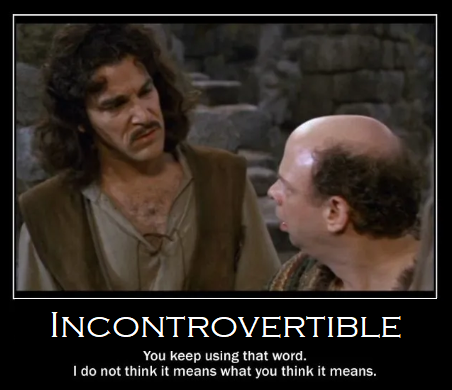
Well, I got a new challenge from a God-denier, who made the claim that evolution can even explain the origin of human brains. This particular God-denier didn’t just say that evolution can explain human brains, she claimed “There is incontrovertible evidence for evolution of the brain“. “iNconTroVerTible”. I’m reminded of The Princess Bide when Inigo Montoya says to the Sicilian “You keep using that word. I don’t think it means what you think it means.”

She provided a link to Wikipedia as the source of this “incontrovertible” evidence. I pushed back asking if she wanted to use a crowd-sourced blog as her “incontrovertible evidence”, but she assured me that it’s impossible to refute. Thinking she could bluster her way through a conversation without me being skeptical of her source, she left it out there as though the matter was settled that evolution can explain human brains. But I don’t surrender to bluster so easily. Let’s analyze her claim to see if Wikipedia, is relying on evidence or assumptions

Here’s how this works: I will post the quotes from the article in red and then just below the quote, I’ll post my analysis in the default black font. I have bolded key words throughout, so the bold does not appear in the original work. Throughout, you’ll notice that instead of actual evidence, the author(s) of the article relies on assumptions. Let’s get started:

This approach (endocasts), however, is limited in regard to what information can be gathered

It looks like the gaps in available information that can be gathered has been filled with assumptions of evolution’s power.

While endocasts are extremely helpful in revealing superficial brain anatomy, they cannot reveal brain structure, particularly of deeper brain areas.

Since the only thing these endocasts can show is size, we must again reject this quote as incontrovertible evidence. It is simply an assumption. Since their endocast model can only determine skull capacity, are we now to conclude that they believe that larger adults are smarter than smaller adults?

The evolutionary history of the human brain shows primarily a gradually bigger brain relative to body size during the evolutionary path from early primates to hominins and finally to Homo sapiens

Also assumed (but not proven) is the mantra that early primates evolved into humans. I do not grant this assumption upon which they rely for their story to be true. How can it be incontrovertible evidence if their premises are packed full of unproven assumptions?

This can be visualized

They mean imagined. Next they try to escape the problem imposed by the assumption that brain size related to increased intelligence due to the politically incorrect nature of the assumption

Consequently, the authors argue that the notion of an increase in brain size being related to advances in cogntion (sp) needs to be re-thought in light of global variation in brain size, as the brains of many modern humans with normal cogntive (sp) capacities are only 400g/ml larger than chimpanzees

Notice how since the actual evidence of the brains themselves were not preserved in fossils. Those who assume that evolution can “incontrovertibly” produce human brains are (like the empty skulls of the fossils) devoid of actual evidence.

It is also important to note that the measure of brain mass or volume, seen as cranial capacity, or even relative brain size, which is brain mass that is expressed as a percentage of body mass, are not a measure of intelligence, use, or function of regions of the brain.Total neurons, however, also do not indicate a higher ranking in cognitive abilities. Elephants have a higher number of total neurons (257 billion) compared to humans (100 billion). Relative brain size, overall mass, and total number of neurons are only a few metrics that help scientists follow the evolutionary trend of increased brain to body ratio through the hominin phylogeny

They consider it important to note that neither higher capacity of brain size nor total number of neurons increase cognitive abilities. So why do they assume that the fossil skulls contained brains with less intelligence/cognition than current brains? The evidence is missing…all that’s left is assumptions

Their findings implyIt also suggestsWhat is the least controversial is

The last paragraph in that section includes the 3 phrases from above. None of those sound like “incontrovertible” evidence to me. It sounds like they are having to assume some things, infer some things and suggest some things…but where’s the evidence itself?

The more convoluted the surface of the brain is, the greater the surface area of the cortex which allows for an expansion of cortex. It is the most evolutionarily advanced part of the brain. Greater surface area of the brain is linked to higher intelligence as is the thicker cortex but there is an inverse relationship—the thicker the cortex, the more difficult it is for it to fold. In adult humans, thicker cerebral cortex has been linked to higher intelligence

Again, those paying attention will see that the very substance that they need to verify their claim of evolution creating the brain: brain surface, cortex, thicker cortex ARE ALL COMPLETELY MISSING. From the start Wikipedia authors admit that the brain is not preserved in the fossils, so the very evidence in question is missing! It’s not just that this Wikipedia article is NOT incontrovertible, it’s laughably impotent to explain the evolution of human brains at all

If they actually wanted to show how evolution was able to produce human brains, they would have to have brains of creatures that they can PROVE are indeed ancestors of humans and show that natural selection acting on random mutations produced human brains. This Wikipedia article did not do any of that. It was empty speculation

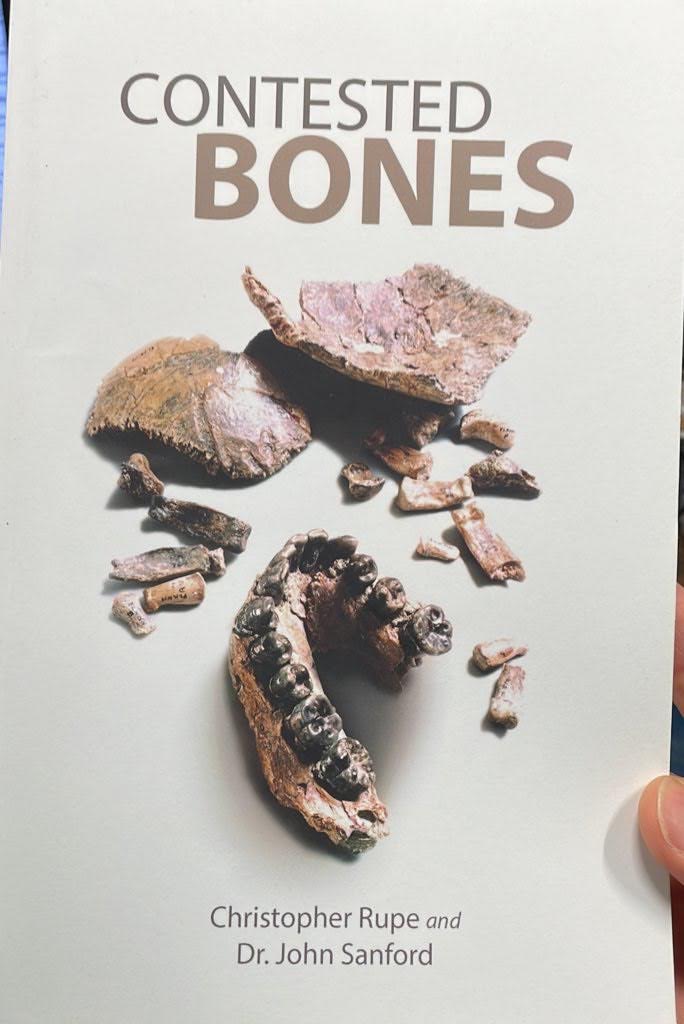
If anyone would like to read an account of the fossils without the Darwinian infection, read Sanford’s Contested Bones and Lubenow’s Bones of Contention

God created mankind in his image. God’s Word is clear and we can trust that revelation, so evolution is false. When Adam sinned, his descendants and all of creation fell under the curse of sin: death, suffering, and thorns. As was promised in Genesis 3:15, God the Son (Jesus) became incarnate as a descendant of Adam and (where Adam failed) Jesus perfectly kept the law. Jesus gave his life to pay for the sins (by taking upon Himself all the curses of sin: death, suffering, thorns) of all those who would turn from their sin and humbly submit to the authority of Jesus.

Can Evolution Explain Morality?

I’ve been told that natural selection acting on random mutations has enough power to produce everything in biology. I’ve put these claims to the test several times

Well, I got a new challenge from a God-denier, who made the claim that evolution can even explain the origin of morality. They provided a link to a “scientific” paper , which has been cited 6 times, thinking they could bluster their way through a conversation without being skeptical. But I don’t surrender to bluster so easily. Let’s analyze her claim to see if the professor, who wrote the article, is relying on evidence or assumptions

Here’s how this works: I will post the quotes from the article in red and then just below the quote, I’ll post my analysis in the default black font. I have bolded key words throughout, so the bold does not appear in the original work. Throughout, you’ll notice that instead of actual evidence, the author of the article relies on assumptions. Let’s get started:

The author of this article, Professor Douglas Allchin, begins at a good place, with definitions. First we must start with “What is Morality?” Merriam Webster defines morality as ‘Conformity to ideals of right human conduct’.

How did this peer-reviewed paper define morality?

The first challenge for biologists is characterizing morality in terms amenable to science. Abstract concepts of “right” and “wrong” or virtuous motives and good intentions must be expressed in terms of what can be observed or measured. First, then, biologists address morality concretely as a form of behavior. As such, it fits in a context of other behaviors: foraging, mating and nesting, securing territory, play, grooming, and other social interactions

Bold text is not in the original. Notice how they immediately change the definition from “ideals of right conduct” to a “form of behavior that fits a context”. What context? EVOLUTION. While the actual word is not used, the context of evolution (foraging, mating, nesting, grooming…) is exactly the concepts that evolution is supposed to have solved. Right from the start, they’ve smuggled evolution into the definition. So right from the start, rather than actually showing that evolution can explain the origins of “ideals of right conduct”, professor Allchin imbeds the solution right into the definition.

Conceptualizing morality as a form of behavior opens the possibility of observing it in other species. Indeed, if complex features evolve gradually, one might well expect to find stages of protomorality, incipient morality, or various precursors in organisms besides humans.

Two things with this paragraph:

  • Remember they defined morality as forging, mating, nesting, grooming & social interacting behaviors. So OF COURSE other species forage, mate, nest, groom and interact. When they define their terms in such a way as it’s just living, then they can claim victory that evolution can explain eating but say “tHat’s mOraLity”
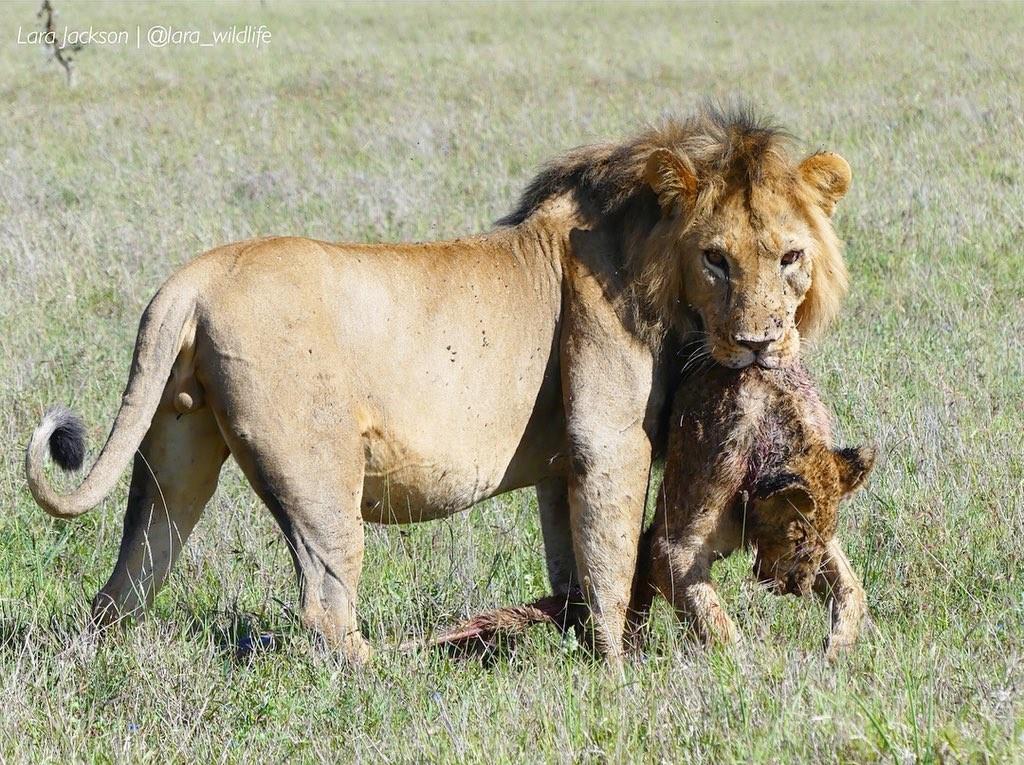
  • Secondly, humans did not evolve from any modern species. So, you cannot test any modern species for “protomorality” or “incipient morality” at least in relation to human morality. If you want to test other species for human morality, why not celebrate the morality of male lions cleaning house: the new head of the pride, methodically killing the offspring of other males in the pride. Should the evolutionists want to involve other species as tests for morality, they have no objective reason not the start there. Why don’t the atheists want to uphold the thieving, raping, bullying, and exclusion of both intra and inter species interactions in their assertions of evolution’s great power to produce morality? Why would God-deniers NOT consider male lions killing the offspring of other lions as moral?

But which behaviors are “moral”? Here, biologists must proceed cautiously. One cannot even identify the relevant behaviors without a working concept of “right” and “wrong” or of “morality.” Invoking a value judgment threatens to prejudice the whole endeavor. The biologist’s proper approach is thereby indifferent and fluid, contingent on definitions of ethics identified by others. Biologists may encounter multiple conceptions of what is to be explained. Different benchmark definitions may yield separate complementary explanations. Of course, biologists are accustomed to addressing the “same” phenomenon on multiple levels of organization: molecular and cellular, physiological, populational, ecological, and evolutionary. Biologists have, thus, developed a suite of explanations which apply to different aspects of moral behavior.

Indeed. How can they identity behaviors as right or wrong? Notice in the closing sentence, professor Allchin talks about tools: “a suite of explanations” which they will apply preferentially and arbitrarily to different behaviors. We’ll watch this as more and more of the paper is analyzed.

For guidance, then, a biologist turns to moral philosophers. Yet, even after centuries of reflection and debate, philosophers themselves do not agree on core ethical principles for defining “good.” They generally recognize, however, three basic approaches. One approach, consequentialism, focuses on the outcomes themselves. For example, morality is assessed as the greatest good for the greatest number. Good may be defined variously as benefit, happiness, or pleasure.

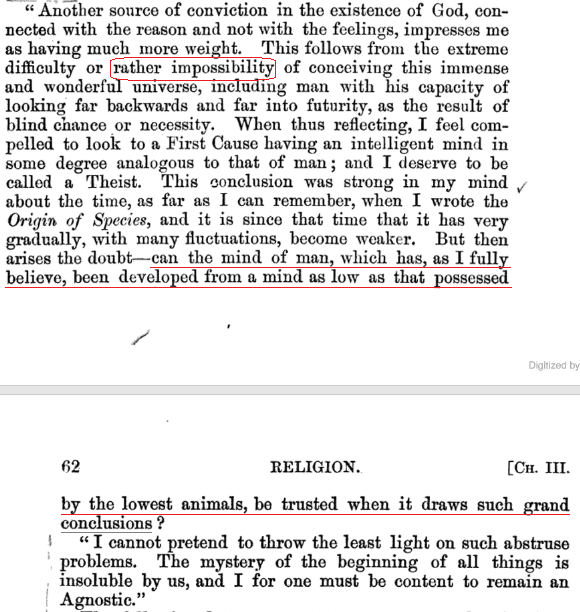
Didn’t these “moral philosophers” also evolve from ancestral simians with supposedly less-evolved morality. Why trust what evolved apes have to say about morality? Charles Darwin recognized this philosophical problem in the 19th century when in his autobiography, he wrote “But then arises the doubt-can the mind of man, which has, as I fully believe, been developed from a mind as low as that possessed by the lowest animals, be trusted when it draws such grand conclusions?” Why should we trust the foundations of their philosophy?

Notice also how the consequentialists define good: Good is whatever is the greatest good for the greatest number. You’ll notice the clear obfuscation of their claim about “good”. How do they know what is truly good? Based on what metric? Over which time period? I wrote about the irrationality of claiming goodness without an objective standard in my article, Empathy is Arbitrary, Inconsistent, and Irrational for Atheists. It applies equally as well for these lab-coats, who want to talk about pragmatism.

Evolution itself does not express or yield values

Nature may seem to exhibit its own values. For example, natural selection may seem to “favor” adaptive traits. Survival and reproduction may seem inherent values because they lead to continuity of the lineage. However, historical facts are distinct from values. Effects do not indicate intentions

This is a good paragraph and I agree with it – because it definitively declares that evolution cannot explain the origins of morality – ideals of right conduct. The title of their article is misleading, but they rationalize their deception with remarkable openness about the inability of evolution to explain ideals/values like that paragraph above. After all, since morality is not objective to them, why should they be honest about their hopelessness from the beginning?

Biological analysis may enrich our understanding of morality, but it is also limited. Science is not able to discover ethical principles in nature, nor to justify them, nor to evaluate them, say, based on evolutionary history, nor even to develop them based on some presumed universal or “objective” principle of “human nature.” Many have tried. All have failed

EXACTLY! Case closed. I appreciate everyone for reading this article which exposes this admission by professor Allchin that evolution is unable to explain ethical principles, justifications, or objective ideals of morality. Should I even continue to evaluate the remaining 7000 words of their article when it is clear up to this point that they have admitted defeat? They do try as this next sentence declares:

Having introduced these caveats, then, let us consider what biologists have discovered about morality as an evolved form of behavior

Caveats indeed. Caveats of the corpse of their case

They continue anyway, although their case is beyond hope:

Behavior that benefits other organisms may sometimes also benefit the individual

Like symbiosis? Symbiosis is a definite falsification of evolution. It’s a strange tact indeed for professor Allchin to highlight one of the most damning observations to evolutionary theory. Perhaps though he meant that cooperation within your own species could help with the evolutionary fitness of the overall species. It stretches credulity that selflessness could be explained by natural selection acting on unguided mutations, but that is the claim they are making. They tried to suggest the kin selection could account for morality in the subsequent paragraphs, but I covered this failed hypothesis in my article, Can Evolution Explain Altruism? When evaluating the “scientific” articles for that post, they proposed a mysterious force called “strong reciprocity”, which had no origin or mechanism. Another failure for the theory of evolution. Professor Allchin tries later in his article to postulate strong reciprocity as a solution. Too bad.

But notice too that he’s done something sneaky here. He just assumed that cooperation (or mutually beneficial behavior) just appeared. He provided no mechanism or origin story for this behavior. Without explanation, he just assumed it was there. In an article that supposedly explains the origin, professor Allchin is short on actual explanations and long on assumptions

In describing the evolution of humans in Descent of Man, Darwin (1871) prominently addressed mental and moral abilities. Following cultural discourse at the time, he focused on what he called the moral sense, or conscience, notably reflected in the emotion of remorse. “Why do we feel moral duty?” Darwin wondered. First, Darwin observed that animals could evolve societies, structured (he assumed) by a social instinct. Second, with multiple instincts, behavior might not always accord with social benefit. But memory, Darwin thought, would help resolve such conflicts as the organism learned to regulate its instincts, making the social instinct primary. Third, the use of language would allow organisms to communicate their needs clearly to one another. Fourth, repetition would lead to habit and a spontaneous sense of what one “ought” to do.

Notice the saturated assumptions in the paragraph. Everything proposed by Darwin was an assumption. None of what he observed was an origin of the creatures, their behavior, or their “structured society”. All of those things were already in existence – so like the modern lab coats, Darwin simply assumed that they evolved. I’ve been told that “extraordinary claims (like evolution can explain morality) requires extraordinary evidence”. There’s no evidence – let alone extraordinary evidence in that paragraph. It (like the rest of the paper) can be summarily dismissed.

In the next 5 paragraphs professor Allchin describes stories of various mammals caring for others of their species as if that is an explanation of evolution’s great power to produce moral behavior. Two things he failed to realize:

  1. Humans did not evolve from any creatures that are currently alive. The best he could assume is that humans and any other mammals share a common ancestor. Professor Allchin, rather than demonstrating common ancestry, simply assumed common ancestry. The very best that professor Allchin could speculate is that both apes and humans experienced an even more impossible assertion: convergent evolution since the hypothetical common ancestor cannot be evaluated for the presence of moral behavior.
  2. The caring/moral behavior already exists in the creatures being described. There’s no step-by-step explanation of the caring/moral behavior being produced by some evolutionary mechanism. Saying that something (moral behavior) exists does NOT explain HOW evolution produced it. It is very common among internet pop apologists for evolution to assert: “x trait exists and evolution did it.” We see from this article where they get it. They are taught to think that way by their deluded lab-coat-wearing priests.

One way to assess foundational human motivation is to observe behavior before possible learning or training. Human infants (age 18 months), for example, frequently help adults in simple problematic tasks in a lab setting—without being asked and without reward…The question remains how such feelings evolved and whether the social environment was relevant historically

The question remains indeed. Everything that professor Allchin has speculated about already exists. Not one word has been dedicated to explaining how evolution was able to produce moral behavior where moral behavior did not exist before. Those reading Allchin’s article with a skeptical mind could just as easily be convinced that since this behavior already exists in “human infants” that these young humans were created in God’s image as moral agents from the beginning. The authors have done NOTHING to persuade a skeptical reader of their stated motive (evolution can explain morality). They just assume it

Neuroimaging studies show significantly that actual moral reasoning involves both emotion and logic

The naturalist author of this paper has complicated his task. Not only has he convinced me that that evolution cannot explain morality, evolution definitely cannot explain reasoning or logic. Rather than trying to just come up with an evolutionary mechanism that can produce moral behavior, now professor Allchin has inadvertently jumped into a philosophical canyon from which he could never hope to explain. Rather the unchanging, abstract, absolute laws of logic and its correct application (reasoning) is explained only in a Christian worldview.

The flexibility afforded by learned behavior allows organisms to respond to local environments, which may change during an organism’s lifetime or vary from organism to organism within the same species. Evolution may thus favor the brain’s potential for behavioral plasticity and for placing “values” on certain responses

Again – no explanation or evolutionary mechanism…but “evolution may…” as if evolution is a concrete entity that actually DOES something. That’s the reification fallacy by professor Allchin. No-no professor!

In addition, learning has the potential to modify, or regulate, innate behavior or dispositions. The psychological level thereby becomes emergent, exhibiting new interactions and properties relatively independent of lower level functions (genetic and physiological) and able in part to influence them

Emergent? This is a common assertion by naturalists when they are unable to actually explain origins. Following is a conglomeration of real/hypothetical conversations with God-deniers:

  • Christian: “From where did the laws of logic arise in a cosmos made only of particles?”
  • God-denier: “They are emergent properties
  • Christian: “From where did the laws of gravity and physics and chemistry arise?”
  • God-denier: “They are emergent properties
  • Christian: “Can you explain how evolution produced moral behavior?”
  • God-denier: “They are emergent properties

Emergent properties offer no explanatory power. It’s just a sciency-sounding moniker for the naturalist, who recognizes that from within his framework, the topic is unexplainable.

Professor Allchin goes on to complain about “cheaters” as obstacles to “sharing behavior” and common good, but in all of the complaining, he never explains how evolution produced moral behavior. Why’s that Professor Allchin?

Organisms may cooperate selectively with reciprocators

I’ve already answered the proposal of reciprocity above and in my article on, Can Evolution Explain Altruism? Giving only to get back (reciprocity) is selfish – not moral or altruistic.

Getting to the end of his rope, Professor Allchin jumps from moral behavior to Might-Makes-Right:

Social organisms may enforce cooperation through rewards and punishment

And AGAIN, professor Allchin simply observes EXISTING behavior – not how evolutionary mechanisms produced it. This article was supposed to explain how evolution could explain morality rather than just pointing to it as he does throughout. It would be like asking: “How did Honda produce that Odyssey minivan?” and having a professor respond: “There’s one over there!!!” All the while, the professor thinks he’s answered the question. Lazy and smug.

Organisms may benefit from social information

May?!?! Isn’t this supposed to be a scientific article? Something that explains the origins of morality by means of evolution?? May indeed!!! And “benefit” – how does one determine what is truly beneficial? By what metric?

Add morality to the ever-growing list of things that evolution fails to explain. I’m with Dr. Greg Bahnsen – evolution cannot adequately explain anything, and the science clearly bears this out

I’m not the only one or even the first one or even the best at analyzing the outlandish claims of the Darwinists that evolution can explain morality. Here are some articles from crev.info that show the impotent claims that “eVoLutioN cAn expLaiN moRaLity” to be nothing more than empty bluster:

Review: Good Night Oppy

This isn’t a typical full review of the new content by Amazon, but I’ll include my overall thoughts about the movie

It really is stunning to me to hear God-deniers say. “The worldwide flood recorded in Genesis is impossible.” or “there’s no way the entire globe could have been flooded as recorded in Genesis” or “Noah’s flood? That’s just a fairy tale”. What does that have to do with the movie, Oppy?

At near the 9 minute mark one of the lab coats says: “The two Viking orbiters as they looked down on Mars, they saw…that’s strange. There could be signs of past water flowing. Was Mars once a green world with living things and blue oceans?

At about 39:45 “We picked the Spirit landing site, Gusev Crater, that looked like it had a huge dried-up riverbed flowing through into it, and we went there hoping to find evidence of past water and past habitability. I mean there has to have been a lake in Gusev Crater at one time. But all Spirit found was this prison of lava rocks.”

“And it turns out that the composition of these little blueberries, was a mineral called hematite, which is a mineral that often forms in the presence of water.”

“From the minerology, from the geochemistry, everything that we needed to come to a reasonable conclusion that there was once water on Mars. It was right there in the walls of Eagle Crater. But this is a very acidic environment. Not a place where life could have developed.”

“So, yes there had been liquid water, but this wasn’t water that you or I would want to drink. It was basically like battery acid.”

“What you really want is nice, flowing, neutral-pH groundwater. And so to go and find a story of habitability, you’ve got to go on a bit of a roadtrip”

“This is a clay that has been intensely altered by relatively neutral pH water, representing the most favorable conditions for biology that Opportunity has encountered”

“Water. Drinkable neutral water once existed on the surface of Mars. And not only was there water, but it could possible sustain ancient microbial life. So that is just revolutionary.”

“It showed us that the ancient Mars was much more suitable to the origin of life.

This was the Holy Grail. This is the reason we had gone to Mars. Oppy discovered Mars was a wet world very much like Earth. There were oceans. Water played a huge role in its early history. It completely altered the planet.”

“And Opportunity spent years exploring Endeavor Crater, making incredible discoveries that tell that story of water. So we could go back in time to a planet that might actually have had life.

“Mars had water. What happened to that water? And can we take the information and understand how that could happen here on Earth? And can we understand our part in that. Are we doing something that can accelerate that here on Earth. Because that’s something that you don’t recover from.”

Are you kidding me? They were able to turn this documentary about a planet with no water, no life, no humans, no fossil fuels into a global warming fear-mongering documentary…like most of the rest of them.

Their motivation was religious in nature (“This was the Holy Grail”), and it’s clear that their research was interested only in finding naturalistic origins of life.

Don’t misinterpret my critiques as a dislike for discovery or research. But what did you notice about their motivation for exploration? Extra terrestrial life. This blind search for life in lifeless places reveals their faith in naturalism. In their search for life, they recognize the need for water. So, in this video, we see over and over these lab-coats share their desire to find water. There’s not a drop of water on Mars.

But a planet (Earth) that is more than 70% covered by water could NOT have had a worldwide flood according to naturalists, and a planet (Mars) with not a single drop of liquid water is assumed to have been flooded in the distant past. The inconsistency and hypocrisy is astounding

Another level of hypocrisy among the God-deniers, is their denouncement of God’s amazing designs in biology. It was clear that the design of the robots was mimicry of the design of the human body. Same height. Same use of binocular vision. Same use of limbs and joints found in human arms. Yet I hear from God-deniers all the time, “humans are designed badly”. It’s a ridiculous claim for God-deniers to say humans are designed poorly when scientists literally mimic the incredible designs by the Almighty to achieve discoveries on other planets.

Overall, the documentary was positive and encouraged people to be involved in engineering solutions and discovery. I support finding engineering solutions and discovery, but motivations and intentions matter. There’s much better motivations for discovery and engineering solutions than the most unsuccessful career path of all time: astrobiology!

Can Evolution Explain the Eye?

Photo by Pixabay on Pexels.com

The world is filled with magnificent biological designs and interrelated interdependent systems. I’ve been told that natural selection acting on random mutations has enough power to produce everything in biology. I’ve put these claims to the test several times

Well, I got a new challenge from a God-denier, who made the claim that evolution can even account for eyes. They provided a link to a “scientific” paper thinking they could bluster their way through a conversation without being skeptical. But I don’t fall to bluster so easily. Let’s analyze the claim to see if the scientists, who made the claim are asserting based on evidence or assumptions

Here’s how this works: I will post the quotes from the article in red and then just below the quote, I’ll post my analysis in the default black font preceded by a dash. I have bolded key words throughout, so the bold does not appear in the original work. Throughout, you’ll notice that instead of actual evidence, the authors of the article rely on assumptions. And those who are particularly intrepid and can work through this analysis to the end will be gifted with a unique surprise at the end

“Sight is an evolutionary gift

– Odd choice of words from a scientific journal. Notice how evolution is reified as a magnificent gift-giver. Sounds more like paganism than science

“Life probably first appeared ~3.7 billion years ago”

– Probably?!?!? Indeed

“more likely

– Aren’t we supposed to be talking about evidence rather than making assumptions?

“The opsin in rhodopsin probably evolved

Probably?!?!? Notice the use of the magic word: “evolved”. Do you care to go into the details? It seems like they missed a step in the explanation and tried to sweep the actual explanation under the “it evolved” rug. Pathetic!

“The passage of such molecules from microbial opsins to metazoan opsins probably came from a common ancestor as these are related, albeit distantly”

– Probably?!?!? Probably is used TWELVE times in the article. It sounds like a collection of assumptions rather than the actual evidence that we were told to expect

“Once an opsin (or the predecessor of the opsins) covalently bonded with retinal, perhaps in a cell with a cilium or two, the slow crawl to an eye began”

– Perhaps?!?! It’s a fine yarn, but the science-sounding veneer is wearing thin

Perhaps after 35 000 generations, an organism discovered that developing a concave cup instead of a spot produced a more successful and competitive organ for sight”

– I really thought this was going to be a peer-reviewed scientific paper, but it’s just probably after probably followed by reification fallacy. How exactly did the unguided, sightless process of evolution look ahead to discover anything? They don’t know

“As Nilsson and Pelger suggested, from an eyespot to an eyecup to a fully formed camera-style eye could take as few as 364 000 generations, and the production of such an eye in perhaps as short a period as half a million years”

– This is called hedging. Suggested. Could. Perhaps. It’s not even distantly evidence, just speculation

“If one assumes that the eye must provide spatial information to be defined as an eye, then the curvature of a cup would create the first eye, as primitive spatial information would be provided

– Notice how they just assumed that a critical component of the eye just popped into existence. It was needed, so nature provided. No explanation, just that it would be magically provided

“A cornea, lens, extraocular muscles (EOMs), and ocular adnexa were added as necessary

– In a cosmos with no design, no purpose, just blind pitiless indifference, what is necessary? How does the naturalist suddenly assume purpose and necessity? Even worse, the explanation is never given, just “it was necessary – so evolution provided” as if there’s design inevitabilities just waiting out in the ether to be added to biological organisms. It’s a ridiculous assumption by evolutionists

“Multiple such ommatidia would likely have been produced by gene duplication”

– That’s not science. It’s just an assumption wrapped in a façade of scientism

“The morphology of the compound eye would itself evolve

– Why do they continue to use the magic word: evolve, rather than explaining what happened? Maybe they don’t know so they just say “it evolved”

“Although little is known about its genetics”

– That’s actually optimistic. What exactly do you know AT ALL about its genetics?

“How this organism interprets the image it receives remains a mystery

– Indeed! Mysteries abound within this “scientific” paper

“These organelles are believed to have originated through ancient symbiosis with a red alga23 or perhaps other protists”

– Believed?!?!? Perhaps?!?!? Yawn. I was hoping to find some evidence in this scientific paper, but they keep giving me their beliefs. In addition to that, symbiosis is a paradox for evolutionists. Symbiosis is an unimaginable coincidence built on another unimaginable coincidence, but since symbiosis is observed, the evolutionist just says: “LooK wHaT nAtuRe diD!”

“convergent evolution”

This is a term that simply means: “We Darwinists don’t know how/why the same structures emerged in disparate species, but here they are, so nature must have done it twice”. It has no explanatory power…just a sciency-sounding term

“This ancient arthropod probably lived between 600 and 550 mya before the Cambrian explosion”

– Again, we’ll note that we’re dealing with assumptions and not science. The giant pink elephant in the room with which these authors fail to deal, is how did the extremely complicated eyes of the trilobite emerge via natural processes. They have no explanations just the assumption that nature was able to produce these complex eyes. Do you doubt my analysis of this sentence? Check out the very next sentence in the peer-reviewed scientific paper

“This would suggest that eyes were forming well before the Cambrian period but no record of such pre-Cambrian trilobites, or other animals with eyes, exists, at least to date”

– THERE IS NO RECORD (NO EVIDENCE) OF THE EVOLUTION OF THE EYE…just more assumptions. The key to those who claim that there’s a mountain of evidence for evolution is the hope that no one will actually read their peer-reviewed papers. They didn’t count on ApoloJedi skeptically analyzing their claims of evidence…only to expose that this “mountain” is a bottomless crater covered by assumptions

“As discussed earlier, the compound eye began, possibly in a worm-like creature, preceding the trilobites or contemporary to them”

– This sentence is further proof that anonymous internet God-denying keyboard warriors  have never read these peer-reviewed scientific papers. They Google search ‘the evolution of the eye’ and post the 1st link in the list. Little do they know that I’m not intimidated by their bluster. I’m literally taking these papers line by line and exposing the sheer blatant assumptions and complete lack of evidence. Because there is no evidence of the evolution of the compound eye of the trilobite, they have to say “the compound eye began”. It just began according to their assumption. No explanation. No evidence. It just began. When did the compound eye begin, evolutionists? “Possibly preceding trilobites or contemporary. We’re not sure” because THERE’S NO EVIDENCE

“There are at least six different models of compound eyes and it would appear that the most likely explanation is that the apposition-style eye came first and radiated into the other forms although this explanation is not completely satisfactory

– No doubt. There’s at least 6 options, but none of them are satisfactory.

“The octopus evolved later and exhibits a more derived eye that includes a lens, a horizontally oval pupil, and a highly sophisticated system of EOMs”

– Hey evolutionists, how did the compound eye of the octopus come about…the steps…the processes? “It evolved”. Ohhhhhh, that’s not a very compelling explanation for us skeptics of evolution.

“The agnathans are the closest extant relative to the first cephalochordates alive today, so we must rely upon them to help us understand the development of eyes in the early vertebrate lineage”

– Notice the assumption of common decent and since there is no evidence of a step-by-step progression from agnathans to humans, the Darwinists “MUST RELY” on these assumptions in their artwork to show the fabled evolution of the vertebrate eye. Highly suspicious

“The Devonian was an important period”

– To the accidental aggregation of stardust in an amoral purposeless blind pitiless indifferent cosmos, how do you justify what is “important”?

“Some spiders developed excellent eyesight and clever adaptations to squeeze the optics and neurologic equipment into very small spaces”

– Sounds very much like purposeful design rather than natural selection throwing together random mutations into “clever equipment” with efficiency and effectiveness.

“Shubin and his team discovered the fossil of Tiktaalik, which probably represents the transitional form from an aquatic animal to a terrestrial one”

– Probably?!?!? The contrary analysis of Tiktaalik exposes the evolutionary assumptions as impotent

“external eyelids appeared

– They just appeared! The explanation missed a step or 10,000

“Although our knowledge of dinosaurian vision is limited, we can make some assumptions based on the last common ancestor, indirectly related creatures and extant progeny including direct descendants”

– At least they admitted to making assumptions in this part, but they do fail to admit their assumptions about the ancestors and descendants of dinosaurs. There are no fossils of dinosaur ancestors. The evidence for dinosaur ancestors is completely missing

“We can conclude much of this from the avian lineage as birds are living dinosaurs”

– Not recognizing their own assumptions that birds are the direct descendent of dinosaurs, they try to make their assumptions count as direct evidence. It’s just an assumption, and their conclusions is based on the assumption – not evidence

“It is not known for certain”

– Clearly, but that doesn’t stop the authors from crafting a story filled with assumptions

“The Old World monkeys were separated from the New World monkeys and evolved a third visual pigment”

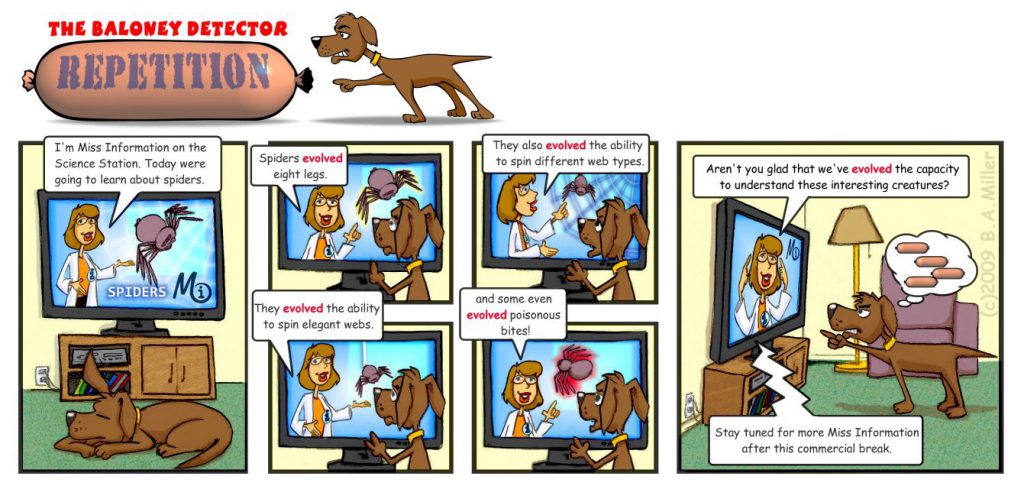
– There’s that magic “evolved” word again. No details. Just “nature-dun-it” I’ve been told that evolution simply means ‘change’. If indeed evolution just means change, can we substitute ‘changed’ in for ‘evolved’? Here’s what it would look like: “The Old World monkeys were separated from the New World monkeys and CHANGED a third visual pigment”. Maybe not. ‘Evolved’ doesn’t just mean changed. There’s way more magic built into the usage of the term

“This third visual pigment is not the same one as found in fish, reptiles, or birds, and likely represents an error in duplication of the LWL visual pigment”

Likely. More assumptions. Evolutionists assume that an accumulation of errors (mutations) produced all of life. It’s all they have to work with. But it strains the very limited of common sense to assert that you can gain function from an accumulation of brokenness

“they illustrate visual photopigment evolution in progress

– Isn’t evolution ALWAYS supposed to be in progress? I guess they have to assert this because observations of fossils show that “abrupt appearance” and “stasis” are the norm. No progress

In their conclusion (for those intrepid readers, here’s your gift from the scientists who authored their paper!):

“We know from computer models, and deductive reasoning, that eyes can evolve quickly”

No evidence? Just assumptions and intelligently designed (biased) algorithms that assert an evolution of the eye. This can’t be repeated enough: if there were evidence, they would have produced it in this article. But they didn’t. In their concluding paragraph they admit that the evolution of the eye is speculated based on a computer model. And it’s not just that they claimed eyes evolved – but that they evolved QUICKLY. The Grand Theory of Evolution has been taught that it takes lots of time to change creatures from one to another. It’s likely these authors are not familiar with the waiting time problem…although they should be.

As Christians we know that evolution cannot explain the emergence of the eye because it is contrary to what God has revealed in the Bible. But the analysis of the claims of the evolutionists has a purpose beyond just saying (from the Christian worldview) that evolution is in conflict with God’s Word, so evolution isn’t true. This purpose is to see if their claims (from their perspective) is legitimate. Do they indeed have evidence to support their claims? After reading through this article, you can see that their claims are impotent and the definitive answer is NO. There’s no need to be bullied when an evolutionist claims: “There’s a mountain of overwhelming evidence for evolution.” As I’ve done in this series of articles, I say “SHOW ME!” And when we peek behind the curtain, it’s one assumption built on another.

We can trust What God has revealed in his Word about the past, so we can trust Him about the future too

UPDATE: Even the simplest vision is far beyond the capabilities of the BLIND forces of natural selection acting on random mutations

Can Evolution Explain Empathy?

Photo by Alex Green on Pexels.com

If you’re not familiar with my series of posts, which analyze the claims of evolutionists, who claim that “nothing in biology makes sense except in light of evolution” feel free to browse the articles below

In these articles, we as Christians understand that evolution truly lacks explanatory power for anything that is in conflict with God’s eternal word, but for purposes of exposing the deficiency of the God-denier’s worldview, we have taken the claims of the evolutionists and put them to the test. Can they actually justify what they are trying to explain, or are their claims filled with assumptions and artwork? Today we’ll answer a God-denier, who feels that evolution can explain empathy.

You can read the entire article here. Let’s see what this author, Frans De Waal, thinks is indisputable proof that the evolutionary processes of natural selection acting on random mutations in the struggle for survival in an environment of limited resources – can in fact produce empathy

We tend to think of empathy as a uniquely human trait. But it’s something apes and other animals demonstrate

Right off the bat, we see that the author assumes that humans have evolved from either/both modern apes or other animals. But this is contrary to common evolutionary textbooks which teach that humans and apes evolved from a common ancestor. The BEST this author could claim would be to say either that there is evidence that the human/ape common ancestor already possessed the trait of empathy OR that empathy is a trait produced by the ambiguous and magical term “convergent evolution”

It’s good to have definitions and the author uses this definition of empathy

The act of perspective-taking is summed up by one of the most enduring definitions of empathy that we have, formulated by Adam Smith as “changing places in fancy with the sufferer.”

We’ll go with that definition

This capacity likely evolved because it served our ancestors’ survival in two ways. First, like every mammal, we need to be sensitive to the needs of our offspring. Second, our species depends on cooperation, which means that we do better if we are surrounded by healthy, capable group mates. Taking care of them is just a matter of enlightened self-interest.

Notice the unscientific and hopeful word “likely”. If this article were actual evidence of the ability of evolution to produce empathy, the author would have said “Here we see a population of organisms that had no empathy, but in order to survive the selection pressure, its direct descendants have empathy because of these XYZ mutations”. So, no science or evidence here

Let’s test the claim about mammals needing to be sensitive to the needs of our offspring…specifically the word “need”. Evolutionary processes (natural selection acting on random mutation) do not function based on a specific direction of “need”. This is a Post Hoc fallacy for the author to see that mammals care for their young THEREFORE evolution must have produced behavior that parents are “sensitive to the needs of our offspring”. If this were a scientific explanation, the author would have said “Mutations XYZ produced in parents of population group ABC the ability to be sensitive to the needs of offspring to account for selective pressure 123.” But that’s not what the author said. This author made the unwarranted claim that “since we see empathy today in mammals, then evolution MUST HAVE done it….somehow because we NEEEEEEEEED it”

In the second half of that claim, the author says that our species depends on cooperation because of enlightened self-interest. Now, the author has not yet defined “enlightened” or what evolutionary process produced “enlightenment”. For now, we’ll put this in the bucket of magic from which evolutionists invariably pull to “explain” some part of biology for which mutations don’t really fit.

It is hard to imagine that empathy…came into existence only when our lineage split off from that of the apes. It must be far older than that. Examples of empathy in other animals would suggest a long evolutionary history to this capacity in humans.

Again, the author fails to provide evidence of his claims and again, humans have not evolved from creatures, which exist today. Do you remember the definition the author used for empathy: the ability to “change place in fancy with the sufferer”? Yet no examples of mice or hippos explaining why they gave up a meal so that bats and ospreys could eat healthier. How many camels did the author interview to show that she (the camel) could change places in fancy with a sufferer?

But perhaps the most compelling evidence for the strength of animal empathy…

The goalposts have been subtly moved from: Empathy can be explained by evolution to Empathy exists. The next three paragraphs in the article bring emotional language like (“escape, reward, threat, arousing sympathy, crying, weep, tenderly, lightly touches, emotional connectedness, striking, carefully unfolded, notion of what would be good, screaming, yelping, distress…”) Emotional language isn’t a bad thing, but it doesn’t fit well in a paper, which is supposed to explain the ORIGIN of empathy rather than just its existence. The next paragraph begins with a comment that needs no comment

This is not to say that all we have are anecdotes

But a comment on the insufficiency of the article in explaining evolution’s tremendous power impotence is warranted. Why would he spend 3 paragraphs on impassioned anecdotes if the evidence from clinical studies on the origin of empathy were so very compelling? But let’s see what they have to say about the actual studies

it is a demonstrable tendency that probably reflects empathy, since the objective of the consoler seems to be to alleviate the distress of the other

“Probably”? “seems to”? I suppose I was expecting more conclusive answers than “probably” from a theory that flaunts bravado like “nothing in biology makes sense except in light of evolution”. Pretty tame

In fact, recent neuroscience research suggests that very basic processes do underlie empathy. Researchers at the University of Parma, in Italy, were the first to report that monkeys have special brain cells

Notice two things from this paragraph:

  • Humans did not evolve from monkeys. At BEST, an evolutionist could only say that humans and monkeys share a common ancestor or that convergent evolution produced the same mutation in both humans and monkeys. Strangely, evolutionists tend to like the convergent evolution fable that complicates their overwhelming math problems
  • The monkeys ALREADY had the “special brain cells. Their argument hinges on these “special brain cells” learning the ability to perform a function. No talk about how nature was able to PRODUCE these “special brain cells”. For their argument to work, they must show step by step via numerous successive slight modifications how random mutation produced these “special brain cells”. Just assuming they already exist and that “turning them on” will produce empathy in creatures that formerly did not have “special brain cells” is the post hoc fallacy

Biologists prefer such bottom-up accounts. They always assume continuity between past and present, child and adult, human and animal, even between humans and the most primitive mammals.

“prefer” ?!?!?? “always assume”?!?!? To prove evolution, evolutionists rely on their preferences and assumptions. Rather than giving us observations on the leaf nodes (humans and chimps alive today), a compelling argument for evolutionists would be to show evidence from their assumed common ancestor how empathy evolved by evolutionary mechanisms. This type of argumentation is completely lacking. Instead they give us “preferences” and “assumptions”…mixed in with some fine artwork from time to time

Empathy probably evolved in the context of the parental care that characterizes all mammals

“probably”?!?? I prefer evidence to probably. And why use the ambiguous term “evolved” rather than describing in great detail the process of the construction of genes/cells/organs that produce empathy, evolutionists sweep the details away with “it probably evolved”. When an evolutionist doesn’t know the process, they can conveniently hide it in the sciency-sounding phrase: “it evolved” or in this case “probably evolved”.

https://crev.info/2021/03/it-evolved-is-not-science/

Signaling their state through smiling and crying, human infants urge their caregiver to take action

Like many other evolutionists, the term “signaling” is just assumed to be part of nature. For them, no explanation is needed – just that signaling exists. But signaling is amazingly complex and requires at least:

  • Ability by signaler to signal
  • Need by signaler to signal
  • Medium for signaler to be able to transmit signal in a way that it can be perceived by recipient
  • Meaning in a signal (information)
  • Ability by receiver to interpret signal correctly
  • Ability by receiver to provide a survival advantage to signaler

These signals, which evolutionists just assume have remarkable parallels to information theory. Dr. Werner Gitt explains the complexity involved with sender/signaler and recipient/receiver in his book In The Beginning Was Information. It’s not just unlikely that evolution (natural selection acting on the single successive slight modifications of random mutations) could construct complex coding communication as shown below, it’s impossible

p60 In the Beginning Was Information – Gitt

During the 180 million years of mammalian evolution, females who responded to their offspring’s needs out-reproduced those who were cold and distant

How could the author possibly know the results of every single mammalian parent/offspring interaction for almost 67 billion days such that he could claim the warm ones were better than the cold ones? It’s a ridiculous claim that is both totally lacking in evidence and entirely unverifiable.

Effective cooperation requires being exquisitely in tune with the emotional states and goals of others

This is a post hoc pragmatic “argument” rather than the detailed step by step explanation of construction of genes/cells/organs that produce empathy. Again, rather than giving us evidence, the author tells us a fantastic story. Evolution does not require anything but the effective propagation of genes. Bacteria, mosquitos, mice and fish are far more measurably fit than humans but they didn’t require empathy. Pragmatism fails as an argument and evolution (survival of the fittest by natural selection) is completely at odds with empathy (preventing natural selection without a fitness gain).

The way a chimpanzee bashes in the skull of a live monkey by hitting it against a tree trunk is no advertisement for ape empathy

THAT sounds more like evolution than empathy. Darwin described nature as “red in tooth and claw”. It’s a reversal by evolutionists to say now rather than the survival of the fittest to now say that evolution produced creatures that purposefully prevent natural selection.

Lions kill cubs from other males – not empathy

The possibility that empathy is part of our primate heritage

“possibility”?!!?!? Again with the utter lack of evidence

What we need, therefore, is a vision of human nature that encompasses all of our tendencies: the good, the bad, and the ugly

More pragmatism. The author wants to “envision” an explanation, so he wishes very hard for evolution to be that explanation. Wishing it, doesn’t make it so

Emotions trump rules. This is why, when speaking of moral role models, we talk of their hearts, not their brains…Moral rules tell us when and how to apply our empathic tendencies, but the tendencies themselves have been in existence since time immemorial

“Emotions trump rules, but rules trump emotions.” Didn’t the author of the article proofread his article before publishing it? Within two paragraphs he completely contradicts himself, but within an evolutionary framework, what’s wrong with contradictions? Maybe being contradictory improves his fitness somehow.

Go back and read his last sentence…is he closing off a scientific paper that is full of overwhelming evidence or is he writing a conclusion to a fanciful epic? Sounds fanciful to me

Another analysis of the impotent claims of evolution in the books…blog. Don’t be intimidated by those who boast, “The evidence for evolution is overwhelming.” EVERY time one of these evolutionists has put up a link to an article that they think explains the theory of evolution, once analyzed, the claims fall far short of evidence

Conversely, we can trust the revelation of the One, who knows everything and is eternally faithful. God revealed in the Bible that He created the plants, animals, and people to reproduce according to their kinds, so evolution’s story is incompatible.

Can Evolution Explain The Indonesian Mimicry Octopus?

In an online exchange, I asked a God-denier to provide evidence that evolution could explain the origins of the Indonesian Mimic Octopus. This exchange happened after after the person with the Twitter profile name, @AmputeeAtheist, called a Christian brother “stupid” for showing in an article how evolutionists have bad assumptions rather than evidence for their theory

In the link that @AmputeeAtheist provided which supposedly provided proof that evolution can explain the origins of any octopus…let alone the Indonesian Mimic Octopus, we are given several options to choose from to verify his claims.

Unbeknownst to @AmputeeAtheist, since he failed to read his own link, the second article in his list was written by Dr. Brian Thomas, who works for The Institute For Creation Research. How embarrassing for him

Embarrassing Link for God-Deniers

If you haven’t had a chance, stop now and watch the video in @Rational_faith_ ‘s article about the Indonesian Mimic Octopus. God’s design is indeed wondrous!

As I have done in my series of articles exposing evolution’s inability to explain anything, I’ll take a couple of the “scientific” articles in @AmputeeAtheist ‘s link and expose how there’s no actual evidence in them, but they are littered with assumptions and ambiguity:

Here’s the first article in the list – https://academic.oup.com/bioscience/article/60/11/962/329655?login=true

Most of the article is behind a paywall, but the article reveals how little these highly-trained lab coats know about the evolution of octopi.

“remarkable”
“astonishing”
“unusual”
“There is also conflicting research about whether its defense mechanisms are learned or inherited”
“The researchers had predicted…Instead, they discovered…”
“evolved”

“the traits evolved”

You’ll notice the deafening lack of details and the monumental surprise of the researchers that an octopus could have evolved

The second article in @AmputeeAtheist’s link, as was pointed out earlier, was written by a Christian, who trusts God’s revelation in scripture that animals were created rather than evolved, so there’s no need to expose the evolutionary deceit there. But you can read this magnificent article here. So, we’ll move on to the next article

This article is FULL of assumptions and ambiguity but is however lacking evidence that evolution can explain the origins of the Indonesian Mimic Octopus (IMO). Let’s review what it would take to show evidence

  • DNA of direct ancestor species of IMO without mimic traits
  • Repeatable evolutionary mechanism (X) that creates the information that builds phenotypic traits for the IMO to mimic more than 15 disparate species
  • Repeatable evolutionary mechanism (Y) that creates the information that controls (software) the phenotypic traits for the IMO to mimic more than 15 disparate species
  • Both mechanisms (X) and (Y) must be unguided and shown to be mechanisms that transform DNA base pairs in single, successive, slight modifications

Let’s see if this article contains any evidence like that or if it’s filled with assumptions

Before you shriek “Quote-mining!!!!”, you can read the whole article here and if you can show that instead of assumptions and ambiguity, there is actual evidence, be my guest. But on to the analysis. NOTES: Quotes from the article are in italics, and my comments of each quote are directly below:

flatfish swimming appears to have evolved concurrently with extremely long arms

Notice that the details are missing. And asserting (completely without evidence) that anything evolved concurrently is incompatible with evolutionary assumptions that the process of evolution proceeds with numerous, successive, slight modifications

the subsequent diversification of their descendents into lineages with successful conspicuous defence behaviours, remains a puzzling topic in evolutionary biology

Puzzling? Clearly!

have evolved

Details missing!

Maybe we’ll find the answer in the section titled: TOWARDS AN EVOLUTIONARY UNDERSTANDING OF A CONSPICUOUS PRIMARY DEFENCE IN T. MIMICUS

explore possible scenarios for the evolution

Possible scenarios? You mean there’s no ACTUAL evidence, just possible scenarios? That’s what I’ve been saying all along

Central to this investigation is the well-documented fact that many behaviours, including visual defences and their associated body colour patterns (e.g. Brodie III, 1989), are heritable traits

The link supposedly pointing to Brodie’s article is broken and subsequent search for the CENTRAL PILLAR TO THIS INVESTIGATION was fruitless. An article written by Brodie, on which their whole research relies, is missing in action

we assume

Obviously!

possible social mimicry…may also influence

More assumptions

evolve at the same time

Details missing!

Exaptations, by contrast, are traits that ‘are fit for their current role … but were not designed for it’

There is by definition NO DESIGN in evolution.

evolved originally either as adaptations for other uses

Details missing!

is likely to have evolved early in this lineage

Details missing! Assumptions abound!

we estimated genealogical relationships

Estimated? Estimated? I thought this was supposed to be about evidence

In the event of discrepancies between our observations and published accounts we followed our own observations

There was a fine chart (Figure 2) that presumed to show evolutionary relationships. However, they brought their own argument into question that they relied on evidence rather than subjective opinion in their admission above

appears most closely related

Ambiguity persists in that quote

may have evolved

Lots of assumptions and the details missing!

it appears that

Ambiguity persists

behavioural and morphological traits emerge concurrently

Incompatible with evolutionary assumptions that the process of evolution proceeds with numerous, successive, slight modifications

may have yielded

More ambiguity

may have evolved

Details missing!

may enable

More ambiguity

may evolve imperfect mimicry of an intermediate form

More ambiguity and where’s this intermediate form? ANOTHER missing link?

Although the lack of a conclusive flatfish model has generally been identified as a weakness in the cephalopod mimicry literature (Hanlon et al., 2008), we feel it reflects imperfect mimicry of multiple models in regions of high biodiversity

Feelings and weaknesses saturate this article

We do not know how potential unpalatability…may further contribute to predator confusion, learning, and/or future avoidance

They DO NOT KNOW…no doubt

The pattern is emerging that evolution, while presented as a theory with oVerWheLmiNg evidence, is instead supported by massive assumptions behind a venire of white lab coats

The Altruism Exchange – Part 4

Photo by Karolina Grabowska on Pexels.com

The Tall Friendly Atheist Dad (TFAD) didn’t care much for my questioning of the ‘one true religion of Darwinism’. Last year, I wrote a post asking the question “Can Evolution Explain Altruism?” and after exposing the claims of those, who answered affirmatively, as impotent – TFAD put quite a bit of time and effort into a 4 part rebuttal. I answered his first 2 submissions in Part 1 and Part 2 of my replies, and for the most part TFAD wasted his “shots” on nit picking and majoring on the minors. In his third objection, TFAD did address the substance of my arguments, but my rebuttal of his objections showed that my original contention is escaped his objections without damage. Let’s see if his final objection can make him a champion for Darwin by slaying anyone, who would dare question the narrative or if his best quality is his friendliness.

Right from the start TFAD attacks the argument messenger

TFAD: “…you’re trying to counter scientific ignorance writ-large in the form of Fundamental Evangelicalism combined with Presuppositional Apologetics…After much consternation, I’ve decided to release the 4th and final part, but with most of the links removed. Not that Creationists care much for them”

So, TFAD postures his stance in his final response with the assertion that his opponent is “scientifically ignorant” and never checks sources. TFAD quickly forgets that checking sources is what started this discussion. Way back in the original post TFAD posted the link that would birth this discussion shown in the picture below (TFAD comments in red)

He’s not off to a good start, since while some creationists or presuppositionalists that he’s encountered in the past might have ignored a link or been ignorant of the teachings of evolution, The ApoloJedi guild is not so easily dismissed. TFAD now moves to object to the use of presuppositional apologetics and defines it as special pleading

TFAD: “they need this out BECAUSE the evidence from philosophy, morality and especially the natural sciences all defeat the case for God’s existence and his superior qualities when considered strictly on their merits”

This is tone deaf bluster as each of these categories is the “home field” of the Christian. In matters of philosophy, only Christianity can justify logic, reasoning, and knowledge. In fact, I recently asked the question of the naturalist “Can Evolution Explain Reason?” and similarly showed naturalism to be devoid of explanatory power. His bluster gets insanely absurd when he claims that evidence for morality defeats the case for God’s existence. The most famous of God-deniers, Richard Dawkins, proclaims of atheism

RD: “The universe that we observe has precisely the properties we should expect if there is, at bottom, no design, no purpose, no evil, no good, nothing but pitiless indifference.”

Any morality that a God-denier might propose is subjective, self-defeating, and irrational as shown

His final claim that the evidence from the natural sciences is one that we can debate only because Christianity is true as was shown earlier in the link regarding logic, reasoning, and knowledge. Should an atheist want to discuss evidence, they would need to demonstrate that their worldview can consistently and sufficiently provide a foundation for the very things on which evidence relies (logic, induction, truth, and morality), and because of their epistemic assumptions, none can possibly be forthcoming.

TFAD: “ApoloJedi has only used a social definition of altruism, ‘good done for no thought of reward’, not an academic one. If ApoloJedi is trying to convince like-minded believers of his position, mission accomplished, but has he done enough to convince rational skeptics like me? No.”

OK. Can we observe behaviors in creatures today that one would define as the social definition of altruism? YES! Those observations are seen without question. I asked the question whether evolution can explain those behaviors, and it cannot. TFAD wanting to protect his strongly held faith commitment to the religion of survival of the fittest would rather redefine altruism to mean something that involves a reward, so that the dogma of ‘natural selection acting on random mutations in the struggle to produce the most fit offspring’ might have a minute chance of partial explanation. But it’s just like when the staunch evolutionists vainly and incorrectly claimed to have defeated Behe’s mousetrap analogy by saying “But HERE’S a different mousetrap that doesn’t look like your analogy”, TFAD says “But HERE’S a different kind of rewarding altruism (not true altruism) that isn’t defeated by your scandalous questions.”

In a response to my quote that reads “it is my intent to always revere Christ Jesus as the authority in all matters”, TFAD has this to say with incredulity

TFAD: “In all matters, especially scientific? But why? Why would anyone hold as a scientific authority a person who – despite being the one who created the universe (Colossians 1:16) – didn’t know or care to teach about bacteria or atoms or DNA? What was Jesus’ knowledge about electricity or vaccines or neurochemistry?”

Yes. All matters. Hold on for some scriptural support of my original claim and then some comments

  • 2 Cor 10:5 We destroy arguments and every lofty opinion raised against the knowledge of God, and take every thought captive to obey Christ
  • Matt 28:18 And Jesus came and said to them, “All authority in heaven and on earth has been given to me
  • Eph 1:20-21 when God raised Jesus from the dead and seated him at his right hand in the heavenly places, far above all rule and authority and power and dominion, and above every name that is named, not only in this age but also in the one to come

From Abraham Kuyper “There is not a square inch in the whole domain of our human existence over which Christ, who is Sovereign over all, does not cry, Mine!” So, Yes TFAD, Jesus is authoritative over scientific matters, electricity, vaccines and neurochemistry. And while Jesus has an eternal dominion over these fields of science, the things you currently believe about science will be mocked as archaic by natural philosophers a few hundred years into the future. Your own epistemology of provisionalism gives you no certainty that your temporal faith commitments are anything other than your opinion.

In critiquing this line in my post: “and not put the God-denier in the judge’s seat as if he/she can correctly judge evidence in accordance with a perfect perception of reality. Only God has a perfect perception of all of reality” TFAD had this to say:

TFAD: “This is a common line from Pre-Suppositionalists that I believe actually betrays why they’re reluctant to apply the same standard to God as what they happily do every day to everybody and everything else. It’s funny – Pre-Suppositionalists, and even most Protestant Evangelicals, will happily sit in judgement over other people’s behaviour, over the morality other religions, the existence of their associated deities, and over the morality and judgement of certain presidential candidates and their families – yet when it comes to their deity, suddenly being in the judge’s seat is wrong. You can’t have it both ways. Either judge nothing on its merits, or judge everything on its merits”

Unknowingly TFAD has stepped beyond the perceived safety of the modern academic paradigm, and has jumped into the presupp-infested waters of metaphysics. STANDARDS. Oh yes, God has his standard of righteousness on which everyone will be judged. Those, who are in a right relationship with Jesus by grace through faith will not be punished for their wickedness, but those who are dead in their trespasses will face righteous judgment from the Eternal Judge. Regarding his lament that God sits in the judgment seat but denies that seat to the God-denier as special pleading – it’s only special pleading if God is not the eternal Judge. In the same way that it’s not special pleading for the Chief Justice of the Supreme Court to sit in his judges chair and pass judgments (along with the other SCOTUS judges) and deny Neil Young a place at the judge’s seat. Because Neil Young is a has-been musician not a judge. It’s idolatry for the creation (mankind) to think of itself as the Creator or in any way worthy to be sitting in the holy judgment seat. If you want to “judge everything on its merits”, what is your merit (standard)? When the standard is God’s Holy Word, the God-denier will quickly withdraw his desire to be judged on that merit

TFAD: “Now, let’s ask the question: from the Bible’s perspective, how accurate does God perceive reality? Badly is the answer. For example, Genesis 1:6 describes a firmament, a crystalline dome that divides the sky from outer space and has windows to let the rain in (Genesis 7:11) and covers the earth. And let’s be clear: the Hebrew word for firmament, “raqiya”, means a solid dome, not simply the atmosphere”

While I could remind TFAD that his own epistemology is provisional, and he himself does not and cannot truly perceive reality with perfect accuracy, we’ll analyze his misunderstanding of the biblical text that he notes. He claims that God believes that the firmament or expanse from Genesis 1 is a crystalline solid dome. Not unsurprisingly TFAD did not quote Genesis 1:20 that says the birds fly in the expanse, so it could not be solid.

TFAD: “Genesis also describes the moon as a “lesser light” in contrast to the sun being the “greater light”. The problem? The moon has no capacity to generate light”

Looks like TFAD has revived his classic picking-at-nits argument. God clearly defined his purpose for the moon and as a reflector, it functions quite well. But if the moon were a fusion reactor like Solar, the earth would be completely sterile from a star so close. What else might happen is a tiny star were so close to Earth? When the fusion materials were depleted, it would go supernova, and that would end poorly for the biological creatures God had designed for his glory. TFAD although wanting to be the Judge and the Creator didn’t think that one through very well.

TFAD: “But let’s continue to evaluate God’s perception of the reality he supposedly created. Isaiah 11:12 refers to the four quarters of the earth, which is a reflection of a classic belief that the earth was a circular disk, not a globe. Job 38:19 asks “What is the way to the abode of light? And where does darkness reside?”. Light doesn’t live anywhere – light is an electromagnetic wave in certain bands of wavelengths, and darkness is not a thing, it’s merely the absence of light.”

This is a common tactic from God-deniers – force wooden literalism onto poetic passages. We’ll chalk this up as continued nit-picking as these lazy objections have been addressed even before Al Gore invented the internet

TFAD: “And the Bible is without any description of our local solar system. God, not once, mentions any other planets”

That’s like saying, “My toothbrush, although it can float, cannot launch F-18 Hornets into the sky therefore the inventor of toothbrushes is an idiot!” God’s purpose in the Bible is to teach us how to be in a right relationship with Him. He left many things for people to discover for His glory, so it is absurd to declare that God does not have a correct perception of reality because He didn’t catalogue all knowledge.

To my valid claim that “God, who is the source of all knowledge, has revealed some of his knowledge so that we can know those things with certainty” TFAD responded:

TFAD: “Only if we are willing to cede our intellect (as well as our humanity) to a book written by men who wondered where the sun went at night.”

It’s likely that many of you have heard this little jab that the authors of the Bible (kings, doctors, philosophers, warriors, judges, lawyers) were dimwits. Secondly, as has been pointed out many times, “intellect” is only possible because Christianity is true. Were humans simply the accidental aggregation of stardust, intellect would not be possible, knowable, or trustworthy

TFAD: “Does God command altrusim (sp) ? Only when he’s not commanding genocide (1 Samuel 15), endorsing slavery (Exodus 21), literally de-valuing women (Leviticus 27), having his people kidnap little girls after their parents and brothers have been murdered (Numbers 31), and much, much more.”

God-deniers seem not to comprehend the difference between judgment and genocide as they irrationally judge God without warrant. To the God-denier, what’s wrong with disintegrating aggregations of particles in an amoral cosmos? They have no consistent/justified moral foundation on which to stand. Slavery? Again, to the God-denier, why is slavery wrong? On what basis do you declare ANYTHING that God commands as immoral? The best they can say is that they don’t personally like it at this time since they have no absolute standard by which to judge others. Would it be too much to duplicate the meme of the boyfriend looker from above to highlight the inherent problems of those, who outwardly deny God, recognize the need for moral absolutes? Why not – as it’s my new favorite meme

Now we get into the part of TFAD’s objection where he exposes his ignorance of the concept of an “internal critique”. An internal critique is taking on the perspective of your interlocutor and showing how (within his own viewpoint) his perspective leads to a contraction, an absurdity, and/or inconsistency. An external critique, which is far less persuasive in terms of argumentation, is showing an interlocutor why they are wrong according to one’s own view.

TFAD: “ApoloJedi isn’t saying the theory of evolution is unscientific because he has conferred with those with professional qualifications and done a comparative study of numerous genomes to come up with a competing data set that has withstood scientific scrutiny to the point that it attracts academic attention. No. He is saying evolution is false because it is discordant with his theology”

He said this in response to my brief explanation that evolution is incorrect according to the truth that God revealed in both the Bible and in nature from the Christian perspective (external critique). But I immediately continued with the summation of the blog post which showed from the internal critique (analyzing the teachings/writings of evolutionists in their failed attempt to explain altruism via evolution) that the theory of evolution is impotent in accounting for anything altruism. This was a very brief recognition that evolution is not just wrong from my own perspective, but also from theirs

TFAD: “The article didn’t enter the worldview of the God-denier, for the simple reason that ApoloJedi’s article was a theological hatchet job, and evolution is a science issue – not a theological one. Christians such as Dr. Francis Collins, Dr. Theodosius Dobzhansky and Pope Francis see no threat to their faith when looking at the theory of evolution, so why does ApoloJedi?”

If I had not been doing an internal critique, I would have filled my blog post with links to ICR.org, Creation.com, and AnswersInGenesis.org (because they are awesome websites). But that would have been an external critique of evolutionism. But I didn’t. I asked evolutionists to account for their claims, and they could not. Regarding Francis and Francis: I do not share the same faith (also named the same and share some elements) as Francis Collins and Pope Francis, so the critique was warranted

At the end of his blog, TFAD falls right back into the very same thinking that my original post exposed as impotent. I showed that the only way that “altruism” can possibly be explained by evolution is by redefining altruism to mean something that it does not mean

TFAD: “cooperative tendencies…natural selection and social selection have worked and do work against individuals who do not help and share with others…reciprocal altruism, ‘strong reciprocity’…Kin‐based altruism benefits biological relatives”

As though he had not read the original post that showed these terms clearly as redefining the word – altruism, TFAD tries to throw “strong reciprocity” at the evolutionary paradox again thinking maybe no one would notice this time.

Hopefully, this discussion will help those, who feel like they must bow obediently to whatever those in white lab coats tell you to believe without any critical thinking. Because, with some skeptical analysis, we can see that bias drives a lot of research and just because evolution is popular doesn’t mean it’s true.

The Altruism Exchange – Part 3

Photo by RODNAE Productions on Pexels.com

In part 1 and part 2 of the rebuttal to the Tall Friendly Atheist Dad’s objections to my original article: “Can Evolution Explain Altruism” we saw that he objected from the margins and never really addressed the meat of the article. He has shown himself to be verbose and persistent…and friendly. Let’s see if Part 3 of his objection will produce some positive criticism. As before, the tall friendly one will be referred to as TFAD, TFAD’s comments will be in red.

My original post included the line “So, scientists have recognized that it is counter-intuitive to assume that altruism fits within the evolutionary explanations”. And it’s not just scientists. There’s an inherent understanding that a mechanism (evolution) that’s taught as “survival of the fittest”, “red in tooth and claw”, and “culls the weak” has basic problems also explaining sacrificial giving to help the weak survive, empathy, and protecting the weak (even of other species) at the expense of one’s own reproductive success. But TFAD declares:

“This is wrong, as well as completely missing the point. No expert on the subject says that altruism is on the whole incompatible with evolution as a mechanism for human development or advancement. Nay, a cursory Google Scholar search for “evolutionary origins human altruism” brings up over 80’000 results which actually tie human altruism to evolution”

There are so many things with TFAD’s objection to dissect. Best start at the top:

  • For him to declare someone to be wrong, he would have to have absolute knowledge, but an epistemology which assumes naturalism has no such foundation for the preconditions of intelligibility. This is not just me lazily saying “I’m right and you’re wrong!” He has recognized the deficiency in his own worldview
  • AND, I am NOT wrong. People that TFAD would recognize as experts (no creationist links below) DO recognize the inherent contradiction of the mechanisms of evolution with altruism. While researchers think they may have answers, the point remains – Altruism is in conflict with evolutionary thought.
  • “No expert” – While TFAD did not specifically define expert, it would not take long to infer what he means by expert. Are experts only those who have PhDs? What about PhDs who are Christians? What about PhDs who have different ideological assumptions than you? What about PhDs who are employed by companies that you consider biased? If a person does not have a PhD can they object or point out inconsistencies in a claim/idea? Since TFAD does not have a PhD (or recognized expertise beyond height/friendliness) why is his objection to my exposure of evolutionary deficiency worth considering? This is not to say that education is bad or that there are not people who are highly trained in specific fields. There are. And I am questioning the assumptions, processes, and conclusions of some of those experts because their reasoning (as I have shown) is questionable. People mustn’t be silenced because they do not have fancy letters after their name. No one would consider me an expert in biology, which exposes the inadequacy of the explanations of evolutionists for altruism, since a non-expert (me) has easily shown the flaws in their thinking
  • TFAD found more than 80,000 results when searching for “evolutionary origins human altruism”, and he interpreted this as “See, evolution explains altruism”. This is what is called prejudicial conjecture. Rather than reading the 80,000 results or even a few of them, he just assumed (with his bias) that all of them are the answer. If we were to use the methodology of TFAD to try to answer the question “Is inflation good for the economy?” Google returns about 269,000,000 results. And following his progression of thought, I could claim “no, it is not! See, there are 269,000,000 articles telling me why.” I’m sure you all see the flaw TFAD’s argument, and it hath a name: prejudicial conjecture.

TFAD proceeds next down the well-worn “rabbit trail” of criticizing presuppositional apologetics again for a few paragraphs. It’s not really part of the discussion, but it gives TFAD warm fuzzies to be critical of philosophies with which he disagrees. But back to the real substance of the ongoing debate

I wrote “Essentially, he told me that science DOES have answers, and I’m ignorant of those answers because I’ve never read them” and TFAD countered:

“Not quite. I never said he was ignorant of the answers because he’s never read them. What I will say is that lousy epistomology (sp) utilising intellectually treasonous theology prevents people with theological blinders on from accepting the fact they could ever be wrong about something, particularly when that something challenges their deeply-held religious convictions. So ApoloJedi is not ignorant because he hasn’t read the answers – he’s ignorant (to use his word) because his chain of logic prevents him from ever being corrected on any topic he sees as contradictory to his theology.”

TFAD again has fallen into the trap of misunderstanding the entire purpose of the original blog post. I used the definitions of the evolutionists. I used the papers and books of the evolutionists. I used the links and assumptions of the evolutionists…all as an internal critique of their explanations of things (altruism) clearly seen. What remains unseen are their assumptions that natural selection acting on random mutations in the struggle for survival can produce behavior that is sacrificial to the reproductive fitness of the giver. TFAD says that I am opposed to “ever being corrected on any topic he sees as contradictory to his theology”. Should TFAD desire to take this path of argumentation, he needs to establish an epistemology with transcendent justification whereby his philosophical foundation is sufficient to correct others. As already shown and as he has already admitted, his philosophical foundation is unable to do so. Even if he does not want to go so deep as to engage in metaphysical foundations (as he really hates presuppositional apologetics), he could at the very least demonstrate (from his own perspective) the necessary evidence that evolutionary mechanisms can produce altruistic behavior in creatures where their direct ancestor did not behave altruistically. This glaring deficiency is what precipitated the original blog post in the 1st place, and TFAD would rather distract and pick at nits than demonstrate actual evidence that would put the whole issue to bed.

Fehr/Fischbacher

When, in my original post, I said “They (Fehr/Fischbacher) clearly recognize the counter-intuitive nature of the claim that evolution can sufficiently account for altruism”, TFAD almost shouted:

“No they don’t! ApoloJedi can quote an abstract, but not read it properly – it said “current gene-based theories” cannot explain, but it did not say evolution on the whole can’t account for it…All they said was that according to current gene-only evolutionary models, no theory sufficiently explains human altruism – hence why they believe the need for a co-evolutionary model that incorporates both genes and culture”

Gene-based theory IS the theory of evolution. Remember bullet points 2, 3, and 4 from the original post

There was nothing about culture, which TFAD now suddenly adds to the mix. TFAD never defines culture, but we can infer that he’s jumped down the Lamarkian rabbit hole of thinking that acquired characteristics can be passed on genetically. Lamarkism, the idea that a weightlifter will produce offspring with higher percentages of muscle or someone who pierces their ears will have offspring with pierced ears, is now generally dismissed, but there are rare exceptions. The theory of evolution is taught that beneficial heritable genetic traits persist while natural selection “weeds out” phenotypes that are unfit.

Moving on -> Many of you are familiar with the term “gaslighting“. TFAD attempts to gaslight the audience by questioning the reader’s understanding of reality. In the original post, I pointed out the redefinition of altruism made by Fehr/Fischbacher when in their definition of a new mysterious force they have defined as “Strong Reciprocity”, they talk about being rewarded for altruistic behavior “Reward? If there is a reward, it’s not altruism. Right from the beginning, they change the definition of altruism from something that is unselfish to appeal to the inherent selfishness”. But TFAD gaslights the reader by saying

“At no point do either of these definitons (sp) nor the SEP definition consider altruism as “doing something beneficial for no thought of reward””

When the very definition of altruism IS “Behavior by an animal that is not beneficial to or may be harmful to itself but that benefits others of its species”. When Fehr/Fischbacher introduce “reward”, they are not longer talking about altruism. But TFAD continues to say that selfish rewards and expecting “fair outcomes” are part of altruism, when we know in reality that altruism has nothing to do with selfishness or expecting fair outcomes. TFAD again tries to distract when he says

“I really don’t care about Merrian-Webster’s definition – I’d much rather use Stanford’s version because it is more academcially (sp) rigorous”

This reminds me of the objection from evolutionists that they have successfully refuted Michael Behe’s example of irreducible complexity in the standard mousetrap. In an analogy, Behe described the necessary components of the standard mousetrap (Model SM) as needing a base, spring, hammer, catch, and trigger all arranged in a very specific ingenious way that these pieces interact to kill mice. The analogy is that a blind/purposeless/atomic process (evolution) cannot produce the standard mousetrap (SM) that we see today, because it requires multiple interacting parts to be assembled in place with all proper tolerances, dimensions, materials, and initial conditions lest it not be preserved for lack of functionality. The evolutionists have said that there are mousetraps (not model SM, but model FF) that do not require the 5 interacting pieces. But that’s not Behe’s claim. Evolutionists have to account for what is seen, which is Model SM. Sure an intelligent objector can theorize Model FF that is designed to catch mice a different way, but Model SM (which is analogously seen today in complex interacting biological systems) is irreducibly complex. So, what TFAD has subtly done is propose a different definition of altruism (like Model FF) in an attempt to distract from evolution’s inability to explain real altruism (Model SM). And just like the evolutionist’s failed attempt to explain away irreducible complexity, TFAD’s attempt similarly fails.

In a last ditch effort to object to my questioning of evolution’s claimed abilities, TFAD distances himself from the very sources that he recommended. He posted a link from Google Scholar that he recommended I should analyze before questioning whether evolution could explain altruism, and Fehr/Fischbacher were 1st in the list.

“And you know why? Because Fehr & Fischbacher are economists with specialisations in human behaviour – not geneticists.”

Now that I’ve pressed back on his claims that evolution can explain altruism, it’s likely that he would not call Fehr/Fischbacher “experts” since they are just economists, even though he recommended them in the 1st place

While TFAD has been less than complimentary about creationist’s understanding of the theory of evolution, we now have to point out the TFAD does not understand the finer points of evolution

“Convergent evolution ain’t no mere assertion – it’s a demonstrable fact. Let’s think about it – if two separate primate species have overlapping characteristics and genetics, where do you think it’s pointing to?”

I had pointed out that the best that modern experiments can do when comparing common traits between widely disparate species would be to speculate that that it was the result of convergent evolution. Now convergent evolution is the description of the observation that two (or more) species that are not evolutionarily closely related have similar structures. An example would be wings. Birds, insects and bats have wings, but they are not closely related according to evolutionists, so evolutionists describe this marvel as convergent evolution. So, when TFAD says it’s demonstrable fact, it’s true that evolutionists have named an inexplicable observation as convergent evolution, but it doesn’t EXPLAIN anything. They could just have easily called it sorcery because those 2 terms have the same level of explanatory power – ZERO. TFAD thinks convergent evolution means “overlapping characteristics”, but as shown, it’s not overlapping traits from evolutionarily closely-related species. And it’s not a mechanism or a process. It’s just the assigned label of a mystery that’s devoid of explanation

Dawkins

Next TFAD takes aim at my analysis of Richard Dawkin’s book, The Selfish Gene. TFAD states:

“I’m curious as to why ApoloJedi chose The Selfish Gene instead of something like much more recent”

The Selfish Gene by RD is, according to the Royal Society, the most influential science book of all time. It has 4 editions, it’s written by the most well-known living evolutionist, and it’s sold over one million copies. The Guardian ranks it as the 10th best non-fiction book of all time. Why would I NOT choose to use one of the most popular science books written by one of the most popular science writers of all time in my article? If I had not, TFAD would have questioned why I DIDN’T use this popular and influential book. As noted in Part 1 of the Altruism Exchange, TFAD will have no end to the number of resources and books that I could have used. “Why not this one? Why not that one? Why not THOSE or THESE?!?!?” Ad infinitum

“Go tell Richard Dawkins that. He’ll be pleased a Creationist has been reading his books. But Dawkins is an expert in biology, not human psychology.”

Again with the “you’re not an expert” accusation. If nothing else, TFAD has shown that he’s the expert on who is NOT an expert. Well, maybe TFAD should go tell Richard Dawkins that despite all of the hours spent researching, writing, and publishing a book that attempts (and fails) to elucidate evolution’s ability to account for evolution, that he’s not an expert. Dawkins’ own words from the opening of his book tell us that he intended to write an account that explains clear examples of altruism via evolutionary mechanisms

Openstax Biology 2e

In his objection to the portion of my post that cited Openstax (the College Biology book), TFAD missed the whole point. In their chapter titled “Altruistic Behavior”, they gave examples and definitions of strong reciprocity and (like me) criticized the notion of a selfish gene being able to explain altruism. With the end of their examples, they proclaimed “Most of the behaviors described above do not seem to satisfy this definition (of altruism).” So they spent all that time trying to compose examples of why altruism is explained by evolution and then admitted, “but those aren’t TRULY altruistic”. And I agree. They were unable to give an accounting of observed altruism via evolutionary mechanisms. TFAD focuses instead on pulling the reader back to his preferred definition of altruism and opining that evolution is true.

TFAD: “Heritable traits that enhance one’s odds of survival – that sounds a heckuva lot like evolution to me”

Yes – heritable traits. But TFAD said that just after he quoted Openstax as saying “These instinctual behaviors may then be applied, in special circumstances, to other species, as long as it doesn’t lower the animal’s fitness.” But remember the definition of altruism? “behavior by an animal that is not beneficial to or may be harmful to itself but that benefits others of its species.” Astute readers will again see the raw contradiction…as I have been contending all along.

In the original article I said “In their first paragraph they invoke a sciency-sounding phrase, kin selection, as if merely naming an observation actually explains it…Kin selection like convergent evolution like strong reciprocity are terms that hide the explanation under the guise of science. People hear “kin selection” and assume, “well, it’s got a fancy name, so someone must have demonstrated that evolution is the only explanation for it.”” TFAD replies

“Got bad news for you, good sir – kin selection is an observed and documented scientific fact…Kin selection, strong reciprocity and convergent evolution are ALL documented phenomena in the scientific literature. Ignore it at your intellectual peril”

I never said kin selection wasn’t observed. I said kin selection doesn’t EXPLAIN altruism…or anything else. Like convergent evolution, kin selection is simply a label. It’s not an explanation. TFAD thinks that because the WhiteLabCoats have placed a label on something, that it has explanatory power, but AS I SAID in the original post, the label gives it no explanatory power.

TFAD put a lot of effort into his objections, and I appreciate the sharpening of thought and communication. But as shown, his objections never quite hit the core of the argument. His strong faith commitment to the theory of evolution prevented him from seeing the contradictions based on my internal critique of evolutionism, and his bias left my original contention completely intact that the theory of evolution cannot explain altruism.