Dr. Steven Ball is a professor at LeTourneau University in Texas and has written several papers criticizing the historical Christian position of young earth creation. In many of my online interactions, I have had self-identifying atheists post links to his papers as if they are the final word on how Christendom must deny the Biblical account in favor of the secular narrative of origins. This and maybe other blog posts will review and address Ball’s papers
His first paper is titled “A Christian Physicist Examines the Age of the Earth”. I will note his comments in red with my comments directly underneath in the default black. Each of his chapters will be divided into a distinct blog post to keep the posts from being too long
Dr. Steven Ball is a physics professor at LeTourneau University. He has written a few papers advocating for old earthism, that could use some cross-examination. His first paper is titled “A Christian Physicist Examines the Age of the Earth”. I will note his comments in red with my comments directly underneath in the default black. Each of his chapters will be divided into a distinct blog post to keep the posts from being too long
In a nutshell, the premise of Creation Science is that the Bible gives us answers to many questions also addressed by science
Right from the beginning, he subtly elevates the modern academic paradigm (which he conflates with science throughout) as superior to the Bible. This position of authority that he grants gives him the interpretive permission to redefine the words and concepts of the Bible in order to accommodate his interpretation of the modern academic paradigm (MAP). Authority is the BIG issue in this discussion, and young earth creationists have the epistemic understanding that the Bible is the authoritative principium rather than MAP.
Secondly, Ball like many, who are familiar with this discussion, think that the age of the earth is a question that is answered by science. This is wrong in at least two ways
The Bible is not a science textbook. The Bible is mostly a history book. Orthodox Christianity recognizes that the Bible is the inerrant inspired Word of God. So, what God has revealed about the past cannot be refuted. Since what God has revealed about the past is in conflict with what is currently being taught about origins in (what some people call) the scientific community, there is tension. Christians who wish to be faithful to the scientific community are then faced with the need for reconciliation between what is taught in the Bible with MAP. So, they choose to redefine Genesis as some figurative myth and say “oh, the Bible isn’t a science book” and “the Bible tells us how to go to heaven and science tells us how the heavens go” These are cute bumper stickers, but it is again as subtle dismissal of what the Bible has revealed about history
Age is not a question that is best answered by science. Science measures in the present. To get information about the past, which would be more accurately termed forensics, one measures items in the present and then (in combination with assumptions) EXTRAPOLATES into the past to form a theory. The further back in time one extrapolates, the greater the margin of error. The BEST way to determine age is historical documentation. If I want to know how old I am, I do not radiometric date the elements in my body and extrapolate into the past based on the ratio of radiometric particles. The best way would be for me to check my birth certificate or ask my Jedi father. In 1992 the rocks from Mt St Helens were dated anywhere from 350,000 years old to 2,800,000 years old depending on the method. But the ACTUAL date of the rocks was 12 years. When was the Statue of Liberty brought to NY harbor? You can measure the amount of rust on the surface and extrapolate into the past, or you can check historical records. That’s not to say that forensics cannot be of assistance in determining age, but as shown, if there is documentation of age, it is more reliable that extrapolation into the unknown past.
Ball began his argument by standing on his credentials
As a Christian physicist, I’ve been blessed with the freedom and opportunity to examine the scientific evidence for the age of the Earth in some detail, and have concluded that it emphatically points to an age of around 4.6 billion years
But as we have just discussed, scientific fields like physics can only (at best) assist as a forensics tool to find past ages. The most useful tool for finding past ages is documentation and the Bible provides this. Ball’s acclamation of his credentials for determining the age of the earth is like a Formula 1 driver coming to an NBA court and telling the 7 foot basketball players how to run faster because he drives really fast. Forensics has its place, but historical documentation trumps extrapolation for answering age questions.
But then again, a massive conspiracy of manufactured false evidence from many fields of scientific research for an older Earth and universe is a bit farfetched even for conspiracy fans
Although there have been fraudulent assertions, persistent peer-reviewed articles retracted, and monetary incentives to remain within the bounds of the modern academic paradigm, most who hold to biblical creation do not assert that there is a massive old-earth conspiracy. Biblical creationists simply recognize that the question of the age of the earth comes down to authority of the Bible and assumptions. I have already discussed the issue of authority above, but origins theories are rife with unrecognized assumptions
Uniformitarianism – The belief that processes have continued from the beginning exactly as they always have. There is an implicit denial of catastrophism including the global flood. Old earthers tend to deny the global flood, so they interpret the evidence from the global flood as if all accumulated soil layers, erosion, tectonics movements, and radiometric decay rates have never changed. It is an assumption that purposefully denies or incorrectly reinterprets Genesis 6-9 as if it were a minor flood in the middle east. There are HUGE theological problems with this view that have been covered here
Popularity – Because the idea of old earth is so popular amongst academics, then it mUsT be true. This leads to an a priori assumption that old earthism is true because popular
So it follows that science and the Bible should be giving us consistent messages by virtue of the same authorship. When they appear to conflict, it could be a problem in our understanding of science or of the Scriptures
This is true. It is the very heart of the matter. It’s a shame that he did not spend more time elucidating his views here, but we can see from his arguments from whence his views are birthed. Ball grips firmly to the modern academic paradigm and thusly feels justified in redefining the Bible to accommodate it
Sadly, Ball not only believes in old earthism, but has swallowed the Neo-Darwinian lure that is so pervasive today:
From a scientific perspective, Darwin’s theory appears to have supporting evidence from a number of fields (comparative anatomy, the universal genetic code of DNA, geographical distributions of species, the overall progression of life in the fossil record, among others)
None of the interpretations of the “number of fields” has greater weight than what God revealed in the Bible – and the Bible clearly does not teach the same history as the evolutionists. In an attempt to reconcile the obvious differences, Ball and other old earthers redefine what is clearly history to a poetic figurative myth.
Using Dr. Ball’s argument, someone could just as easily say “From a scientific perspective, since there is strong supporting evidence from a number of fields of science, there was no virgin birth, parting of any seas, water to wine, or resurrection. Trust the science.” Elevating something else as the magisterial interpretive authority yields serious heretical problems. Those, who would elevate culture as authoritative, could say “Modern culture recognizes that homosexuality is very normal and should be celebrated, so those who read the Bible as if homosexuality should be condemned do not understand the Bible correctly. The Bible encourages people to be homosexual since Jesus was a homosexual.” As shown, it is reprehensible and inconsistent to propose an magisterial authority OTHER than the Bible.
As a scientist, I support further research into the origins of life. Darwin’s theory should stand or fall on the basis of scientific evidence.
Shouldn’t truth stand or fall on the BASIS of what God has revealed? Notice too that Ball has committed the unpardonable sin (according to the internet atheists): He combined the theory of the origin of life with the Darwinian theory. If he were to try this online, you can be sure that the Darwinists would be shrieking alongside the abiogeneticists. As a Christian, I would have expected for him to start with John 1:3 “All things were made through him, and without him was not any thing made that was made” and Colossians 1:16 “For by him (Jesus) all things were created, in heaven and on earth, visible and invisible, whether thrones or dominions or rulers or authorities—all things were created through him and for him.” From this, we can know with certainty that life (ALL LIFE) was created by God. Searching for an naturalistic origin goes against what God has already told us. There’s no need to “reinvent the wheel”. Ball would be a better scientist if he accepted God’s revelation rather than straining against the goads
“Crises have served to overthrow some of the most deeply entrenched (and incorrect) theories in the past, simply because there were enough thinking people who cared about establishing the truth”
One knowledgeable about the history of scientific thought should be skeptical of the dominant paradigm. Notice how the dominant scientific paradigms of the past have all been refuted. Holding onto Darwinism as if it provided truth since its proponents choose to censor and expel any dissidents is bound for extinction in the same way
1500s Geocentrism – Falsified
1600s Phlogiston – Falsified
1700s Bloodletting – Falsified
1800s Spontaneous Generation – Falsified
1858 Darwinism – Falsification Inevitable
1900s Steady State Theory – Falsified
1980s Inevitable Ice Age – Falsified
2000s Eat mostly carbs (food pyramid) – Falsified
2020s CV19 originated in a wet market from bats. CV19 will kill most of earth’s human population – Falsified
Much of this fighting has been viewed very negatively by the nonChristian community. Forcing the public schools to teach Creation Science would not win nonChristians over to Christ. Certainly not when the premise itself is that science is wrong when it seems to disagree with the Bible. While the scientific community can be faulted for harboring contempt for those who don’t accept the commonly held theories, I would hold my fellow Christians to a higher standard. It does no good to belittle the scientific community. In fact Christians everywhere would benefit from a more healthy respect for science in general
No one wants or is advocating for public schools to teach creation science. Ball is fighting against an argument that no one is making. Even though Ball doesn’t hold himself to the highest standard of accuracy by conflating the modern academic paradigm with science, he blames the Bible-believing Christians for not upholding the “higher standard” of yielding to the modern paradigm
Many scientists who accept an older Earth have clear Christian faith commitments
This is true, but they are inconsistent in their epistemology. At this point, I want to note that Christians can believe in evolution and old earthism since we know from the Bible that salvation is by grace through faith in Jesus alone. We are not saved by the amount of correct information that we believe but by the gift of God’s steadfast mercy. But Christians have been warned by Paul in his epistle to the Colossians “See to it that no one takes you captive by philosophy and empty deceit, according to human tradition, according to the elemental spirits of the world, and not according to Christ”. Old earthism and Darwinism were birthed by worldly thinking not by a commitment to Christ. We must start with the Bible and then see the world through the lens of what God has specially revealed. Conversely, Dr. Ball is telling us to see the Bible through the lens of the modern academic paradigm. It’s exactly backwards to what we as Christians should be doing
As the now popular Christian saying goes, we should not put God in a box. Many miracles described in the Bible may not be understood scientifically, but they are accepted by faith. Likewise, the hand of God may be evident even when science provides us a measure of understanding
With the 1st sentence, I can heartily agree. We ought not put God in the box *of naturalism*, which is what Ball is doing. This is the goal of Ball: teach Christians to question the historic/orthodox Christian understanding of the Bible in favor of the naturalistic explanations. Speaking of miracles – using the same interpretive methodology that Genesis cannot be true because the “science says” that it cannot be done, a skeptic could reject the parting of the Red Sea, a floating axehead, the virgin birth and the resurrection because “science says” that they cannot be done. A consistent methodology would elevate science above everything in scripture. Since I’m sure that Ball accepts the resurrection of Jesus, he is teaching an inconsistent view of scripture.
This author proposes that we try to look at the scientific evidence without any theological filter
This is the naïve assumption that there is no way to view evidence without a bias. It’s the pretended neutrality fallacy. Everyone comes to the evidence with a worldview. One’s worldview can have a basis on revelation from God OR on the basis of something lesser. Ball has chosen to view the evidence through the naturalistic worldview with a theological rider. It’s exactly backwards from what we are told to do in Colossians 2:8 “See to it that no one takes you captive by philosophy and empty deceit, according to human tradition, according to the elemental spirits of the world, and not according to Christ”
We should not deter people from this search by requiring them to reject the very science that is prompting them
Two things here
He is conflating the modern academic paradigm as science again. Science is the pursuit of knowledge, but Ball views it instead as however the naturalistic practitioners of empiricism view the evidence through their presuppositions
If people reject what the Bible says, then no amount of evidence will convince them. Don’t believe me? Then take it up with Jesus from Luke 16: “He said to him, ‘If they do not hear Moses and the Prophets, neither will they be convinced if someone should rise from the dead’”
We’ll pick up Dr. Ball’s arguments from chapter 2 in the next blog post. Until then:
In software designer circles, a “bug” isn’t an insect; it’s a problem in the code that keeps the software from performing as expected. It’s a well-known joke amongst the programmers that when a problem is discovered during the quality control (QC) process that the problem is a “feature, not a bug”. When the software breaks unexpectedly, and QC send the code back to the coders for repairs, the laughs about the “feature” devolve quickly to groans as the coders begin tracing through the code to exterminate the “bug”. It’s a tale as old as Y2K.
God-deniers have a similar bug in their thinking, but they sometimes refer to it as a feature. What am I talking about? Knowledge! What is knowledge? Knowledge is most accurately desribed as “that which corresponds to the mind of God”, but in this article and for most people the definition of “justified true beliefs” will suffice. How do we know things? Epistemology is the theory of how something can be known. Now the article I wanted to write about epistemology has already been written by Dr. Jason Lisle. He describes below the “bug” in the thinking of God-deniers:
So we are left with three equally unsatisfying options. (1) The chain of reasoning goes on forever and can therefore never be completed – making knowledge impossible. (2) The chain of reasoning terminates in an ultimate standard that cannot be justified, meaning all other beliefs (which are based on it) are ultimately unjustified – making knowledge impossible. (3) The chain of reasoning terminates in one or more ultimate standards that rely upon themselves for justification – a circular argument, which is ultimately arbitrary and unjustified – making knowledge impossible. This perplexing problem is known as the Münchhausen trilemma.
If the Münchhausen trilemma is correct, then we can demonstrate that knowledge is impossible. But, of course, this is instantly self-refuting. If we know that knowledge is impossible, then we do know something and hence knowledge is possible.
Knowledge itself is only provisional for the God-denier, because either that knowledge is reliant upon some other element of provisional knowledge into infinity or it could be refuted based on some future discovery. The bug in the thinking of God-deniers is that they can never know anything for certain. They put on a brave face by calling it a “feature” that their thinking is self-correcting upon the discovery of new evidence. But you can see that whatever they assert to know *now* is not knowledge at all. It is only provisional. It is a serious bug. It is bluster for them to claim that their enormous epistemic deficiency is a feature. This is demonstrable as anyone familiar with the history of science knows. The dominant paradigm from these time periods has been replaced by new paradigms, but if you lived in one of the time periods shown below, the gatekeepers of the dominant paradigm would try to silence dissenters the same way that those, who have faith in today’s dominant paradigm (materialistic biological evolution) censor dissenters
Prior to the 1500s, scientists believed and modeled that the earth was the center of the solar system. – Falsified
Prior to the 1600s, scientists believed in alchemy and phlogiston– Falsified
Prior to the 1700s, scientists believed that bloodletting and leeches removed bad blood from sick patients. – Falsified
Prior to the 1900s, scientists taught that the universe eternal (steady state theory) – Falsified
In the 1970s, scientists taught impending contradictory catastrophes would destroy humanity in the subsequent decades: ice age and unstoppable heat wave. – Falsified
In the 1980s, scientists taught that eating mostly carbs was the healthiest way to live in a failed marketing campaign called the food pyramid – Falsified
In the early 2000s, scientists taught that the ice sheets at the poles would be completely melted due to global warming by the 2013 – Falsified
The problem with the unbeliever is not that he cannot justify any of his beliefs. Rather, the problem is that he cannot justify any of his beliefs within his professed worldview. If evolution were true, then knowledge would be impossible. But evolution is not true. Since the Bible is true, evolutionists are able to have knowledge. Their beliefs in sensory experience and rationality are ultimately justified because the Bible is true.
Because Christians and non-Christians have different epistemologies, Christians are not saddled with such a crushing burden. Christians have a revelational epistemology meaning that we accept God’s revelation in creation, in the Bible and through the incarnation. The omniscient God knows everything, and He has revealed some of his knowledge to us so that we can be certain of those things which God has revealed. So, a Christian has a sufficient grounding for knowledge. From this grounding, a Christian can reasonably engage in scientific research, engineering, hospitality, altruism, programming,
Because Non-Christians have rejected the One, who knows everything (the only Source of justifiable knowledge) he can never be (justifiably) certain of anything. An honest non-Christian can only hold a provisional level of understanding since some future discovery or new bit of evidence might change everything they think they know. The apostle Paul is right when he writes to Timothy:
In many of my discussions with skeptics online, I’ve had the skeptics tell me, “it’s a feature, not a bug”. This is usually after we have talked about someone’s ability to justify knowledge.
As a final elaboration upon the Christian revelational epistemology, I turn to Dr. Lisle again in a long quote from his third article. Please take the time to read each article as all three are worth the time it takes to read them :
Truth is that which corresponds to the mind of God. But unbelievers sometimes scoff at this definition and attempt to refute it by asking, “How can you possibly know what God thinks?” But, of course, this question is easy to answer: revelation. God has revealed some of His thoughts to us and He has done this in numerous ways. Most specifically, God used men to write a book that expresses His thoughts, namely, the Bible. Do you want to know what God thinks about something? Read the Bible!
But there are other ways God has revealed Himself. God has placed knowledge into the core of our being from our conception. For example, God’s moral requirements – His laws – have been placed into the minds of all people. Thus, even people who have never read the Bible have some knowledge of the law of God (Romans 2:14-15). We are able to have some knowledge of right and wrong even without reading the Bible because God has “written” His law on the hearts of all people. This is a type of revelation.
God has designed sensory organs, such as eyes and ears, that allow us to have knowledge of the external world. Furthermore, God has placed knowledge within us that our senses are basically reliable; so, we can have confidence that what we see and hear is a good map of reality. By our senses, we can learn true things about the world, such as “the sun is very bright.” Consider the contrary. If God had not designed our senses to be basically reliable, or if God had not given us knowledge that our senses are basically reliable, then we could never learn anything about the external world. Sure, we might see that the sun is bright. But we would have no reason to trust that what we see corresponds to the real universe.
God has also placed some knowledge of logic within us. Logic is the principles of correct reasoning – a reflection of the way God thinks. God created mankind after His image/likeness. And this includes the ability to think – to some extent – in a way that is consistent with God’s character. Thus, we are born with some degree of rationality. (It is possible to prove that some laws of logic are known without ever being learned; hence God has “hardwired” them into our being.)[3] Furthermore, God has given us the ability to improve our reasoning skills through careful contemplation using our mind and from education using our sensory organs.
In addition, God has placed some knowledge of Himself inside all people such that when we look at the natural world, we instantly recognize it as the work of God. Romans 1:19-20 states, “because that which is known about God is evident within them; for God made it evident to them. For since the creation of the world His invisible attributes, His eternal power and divine nature, have been clearly seen, being understood through what has been made, so that they are without excuse.” Thus, all people have knowledge of God.
This fact should have a profound impact on the way we do apologetics. If indeed all people have knowledge of God, then they do not require additional evidence for God. Many Christians proceed as if the unbeliever is genuinely ignorant of God. Under this mistaken belief, the Christian urges the unbeliever to trust in God by presenting new evidence for God. But according to Romans 1:18-20, all unbelievers already know God but they “suppress the truth in unrighteousness.” The presuppositional apologist therefore aims to expose the unbelievers suppressed knowledge of God.
Since all knowledge is ultimately from God, it follows that anything we know has been revealed to us by God in some way. We can know things by sensory experience, but only because God designed our senses to be basically reliable. We can know things through rational reasoning, but only because God designed our minds and has given us access to His laws of logic. Hence, the biblical God is the ultimate justification for all truth claims.
Of course, even people who have never read the Bible do have knowledge. But this is because the Bible is true. Unbelievers learn things through sensory experience and rational reasoning just like believers. But in order for their beliefs to be justified, they would require some reason to trust their sensory organs, and their thinking process. If the Bible were not true, there would be no reason to trust in such things.[4] Hence, all beliefs based on those assumptions would lack justification.
We can have knowledge only because God exists and has revealed Himself in exactly the way the Bible teaches. God, as revealed in the Bible, is the ultimate foundation for all human knowledge. If the Bible were not true, we could know nothing. We might have beliefs, and some of them might even be true, but they could never be justified apart from the biblical worldview.
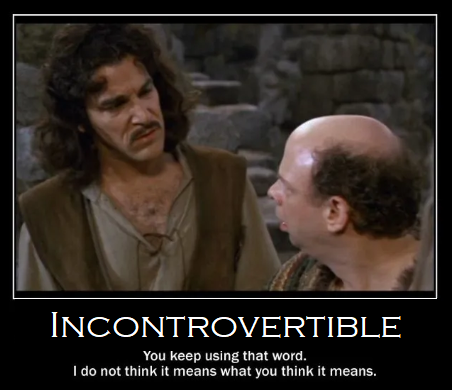
Well, I got a new challenge from a God-denier, who made the claim that evolution can even explain the origin of human brains. This particular God-denier didn’t just say that evolution can explain human brains, she claimed “There is incontrovertible evidence for evolution of the brain“. “iNconTroVerTible”. I’m reminded of The Princess Bide when Inigo Montoya says to the Sicilian “You keep using that word. I don’t think it means what you think it means.”
She provided a link to Wikipedia as the source of this “incontrovertible” evidence. I pushed back asking if she wanted to use a crowd-sourced blog as her “incontrovertible evidence”, but she assured me that it’s impossible to refute. Thinking she could bluster her way through a conversation without me being skeptical of her source, she left it out there as though the matter was settled that evolution can explain human brains. But I don’t surrender to bluster so easily. Let’s analyze her claim to see if Wikipedia, is relying on evidence or assumptions
Here’s how this works: I will post the quotes from the article in red and then just below the quote, I’ll post my analysis in the default black font. I have bolded key words throughout, so the bold does not appear in the original work. Throughout, you’ll notice that instead of actual evidence, the author(s) of the article relies on assumptions. Let’s get started:
This approach (endocasts), however, is limited in regard to what information can be gathered
It looks like the gaps in available information that can be gathered has been filled with assumptions of evolution’s power.
While endocasts are extremely helpful in revealing superficial brain anatomy, they cannot reveal brain structure, particularly of deeper brain areas.
Since the only thing these endocasts can show is size, we must again reject this quote as incontrovertible evidence. It is simply an assumption. Since their endocast model can only determine skull capacity, are we now to conclude that they believe that larger adults are smarter than smaller adults?
The evolutionary history of the human brain shows primarily a gradually bigger brain relative to body size during the evolutionary path from early primates to hominins and finally to Homo sapiens
Also assumed (but not proven) is the mantra that early primates evolved into humans. I do not grant this assumption upon which they rely for their story to be true. How can it be incontrovertible evidence if their premises are packed full of unproven assumptions?
This can be visualized
They mean imagined. Next they try to escape the problem imposed by the assumption that brain size related to increased intelligence due to the politically incorrect nature of the assumption
Consequently, the authors argue that the notion of an increase in brain size being related to advances in cogntion (sp) needs to be re-thought in light of global variation in brain size, as the brains of many modern humans with normal cogntive (sp) capacities are only 400g/ml larger than chimpanzees
Notice how since the actual evidence of the brains themselves were not preserved in fossils. Those who assume that evolution can “incontrovertibly” produce human brains are (like the empty skulls of the fossils) devoid of actual evidence.
It is also important to note that the measure of brain mass or volume, seen as cranial capacity, or even relative brain size, which is brain mass that is expressed as a percentage of body mass, are not a measure of intelligence, use, or function of regions of the brain.Total neurons, however, also do not indicate a higher ranking in cognitive abilities. Elephants have a higher number of total neurons (257 billion) compared to humans (100 billion). Relative brain size, overall mass, and total number of neurons are only a few metrics that help scientists follow the evolutionary trend of increased brain to body ratio through the hominin phylogeny
They consider it important to note that neither higher capacity of brain size nor total number of neurons increase cognitive abilities. So why do they assume that the fossil skulls contained brains with less intelligence/cognition than current brains? The evidence is missing…all that’s left is assumptions
Their findings imply…It also suggests…What is the least controversial is
The last paragraph in that section includes the 3 phrases from above. None of those sound like “incontrovertible” evidence to me. It sounds like they are having to assume some things, infer some things and suggest some things…but where’s the evidence itself?
The more convoluted the surface of the brain is, the greater the surface area of the cortex which allows for an expansion of cortex. It is the most evolutionarily advanced part of the brain. Greater surface area of the brain is linked to higher intelligence as is the thicker cortex but there is an inverse relationship—the thicker the cortex, the more difficult it is for it to fold. In adult humans, thicker cerebral cortex has been linked to higher intelligence
Again, those paying attention will see that the very substance that they need to verify their claim of evolution creating the brain: brain surface, cortex, thicker cortex ARE ALL COMPLETELY MISSING. From the start Wikipedia authors admit that the brain is not preserved in the fossils, so the very evidence in question is missing! It’s not just that this Wikipedia article is NOT incontrovertible, it’s laughably impotent to explain the evolution of human brains at all
If they actually wanted to show how evolution was able to produce human brains, they would have to have brains of creatures that they can PROVE are indeed ancestors of humans and show that natural selection acting on random mutations produced human brains. This Wikipedia article did not do any of that. It was empty speculation
If anyone would like to read an account of the fossils without the Darwinian infection, read Sanford’s Contested Bones and Lubenow’s Bones of Contention
God created mankind in his image. God’s Word is clear and we can trust that revelation, so evolution is false. When Adam sinned, his descendants and all of creation fell under the curse of sin: death, suffering, and thorns. As was promised in Genesis 3:15, God the Son (Jesus) became incarnate as a descendant of Adam and (where Adam failed) Jesus perfectly kept the law. Jesus gave his life to pay for the sins (by taking upon Himself all the curses of sin: death, suffering, thorns) of all those who would turn from their sin and humbly submit to the authority of Jesus.
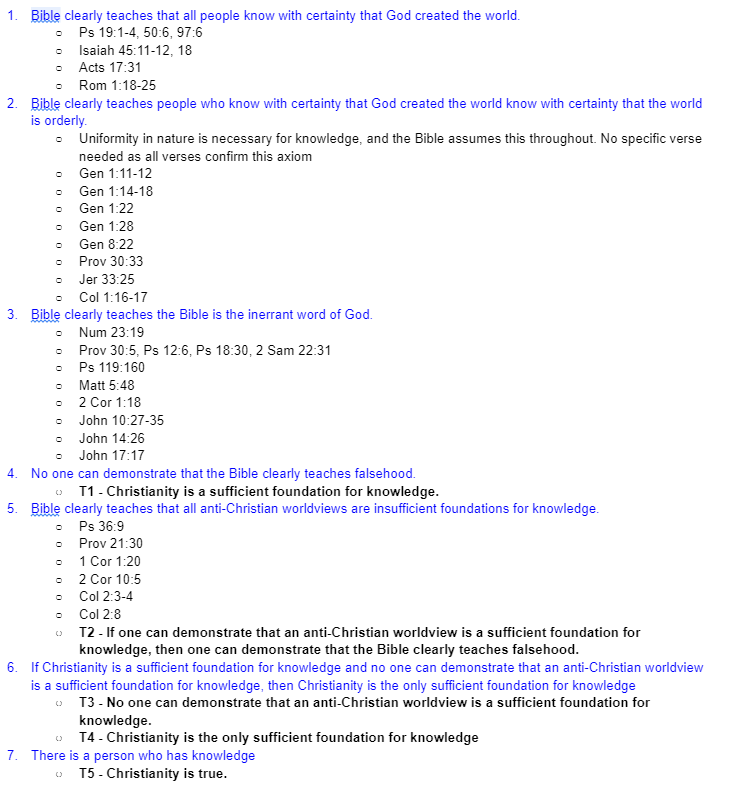
Deductive proof? That sounds pretty strong. There are dozens of arguments for the truth of Christianity. My friends at Theologetics have We already know that revelation from God is irrefutable. And we know that all evidence corroborates what God has revealed, but a deductive proof for Christianity might be seen by some to be beyond the ability of Christians to declare.
First, let’s start with some definitions. What is deductive reasoning?
Deductive reasoning does not rely on generalizations as opposed to Inductive reasoning, which can only present a probable conclusion based on the particular evidence given. Deductive reasoning gives an argument that provides a conclusion that is certain if the premises are valid and true.
Eli Ayala recently hosted Jon Kaus from Christ Church Twin Cities on his YouTube channel and Jon Kaus briefly explained his work on the deductive proof of Christianity in part 1 and part 2. After watching this video, I searched out Jon Kaus’s videos on his Christ Church Twin Cities website. I was able to find where Kaus presented his arguments in 8 conference sessions with affiliated slideshows. These slideshows are available as links on the respective YouTube videos in the link below
Based on Mr. Kaus’s work, his slideshows, and presentations, here is an organized representation of the axioms, theorems, and conclusion.
Most (if not all) of the work that Kaus has done is based on the work of Cornelius Van Til and Greg Bahnsen. It has been an awesome experience learning what Kaus has been able to put together and I hope you too enjoy this fantastic work
It’s a fairly common online assertion that the Bible is “fuLL oF cOnTraDicTioNs!” by those who are unfamiliar with the common mistakes that skeptics make when they make such claims. In a recent online discussion, a God-denier claimed that that Bible was full of contradictions. The principle assertion of contradiction was that Elijah ascended into Heaven (2 Kings 2:11) but Jesus claimed in John 3:13 that no one but the Son has ever ascended into Heaven
Before I begin the rebuttal, let the reader understand that God-deniers have no grounds for declaring anything to be contradictory. Unless one starts with the God, who has revealed Himself in creation, in the Bible, and in the incarnation, there is no possible justification for logic, knowledge, morality, or truth. So, when a God-denier (like AmputeeAtheist) claims that the Bible contains contradictions, he has no logical or knowledgeable grounding from which to determine anything to be contradictory. From the perspective of the God-denier, there is only chaotic matter. As the imminent naturalist Carl Sagan religiously stated: “The cosmos is all there is, or was or ever will be.” There is no room in the worldview of the naturalist for unchanging abstract absolutes like laws of logic or induction. Lastly, before I refute this critic, AmputeeAtheist has NOT demonstrated conclusively that this is even a contradiction. He has taken only a paper-thin glance at the words (likely from an atheist meme online) and declared lazily that it ‘jUsT hAs tO bE a cOntraDictiOn”. For it to actually be a contradiction, no possible explanation can exist (which I will show below), and AmputeeAtheist has failed to demonstrate that there is no possible resolution. The unjustified assertion that “there is a contradiction” is echo chamber material suitable only for the “atheist choir”.
Let’s see what Jesus said in John 3:13
And no man hath ascended up to heaven, but he that came down from heaven, even the Son of man which is in heaven
Is Jesus saying that no one has ever gone to Heaven? Would Jesus have been familiar with the 2 Kings passage that describes how Elijah was whisked off to Heaven in a chariot? Of course! So, why would Jesus make the claim that none have ascended into heaven?
To answer this, we must 1st look at the scriptures (the Old Testament) to see what Jesus was actually saying. Since the New testament is essentially the inspired commentary & fulfillment of what was revealed in the old testament, we should exegete (study the scripture) to see what Jesus might have meant when He said “ascend”.
Throughout the old testament, there is a theme that those, who met with God or interacted with God, did so on the mountaintops. This is important because man was incapable of getting to the “heavens” where God was. The understanding is that God must, in his grace, come down to meet mankind because man is unable to get to Him
Gen 8:18-22 When the ark landed on the mountains of Ararat, Noah built an altar to the LORD. Noah could worship the Lord, but despite the fact that Noah was at the highest point, he could not ascend to heaven
Gen 11 Shortly after the flood, the people intended to build a tower to the Heavens so that instead of proclaiming the Name of God as image bearers, they wanted to make a name for themselves as gods. The people at the tower of Babel failed to ascend to the presence of God.
Gen 22 God told Abraham to ascend Mount Moriah to sacrifice Isaac there. At the top of that mountain, God intervened and provided a substitute atonement for Abraham and his son. Abraham ascended as high as he could, but God had to descend from Heaven to meet with Abraham
There are 149 places in the ESV of the use of the phrase “high places”. Even the pagan worshippers, who setup their idols put them on the mountains or high places as a failed attempt to ascend to the Heavens or ascend to their false deity
Exodus 3 – Moses was tending his sheep on Mount Horeb and this is where God descended to meet with Moses. Moses could not ascend to Heaven. God had to come down to meet with Moses
Exodus 19 – Moses ascends Mount Sinai to meet with God, but since Moses cannot ascend into Heaven into the presence of God, God says in verse 9 “I am going to come to you” at the highest point you can possibly reach, which is far short of ascending to Heaven.
Exodus 34 – This theme is repeated but stated more clearly.in verse 2 God tells Moses to “come up on Mount Sinai” and in verse 5 it says “the LORD came down”. No one (including Moses) can ascend to Heaven in their own power.
Secondly and more importantly, let’s look to see in what context Jesus was speaking these words to Nicodemus. In the interaction Jesus has just scolded Nicodemus that as Israel’s presumed teacher, Nicodemus (while knowledgeable of the scriptures) does not understand them
Jesus answered him, “Are you the teacher of Israel and yet you do not understand these things? Truly, truly, I say to you, we speak of what we know, and bear witness to what we have seen, but you do not receive our testimony. If I have told you earthly things and you do not believe, how can you believe if I tell you heavenly things? No one has ascended into heaven except he who descended from heaven, the Son of Man.
John 3:10-13
Jesus is taking from Proverbs 30, which is a lament by the author in his realization that rejecting the understanding/knowledge/wisdom of God is stupid. Jesus is equating the author of Proverbs 30 with Israel’s teachers of the law in general and Nicodemus specifically.
Surely I am too stupid to be a man. I have not the understanding of a man. I have not learned wisdom, nor have I knowledge of the Holy One. Who has ascended to heaven and come down? Who has gathered the wind in his fists? Who has wrapped up the waters in a garment? Who has established all the ends of the earth? What is his name, and what is his son’s name? Surely you know!
Proverbs 30:2-4
The author continues saying that there is no who who can ascend into heaven to learn from God and return to teach the people about God. But in John 3, Jesus claims to ACTUALLY be the One, who has done this. Jesus has been in the presence of the Father, and He has both descended and ascended to the Father to bring both knowledge and forgiveness to mankind. Unlike what the skeptic has learned from atheist memes, Jesus is not claiming that no one has ever gone to Heaven. Jesus is displaying his rightful divinity and exposing, that despite their rote memorization of the law/prophets, the supposed teachers of Israel are unlearned (stupid) about God.
Nicodemus would also have recognized from Jesus’s words the passage in Deuteronomy 30 where Moses writes
“For this commandment that I command you today is not too hard for you, neither is it far off. It is not in heaven, that you should say, ‘Who will ascend to heaven for us and bring it to us, that we may hear it and do it?‘ Neither is it beyond the sea, that you should say, ‘Who will go over the sea for us and bring it to us, that we may hear it and do it?’ But the word is very near you. It is in your mouth and in your heart, so that you can do it.
Deuteronomy 30:11-14
For those, whom the LORD has called and empowered, the commands of God are expectations. To follow those commands, one need not perform the impossible tasks of “ascend to heaven” or swim “beyond the sea” to obey. And yet, when Israel (and ultimately all of mankind) do fail to keep God’s commands, Jesus is faithful to perform the impossible Himself: bring the knowledge of God from Heaven down to mankind and atone for man’s disobedience.
Jesus does not stray from his consistent train of thought in John 6 verses 38, 42-44 and 62-63
For I have come down from heaven, not to do my own will but the will of him who sent me…So the Jews grumbled about him, because he said, “I am the bread that came down from heaven.” They said, “Is not this Jesus, the son of Joseph, whose father and mother we know? How does he now say, ‘I have come down from heaven’?” Jesus answered them, “Do not grumble among yourselves. No one can come to me unless the Father who sent me draws him. And I will raise him up on the last day…Then what if you were to see the Son of Man ascending to where he was before? It is the Spirit who gives life; the flesh is no help at all. The words that I have spoken to you are spirit and life.
John 6
Jesus did not claim that no one has ever died and gone to Heaven. Considering Jesus knowledge of the scriptures, the context of his teaching, and the audience, it is clear that Jesus was identifying Himself as God, who has been in the presence of the Father, but has descended to mankind to bring knowledge and redemption.
We also see from Jesus’s disciples that they understood Jesus to be talking about Himself as descending from Heaven. John the Baptist says in John 3:31
He (Jesus) who comes from above is above all. He who is of the earth belongs to the earth and speaks an earthly way. He (Jesus) who comes from heaven is above all. He bears witness to what He has seen and heard, yet no one receives his testimony. Whoever receives his testimony sets his seal to this, that God is true.
John 3:31-33
And Paul in Rom 10 and I Cor 15
But the righteousness based on faith says, “Do not say in your heart, ‘who will ascend into heaven?'” (that is, to bring Christ down) “or ‘who will descend into the abyss?'” (that is, to bring Christ up from the dead).
The first man (Adam) was from the earth, a man of dust; the second man (Jesus) is from heaven.
And while Paul did not specifically use the words ascend or descend in Philippians 2, it is clear that Jesus came from the presence of the Father in Heaven to descend to earth
Have this mind among yourselves, which is yours in Christ Jesus, who, though he was in the form of God, did not count equality with God a thing to be grasped, but emptied himself, by taking the form of a servant, being born in the likeness of men. And being found in human form, he humbled himself by becoming obedient to the point of death, even death on a cross
Philippians 2:5-8
There are no contradictions in the Bible. Although the God-denier was lazy and ignorant of the scriptures in making the claim that Jesus contradicted the scriptures with his words in John 3, with an understanding of the context, we see that it is silly to make such a claim. If you’re interested in more articles like this, check out the ever-growing list of refuted claims-of-contradiction by the author of Domain for Truth!
Because God, who knows everything and is eternally faithful, can be trusted in his revelation about the past, we can trust His revelation about our future
How do you answer the exvangelical or God-denier or self-proclaimed atheist who says,
Go read Mark 16:18 and then drink up or shutup!
Let’s look at the words of Jesus recorded in Mark 16 and see if we can provide an apologetic answer
And he said to them, “Go into all the world and proclaim the gospel to the whole creation. Whoever believes and is baptized will be saved, but whoever does not believe will be condemned. And these signs will accompany those who believe: in my name they will cast out demons; they will speak in new tongues; they will pick up serpents with their hands; and if they drink any deadly poison, it will not hurt them; they will lay their hands on the sick, and they will recover.”
This sounds like an example of an internal critique. If the Christian is truly convinced that they are a follower of Jesus (so the skeptic would challenge), then the signs spoken of above will be exhibited in their life. Should a Christian immediately go out, find some serpents and slurp up some venom? Mmmm – No. Here are a few tips for how to respond to our skeptic friends.
When faced with a similar temptation from Satan, Our Lord responded with scripture. Flip over just a few pages to the right in your Bible, to find the history of Jesus’s temptation as recorded in Luke 4. Starting in verse 9 “And he took him to Jerusalem and set him on the pinnacle of the temple and said to him, “If you are the Son of God, throw yourself down from here, for it is written, “‘He will command his angels concerning you, to guard you,’ and “‘On their hands they will bear you up, lest you strike your foot against a stone.'” And Jesus answered him, “It is said, ‘You shall not put the Lord your God to the test.'” So, the first of our possible responses is that we are not to put God to the test. Jesus, in the face of the same temptation as our skeptic friend (although He also had the assurance of God’s protection), did not yield to the whims of Satan and his petty temptation. In like manner, let the skeptic know that as a follower of the Way, you will act as Jesus did in the same situation
We see from Mark that remaining healthy after drinking deadly poison as a possible “sign”. But not every Christian is associated with every sign in the Bible. Acts 2:3, Acts 5:12, 2 Cor 12:12, I Cor 12:4, Acts 9:6 are all examples of signs that have accompanied some believers. Not every believer casts out demons. Not every believer has spoken in tongues. Not every believer has the gift of healing, so in logical progression, we can can say that not every believer will survive drinking serpent venom. From the context and from the rest of scripture, we see that this sign is not intended as some sort of entry exam or comprehensive conditional test. It was in fact recorded several times that not every disciple was exhibiting every sign but was still a faithful disciple of the Eternal Monarch (Mark 9:28, Mark 14:66-72). Not every Christian has every gift, so it’s a false expectation for someone to say that “if you don’t survive drinking venom, then you are not a Christian.” It’s a false expectation
We have indisputable proof that the poison of a deadly serpent did not harm the Apostle Paul as recorded in Acts 28. So shocked were the onlookers that they recognized the divine protection afforded to Paul. So, God remained faithful to his Word in protecting Paul for the glory of God. It does not logically follow, however that EVERY instance of encounters with asps by Christians will be health in this life
From Genesis to Revelation we see the serpent as the enemy of God and his people both literally and figuratively. Because of what Jesus has done, the works of the devil are both destroyed in this life and in eternity. Either way, the Christian need not fear the works of the devil (Matthew 10:26-31)
Lastly, all modern translations note that Mark 16:9-20 is not found in the earliest or most reliable manuscripts from which the book of Mark has been translated. Scholars have debated the reasons as to why this segment of scripture does not have the same kinds of support as the rest of scripture. You can hear some of the information in this video.
We can see, that this challenge from the skeptic is not a proper internal critique. Whereas a proper internal critique would take into account the other assumptions of the Christian from above. So, there’s no need to wilt or despair should you encounter the “venom” of the skeptic. God is faithful and we can trust his eternal Word
As you will see the most important issue of the internal debate among Christians about the “age of the earth” is Authority. Old earthers choose to elevate the modern academic paradigm over scripture, so they are willing to redefine the words, phrases, and ideas revealed in scripture to accommodate what modern academics think about observations. However biblical creationists elevate God’s revelation in scripture as the ultimate authority, and we interpret observations based on what God revealed in his word.
One of the things I wanted to do in the interview but forgot is to mention the importance of framing the debate. Too often the debate of the age of the earth is portrayed as science vs. religion. This is NOT the case. It is interpretations of observations vs. God’s revealed Word. So, as Christians when talking about this topic, be sure that the words we use are clear to the topic. It is the Modern Academic Paradigm vs. God’s Revelation
Enjoy the interview linked below. Hint: Watch the video on 1.5X speed and then my pauses do not sound so bad 🙂
Dr. Ross sent me his book almost a year ago and I finished reading it and annotating it within a few months. So, as I have gone back and read through the chapter again for the book review, I am not really finding anything new. From beginning to end, I have found that Dr. Ross although he claims that the Bible is his highest authority, he sees the modern academic paradigm as the highest interpretive authority and conforms his reading of the Bible to accommodate it.
In his personal testimony, we see evidence of this
I did not converse with a Christian about spiritual matters until I was 27. Studies in science consumed all my time and eventually convinced me, at age 15 that a transcendent God must exist. At the time, I doubted that a God who created a hundred billion trillion stars would care much about frail humans on an insignificant planet…In my first reading of Genesis 1, I saw indications that the creation days were long periods of time
If you teach people that the universe is billions of years old, by the time they are almost 30 years old (as Ross admits that he was) and have been indoctrinated by this mantra, they will try to fit everything they see into that worldview…including the Bible.
These are the parts of the text that Dr. Ross felt there was plasticity which would allow him to redefine the scriptures to accommodate the modern academic paradigm
The timing of Eve’s creation
He does not explain specifically here why he thinks this allows for creation days to be very long periods, but we can infer from a paragraph on the previous page why he thinks this is plausible. “Eve was created on the same day as Adam (the sixth) but not until after Adam took care of several large tasks.”
This sounds like the easily refuted argument that he used from chapter 7, when he claimed that Adam had four careers so the text could not possibly have been talking about a single day. His personal incredulity and injection of outside influence completely discounts Ross’s wild claim
The lack of an evening and morning for the seventh day
Clearly, Dr. Ross sees the importance of the evening/morning pattern when God revealed his creative works for 85% of the creation week. What’s not clear is why Dr. Ross takes the single example of missing morning/evening pattern and creates a rule for it. Dr. Ross’s shallow reading of the text ignores the deeper context and exegesis of Exodus 20 when the days are clearly defined with unmistakable 24 hour boundaries.
The Genesis 2:4 usage of the word “day” in reference to the entire creation week
So, at best, Ross can only say that the Hebrew word for day (yom) can have the colloquial understanding of a week of time…not the billions and billions and billions of years necessary to accommodate the modern academic paradigm. Biblical creationists agree that there is flexibility in the Hebrew word ‘yom’, but exegetically, it must fit the context, and in the context of Genesis 1, we can easily conclude from the text that it is signifying days as we know them today (24 hours).
I was especially intrigued by God’s creation hiatus following the six prolific creation periods.
We should all be intrigued by God’s creation hiatus, but it would be wildly bizarre to assume there were suddenly billions of years injected into the text from that thought
Finally, here was an explanation for the fossil record enigma
There are three things to keep in mind when interpreting scripture: context, context and context. When we view the scripture in context there was unquestionably a global flood that adequately (and more correctly) explains the fossil record…so the enigma is for the old earthist, who must redefine a world-consuming flood to mean a minor middle eastern rain storm and then create epicycles to explain both the text and modern observations
Dr. Ross continues at the bottom of pg242 and top of pg243 with the strange explanation for what it means to love the LORD with all of your mind
Loving God with “all your mind” means looking beyond the most simplistic interpretation of a given text, especially if that interpretation leads to complications and convolutions of other texts…Yet, ironically, a 24-hour creation day interpretation of Genesis 1 (and 2) complicates and convolutes at least aspects of God’s creation story – the sequence of events, the meaning of Adam’s work and words, and the speed of biological development.
Speaking of irony-> Just above Dr. Ross admitted that after almost 30 years of indoctrination in the modern academic paradigm, on his 1st reading of Genesis, his simplistic interpretation was that God created over billions of years…just as he’d been taught his whole life. So, clearly he’s only against OTHER people’s simplistic interpretation of Genesis 1.
Regarding his claim that the biblical creationist’s interpretation of Genesis 1 complicates and convolutes the aspects of the creation story, Dr. Ross AGAIN upholds the modern academic paradigm and demands that the Bible’s reading be conformed to those assumptions.
And as was shown in Chapter 4 and chapter 5 reviews when Dr. Ross attempted to claim that ALL of church history believed in old earthism, he was WRONG. Old earthism is a modern concoction that attempts to dissolve the modern academic paradigm into biblical interpretation, but as we see, they are like oil and water with no ability to mix.
On p244 Ross asks the question
How Did Adam Do So Much?…Similarly, for Adam to have named all of Eden’s animals within a few hours would seem to shrink not just the size but also the bounty of Eden…species
While I already covered Ross’s misunderstanding of scripture in my review of chapter 7, it doesn’t hurt to quickly address his repeated conflation of species and kinds. Kinds ≠ Species. The biblical kind is defined in Genesis 1 simply denoted a creature’s ability to reproduce at the time of creation. Since there have been many mutations, many creatures that were formerly able to reproduce lost the ability to reproduce. This does not mean they were not originally created as the same kind. But what this means is that Kind is more synonymous with the modern scientific distinction of family.
This means that Adam did not have to name millions of species as is claimed by Ross. Adam could have take care of his divinely-appointed job of naming the animals much more quickly by naming animals in groups
At the bottom of p244 Dr. Ross says
Young-earth creationists see as the futility of attempting to integrate Genesis with the scientific paradigm arises from a subtle error in applying a basic interpretive principle “Begin by establishing [not assuming] the point of view.” The result is a scientifically implausible order of creation events”
A few of things with this quote. Dr. Ross projects his own shortcomings in interpretation onto biblical creationists. Firstly, He conflates science with the modern academic paradigm as he has done throughout his book. Young earth creationists have no interest in trying to integrate Genesis with the modern academic paradigm. The observations of today are completely in accord with what we read in scripture. It is the old earthers like Ross, who have undertaken the mission of trying to integrate the modern academic paradigm with scripture. Secondly, the error is on the side of old earthers, who inject their assumptions from the modern academic paradigm into their biblical interpretation. Biblical creationists rather start with the basic interpretive principle that what God revealed in his word is true, so what we observe today is in accord with what He revealed in the Bible. Regarding his quote about the implausible order of creation events, you can see that Ross rejects the order of creation events that God revealed in scripture in order to accommodate naturalist assumptions.
On pg247-248 Ross unsuccessfully attempts to push the inconsistencies of his biblical interpretations with the observations onto biblical creationists.
A few purported conflicts between the Bible [old earth interpretations] and the fossil record have arisen…
The conflicts arise only for the old earther since the catastrophic worldwide flood is the only sufficient explanation for the observations. For the old earther, it is assumed that fossils were buried in the order that the soil-of-the-time was exposed as the top soil and that there were epochs when certain creatures did not exist. Dr Ross believes this imperative, but there are out-of-place (for the old earther) fossils that are discordant with those assumptions.
Genesis 1 gives the order of God’s creative works, but in both Dr. Ross’s posted timeline, which he posted years ago and on p249 we can see that Dr. Ross tries very hard to inject the modern academic paradigm into scripture
There are several problems with his chart, but I want to point out a particularly grievous problem in rows 9 and 10. Ross tells us that God’s last creative work was Adam and Eve, but just prior in row 9, Ross tells us that the Australian aboriginals emerged prior to Adam and Eve. This is both a terrible assumption and racist. Now, I do not believe Ross is a racist, but his views of the modern academic paradigm as an authority over scripture has resulted in a view that has racist implications.
As biblical creationists, we can praise God for the consistent nature of his revelation. We do not have to redefine the words in the Bible to accommodate modern academic paradigms or cultural changes in sexuality or political revolutions as we have seen Dr. Ross do. God’s Word is eternal and we can trust God to keep his word regarding the future since we can trust his revelation from the past.
This week I saw in my Twitter feed this claim from an atheist
Presuppositional Apologetics is conversational violence
Some of the subsequent discussion helped me to see that most people, like this skeptic, do not understand what the term means. Many people think it means one of the following
I’m right, you’re wrong, that’s the end of it
I have blind faith in the deity of my family/culture/choice so I’m right
I don’t have any evidence, so I just assume God
This leads many skeptics to wrongly think they have defeated a presuppositional argument with the following fallacies
“You have faith in your sky-daddy, but I have evidence”
“Your blind faith is simply a result of you being born into a Christian family in America. If you were born in India, you’d be a Hindu”
“You have no evidence, so you have to resort to word games”
“Presup (presuppositional apologetics) is conversational violence”
“I assume FSM/Sasqatch/Allah is the true god, so that has as much validity as your biblegod.”
“That’s just word salad. It doesn’t mean anything.”
Definitions – The Place to Start
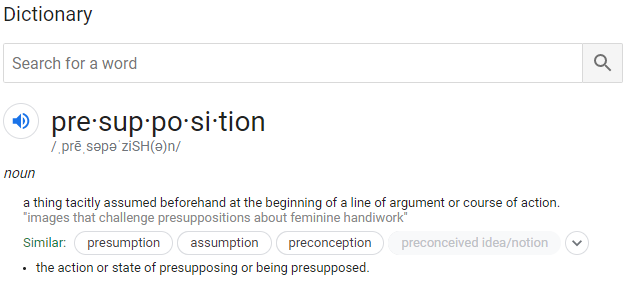
Those are misconceptions that I’d like to try to clear up in this blog post. Let’s start as basic as we can. What is a presupposition? The Google dictionary says it is
a thing tacitly assumed beforehand at the beginning of a line of argument or course of action.
Where did I come from? What is the origin of the universe/earth/life?
Where are we headed? What does the future hold?
What is my purpose?
How should I behave? What is moral? Is justice/forgiveness possible?
How do I know things (epistemology)? What is truth?
We’ll answer these below in analyzing worldview.
What is apologetics?
reasoned arguments or writings in justification of something, typically a theory or religious doctrine
Christians start with the presupposition that there is no higher authority than the One, who knows everything & is eternally faithful, and his revelation in creation, in the Bible, and through the incarnation cannot fail to be wrong. Therefore presuppositional apologetics is
The defense of the truth of Christianity, by analyzing the assumptions of those who would challenge it from a precarious foundation that cannot sufficiently justify the tools (logic, induction, morality) necessary to make a rational objection
Presuppositional apologetics is distinct from other main types of apologetics like
Classical apologetics – Using philosophical arguments like the cosmological and teleological arguments to prove the existence of God.
While these methods of apologetics have value to Christians to edify and build up the church, they are not as effective as tools for persuading the skeptic for the 4 reasons shown below. To be clear, there is overwhelming evidence and philosophical corroboration for the truth of God’s revelation, but since God is the Source of truth, no evidence or philosophical authority can refute or be the substantiation for God. God and his revelation are the ultimate authority.
Someone, like me, who thinks presuppositional apologetics gets to the heart of the issue quickly, will not present classical or evidential arguments to a skeptic because
Everyone interprets evidence according to their worldview. So, it is a futile effort to throw evidence back and forth because in an argument since everyone has access to the same evidence. All evidence proves God
We have all been infected by the curse of sin. Even a person’s reasoning is corrupt
God is the ultimate authority. There is no higher authority by which to confirm/refute what He has chosen to reveal.
The skeptic is not the judge of what’s true or false. God is the judge, and presenting evidence to the skeptic makes him/her the judge of whether they think the evidence is sufficient to convince them. This puts the sinner in the judge’s box and God in the place of the defendant.
Everyone has presuppositions. The Christian presuppositions are shown above. The skeptic presupposes that “the cosmos is all there is, ever was or ever will be.” The skeptic is bound by particles
Worldview Test – Presuppositional Scrutiny
So, rather than comparing one’s interpretations of evidences (as an evidential apologist would do), it is more incisive to compare presuppositions/worldviews. A worldview should be both internally consistent and externally consistent. When I say internally consistent, I mean that it should not contain contradictions in trying to provide rational answers to the worldview questions. For example, if someone claims that the flying spaghetti monster is the creator of all things, but then realizes that Sicilians invented spaghetti in about the 12th century, there is an internal contradiction. They cannot both be true because the FSM is made of matter and is supposed to be the source of matter. Internal contradiction. Being externally consistent would mean that the worldview has to account for all of the reality.
Secondly, when looking to test presuppositions, one should look for arbitrariness. Is a claim within a worldview arbitrary? For example, secular humanists claim that morals should be defined by empathy (To be clear, empathy is a good thing and should be considered. Christians can justify empathy by referring to Matt 22:39 2nd greatest commandment.) But considering their worldview, which says that humans are simply accidental aggregations of stardust in a blind pitiless indifferent cosmos, why did they arbitrarily choose empathy as a standard for morality? It is arbitrary, because they could have chosen setting morality to the strongest or smartest or prettiest or cleanest or tallest or fastest…Arbitrary.
When doing presuppositional analysis, test each claim for consistency and arbitrariness.
Testing the Presuppositions of Naturalism
Where did I come from? – The cosmos is all that is or was or ever will be. The belief is that at the big bang all matter sprang forth and over billions of years dust coalesced to produce stars, galaxies, planets, life, and humans. It is inconsistent to claim that particles can produce consciousness, justice, logic, math, beauty…
Where are we headed? – Ultimately, there is just death and collapse of the cosmos through entropy. If human life is simply the brief interruption of non-consciousness in a universe bound for frozen emptiness, there is no hope. It is inconsistent for the naturalist to assume hope or justice.
What is my purpose? – Richard Dawkins says “There is at bottom no design, no purpose, no good no evil just blind pitiless indifference.” There is no purpose in the cosmos. There are internal contradictions here because people act with purpose. People strive to achieve purpose, but since the cosmos cannot provide purpose, it is a quixotic quest to conjure up purpose.
How should I behave? What is moral? – Everyone recognizes morality, but in a cosmos made only of particles, it is arbitrary and inconsistent to claim that some behaviors are good and others bad. At end, the naturalist can claim only to prefer one set of behaviors to another since there are no binding morals.
How can I know what is true? – For the naturalist, all “knowledge” is provisional. At any moment the current learned paradigm can be replaced by new findings, so there is no path to certainty. A person’s senses and reasoning can only be validated by a person’s senses and reasoning, which is viciously circular. There is also no valid reason to trust one’s senses and reasoning to provide truth since according to naturalism, senses and reasoning were produced by accidental natural forces for survival. It is an internal contradiction then to expect survival tools to provide truth. This does NOT mean that naturalists cannot know things. They do know things, but they cannot justify that knowledge. Because of their epistemic assumptions, their attempt to justify knowledge will eventually be impaled on one of the prongs of the Münchhausen trilemma.
Building a Positive Case for Christian Presuppositions
Where did I come from? – Genesis 1 explains the origins of the universe and humanity
Where are we headed? – Because of sin and because of what God revealed about the punishment of sin, those who do not repent of their sin and humbly submit to the authority of Jesus will face condemnation. But those who repent will be resurrected to abundant life
What is truth? – Truth is what conforms to the mind of God
How should I behave? – According to God’s morals. Because humans have been created in God’s image, we should reflect his character. When we fail to accurately represent God, there is punishment. But God, who is rich in mercy, has made a way to find forgiveness and abundant life through turning away from sin and trusting Jesus, who died and defeated death on our behalf.
How can we know the truth? Because God (who knows everything and is eternally faithful) has revealed some things so that we can know them for certain, knowledge is possible. He has revealed Himself in creation, in the Bible, and by the incarnation. These revelations are interdependent and self-authenticating.
Jesus is the Creator of all things as attested in the Bible
The Bible claims to be the Word of Almighty God. The prophetic claims in the Bible have come true. The Bible claims that “the fear of the LORD is the beginning of knowledge” and “all the treasures of wisdom and knowledge” are in Christ” and “God is the foundation of wisdom and knowledge”. One does not have to believe the Bible to know things, but because people can know things, we know God’s revelation is true. The Bible is the justification for knowledge.
How can I know what is true? – Christians do not know everything, but we know One, who does know everything. Because the One, who knows everything and is eternally faithful, has revealed some things in his word, we can be certain that those things are true.
The skeptic may not LIKE the Christian presuppositions, but since they provide both internal and external cohesiveness (and Christianity claims exclusivity), it is the only justified source for knowledge, reason, and logic.
Addressing the Claim of Biblical Contradictions
The skeptic many times says, “But the Bible is full of contradictions!” Let’s see if this is true.
As we have already pointed out, the skeptic has no grounds to complain about contradictions because naturalism cannot coherently justify laws of logic the misuse of which produces contradictions. What is a contradiction? Dictionary.com defines it as “assertion of the contrary or opposite, a statement or proposition that contradicts or denies another or itself and is logically incongruous, direct opposition between things compared; inconsistency.”
Most skeptics think that the following is a logical contradiction in the Bible
The skeptic should familiarize himself or herself with the nature of contradictions, and before accusing the Bible of being filled with them, be familiar with the reasons why there are no contradictions in the Bible.
The skeptic can look here for a primer on mistakes they make when claiming contradictions in the Bible
In the conversation that I mentioned at the beginning of this post, the claim was made that presuppositional apologetics is conversational violence. I responded to him with the questions “Why is conversational violence wrong from the atheist perspective? Doesn’t violence help drive conversational evolution, so that only the fittest arguments persist to the next generation?”
Conversational violence would be expected from the naturalist point of view to be a pressure for selection to weed out bad arguments
He responded
You may be onto something here…An evidential apologist is like the soldier, they ostensibly address legitimate topics like providing evidence for their SN claims. A presup has figured out they can’t play on this field so they instead try to frustrate and weaponize fear (shut mouths like Sye, cause confusion with obscure philosophical conundrums…)
It’s not a terrible analogy, but the conclusion is wrong. Let’s continue the analogy. If truth is the ground being fought over and the bullets are arguments, the presup is doing the opposite of creating conversational violence. Presuppositional analysis is a way to disarm the naturalist because all of his “bullets” require the great Designer. The Christian presuppositional apologist is showing the skeptic that by using his “bullets” to form rational arguments, he is confirming that there are unchanging, abstract, absolute standards like laws of logic, truth, morality and induction which only the unchanging transcendent, absolute Eternal Monarch can justify. Naturalism completely fails to provide sufficient justification for the assumptions needed to create arguments.
Presup disarms the skeptic and causes them to be skeptical of their own claims. A Presuppositional apologist should be ready to share the gospel of repentance and submission to the King when the skeptic’s worldview collapses. Preach the word. Read your Bible and believe your Bible so that the Word pours forth in every conversation. Let the Holy Spirit use the preaching of the Word to convict of sin and of the need for forgiveness through Jesus.
Romans 10:17 “Consequently faith comes from hearing and hearing through the word of Christ.”