
Study Your Bible

19-short-attention-span

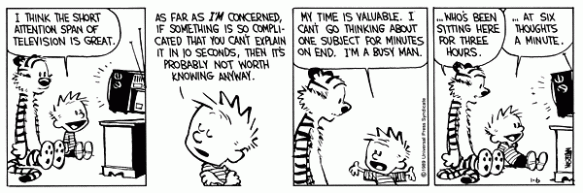
Calvin and Hobbes – Bill Watterson

In a technologically modern world, we have become so accustomed to having things instantaneously. The latest fad is to purchase external Siri, Alexa, Google boxes that answer your voice questions and perform simple online tasks. Today’s window of focus is 140 characters or seven second Vines.

We can be easily tempted to let someone else read, study, pray over, and digest God’s Word – so that they can summarize the message for us. But as a citizen in the eternal Kingdom, don’t let that temptation manifest itself in your life as your primary intake of the Word. Study your Bible. Besides the benefit of enjoying a nourishing time with the Creator and pondering the Words of life, there’s a danger in only letting someone else tell you their thoughts about God’s Word.

In my most previous two posts, I pointed out the exegetical flaws of some men, who have metastasized their peculiar interpretation of scripture. So that they can accommodate their belief in billions of years, they are forced to claim that the flood of Noah’s day was a local flood. It has been shown over and over again how this teaching is false, but in my personal Bible study this week, I came across yet another scripture that refutes their teachings.

Isaiah 54:9 says, “To me this is like the days of Noah, when I swore that the waters of Noah would never again cover the earth. So, now I have sworn not to be angry with you, never to rebuke you again.”

Hugh Ross assumes that Psalm 104:9 is talking ONLY about the creation week, so that the waters of creation could not cover the earth again in Noah’s day. But Isaiah clearly teaches that the waters DID completely cover the earth during Noah’s day, so Ross’s assumption that Psalm 104 is solely about creation week is false.

Another reason why we know that Psalm 104 is not solely about creation week but also includes post-fall timeframe is because of verse 21: “The lions roar for their prey and seek their food from God.”

Genesis 1:30 tells us that carnivorous activity was not part of God’s original creation. “And to all the beasts of the earth and all the birds of the air and all the creatures that move on the ground – everything that has the breath of life in it- I give every green plant for food.”

If lions are stalking prey in the poetry of Psalm 104, then it must be, at the very earliest, after sin’s curse affected the universe, but is even more likely talking about the post flood world in which the author of the Psalm lived.

Studying God’s word for yourself is a blessing in so many ways, not the least of which is being able to identify false teachings.

Since we can trust God about what He has revealed about the past, we can trust Him with our future!


 

Old Earthism Fail – Part 2

Earlier this week I reviewed at debate between Biblical creationists and old earth creationists. I pointed out the clear problem that old earthers have with Bible exegesis.

Today, I want to bring light to a major problem that they continue to propagate. The old earther, Hugh Ross, continues to claim that the Bible teaches that the flood of Noah’s day was a local flood. There are a number of biblical problems with the claim that the flood of Noah’s day was simply a local flood. We’ll discuss a few of them here.

Hugh Ross struggles to make his point using Psalm 104 as his primary text. In fact, the only place in the Bible that he can bend the words to his liking is verse 9 of Psalm 104.

You (God) set a boundary they (the waters) cannot cross; never again will they cover the earth.

This poetic passage includes phrases like:

“O LORD…you are clothed…”
“He wraps Himself in light”
“He stretches out the heavens like a tent”
“He makes the clouds his chariot and rides on the wings of the winds”
“He makes winds his messengers, flames of fire his servants”
“He set the earth on its foundations; it can never be moved”

This passage is clearly a passage of poetry. Why build one’s doctrine on poetry at the expense of historical revelations from God?

So, Ross’s assumption is that the entire passage of Psalm 104 is a commentary about only the creation week, and he claims that (rather than Genesis’ historical account) this poetry is a solid foundation upon which to establish his untenable position. In his belief that the entire Psalm 104 passage is about creation, Ross says that the flood of Noah’s day could not have covered the earth since verse 9 says that the water will never again cover the earth. Since the creation account talks about how the earth was brought forth from water, Ross thinks that his sandy foundation in the Psalms absolves him from proper exegesis. It is important for us as Christians to interpret the Bible according to its genre and within the context of the whole of scripture. I’ll show below how the rest of scripture does not allow a local flood.

For a biblical creationist, the resolution is simple. Psalm 104 is a poetic account of both creation, the flood, and post flood world as a way to bring glory to the Almighty.

So, let’s look at some of the other reasons why the local flood advocated by Ross is contradicted by God’s Word.

  1. At the end of the worldwide flood in Genesis 9:11, God promised to never flood the earth again. His covenant was memorialized with God placing the rainbow in the sky. If Noah’s flood was a local flood, then God would have broken his word by allowing local floods all over the earth.
  2. From Genesis 6:17 – Genesis 7:23 God reveals in his Word 20 superlatives describing his utter destruction of the earth and all air-breathing animals with a flood. The old earthers have got to overcome or dismiss each usage of these 20 superlatives to accommodate their local flood story.
  3. Genesis 7:19 says “They (the waters) rose greatly on the earth, and all the high mountains under the entire heavens were covered.” It cannot be a local flood because all the high mountains under heaven were covered with water.
  4. Genesis 8:4 specifically mentions the mountains of Ararat. Today Ararat measures almost 17,000 feet high. It’s likely that this peak was taller in the past since it has lost height from multiple eruptions. The only mountain specifically mentioned in the Biblical account was Ararat. So, we know that the flood would have had to at least cover this mountain. There is no basin deep enough to contain the amount of water necessary to cover Mt. Ararat. Therefore, the flood of Noah’s day could not be a local flood according to the Bible.
  5. Matthew 24:38-39 are the words of Jesus. “For in the days before the flood, people were eating and drinking, marrying and giving in marriage, up to the day Noah entered the ark, and they knew nothing about what would happen until the flood took them all away.” Another superlative. All were washed away in the flood. Everywhere on earth, all were washed away according to Jesus, and if they are all washed away, it must have been a worldwide flood.
  6. 1 Peter 3:20 Only 8 people in all of the earth were saved from the worldwide flood.
  7. 1 Peter 3:21 The worldwide covering of the earth by water symbolizes baptism. If the flood was a local flood, does baptism just need to be partial covering of water. The symbolism of Jesus’ death (which was complete) and the complete covering of the earth by water, is strongly recognized in the complete submersion by water in baptism.
  8. 2 Peter 2:5 Only 8 people in all of the earth were saved from the worldwide flood.
  9. 2 Peter 3:6 The world was deluged and destroyed. There’s no room here for a local flood.

The old earthers have to dismiss or re-interpret each of these revelations from God in order to make their localized flood fit.

There’s no need to build doctrine on the poetry of Psalm 104 at the expense of the historical account in Genesis as well as the other passages in scripture that clearly teach God’s judgment on the sin of mankind with a worldwide flood.

Thankfully, there is hope. God has a plan of redemption that those who confess their sin and rely on the atoning sacrifice of Jesus will not only be spared from God’s wrath but be joint heirs with Him in the eternal kingdom.

Worldviews Matter

Everyone interprets evidence according to their worldview. If you find evidence that might somehow seem to conflict with reality, one is forced to come up with a rescuing device to protect their worldview. People are usually more concerned with protecting a worldview than knowing the truth.

Here’s an example: Humans were not supposed to have started working with aluminum until about 200 years ago (materialist worldview), so aliens must have visited earth 250,000 years ago (rescuing device).

So, instead of the Biblical worldview, which states that mankind was working with metal just 7 generations after Adam (Genesis 4:22) , someone, who has a naturalistic worldview will need to fabricate stories about aliens bringing complex metal workings from other galaxies as a rescuing device.

Don’t let an atheist tell you that they have evidence and a Christian has only faith. Everyone has the same evidence. We all interpret evidence according to our worldview. Here’s another example:

DNA has verified half-life of 512 years. The extrapolated maximum time that DNA is readable under perfectly preserved conditions is less than 1 million years. So, if DNA is found in a dinosaur bone then there are at least two options when interpreting the evidence.

  1. The creationist says, ‘Since we know how long DNA can last, and we found DNA in dinosaur bones, then the dinosaur bone is MUCH younger than 65 million years. This fits well with a biblical time frame.” The worldview is defined by the Bible.
  2. The atheist says, ‘Since we know dinosaurs lived 65 million years ago, and we found DNA in dinosaur bones, then there must be some unknown mechanism that preserves DNA MUCH longer than we expected.” The worldview is defined by deep time.

Same evidence…but because of different worldviews, then different conclusions are reached.

In the original case above, the atheists use aliens as a rescue device for their worldview since they do not believe the biblical account that humans have been smart from the beginning.

Therefore, evidence alone does not determine truth. One must evaluate the mechanism for interpreting the evidence (worldview) to see if the worldview can withstand scrutiny. The Christian worldview can make sense of

  • Preconditions for intelligibility
  • Universal-unchanging-immaterial laws (laws of logic, physical laws…)
  • Absolute morals
  • Beauty, Truth, Love, Purpose

The atheistic worldview is deficient in its ability to accommodate these self-existent properties.


God’s Existence is Self-Evident

I was recently asked to give the eulogy at my grandmother’s funeral. As I was preparing the words to say, I wanted to speak openly about the importance of worldview questions at at a time when people ask questions about mortality and purpose and afterlife.

IMG_4913


In the past when I have talked about BIG worldview-type questions, I have used these questions:

  • How did we get here?
  • What is the purpose to life?
  • What happens when I die?
  • Is there right and wrong? How can I know right from wrong?
  • Is there a God?

But as I was preparing the eulogy, the last question really stuck in my throat. As I’ve come to understand my Bible better through the teachings of several apologists, it is plain that God’s existence is self-evident. There is no question as to the Creator God’s revelation through nature, his written word, and his Son Jesus.

So, I’ve changed that question to be: Who or what will I worship?

Everyone worships something. People will either worship the Creator God who is worthy of all praise, or they will worship something lesser. These lesser things most often include themselves, but can also include money, security, fame, or something else in creation. To do this, one has to suppress their knowledge of God as revealed in Romans 1:

18 For the wrath of God is revealed from heaven against all ungodliness and wickedness of men who by their wickedness suppress the truth. 19 For what can be known about God is plain to them, because God has shown it to them. 20 Ever since the creation of the world his invisible nature, namely, his eternal power and deity, has been clearly perceived in the things that have been made. So they are without excuse;

There is a danger in not recognizing God as Creator and worshiping him. As Romans 1 continues:

21 for although they knew God they did not honor him as God or give thanks to him, but they became futile in their thinking and their senseless minds were darkened. 22 Claiming to be wise, they became fools, 23 and exchanged the glory of the immortal God for images resembling mortal man or birds or animals or reptiles. 24 Therefore God gave them up in the lusts of their hearts to impurity, to the dishonoring of their bodies among themselves, 25 because they exchanged the truth about God for a lie and worshiped and served the creature rather than the Creator, who is blessed for ever! Amen.

Be thankful to the Creator God and worship him or face the prospect of futile, foolish, and darkened thinking.

The question of God’s existence isn’t in question; just your object of worship.

The Continual Failure of Evolution…

The Grand Theory of Evolution continues to fail as a predictive model when scientists are actually allowed to use data rather than assumptions and extrapolations.

Dennis Venema is professor of biology at Trinity Western University, and he has written some articles that claim evolution to be verified by the data.

Interesting, because when the research is analyzed, what it shows is the exact opposite.

So that you don’t have to read the entire article, here are a few snippets from the researchers:

If the evidence can confirm evolution, then it also can disconfirm evolution.

What does it say? …for it seems that what the science shows is that Venema’s claim, that the genetic evidence confirms evolutionary predictions, is inaccurate.

For starters, phylogenetic incongruence is rampant in evolutionary studies. Genetic sequence data do not fall into the expected evolutionary pattern. Conflicts exist at all levels of the evolutionary tree and throughout both morphological and molecular traits. This paper reports on incongruent gene trees in bats. That is one example of many.

In fact one evolutionist, who has studied thousands of microRNA genes, explained that he has not found “a single example that would support the traditional [evolutionary] tree.” It is, another evolutionist admitted, “a very serious incongruence.”

It is not unusual for similar species to have significant differences in their genome. These results have surprised evolutionists and there does not seem to be any let up as new genomes are deciphered.

The prediction that the mouse and rat genomes would be highly similar made sense according to evolution. But it was dramatically wrong.

In other words, out of the 1,071 trees, there were zero matches. It was “a bit shocking” for evolutionists, as one explained: “We are trying to figure out the phylogenetic relationships of 1.8 million species and can’t even sort out 20 yeast.”

And although evolutionists thought that more data would solve their problems, the opposite has occurred. With the ever increasing volumes of data (particularly molecular data), incongruence between trees “has become pervasive.”

If the pattern fits the evolutionary tree, then it is explained as common evolutionary history. If not, then it is explained as common evolutionary forces.

With all of this contradictory evidence, even evolutionists have realized in recent years that the traditional evolutionary tree model is failing. As one evolutionist explained, “The tree of life is being politely buried.”


So, with all of this contradictory evidence, will people be persuaded to believe in a Creator instead? Probably not. Just more epicycles and sub-hypothesis are created to extend the evolutionary story.

Romans 1 tells us that there is sufficient evidence to believe that the Creator God is evident from what he has created, and there’s enough evidence to pass judgement on the unbeliever.

We can trust God’s Word in what it has revealed about our past, and we can therefore trust Him about our future.

Orion Says “Trust the Bible”

As you look through the pages of the Bible, it is very clear that the universe is not billions of years old. Jesus’ own words in Mark 10:6 says, “At the beginning of creation God made them male and female.”

orion_large-e-mail-view

Orion agrees with Jesus. This short article from the scientists at ICR is worth the read.

Orion is one of the most well-known and easily recognized constellations of the winter sky. The three bright blue stars in Orion’s belt seem to draw our attention instantly.1 Such stars are a strong confirmation of the biblical timescale.

The evidence seems far more consistent with the biblical account—it appears that stars were supernaturally created only thousands of years ago. With blue stars scattered across the cosmos, our universe certainly “looks” young.

Since we can trust God’s Word about history, we can trust Him with our future.

Does Evidence Convince the Non-Believer

I haven’t even finished reading this article yet, but it’s so good that I want to share it on my blog before I forget or something comes up. The writer outlines clearly the point that people interpret evidence according to their worldview, so evidence cannot properly push someone into the Kingdom of God.

People must repent of their sins so that they can see the emptiness of their atheistic worldview. As Romans 1 says, “For the wrath of God is revealed from heaven against all ungodliness and unrighteousness of men, who by their unrighteousness suppress the truth. For what can be known about God is plain to them, because God has shown it to them. For his invisible attributes, namely, his eternal power and divine nature, have been clearly perceived, ever since the creation of the world, in the things that have been made. So they are without excuse.”

There is not enough evidence to convince an atheist that God exists, because they are suppressing this evidence.

There are some big words and complex ideas, but here are a few excerpts that I thought were very good. Still, the whole article is worth the read:

Defending the Christian faith (apologetics) is an injunction that wields a fruitful endeavor. Presuppositional apologetics is a Reformed modus operandi that commences and concludes with God, presupposes the veracity of Scripture, disproves the futility of human contrivance that obstructs truth, and argues that it is inextricable to deny the sensus deitatis (sense of deity) because it is intrinsically recessed internally which leaves everyone without reprieve.

Here’s the quandary: both are given evidence (Scripture), but there are two diametrically opposed conclusions. The affirmations brought into the evidence are their presuppositions. This is the contradistinction between a presuppositional apologist and an atheist: a presuppositional apologist (does not demand evidence for God’s existence) can corroborate their knowledge claims because of revelation from God, while the atheists cannot (demands evidence for God). The former justifies the very concept of evidence, while the latter does not.

This article is not denying evidence as edifying to a Christian. The creation account, the worldwide flood, parting of the Red Sea, and the miracles of Christ: casting out demons, cleansing the lepers, healing a man born blind, healing Peter’s mother in-law, raising the dead, restoring an ear, walking on water, stilling the storm, turning water into wine, feeding thousands and resurrecting gloriously and miraculously are all captivating proofs. Do all of the aforementioned miracles need to be given to a person who demands proof for God’s existence? Absolutely not! According to Thomas Aquinas: “To one who has faith no explanation is necessary. To one without faith no explanation is possible.”

What are the dissimilarities between an atheist and a theist? The atheist cannot account for anything as they appeal to their autonomous reasoning, and seek to justify doing so with their autonomous reasoning. How do they know their reasoning is valid? Apart from revelation, they cannot. A theist (Christian) can account for the laws of logic because of a super naturalistic worldview that is consistent with universal, abstract invariant entities, and is justified by revelation. This is why an atheist has to borrow from the Christian worldview because they are impotent of justifying anything apart from God.

An atheistic worldview cannot account for moral absolutes because they have no justification for absolutes of any kind. Most atheists will say that they are absolutely certain that there is no such thing as absolutes, which is self-refuting babble. Why can’t an atheistic worldview justify moral absolutes? If an atheist denies the existence of God, they lose their appeal to absolute knowledge and nothing could be absolutely morally wrong.

Because we can trust God’s revelation through scripture about the past (and this is corroborated by the evidence we see around us), we can trust God’s revelation about our future. Romans 8

[Rom 8:18-25 ESV] 18 For I consider that the sufferings of this present time are not worth comparing with the glory that is to be revealed to us. 19 For the creation waits with eager longing for the revealing of the sons of God. 20 For the creation was subjected to futility, not willingly, but because of him who subjected it, in hope 21 that the creation itself will be set free from its bondage to corruption and obtain the freedom of the glory of the children of God. 22 For we know that the whole creation has been groaning together in the pains of childbirth until now. 23 And not only the creation, but we ourselves, who have the firstfruits of the Spirit, groan inwardly as we wait eagerly for adoption as sons, the redemption of our bodies. 24 For in this hope we were saved. Now hope that is seen is not hope. For who hopes for what he sees? 25 But if we hope for what we do not see, we wait for it with patience.

Myths About Creationists

I read an article this week about myths regarding Old Earth Creationists. It had some good points, although it still boggles my mind how they can see the clear teaching of scripture and think there’s room for billions of years.

But it motivated me to write a short post on how people believe certain myths about biblical creationists. Only unborn children are treated worse in our culture than those who believe in the validity of the Bible…but a large portion of the mockery is because of misconceptions and strawmen arguments. So, following are the most prominent myths about biblical creationism:

myth-v-truth

  1. Myth 1 – Biblical creationists hate science. Those who would say this are not listening. Biblical creationists love science and learn about the world just like Darwinian scientists. The difference is that the evolutionists would start with the idea that there is no God, and they proceed to interpret evidence with this presupposition. A creationist will interpret evidence with the presupposition that there is a God that has revealed himself throughout history. As we read God’s special revelation in scripture, we see verification of this in the created world around us.
  2. Myth 2 – Biblical creationists are ignorant of or deliberately ignore scientific evidence. This is related to the first myth, but it attributes a little more deviousness or cognitive dissonance onto creationists. It again goes back to one’s starting point. If one starts with the idea that there is no Creator God, then one will assume that everything must be explainable by naturalistic means. But someone who believes there is a God will interpret the same evidence that an evolutionist uses to confirm his worldview, to show that God is indeed active in the physical world. An example of this would be homologous structures in animals. Reptiles (some of them), birds, and mammals have legs, so they must all have come from a common ancestor…right? The evolutionist would answer yes, but a creationist would say that the same evidence leads them to believe that it was a common Designer. Further evidence shows that it would not follow logically to attribute common features to evolution since the same structures (legs in this case) are governed by different sets of genetic code. Were evolution to be true, the same set of genes would control the same feature as shown from the picture below. GeneticHomologyDebunked
  3. Myth 3 – Dinosaurs, fossils, and the geologic column disprove the Bible. This myth is the complete reversal of the truth. If one had never dug into the soil, but had read the Bible through, one would predict that because of a worldwide flood about 4500 years ago, there should be billions of dead things buried in water sorted layers. That is exactly what is found. In fact, those who believe in billions of years are the ones ignoring the evidence (poly-strata fossils, marine fossils on mountaintops, no erosion/bioturbation between layers) left by the flood. As for dinosaurs, there are examples of artwork, sightings, and historical accounts that are evidence showing that mankind has had interactions with dinosaurs in the past…the recent past, because further scientific research shows C14 in dinosaur fossils and short-life DNA and soft tissue in un-fossilized dinosaur bones.
  4. Myth 4 – Biblical creationists care only about Genesis. Genesis is indeed foundational to God’s revelation, but scripture is a cohesive view of God’s redemptive plan throughout history. All throughout scripture we see confirmations of the validity of the Genesis account. Exodus speaks about the seven days of creation in the formation of the Jewish week and Sabbath. The Psalms confirm the creation week and God’s judgement through a worldwide flood. Jesus’ very words in the gospels show how He created mankind at the beginning of creation. The gospels also include the chrono-genealogies, and Paul’s message in Romans and Corinthians shows how death is a result of a historical Adam’s sins. Peter’s message shows how only eight people survived the worldwide flood and prophetically how people will one day scoff at the idea that there was a flood that destroyed the world. God’s revelation in scripture is cohesive throughout, and it is in perfect agreement with the general revelation of nature.


We can trust God’s word about history and therefore have faith that our future is in his hands.

Question Evolution Day

I missed the official Question Evolution Day on February 12th, but I’m re-blogging a pretty good post that I think deserves some reading.

To have coherent logic, certain things must be true about the world. Presups start with God, unbelievers start with humanism. Science needs consistency and logic, neither of which can be accounted for in a naturalistic worldview. When an atheist performs science or uses logic, he is tacitly admitting that God is real (Heb. 1:3, Col. 2:3, John 1:3, Col 1:9), because they are abandoning their worldviews and standing on ours (for example, Bill Nye). A professing atheist can reason and do science stuff because of the truth of God’s Word, and because he is created in the image of God — but they cannot account for logic, morality, and so on.

The most beneficial thing that I found in the post was a link Jason Lisle’s The Ultimate Proof of Creation. I’ve read the book, and it’s fantastic, but in this link, he gets a one hour presentation, so you can hear it too.

Don’t be afraid to question evolution. It is presented in our culture as a fact, but is it? What is meant by evolution? What is the proof for evolution? Can this proof be interpreted in any other way which would necessitate a different conclusion?


6. Age of the Earth—What Did Jesus Say?

There are many theories by Christians that would have you believe that Genesis is a collection of myths or poetic writings that simply refer to God as the Creator. They place little or no value on the historical veracity of Genesis, thereby bringing doubt to most of the rest of the Bible. Most of these Christian theories would however, trust the new testament as authoritative. Well, ok, let’s see what Jesus had to say about Creation as recorded in the new testament gospel of Mark.

“From the beginning of creation, God made them male and female.”

The words of Jesus speak clearly that he believed that humans were created at the beginning of creation. Someone might argue that Jesus was just shooting from the hip, and didn’t really intend for his audience to understand the REAL beginning of creation.

Do you not think that gifted modern speakers are very careful with their words? Would not “the way, the truth, and the life” (John 14:6), the man who has “the words of eternal life” (John 6:68) have total control of his words to speak exactly what he intended?

There are many examples of New Testament writers showing a clear understanding of Genesis as historical record.

BibleScienceGuy's avatarBible-Science Guy

(2 Minute Read)

Earth

Explicit references to Creation by Jesus show that He placed the creation of man at the Beginning, not after long eras of evolution leading up to man.

When teaching on marriage Jesus asserted,
From the beginning of creation, God made them male and female
(Mark 10:6-9).
Thus according to Jesus, God created mankind fully formed as man and woman ready for marriage at the Beginning, not after billions of years of evolution following the Beginning.

While pronouncing woe on the Pharisees Jesus said, “…in order that the blood of all the prophets, shed since the foundation of the world,…from the blood of Abel to the blood of Zechariah.” (Luke 11:50-51) Chronologically, Abel and Zechariah were the first and last martyrs of the Old Testament. We see from this that Jesus believed that Adam’s son Abel lived close to the foundation of…

View original post 464 more words