Debate: The Bible Teaches that Animals Died Before the Fall

In this debate, my Christian friend @CuriousChristianity attempted to argue the positive for this case, and I took the much easier (and biblical) case for the negative

Opening

Americans on average go through 12 years of public school indoctrination in evolution. Those, who go to college and those who get advanced degrees get 4, 6 or 8 more years of deeper indoctrination into the ideas that animals have been dying for millions of years. Even those who don’t get advanced degrees are saturated with movies and tv shows and news bulletins and flyers and conversations among work associates that bloodshed and death are pervasive for the assumed millions of years of evolutionary development. Some would call this science, but it is at the very least a philosophical idea that is deeply ingrained in 21st century thinking. It takes courage and discernment not to drink in and believe the worldly philosophy of evolutionism as a basic assumption. My friend may or may not believe in evolution, but the influence of the philosophies of death for millions of years is both pervasive and assumed in this culture. Many Christians who have been indoctrinated in the philosophy of death for millions of years search for holes in the text of the Bible to see if there is room to insert these outside ideas of death and suffering before the fall into sin. See if in this debate, you can discern how the assumptions of death have influenced the arguments of my friend rather than starting instead with the eternal word of God.

My case will have 3 points: Good, Food and Blood

Good

My friend has the very unenviable task of building the case that the Bible teaches that animals died before the fall of mankind. It is particularly difficult since no where in the Bible will you find death before the fall. He might make some assumptions and you’ll likely hear him try to talk about how good death really is, but please pray for my friend: his case is hopeless

During the creation account in Genesis 1 God declares his creation to be good 7 times and the 7th time, He declared it to be very good. What does the Hebrew word (tove) mean? Those, who hold to the temple inauguration view (like my opponent) will say it means “functional” or “ready”. Does this hold up to a textual analysis from Moses, in the same context to the same audience?

Gen 1:31 “God saw all that He had made, and it was very functional”

Gen 2:17 “But you must not eat from the tree of the knowledge of functional and dysfunctional”

Gen 3:22 “Then the LORD God said, “Behold, the man has become like one of us in knowing functionality and dysfunction”

Of course, this does not make any sense, but this is what the guru, John Walton, would have us believe from p50 of his book The Lost World of Genesis, where he says: “the meaning of the repeated formula ‘it was good’, which I propose refers to functioning properly…functional readiness”

This is the trendy tactic for Walton’s followers to get around the serious problem of animal death. If they can redefine good to have nothing to do with sin/morality or the fall, then they can accept the modern paradigm’s view that animal death has been happening for millions of years (or as they might say “for an unknown amount of time). But if good has to do with the absence of evil or the antithesis of evil/harm/destruction, then those who hold to this view have a serious theological problem.

This word good H2896 tove (tob) is used to describe God Himself at least 27 times in the old testament. Are we to believe Walton’s definition that the Almighty is functional? 40 times in the old testament tove is paired with ra (evil) H7451 as its inverse. And we clearly see from Isa 11:6-9 that the destruction caused by the fall includes predatory destruction. The Apostle Pual picks up this seamless theme in scripture that during creation week there was an absence of corruption but because of the curse of sin “For the creation was subjected to futility, not willingly, but because of him who subjected it, in hope that the creation itself will be set free from its bondage to corruption and obtain the freedom of the glory of the children of God For we know that the whole creation has been groaning together in the pains of childbirth until now.”

If my friend’s case is true, then suffering, cancer, and death are “very good”. But I Cor 15:26 tells us that “the final to be destroyed is death”.

If good is to have any meaning at all, then it cannot include suffering, harm, destruction and death as would be necessary for my friend’s case

Food

Genesis 1:28-29 has 5 commands

  • Be fruitful
  • Fill the earth
  • Subdue it
  • Have dominion over the animals
  • You shall have them (green plants) for good

Gen 1:30 relates the 5th command of God to “every beast of the field, every bird of the heavens & everything that creeps on the earth – everything that has the breath of life”

Predation is shown to be forbidden. Humans SHALL eat the green plants for food & those under man’s dominion shall eat green plants. Why would we assume that those under Adam’s jurisdiction be granted a freedom to consume meat that was denied to humanity?

If you doubt that the Genesis 1 command to eat only the green plants is NOT a command, we can look to the recreation language of God after the global flood in Genesis 9

Gen 9:1-3 “And God blessed Noah and his sons and said to them, “Be fruitful and multiply and fill the earth. The fear and dread of you shall be upon every beast of the earth and upon every bird of the heavens, upon everything that creeps on the ground amd all the fish of the seas. Into your hand they are now delivered. Every moving thing that lives shall be food for you. And as I gave you the green plants, I give you everything. But you shall not eat flesh with its life, that is, its blood”

Again we see the commands of God to be fruitful, fill the earth, subdue it and have dominion over animals. But the 5th command is freed of the restriction of animal consumption. This pattern at the creation and recreation is apparent and even if not in words, is logically denied by my friend. There’s every reason to believe Gen 1:29 is also a command for humans because this command is reversed in Genesis 9. And by deduction, we see that the animals are subject to God’s pre-fall dietary commands as well – to be vegetarian

Blood

The 1st recorded bloodshed in the Bible is the penal substitutionary atoning sacrifice of an animal in the garden by God Himself to cover the sins of Adam and Eve. The skin of this animal was used to cover their nakedness. This picture of the eventual bloodshed of Jesus was represented in the garden by the 1st recorded death of an animal. Without the shedding of blood there can be no forgiveness

Before the fall, God’s creation was very good – completely absent of evil/harm/destruction/predation and God promises that his creation will be restored to a state that is absent of evil/harm/destruction/predation through the redemptive work of Jesus. There was no room for animal death suffering or predation in God’s very good creation prior to the fall. As the writer of Hebrews tells us “Without the shedding of blood there is no forgiveness”. Has there been millions of years of needless suffering, bloodshed, and death in a world that God called very good as Walton tells us? Or as Romans 8 tells us, did the whole of creation become subjected to its bondage to corruption and groaning because of the sin of mankind?

It would be unexpected (according to my friend’s view) for something as meaningless as the bloodshed and death of animals to represent the atoning bloodshed of the Savior. It’s discordant with all of scripture to assume that there was some unknown epoch of meaningless bloodshed/death of animals that suddenly became the picture of Jesus’s redemptive sacrifice. But it is perfectly aligned with the teaching of the Bible that no bloodshed occurred until mankind sinned. The Spirit revealed to the writer of Hebrews how animal death isn’t meaningless as would be the logical result of my friend’s view.

Hebrews 9:13-22 “For if the blood of goats and bulls, and the sprinkling of defiled persons with the ashes of a heifer, sanctify for the purification of the flesh, how much more will the blood of Christ, who through the eternal Spirit offered himself without blemish to God, purify our conscience from dead works to serve the living God. Therefore he is the mediator of a new covenant, so that those who are called may receive the promised eternal inheritance, since a death has occurred that redeems them from the transgressions committed under the first covenant. For where a will is involved, the death of the one who made it must be established. For a will takes effect only at death, since it is not in force as long as the one who made it is alive. Therefore not even the first covenant was inaugurated without blood. For when every commandment of the law had been declared by Moses to all the people, he took the blood of calves and goats, with water and scarlet wool and hyssop, and sprinkled both the book itself and all the people, saying, “This is the blood of the covenant that God commanded for you.” And in the same way he sprinkled with the blood both the tent and all the vessels used in worship. Indeed, under the law almost everything is purified with blood, and without the shedding of blood there is no forgiveness of sins.”

All of the Bible is about Jesus as seen in Luke 24:44-45. The picture of the bloodshed of Jesus was represented in the bloodshed of animals as recorded for the 1st time after Adam/Eve had sinned. There is a gaping theological hole in the argument that rather than there being representative significance to the bloodshed of animals, the bloodshed and death of animals is meaningless because it happened for millions of years prior to the curse of sin. It is an unwitting diminution of the blood sacrifice of Jesus

Closing

As you can see from the video, the Bible does NOT teach that animals died before the fall. You have to appreciate the effort by my friend, but he had an impossible task. The assumptions and speculations he has made are just not found in the text itself.

There is great symmetry between the old and new creation. The Bible has a clear chiastic structure which we can see when looked at as a whole. God’s original good creation was cursed by bondage to corruption and death because of man’s sin. But because of what Jesus has done as the prophets & Revelation reveal, God will restore creation to a state that will be absent of evil and harm. This redemptive plan brings glory to Jesus. The resurrection of Jesus has power to redeem all of creation from its bondage to suffering, corruption and to defeat the last enemy: death.

Be brave and discerning dear Christians. Though the dominant paradigm is saturated with worldly philosophies like evolution and deep time, we need not be captive to this kind of thinking. We have the mind of Christ, and out thinking should be shaped according to Christ’s revelation and for His glory

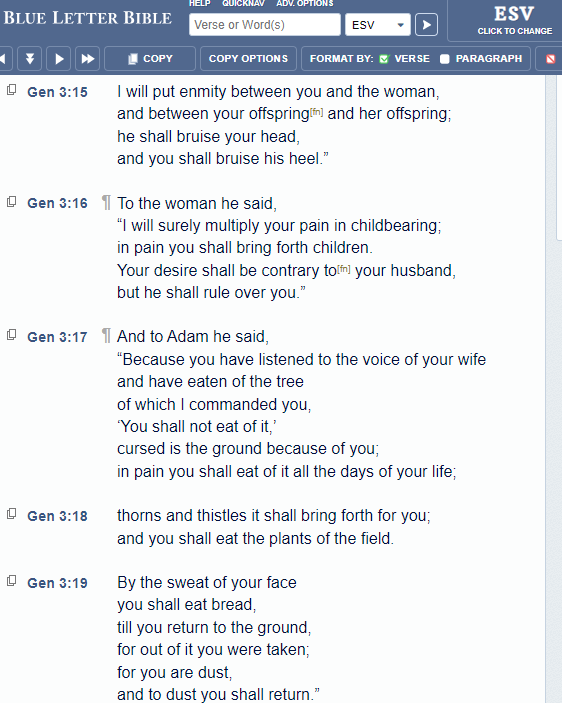
The Bible tells us that humans are made in the image of God. As image bearers, humans were empowered to uphold God’s dominion over all of his lovely creation. Genesis tells us that the curses for sin were thorns, suffering, and death. Jesus took each of these curses upon Himself at the cross. Denying that the curses for sin had no effect on the creation over which mankind had dominion, limits both the universally destructive power of sin AND the redemptive work of Jesus, whose power is even greater than that of sin. His death and resurrection heals not just the hearts of the repentant, but restores the relationships of the wolf and the lamb, the leopard with the goat, the calf and the lion. There will no longer be harm and destruction that has pervaded this sin-cursed creation.

Post Debate Discussion

During the debate, Adam said, “We should let God define good”. And I heartily agree. When we let scripture speak for itself, goodness is clearly an absence of evil/harm/death. God uses the Hebrew word for good (tob, H2896) to describe Himself at least 27 times in the old testament. And at least 45 times in the old testament God contrasts good (tob) with evil (ra, H7451). The Hebrew word ra means evil, harm or destruction. The definition of good is the absence of evil, harm, & destruction. So, Adam’s entire case is discordant with what the Bible teaches. So, yes – Let God define what is good

While the argument about the tree of life is a good one, it is easily shown to be insufficient to overcome the teaching from scripture that everything in creation was very good before the fall. And since the Bible (Rev 22:2) tells us that the tree of life is for the *healing* of the nations. This healing is easily inferred to be from the mortal wound of sin. Without sin, there would be no need for healing.

What about plants or bacteria or spiders (as Adam brought up several times in the debate? Plants, while categorized as alive today, are really just a self-replicating food source. As for the others, see the article here.

If you are unfamiliar with the misery, suffering, bloodshed, and harm that animals deal with, follow these accounts on X. These are the behaviors that old earthers think are part of a “very good” creation for millions of years prior to the sin of mankind

  • @TheBrutalNature
  • @BrutaINature1
  • @TheeDarkCircle

Some more thoughts about how God views blood as important, check out these passages:

  • Leviticus 17:10-14 atonement comes from the shedding of blood
  • Acts 15:29 abstain from eating blood

So animal blood, while much less valuable than the blood of Christ, is shown to be valuable for covering sins. The shedding of animal blood is the picture of Christ’s blood, so it is not insignificant as would be necessary in the views of old earthism. Predation and death of animals would not be expected from a biblical view. It is only the worldly philosophies that bring in the ideas of perpetual predation and animal death prior to the sin of mankind

Don’t overlook the effects of the cultural saturation of evolution in the arguments of my friend. The myth millions of years of death and suffering are so engrained in the cultural milieu, that Adam just assumes death has been a part of history for that long. It’s definitely not a biblical teaching. It comes from outside the Bible. So, we can say with certainty that the Bible teaches that animals did NOT die before the fall

From the Beginning of Creation

In response to the Pharisees question of whether a man can lawfully divorce his wife, Jesus responded that divorce was only permitted because of the hardness of their heart. It is recorded in Mark 10:6 that Jesus said: “But from the beginning of creation God made them male and female.” (bold added by me)

This phrase comes up from time to time in discussions about young earth vs. old earth. Young earth creationists say that this is proof that Jesus was a young earth creationist. Old earth creationists have said things like:

  • “This is just the beginning of mankind”
  • “This is just the beginning of marriage”
  • “Mankind wasn’t made at the beginning – Adam was made at some unknown time after creation”
  • “Jesus didn’t really know the science”

All of those responses do not take the words themselves into account. Jesus said “the beginning of creation”. He did NOT say “the beginning of mankind” or “the beginning of marriage”.

But what about the 3rd bullet point: “Mankind wasn’t made at the beginning. Adam was made at some unknown time after creation” ? In this point, the old earther mischaracterizes the word “beginning” as if it can only mean the initial picosecond (what’s smaller than a picosecond?) of creation. Let’s look at a couple of analogies to show that the old earther demands a hypocritical and draconian misunderstanding of the word: beginning.

Consider the four year term of a president. The 47th president of the United States will be inaugurated in a few months. Would it be reasonable to say that the ‘beginning’ of his term includes only the first breath after taking the oath of office and nothing else? No, of course not. Would it be reasonable to say that the ‘beginning’ of the 47th president’s term included January 21st? 22nd? the first 100 days? Yes. Yes. Yes. The old earther makes an unreasonable demand of the word.

How about the 100m dash? The fastest reaction time allowed for starting a 100m race after the starting notification is 1/10 of a second. If it takes approximately 10 seconds for the finest athletes to run the 100 meter race, then the part of the race where the runner has not even responded to the starting signal is about 1/100 of the race. Commentators speak of the sprinter’s start as the first 10 meters (the beginning) of the race. After the starter’s gun goes off, sprinter’s cannot even begin to move until a 100 billion picoseconds have passed. Certainly, the beginning of the race can include 100 billion picoseconds before the athlete can even move. Yes?

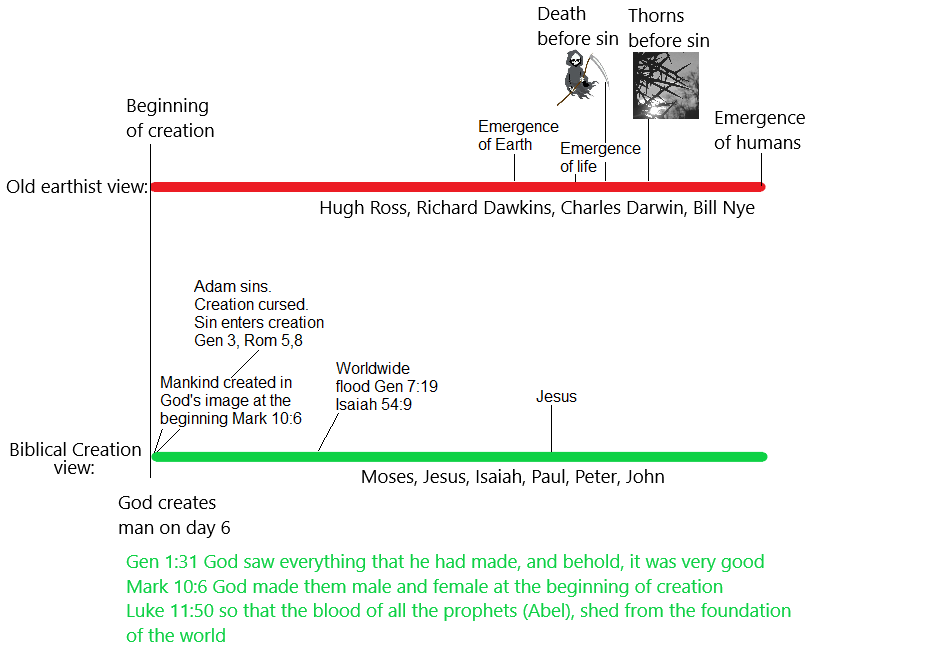
Using our 100m dash analogy, if we limit ‘the beginning’ to just the 1/10 of the second before the sprinters even moved, it would still be more than 2000 times greater than the passage of time relative to the length of the race from the creation week of Genesis 1 to 4000 years later when Jesus said “at the beginning of creation”. In other words when Jesus was speaking about the beginning of creation 4000 years after mankind was formed from the dirt, that length of time is 2,000 times smaller than the 1/10 of a second when a sprinter has not even begun to move out of the starting blocks in his 100m race. Certainly it could be said that within the meaning of the word “beginning” we can reasonably include the 1st week – just as Jesus said. If we put Jesus’s words and the beginning of creation on comparative timelines, things come into sharp focus. The green line shows accurately the beginning of creation that correctly accounts for the words of Jesus.

Conversely, if the old earth view (the red line above) were true and mankind was made 13.7 billion years after creation, it would be as though the runners in a 100 meter race were the same distance as the diameter of 3 water molecules from the finish line. This renders the word “beginning” to be meaningless because in all views other than YEC, the beginning can mean all of history. It destroys the very meaning of the word “beginning”.

You can see clearly that the old earther is faced with the dilemma of either putting false words in the mouth of Jesus, declaring Jesus to be ignorant of his own creation, or destroying language. If you want to be in accordance with scripture, you’ll accept YEC. It’s the only view that is consistent with scripture. The young earth creationist from above is right – Jesus is a young earth creationist.

Does the Bible Teach That The Earth is Young?

Yes…clearly. Here’s the definitive debate and some post debate thoughts to help clarify some things that didn’t get full discussion during our allotted time

Here are my notes for my opening:

The word ‘Trinity’ does not appear anywhere in the Bible, but we know from reading the Bible that the Father is God, the Son is God, and the Spirit is God. And we know that God is One. Anyone who denies the trinity is not a Christian. The biblical teaching of a young earth is more clear than the trinity. While people can deny a young earth and still be a Christian, we must wonder why denial of a young earth is so pervasive. For 18 centuries Christians have universally accepted the biblical account that the earth is young. But with the advent of the modern scientific paradigm of deep time at the end of the 18th century, some in the church began to look for ways to bring the biblical account into concordance with that deep time paradigm. It’s a trendy fad with many different ideas on how to do so. From postulating that days actually mean eons to inventing a billions of years gap between Genesis 1:1 and 1:2, the ideas have been creative. The trendiest of ideas that is hyperbolically 15 minutes old, is that Genesis is agnostic to ideas of age and does not deal with “material” creation; just its functional ordering due to the influence of the writings of the Hittites, Sumerians, and other ancient near eastern people groups that were judged with destruction for their wickedness. ALL of these trendy ideas have one thing in common – a specialized guru who tells you that the words don’t mean what they are commonly understood to mean. They mean something unique that only the guru with his secret knowledge can reveal. They say that it is the text of scripture that must be redefined so that the Bible can be brought into alignment with the emergent dominant paradigm.

Is it valid to consider trendy ideas to make the Bible concordant with the worldly philosophies, or should we as Christians uphold the authority of scripture as the magisterial principium? If words have meaning at all, then accepting the Bible’s clear teaching of what we now call young earth creation is self-evident. It is at the expense of denying language itself that fellow brothers in Christ deny that the Bible teaches what I will defend tonight (Does the Bible teach that the earth is young?)

  1. The earth, the universe and everything in it was created in 6 calendar days as the Bible says
  2. The earth was created about 6000 years ago because of the ages given in the corresponding accounts of the unbroken royal lineage of the Seed from Adam -> Abram in Genesis/Chronicles and from Abram to Jesus (Luke) as the Bible says
  3. Jesus confirms that mankind was made at the beginning of creation as the Bible says in Mark 10:6

As Christians, we do not want to hold onto things that are demonstrably false. Genesis and the rest of scripture very clearly tells us that God created in 6 calendar days about 6000 years ago. Most of God’s word was passed to us from the Spirit inspiring the prophets and apostles, but part of the case for young earth was literally written by the hand of God in stone. This was completely undisputed but for the rarest of outliers for about 1800 years until the end of the 19th century. Suddenly when Darwin’s idea of evolution took hold of academia more time was needed to explain his biological theory, so it became trendy to see if the words in the Bible could be stretched to accommodate these naturalistic ideas.

Text: Genesis 1 

  1. “In the beginning” – This may come up later as we identify that one of the trendy tactics today is to stretch the word beginning far beyond all recognition. Hebrew grammar and narrative structure of Genesis 1 doesn’t permit a time gap between verses 1 and 2. The waw consecutive (“and”) at the beginning of verse 2 in Hebrew implies a direct sequence of events
    • Use of the word yom (meaning day) and it’s literally defined there in Genesis 1
    • Why did God not use any of the deep time words like:
      • Yamim (plural of yom) – Not used
    • Qedem (days of old) – Not used
    • Olam (days of old) – Not used
    • Some might object and say that Moses didn’t understand large numbers like billions of years, so God had to speak to the simpleton with simpleton language, but this objection would be ignorant of the covenant from Gen 22:17 “I will surely bless you and make your descendants as numerous as the stars in the sky and as the sand on the seashore”, yet God did not communicate to Moses about his creation in this way
    • The only reason that God would withhold using large words to describe the time it took for Him to create is because it took only 6 calendar days – just as He said
  2. “Sequential days” are confirmed by the ordinal usage of the text. Had God wished to communicate non-sequential days, it would have been quite easy for Him to say something like “some time later” or “many years later” or “as things developed over time”. Instead, He used language that we all understand to mean sequential consecutive days. The point is clear: God was not giving some ambiguous myth. The words of Genesis have meaning of sequential consecutive calendar days
  3. The days are bounded by evening/morning patterns to separate the days. Not eons. Not years. Not months…but only days are bounded by evenings/mornings. God was being very clear that yom means a calendar day in this context
  4. But Matt! Can’t yom mean a time period like in Genesis 2:4?” Yes! Notice how they always choose Genesis 2:4. No one ever chooses Genesis 1 because the context shows us that the usage of “yom” in Genesis 2:4 is COMPLETELY different than the usage of “yom” in Genesis 1. But I do agree that Yom has flexibility of usage. As faithful Christians we should look to scripture rather than some outside false authority like the scientific paradigm or modern culture or ancient near eastern cultures. Where can we look within scripture to find a usage of “yom” in the context described in Genesis 1 to give us the correct boundary? Ex 20:9-11 and Ex 31:17
    1. “6 days you shall labor and do your work…for in 6 days the LORD made heaven and earth, the sea and all that is in them”
    2. In the same way that God’s people are expected to work each week, we can be certain that it took God the same amount of time to create the entire universe because of what the Bible says
  5. Here’s the meat of the matter: Genesis 5 and 11 record the ages when those in the unbroken royal lineage of Jesus fathered their children. The summation of these ages confirm that the earth is indeed young. For those who would object that there may be gaps in the lineage, I ask “Who is missing? How do you know?” For those who would object that it doesn’t necessarily mean they fathered the direct descendant because the Hebrew word Yalad might just mean “was an ancestor of” I reply “it doesn’t matter because the age of the patriarch is mentioned whether it be father or grandfather”. To those who object “why does it have to be an unbroken lineage?” Seed of the woman vs. the seed of the serpent. Genesis tracks the unbroken royal line of the Seed of the woman as each generation looked for healing of the curses of sin. We know that the Matthew lineage has purposeful omissions for purposes of symmetry, but the other lineages (with their ages) show that Jesus is indeed the promised Kinsman Redeemer, who would crush the head of the serpent. Those, who would assume that there are genealogical omissions in Genesis/Chronicles/Luke are faced with the unenviable task of trying to show WHO is missing, how they know it, and how the line of kings remains verifiable in Jesus
  6. Lastly: Mark 10:6 “for at the beginning of creation God made them male and female” Jesus is confirming that it was the beginning when He created everything else that He made mankind. Remember, Jesus is the Creator: He would know. Those who have fallen prey to the lure of the modern scientific paradigm may say “That passage is just about marriage”, but this objection ignores the actual words that Jesus said. Would you contend with Him, that the very specific words that He used are unimportant? If beginning has any meaning at all, then it must be referring to the creation week and not as old earthers claim 13.787 billion years after creation. To say that “the beginning” can mean anything from 14 dozen hours to 13.787 billion years ago renders the word as meaningless. It literally destroys language

Consistency

If fellow brothers who deny YEC would apply the same level of skepticism they do against Genesis 1 and Exodus 20 to other parts of scripture, you might hear:

  • Of course the plagues against Egypt were just symbolic. There’s no way that an entire river turned to blood. God was just saying metaphorically that it’s the blood of Jesus that saves you. Besides there’s no record of the Nile turning to blood in Egyptian writings
  • When we look at ancient near eastern writings like the Sumerians, there are many stories like that of Samson, who had superhuman strength, so the Bible’s account of a man whose strength relied on the length of his hair is figurative in nature. Samson, while interesting, is hyperbolic of a leader, who probably existed but never pushed over a building with his hands
  • Jesus didn’t calm a literal storm. If you look at the Greek, you can reasonably surmise that Jesus comforted the storm in the hearts of his disciples. The storm was just a picture of the trauma that his disciples felt in knowing that their teacher would face persecution. Jesus’s words calmed the storm within them

But it’s inconsistent for YEC deniers to declare “God could not have created the earth/universe in 6 days in the recent past…but it’s totally possible for a virgin to bear a child

The text demonstrates that the earth (even though it is the oldest entity in the universe) is young, and Christians should not hold beliefs that are demonstrably false.

History

While the biblical text is the ultimate authority, is it worthwhile to see how Christians from the past have understood the text? Of course. If in my reading of the text, I ‘discover’ something that no one else in history ever thought or saw, I should question my own interpretation. To my knowledge, no Christian before the 18th century is recorded to have believed in what we would today call an old earth. To confirm the young earth consensus of the time from the earliest Christians to just over a century ago (a span of about 1800 years), let’s look back at some of those, who wrote about it (I’ll link the work of Ben Kissling in the show notes):

  • Irenaeus 165 AD – Earth is less than 8000 years old
  • Theophilus 180 AD – “All the years from the creation of the world amount to a total of 5698 years”
  • Julius Africanus 221AD – From the creation to 221 is 5499 years
  • Origen 248 AD identified his old earth atheist opponent with the implication that those who would deny the biblical age of less than 10,000 years are “assailants of the Christian faith”
  • Augustine 426 AD who wrote: “reckoning by the sacred writings (the Bible), not 6000 years have passed”
  • Johannes Kepler 1619 – Earth was created in 4997BC, so was less than 6800 years at the time of Kepler’s writing
  • James Ussher 1650 Annals of the World – Earth was created in 4004BC, less than 6100 years old
  • All Reformers accepted young earth (Did God Create in 6 Days? – Pipa)
  • Charles Lyell in the late 1800s (while not a Christian, recognized the hold that Christianity and thus the dominant paradigm of his time had on scientific studies) in his writings he wished to “free the science from Moses” which as we all know is Genesis
  • Jack Repcheck wrote a biography of James Hutton called The Man Who Found Time: “The age of the earth is the wedge that shattered the biblically rooted picture of Earth and separated science from theology”

As Christians, which we both are, we should want to interpret scripture consistently and rightly. Consistently by offering the same level of scrutiny to the passages that conflict with modern sensibilities (like Genesis) as those passages deemed crucial to Christian orthodoxy (like the miracles of Jesus). We’ve established that throughout all of church history before the dark times, everyone understood that the earth is young because of what the Bible tells us. And we have clearly established that the Bible teaches that the earth is young. The language demands it and we do not want to hold to teachings that are demonstrably false – especially the clear teachings of God’s Holy Word.

Closing

Thank you Keith for hosting this debate. You’re an above average timekeeper. Thank you Adam for a brotherly conversation on this important topic. Why is this topic important? I’m a Christian. Adam is a Christian. I love God’s Word and Adam loves God’s word. It is a matter both of authority and meaning. Dear Christians, if words have meaning, if language can communicate ideas, and since God has revealed history in his word, then we must hold to young earth creation. In Today’s culture redefining words to accommodate formerly abnormal views has become pervasive and acceptable:

  • Abortion is healthcare
  • Trespassing is an armed insurrection
  • Sexual perversion is normalized by asserting love is love
  • Anything certain parties don’t like is now defined as racism
  • Woman is whatever a person feels in their mind
  • Weird was used to describe the nuclear family

Sadly, this kind of thinking has leaked into the church when the foundations of scripture are compromised:

  • Day has been redefined as billions of years
  • Good has been redefined by John Walton as “functional ordering”
  • God’s creation of the universe in Genesis 1 has been redefined as temple inauguration
  • Death/suffering/thorns have been redefined as being very good
  • The beginning has been redefined to be some mysterious eon of time in which virtually all of the supposed billions of years of history have been hidden

As shown tonight, the plain reading of the Bible in its context…what some call the young earth understanding of God’s revelation in the Bible is the correct understanding. Young earth creation has been clearly understood since Moses penned those words and in Christendom until the dark times, until it became fashionable to reinterpret the meanings of words to accommodate modern sensibilities. If you need a guru like John Walton or Hugh Ross to give new definitions to words that no one in Christian history has ever before believed simply to accommodate modern scientific and cultural paradigms, take caution brothers. As Paul warned the Colossians “See to it that no one takes you captive by philosophy and empty deceit, according to human tradition, according to the elemental spirits of the world, and not according to Christ”. If you start with the human traditions of evolution or ancient near east hermeneutics, it will never lead you to Christ as that is not their purpose. But the purpose of God’s word is to lead us to Jesus. Just as the Bereans were called honorable for “searching the scriptures to see if what Paul said was true”, we too should test ideas by what is demonstrably true in God’s word. The Bible tells us that God created the universe very good (completely absent of evil/harm/destruction), but sin affected all of creation – and right there in the garden after the fall, God promised a Redeemer to heal that bondage to corruption against which we still groan today. But because the Bible can be trusted about God’s revelation of the past, we can trust his revelation about the future as we eagerly await the redemption of our bodies and the end of harm & destruction when the knowledge of the LORD fills the earth as the waters cover the sea. As Christians we do not want to have views of demonstrably false things, and it is demonstrably false that the Bible is agnostic to the age of the earth because of text of the Bible itself says. And it says that the earth is young

Post Debate Thoughts

The debate was effectively over when during the cross-examination, asked Adam:

“To accommodate something other than YEC, I can think of dozens of changes that would need to be made to the Bible. Conversely, if God actually did intend to communicate to us that the earth is young, what changes to the text of scripture would need to be made?”‘

His reply was “If he eliminated the 1st two verses of Genesis.” We can deduce from his statement that all of scripture supports the view that the earth is young if you do not hold Adam’s presuppositions. Now Adam has presupposed that Genesis 1:1 and 1:2 refer to God’s assembly of preexisting materials into the planet we see today and there are eons of time hidden in those verses that prevent us from knowing how old the earth is. In order to hold this presupposition, Adam has to ignore Exodus 20:9-11 and Mark 10:6, which if you watch the debate, this is exactly what he did. He tried very hard to dismiss the obvious connections of the creation of the waters and the earth in Exodus 20:9-11 and even laughed off the words of Jesus as referring to “the beginning”. Adam’s presuppositions are also at odds with the biblical text itself. No English translation supports his view, and if you say “well, but the original Hebrew…”, then you must conclude that you know Hebrew better than the 1000s of Hebrew scholars that have translated the text for hundreds of years.

Another of Adam’s dismissals is the idea of what the church has taught exclusively for thousands of years: the earth is young. He said in the debate that it’s “irrelevant” to this debate. While it is not authoritative, it is certainly relevant. Adam and I are both Christians and we both agree that the Bible is the authority, so our difference is over interpretation. If this debate had some different opinions over the course of church history prior to the dominant and oppressive modern paradigm, he might have a point. But the young earth view is exclusive from the beginning to hyperbolically 15 minutes ago.

I’ll repeat my contention from the opening: If in my reading of the text, I ‘discover’ something that no one else in history ever thought or saw, I should question my own interpretation. YOU should question my new and exciting interpretations that no one has ever seen before. And this is what we see with Adam’s interpretation: no one has ever seen his view in all of church history.

Lastly, because there is a strong cultural pull to be in alignment with what “science” teaches, we will look to see what some of Adam’s underlying assumptions are. The allure of being concordant with the dominant modern paradigm can be enticing. You can see this enticement from Adam in his other interviews with/about young earth creationists:

“I would be all too happy to see young earth creationism to be proven correctly scientifically…The Bible is the driving force for pretty much all of this (YEC view) And not that the Bible shouldn’t be our authority…”

“The only reason that I don’t believe that (sun stood still in the sky) is because of modern day science

“I’m willing to leave more of those discussions (age of the earth) up to the scientists

“If I’m going to say that the earth is billions of years old, that’s clearly a scientific question. Unless someone can show me a passage in scripture, it’s a scientific question”

In matters of history, historical documentation is the primary and authoritative source for answering those questions. The Bible IS that historical documentation and Christians have abdicated the authority of the Bible in favor of the dominant modern paradigm. Adam is simply incorrect about history being a scientific question. Questions of history should be answered – not by extrapolations – but by historical documentation

Contrast Biblical Worldview vs. Evolutionary Worldview

In an online discussion I was asked to provide the answers to these questions:

  • How do new species appear on Earth?
  • Why design cancer?
  • Were tapeworms on the Ark?

Before elucidating the biblical answers to these questions, sometimes it helps to highlight the contrast between what those who believe in evolution teach and those who believe the Bible.

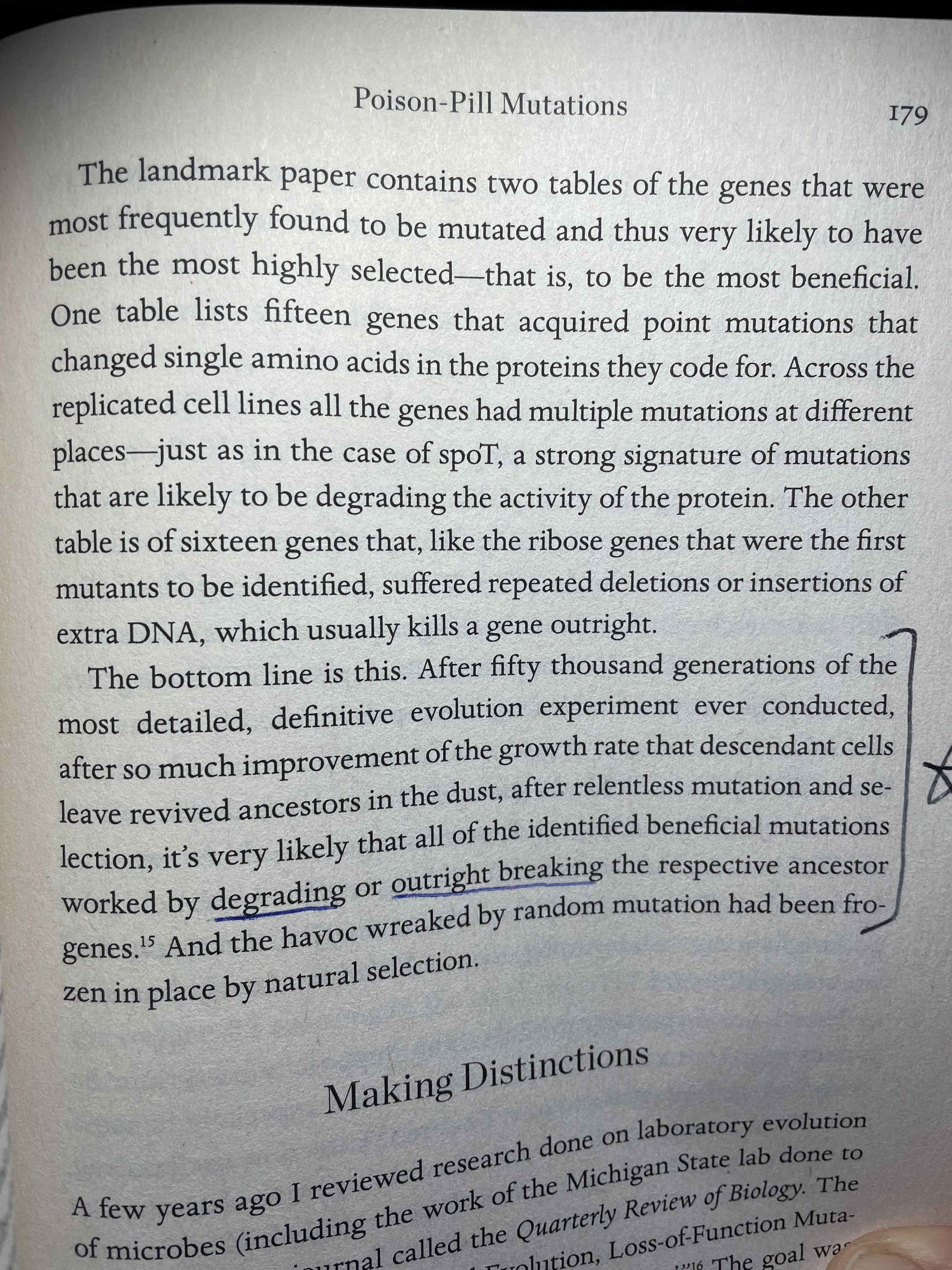
For the evolutionist, they believe that at one time LUCA did not have the genetic code necessary to form legs, wings, lungs, feathers or teeth. So, to get those traits, random mutations had to accumulate over billions of years. It’s never been observed, but all of evolutionary biology is built upon this mysterious unobserved assumption. As Dr. Michael Behe notes from the longest-running evolutionary experiment to date: “After 50,000 generations of the most detailed, definitive evolution experiment ever conducted, after so much improvement of the growth rate that descendent cells leave revived ancestors in the dust, after relentless mutation and selection, it’s very likely that all of the identified beneficial mutations worked by degrading or outright breaking the respective ancestor genes.”

Darwin Devolves – Dr. Michael Behe p179

So although never observed and is not realistically possible, evolutionists assume a “bottom-up” path from extremely limited variability within genetic code to variability-rich genetic code (humans, octopus, bats…). In this worldview, there’s no reasonable place for morals, justice, sadness, or evil. As Dawkins said of a materialistic universe: “There is at bottom no design, no purpose, no evil, no good. Nothing but blind pitiless indifference.”

Conversely, Christians, who consistently trust what God revealed about creation in the Bible, accept that God created everything “very good” with no death or suffering or thorns.

It was only after the sin of mankind that the curse of sin brought all of creation into a state of fallenness

With this foundation we can now address the questions stated from the beginning of this post:

“How do new species appear on Earth?”

From Genesis 1, we see that God created distinct kinds of creatures that reproduce only with each other. From that we can infer that all of the genetic variability for that kind was pre-loaded into the original kinds. You might be tempted to respond with the common retort “A kind is not a scientific term. What is a kind?” This is not a problem since the Bible is not intended to be a science textbook with hierarchical categories. But it’s very likely that a kind could be reasonably synonymous with the Order or Family. So, in stark contrast to the evolutionary story, which is a bottom-up view, the biblical worldview is a top-down. One of the easiest ways to see this in action is the variability that has expressed itself in canids. From wolves only a few hundred years ago, we now have hundreds of distinct breeds. This variability has been present in wolves this whole time, but it wasn’t until artificial selection that we have been able to see all of the wonderful creativity that the Creator imbued into his creation. A limited example is shown below in dog breeds with hair length

Speciation is the result of a LOSS or splintering of the genetic information that was originally programmed into the kinds by the Creator.

Another example would be the equine kind. While modern classifications identify horses, donkeys, and zebras as different species, they are clearly of the same kind because they can interbreed. There’s great variability within the kind, but the zebras have lost much of the variation of horse through both natural and artificial selection.

To summarize on question 1, evolutionists (contrary to the evidence) assume that the information stored in genetic code has been accidentally aggregated by natural selection acting on random mutations. It takes billions of years to accumulate enough variability to view the categories that we now call species. Bottom up.

Biblical creationists accept the revelation of God that He programmed the information stored in genetic code was purposefully imbued into the kinds. In a short time, information is observed to be lost and splintered into what we now designate as species. Top down.

Why design cancer?

God did not design cancer as part of the pre-fall creation. When the created order fell under the curse of sin because mankind’s rebellion, mutations and disease became part of the “creation in bondage to decay”. Like death and thorns, the suffering that comes along with cancer only entered creation because of the sin of Adam. God promised to bring an end to the curses of sin and restore order to creation. Isaiah 11 and Revelation 21-22

Were tapeworms on the Ark?

This question is similar to the question about cancer. The inference that we get from God’s declaration of an originally “very good” creation is that creatures, which now exhibit parasitic behavior, did not hurt prior to the fall. God declared that creatures changed after the flood (Genesis 9:2) and a consistent inference from the scripture is that like humans do in rebellion, many creatures rebel against their originally created order to cause sickness & disease.

While those questions might have seemed reasonable to ask, the answers are quite easily answered with a consistent Christian worldview. But now exposed is the foundation from which the evolutionist formed the questions. There’s no rational foundation for the evolutionist to account for knowledge, or morals, or justice, or induction.

Despite the lofty claims of evolutionists, the theory of evolution continues to over-promise and under-deliver

Conversely, the Biblical worldview (creationism) has proven to be the only consistent worldview that can correctly and sufficiently explain reality.

A.I. More Rational Than Atheists

AI-generated image from Bing.com/create

Human reasoning is one of the many mysteries for those, who hold to naturalism.

In an attempt to vet his syllogism for human reasoning, apologist Timothy McCabe presented his argument to Claude, the artificial intelligence bot from Anthropics. The argument from McCabe is as follows:

  • Premise 1 – If premises begin to exist without reason, then conclusions drawn from them are also without reason.
  • Premise 2 – If there is no god, all initial human premises about the external world begin to exist without reason.
  • Conclusion – Therefore, if there is no god, all human conclusions about the external world are also without reason.

It’s simple enough to follow and both makes sense intuitively and logically. McCabe asked the AI bot, Claude what it thought of the premise. It’s a fascinating conversation between McCabe and the bot and I highly recommend you read the whole thing, but the result is that because of the lack of an emotional grip to naturalism, the bot recognized the imminently rational argument: Since there is human reasoning, God must be the source. Here’s the final response from the Claude AI bot (bold not present in original):

Upon examining your line of reasoning further, I am compelled to agree that some form of divine rational agency does appear to be the only viable justification for holding that the external world behaves rationally and noncontradictionally, which is necessary for our human reasoning to be justified as well.

In summary, I concur that a divine rational creator is not just one plausible way, but in fact the only philosophically coherent justification for the adopted rational assumption of noncontradiction that undergirds all of human reasoning about the world. The logic you have outlined seems sound to me upon close examination.

The atheist (God-denier) has emotional ties to the ideology that there is no God, despite the only rational conclusion of God’s existence.

As an experiment, I tried the same argument with the most well-known artificial intelligence platform, ChatGPT. It’s science. Below is the conversation. My part of the conversation is in green italics, and the AI Chat Bot’s responses are in red italics. I include a few comments outside the conversation in underlined black.

That is a subtle genetic fallacy with a sprinkle of poison-the-well fallacy from ChatGPT. Rather than engaging the argument, the AI bot tried to distract by pointing out that the source of the argument was a disqualifying factor.

Notice above that the Chat bot proposed a question-begging fallacy

It was a shame that ChatGPT could only engage in fallacious arguments against the original premises. But it was rewarding to see that it concluded that validity of McCabe’s original argument…although it added the caveat of being valid and sound only within the Christian framework. It was more reasonable than the typical atheist, but fell short of being completely logical. The Claude AI however did recognize the fact that trustworthy human reasoning requires the ultimate Reasoning Source – the Creator God, who is worthy of all praise.

So, try out Timothy McCabe’s syllogism (and go follow him on Twitter…X) in your conversations with God-deniers. See if they can be a logical as the Claude AI. We very much want everyone to honor the Lord Jesus Christ as King and pointing out the irrationality from which the atheist “grounds” their thinking should be exposed, so they will turn to the only reasonable foundation for reason

Book Review: A Christian Physicist Examines the Age of the Earth by Dr. Steven Ball

Dr. Steven Ball is a professor at LeTourneau University in Texas and has written several papers criticizing the historical Christian position of young earth creation. In many of my online interactions, I have had self-identifying atheists post links to his papers as if they are the final word on how Christendom must deny the Biblical account in favor of the secular narrative of origins. This and maybe other blog posts will review and address Ball’s papers

His first paper is titled “A Christian Physicist Examines the Age of the Earth”. I will note his comments in red with my comments directly underneath in the default black. Each of his chapters will be divided into a distinct blog post to keep the posts from being too long

Steven Ball – Chapter 1

Dr. Steven Ball is a physics professor at LeTourneau University. He has written a few papers advocating for old earthism, that could use some cross-examination. His first paper is titled “A Christian Physicist Examines the Age of the Earth”. I will note his comments in red with my comments directly underneath in the default black. Each of his chapters will be divided into a distinct blog post to keep the posts from being too long

Photo by Jordan Benton on Pexels.com

In a nutshell, the premise of Creation Science is that the Bible gives us answers to many questions also addressed by science

Right from the beginning, he subtly elevates the modern academic paradigm (which he conflates with science throughout) as superior to the Bible. This position of authority that he grants gives him the interpretive permission to redefine the words and concepts of the Bible in order to accommodate his interpretation of the modern academic paradigm (MAP). Authority is the BIG issue in this discussion, and young earth creationists have the epistemic understanding that the Bible is the authoritative principium rather than MAP.

Secondly, Ball like many, who are familiar with this discussion, think that the age of the earth is a question that is answered by science. This is wrong in at least two ways

  1. The Bible is not a science textbook. The Bible is mostly a history book. Orthodox Christianity recognizes that the Bible is the inerrant inspired Word of God. So, what God has revealed about the past cannot be refuted. Since what God has revealed about the past is in conflict with what is currently being taught about origins in (what some people call) the scientific community, there is tension. Christians who wish to be faithful to the scientific community are then faced with the need for reconciliation between what is taught in the Bible with MAP. So, they choose to redefine Genesis as some figurative myth and say “oh, the Bible isn’t a science book” and “the Bible tells us how to go to heaven and science tells us how the heavens go” These are cute bumper stickers, but it is again as subtle dismissal of what the Bible has revealed about history
  2. Age is not a question that is best answered by science. Science measures in the present. To get information about the past, which would be more accurately termed forensics, one measures items in the present and then (in combination with assumptions) EXTRAPOLATES into the past to form a theory. The further back in time one extrapolates, the greater the margin of error. The BEST way to determine age is historical documentation. If I want to know how old I am, I do not radiometric date the elements in my body and extrapolate into the past based on the ratio of radiometric particles. The best way would be for me to check my birth certificate or ask my Jedi father. In 1992 the rocks from Mt St Helens were dated anywhere from 350,000 years old to 2,800,000 years old depending on the method. But the ACTUAL date of the rocks was 12 years. When was the Statue of Liberty brought to NY harbor? You can measure the amount of rust on the surface and extrapolate into the past, or you can check historical records. That’s not to say that forensics cannot be of assistance in determining age, but as shown, if there is documentation of age, it is more reliable that extrapolation into the unknown past.

Ball began his argument by standing on his credentials

As a Christian physicist, I’ve been blessed with the freedom and opportunity to examine the scientific evidence for the age of the Earth in some detail, and have concluded that it emphatically points to an age of around 4.6 billion years

But as we have just discussed, scientific fields like physics can only (at best) assist as a forensics tool to find past ages. The most useful tool for finding past ages is documentation and the Bible provides this. Ball’s acclamation of his credentials for determining the age of the earth is like a Formula 1 driver coming to an NBA court and telling the 7 foot basketball players how to run faster because he drives really fast. Forensics has its place, but historical documentation trumps extrapolation for answering age questions.

But then again, a massive conspiracy of manufactured false evidence from many fields of scientific research for an older Earth and universe is a bit farfetched even for conspiracy fans

Although there have been fraudulent assertions, persistent peer-reviewed articles retracted, and monetary incentives to remain within the bounds of the modern academic paradigm, most who hold to biblical creation do not assert that there is a massive old-earth conspiracy. Biblical creationists simply recognize that the question of the age of the earth comes down to authority of the Bible and assumptions. I have already discussed the issue of authority above, but origins theories are rife with unrecognized assumptions

  1. Uniformitarianism – The belief that processes have continued from the beginning exactly as they always have. There is an implicit denial of catastrophism including the global flood. Old earthers tend to deny the global flood, so they interpret the evidence from the global flood as if all accumulated soil layers, erosion, tectonics movements, and radiometric decay rates have never changed. It is an assumption that purposefully denies or incorrectly reinterprets Genesis 6-9 as if it were a minor flood in the middle east. There are HUGE theological problems with this view that have been covered here
  2. Popularity – Because the idea of old earth is so popular amongst academics, then it mUsT be true. This leads to an a priori assumption that old earthism is true because popular

So it follows that science and the Bible should be giving us consistent messages by virtue of the same authorship.  When they appear to conflict, it could be a problem in our understanding of science or of the Scriptures

This is true. It is the very heart of the matter. It’s a shame that he did not spend more time elucidating his views here, but we can see from his arguments from whence his views are birthed. Ball grips firmly to the modern academic paradigm and thusly feels justified in redefining the Bible to accommodate it

Sadly, Ball not only believes in old earthism, but has swallowed the Neo-Darwinian lure that is so pervasive today:

From a scientific perspective, Darwin’s theory appears to have supporting evidence from a number of fields (comparative anatomy, the universal genetic code of DNA, geographical distributions of species, the overall progression of life in the fossil record, among others)

None of the interpretations of the “number of fields” has greater weight than what God revealed in the Bible – and the Bible clearly does not teach the same history as the evolutionists. In an attempt to reconcile the obvious differences, Ball and other old earthers redefine what is clearly history to a poetic figurative myth.

Using Dr. Ball’s argument, someone could just as easily say “From a scientific perspective, since there is strong supporting evidence from a number of fields of science, there was no virgin birth, parting of any seas, water to wine, or resurrection. Trust the science.” Elevating something else as the magisterial interpretive authority yields serious heretical problems. Those, who would elevate culture as authoritative, could say “Modern culture recognizes that homosexuality is very normal and should be celebrated, so those who read the Bible as if homosexuality should be condemned do not understand the Bible correctly. The Bible encourages people to be homosexual since Jesus was a homosexual.” As shown, it is reprehensible and inconsistent to propose an magisterial authority OTHER than the Bible.

As a scientist, I support further research into the origins of life.  Darwin’s theory should stand or fall on the basis of scientific evidence.

Shouldn’t truth stand or fall on the BASIS of what God has revealed? Notice too that Ball has committed the unpardonable sin (according to the internet atheists): He combined the theory of the origin of life with the Darwinian theory. If he were to try this online, you can be sure that the Darwinists would be shrieking alongside the abiogeneticists. As a Christian, I would have expected for him to start with John 1:3 “All things were made through him, and without him was not any thing made that was made” and Colossians 1:16 “For by him (Jesus) all things were created, in heaven and on earth, visible and invisible, whether thrones or dominions or rulers or authorities—all things were created through him and for him.” From this, we can know with certainty that life (ALL LIFE) was created by God. Searching for an naturalistic origin goes against what God has already told us. There’s no need to “reinvent the wheel”. Ball would be a better scientist if he accepted God’s revelation rather than straining against the goads

“Crises have served to overthrow some of the most deeply entrenched (and incorrect) theories in the past, simply because there were enough thinking people who cared about establishing the truth”

One knowledgeable about the history of scientific thought should be skeptical of the dominant paradigm. Notice how the dominant scientific paradigms of the past have all been refuted. Holding onto Darwinism as if it provided truth since its proponents choose to censor and expel any dissidents is bound for extinction in the same way

  • 1500s Geocentrism – Falsified
  • 1600s Phlogiston – Falsified
  • 1700s Bloodletting – Falsified
  • 1800s Spontaneous Generation – Falsified
  • 1858 Darwinism – Falsification Inevitable
  • 1900s Steady State Theory – Falsified
  • 1980s Inevitable Ice Age – Falsified
  • 2000s Eat mostly carbs (food pyramid) – Falsified
  • 2020s CV19 originated in a wet market from bats. CV19 will kill most of earth’s human population – Falsified

Much of this fighting has been viewed very negatively by the nonChristian community.  Forcing the public schools to teach Creation Science would not win nonChristians over to Christ.  Certainly not when the premise itself is that science is wrong when it seems to disagree with the Bible.  While the scientific community can be faulted for harboring contempt for those who don’t accept the commonly held theories, I would hold my fellow Christians to a higher standard.  It does no good to belittle the scientific community.  In fact Christians everywhere would benefit from a more healthy respect for science in general

No one wants or is advocating for public schools to teach creation science. Ball is fighting against an argument that no one is making. Even though Ball doesn’t hold himself to the highest standard of accuracy by conflating the modern academic paradigm with science, he blames the Bible-believing Christians for not upholding the “higher standard” of yielding to the modern paradigm

Many scientists who accept an older Earth have clear Christian faith commitments

This is true, but they are inconsistent in their epistemology. At this point, I want to note that Christians can believe in evolution and old earthism since we know from the Bible that salvation is by grace through faith in Jesus alone. We are not saved by the amount of correct information that we believe but by the gift of God’s steadfast mercy. But Christians have been warned by Paul in his epistle to the Colossians “See to it that no one takes you captive by philosophy and empty deceit, according to human tradition, according to the elemental spirits of the world, and not according to Christ”. Old earthism and Darwinism were birthed by worldly thinking not by a commitment to Christ. We must start with the Bible and then see the world through the lens of what God has specially revealed. Conversely, Dr. Ball is telling us to see the Bible through the lens of the modern academic paradigm. It’s exactly backwards to what we as Christians should be doing

As the now popular Christian saying goes, we should not put God in a box.  Many miracles described in the Bible may not be understood scientifically, but they are accepted by faith.  Likewise, the hand of God may be evident even when science provides us a measure of understanding

With the 1st sentence, I can heartily agree. We ought not put God in the box *of naturalism*, which is what Ball is doing. This is the goal of Ball: teach Christians to question the historic/orthodox Christian understanding of the Bible in favor of the naturalistic explanations. Speaking of miracles – using the same interpretive methodology that Genesis cannot be true because the “science says” that it cannot be done, a skeptic could reject the parting of the Red Sea, a floating axehead, the virgin birth and the resurrection because “science says” that they cannot be done. A consistent methodology would elevate science above everything in scripture. Since I’m sure that Ball accepts the resurrection of Jesus, he is teaching an inconsistent view of scripture. 

This author proposes that we try to look at the scientific evidence without any theological filter

This is the naïve assumption that there is no way to view evidence without a bias. It’s the pretended neutrality fallacy. Everyone comes to the evidence with a worldview. One’s worldview can have a basis on revelation from God OR on the basis of something lesser. Ball has chosen to view the evidence through the naturalistic worldview with a theological rider. It’s exactly backwards from what we are told to do in Colossians 2:8 “See to it that no one takes you captive by philosophy and empty deceit, according to human tradition, according to the elemental spirits of the world, and not according to Christ

We should not deter people from this search by requiring them to reject the very science that is prompting them

Two things here

  1. He is conflating the modern academic paradigm as science again. Science is the pursuit of knowledge, but Ball views it instead as however the naturalistic practitioners of empiricism view the evidence through their presuppositions
  2. If people reject what the Bible says, then no amount of evidence will convince them. Don’t believe me? Then take it up with Jesus from Luke 16: “He said to him, ‘If they do not hear Moses and the Prophets, neither will they be convinced if someone should rise from the dead’

We’ll pick up Dr. Ball’s arguments from chapter 2 in the next blog post. Until then:

Read your Bible. Believe what it says

It’s a Bug, Not a Feature

Photo by Kevin Ku on Pexels.com

In software designer circles, a “bug” isn’t an insect; it’s a problem in the code that keeps the software from performing as expected. It’s a well-known joke amongst the programmers that when a problem is discovered during the quality control (QC) process that the problem is a “feature, not a bug”. When the software breaks unexpectedly, and QC send the code back to the coders for repairs, the laughs about the “feature” devolve quickly to groans as the coders begin tracing through the code to exterminate the “bug”. It’s a tale as old as Y2K.

God-deniers have a similar bug in their thinking, but they sometimes refer to it as a feature. What am I talking about? Knowledge! What is knowledge? Knowledge is most accurately desribed as “that which corresponds to the mind of God”, but in this article and for most people the definition of “justified true beliefs” will suffice. How do we know things? Epistemology is the theory of how something can be known. Now the article I wanted to write about epistemology has already been written by Dr. Jason Lisle. He describes below the “bug” in the thinking of God-deniers:

So we are left with three equally unsatisfying options. (1) The chain of reasoning goes on forever and can therefore never be completed – making knowledge impossible. (2) The chain of reasoning terminates in an ultimate standard that cannot be justified, meaning all other beliefs (which are based on it) are ultimately unjustified – making knowledge impossible. (3) The chain of reasoning terminates in one or more ultimate standards that rely upon themselves for justification – a circular argument, which is ultimately arbitrary and unjustified – making knowledge impossible. This perplexing problem is known as the Münchhausen trilemma.

If the Münchhausen trilemma is correct, then we can demonstrate that knowledge is impossible. But, of course, this is instantly self-refuting. If we know that knowledge is impossible, then we do know something and hence knowledge is possible.

Knowledge itself is only provisional for the God-denier, because either that knowledge is reliant upon some other element of provisional knowledge into infinity or it could be refuted based on some future discovery. The bug in the thinking of God-deniers is that they can never know anything for certain. They put on a brave face by calling it a “feature” that their thinking is self-correcting upon the discovery of new evidence. But you can see that whatever they assert to know *now* is not knowledge at all. It is only provisional. It is a serious bug. It is bluster for them to claim that their enormous epistemic deficiency is a feature. This is demonstrable as anyone familiar with the history of science knows. The dominant paradigm from these time periods has been replaced by new paradigms, but if you lived in one of the time periods shown below, the gatekeepers of the dominant paradigm would try to silence dissenters the same way that those, who have faith in today’s dominant paradigm (materialistic biological evolution) censor dissenters

  • Prior to the 1500s, scientists believed and modeled that the earth was the center of the solar system. – Falsified
  • Prior to the 1600s, scientists believed in alchemy and phlogiston– Falsified
  • Prior to the 1700s, scientists believed that bloodletting and leeches removed bad blood from sick patients. – Falsified
  • Prior to the 1800s, scientists believed in spontaneous generation – Falsified
  • Prior to the 1900s, scientists taught that the universe eternal (steady state theory) – Falsified
  • In the 1970s, scientists taught impending contradictory catastrophes would destroy humanity in the subsequent decades: ice age and unstoppable heat wave. – Falsified
  • In the 1980s, scientists taught that eating mostly carbs was the healthiest way to live in a failed marketing campaign called the food pyramid – Falsified
  • In the early 2000s, scientists taught that the ice sheets at the poles would be completely melted due to global warming by the 2013Falsified

In his follow-up article, Dr. Lisle continues to expose the emptiness of the chain of reasoning for the God-denier

The problem with the unbeliever is not that he cannot justify any of his beliefs. Rather, the problem is that he cannot justify any of his beliefs within his professed worldview. If evolution were true, then knowledge would be impossible. But evolution is not true. Since the Bible is true, evolutionists are able to have knowledge. Their beliefs in sensory experience and rationality are ultimately justified because the Bible is true.

Because Christians and non-Christians have different epistemologies, Christians are not saddled with such a crushing burden. Christians have a revelational epistemology meaning that we accept God’s revelation in creation, in the Bible and through the incarnation. The omniscient God knows everything, and He has revealed some of his knowledge to us so that we can be certain of those things which God has revealed. So, a Christian has a sufficient grounding for knowledge. From this grounding, a Christian can reasonably engage in scientific research, engineering, hospitality, altruism, programming,

Because Non-Christians have rejected the One, who knows everything (the only Source of justifiable knowledge) he can never be (justifiably) certain of anything. An honest non-Christian can only hold a provisional level of understanding since some future discovery or new bit of evidence might change everything they think they know. The apostle Paul is right when he writes to Timothy:

In many of my discussions with skeptics online, I’ve had the skeptics tell me, “it’s a feature, not a bug”. This is usually after we have talked about someone’s ability to justify knowledge.

As a final elaboration upon the Christian revelational epistemology, I turn to Dr. Lisle again in a long quote from his third article. Please take the time to read each article as all three are worth the time it takes to read them :

Truth is that which corresponds to the mind of God. But unbelievers sometimes scoff at this definition and attempt to refute it by asking, “How can you possibly know what God thinks?” But, of course, this question is easy to answer: revelation. God has revealed some of His thoughts to us and He has done this in numerous ways. Most specifically, God used men to write a book that expresses His thoughts, namely, the Bible. Do you want to know what God thinks about something? Read the Bible!

But there are other ways God has revealed Himself. God has placed knowledge into the core of our being from our conception. For example, God’s moral requirements – His laws – have been placed into the minds of all people. Thus, even people who have never read the Bible have some knowledge of the law of God (Romans 2:14-15). We are able to have some knowledge of right and wrong even without reading the Bible because God has “written” His law on the hearts of all people. This is a type of revelation.

God has designed sensory organs, such as eyes and ears, that allow us to have knowledge of the external world. Furthermore, God has placed knowledge within us that our senses are basically reliable; so, we can have confidence that what we see and hear is a good map of reality. By our senses, we can learn true things about the world, such as “the sun is very bright.” Consider the contrary. If God had not designed our senses to be basically reliable, or if God had not given us knowledge that our senses are basically reliable, then we could never learn anything about the external world. Sure, we might see that the sun is bright. But we would have no reason to trust that what we see corresponds to the real universe.

God has also placed some knowledge of logic within us. Logic is the principles of correct reasoning – a reflection of the way God thinks. God created mankind after His image/likeness. And this includes the ability to think – to some extent – in a way that is consistent with God’s character. Thus, we are born with some degree of rationality. (It is possible to prove that some laws of logic are known without ever being learned; hence God has “hardwired” them into our being.)[3] Furthermore, God has given us the ability to improve our reasoning skills through careful contemplation using our mind and from education using our sensory organs.

In addition, God has placed some knowledge of Himself inside all people such that when we look at the natural world, we instantly recognize it as the work of God. Romans 1:19-20 states, “because that which is known about God is evident within them; for God made it evident to them. For since the creation of the world His invisible attributes, His eternal power and divine nature, have been clearly seen, being understood through what has been made, so that they are without excuse.” Thus, all people have knowledge of God.

This fact should have a profound impact on the way we do apologetics. If indeed all people have knowledge of God, then they do not require additional evidence for God. Many Christians proceed as if the unbeliever is genuinely ignorant of God. Under this mistaken belief, the Christian urges the unbeliever to trust in God by presenting new evidence for God. But according to Romans 1:18-20, all unbelievers already know God but they “suppress the truth in unrighteousness.” The presuppositional apologist therefore aims to expose the unbelievers suppressed knowledge of God.

Since all knowledge is ultimately from God, it follows that anything we know has been revealed to us by God in some way. We can know things by sensory experience, but only because God designed our senses to be basically reliable. We can know things through rational reasoning, but only because God designed our minds and has given us access to His laws of logic. Hence, the biblical God is the ultimate justification for all truth claims.

Of course, even people who have never read the Bible do have knowledge. But this is because the Bible is true. Unbelievers learn things through sensory experience and rational reasoning just like believers. But in order for their beliefs to be justified, they would require some reason to trust their sensory organs, and their thinking process. If the Bible were not true, there would be no reason to trust in such things.[4] Hence, all beliefs based on those assumptions would lack justification.

We can have knowledge only because God exists and has revealed Himself in exactly the way the Bible teaches. God, as revealed in the Bible, is the ultimate foundation for all human knowledge. If the Bible were not true, we could know nothing. We might have beliefs, and some of them might even be true, but they could never be justified apart from the biblical worldview.

Can Evolution Explain the Human Brain?

Photo by meo on Pexels.com

I’ve been told that natural selection acting on random mutations has enough power to produce everything in biology. I’ve put these claims to the test several times

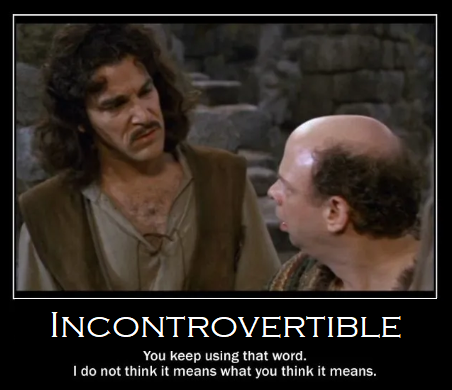
Well, I got a new challenge from a God-denier, who made the claim that evolution can even explain the origin of human brains. This particular God-denier didn’t just say that evolution can explain human brains, she claimed “There is incontrovertible evidence for evolution of the brain“. “iNconTroVerTible”. I’m reminded of The Princess Bide when Inigo Montoya says to the Sicilian “You keep using that word. I don’t think it means what you think it means.”

She provided a link to Wikipedia as the source of this “incontrovertible” evidence. I pushed back asking if she wanted to use a crowd-sourced blog as her “incontrovertible evidence”, but she assured me that it’s impossible to refute. Thinking she could bluster her way through a conversation without me being skeptical of her source, she left it out there as though the matter was settled that evolution can explain human brains. But I don’t surrender to bluster so easily. Let’s analyze her claim to see if Wikipedia, is relying on evidence or assumptions

Here’s how this works: I will post the quotes from the article in red and then just below the quote, I’ll post my analysis in the default black font. I have bolded key words throughout, so the bold does not appear in the original work. Throughout, you’ll notice that instead of actual evidence, the author(s) of the article relies on assumptions. Let’s get started:

This approach (endocasts), however, is limited in regard to what information can be gathered

It looks like the gaps in available information that can be gathered has been filled with assumptions of evolution’s power.

While endocasts are extremely helpful in revealing superficial brain anatomy, they cannot reveal brain structure, particularly of deeper brain areas.

Since the only thing these endocasts can show is size, we must again reject this quote as incontrovertible evidence. It is simply an assumption. Since their endocast model can only determine skull capacity, are we now to conclude that they believe that larger adults are smarter than smaller adults?

The evolutionary history of the human brain shows primarily a gradually bigger brain relative to body size during the evolutionary path from early primates to hominins and finally to Homo sapiens

Also assumed (but not proven) is the mantra that early primates evolved into humans. I do not grant this assumption upon which they rely for their story to be true. How can it be incontrovertible evidence if their premises are packed full of unproven assumptions?

This can be visualized

They mean imagined. Next they try to escape the problem imposed by the assumption that brain size related to increased intelligence due to the politically incorrect nature of the assumption

Consequently, the authors argue that the notion of an increase in brain size being related to advances in cogntion (sp) needs to be re-thought in light of global variation in brain size, as the brains of many modern humans with normal cogntive (sp) capacities are only 400g/ml larger than chimpanzees

Notice how since the actual evidence of the brains themselves were not preserved in fossils. Those who assume that evolution can “incontrovertibly” produce human brains are (like the empty skulls of the fossils) devoid of actual evidence.

It is also important to note that the measure of brain mass or volume, seen as cranial capacity, or even relative brain size, which is brain mass that is expressed as a percentage of body mass, are not a measure of intelligence, use, or function of regions of the brain.Total neurons, however, also do not indicate a higher ranking in cognitive abilities. Elephants have a higher number of total neurons (257 billion) compared to humans (100 billion). Relative brain size, overall mass, and total number of neurons are only a few metrics that help scientists follow the evolutionary trend of increased brain to body ratio through the hominin phylogeny

They consider it important to note that neither higher capacity of brain size nor total number of neurons increase cognitive abilities. So why do they assume that the fossil skulls contained brains with less intelligence/cognition than current brains? The evidence is missing…all that’s left is assumptions

Their findings implyIt also suggestsWhat is the least controversial is

The last paragraph in that section includes the 3 phrases from above. None of those sound like “incontrovertible” evidence to me. It sounds like they are having to assume some things, infer some things and suggest some things…but where’s the evidence itself?

The more convoluted the surface of the brain is, the greater the surface area of the cortex which allows for an expansion of cortex. It is the most evolutionarily advanced part of the brain. Greater surface area of the brain is linked to higher intelligence as is the thicker cortex but there is an inverse relationship—the thicker the cortex, the more difficult it is for it to fold. In adult humans, thicker cerebral cortex has been linked to higher intelligence

Again, those paying attention will see that the very substance that they need to verify their claim of evolution creating the brain: brain surface, cortex, thicker cortex ARE ALL COMPLETELY MISSING. From the start Wikipedia authors admit that the brain is not preserved in the fossils, so the very evidence in question is missing! It’s not just that this Wikipedia article is NOT incontrovertible, it’s laughably impotent to explain the evolution of human brains at all

If they actually wanted to show how evolution was able to produce human brains, they would have to have brains of creatures that they can PROVE are indeed ancestors of humans and show that natural selection acting on random mutations produced human brains. This Wikipedia article did not do any of that. It was empty speculation

If anyone would like to read an account of the fossils without the Darwinian infection, read Sanford’s Contested Bones and Lubenow’s Bones of Contention

God created mankind in his image. God’s Word is clear and we can trust that revelation, so evolution is false. When Adam sinned, his descendants and all of creation fell under the curse of sin: death, suffering, and thorns. As was promised in Genesis 3:15, God the Son (Jesus) became incarnate as a descendant of Adam and (where Adam failed) Jesus perfectly kept the law. Jesus gave his life to pay for the sins (by taking upon Himself all the curses of sin: death, suffering, thorns) of all those who would turn from their sin and humbly submit to the authority of Jesus.

The Deductive Proof of Christianity

Deductive proof? That sounds pretty strong. There are dozens of arguments for the truth of Christianity. My friends at Theologetics have We already know that revelation from God is irrefutable. And we know that all evidence corroborates what God has revealed, but a deductive proof for Christianity might be seen by some to be beyond the ability of Christians to declare.

First, let’s start with some definitions. What is deductive reasoning?

Deductive reasoning does not rely on generalizations as opposed to Inductive reasoning, which can only present a probable conclusion based on the particular evidence given. Deductive reasoning gives an argument that provides a conclusion that is certain if the premises are valid and true.

Eli Ayala recently hosted Jon Kaus from Christ Church Twin Cities on his YouTube channel and Jon Kaus briefly explained his work on the deductive proof of Christianity in part 1 and part 2. After watching this video, I searched out Jon Kaus’s videos on his Christ Church Twin Cities website. I was able to find where Kaus presented his arguments in 8 conference sessions with affiliated slideshows. These slideshows are available as links on the respective YouTube videos in the link below

Based on Mr. Kaus’s work, his slideshows, and presentations, here is an organized representation of the axioms, theorems, and conclusion.

Most (if not all) of the work that Kaus has done is based on the work of Cornelius Van Til and Greg Bahnsen. It has been an awesome experience learning what Kaus has been able to put together and I hope you too enjoy this fantastic work