In part 1 of my comprehensive book review of preeminent paleoanthropologist, Ian Tattersall’s book, Masters of the Planet – The Search For Our Human Origins, we discussed many of the blind assumptions and uncertainty that attempted to fill the gaps in his lack of evidence for human evolution. As we pick up in Chapter 6, we’ll see much of the same speculation and story-telling
Chapter 6 – Life on the Savanna
He continues in his evaluation of Homo Ergaster
And in the absence of substantial evidence of technological change, we have to fall back on physical and other indirect indicators…these indicators are highly suggestive even though we are hard put to draw specific conclusions
The uncertainty and speculation persists. He’s staying true to the evolutionary story even with the absence of substantial evidence
There is no shortage of ideas; and although there is little evidence to substantiate any of them, a circumstantial case can be built
So much religion. Not so much evidence
Perhaps
may have been more important than the material evidence indicates
suggested
may have been
so it seems likely
Whatever their origin
would have
would not have been
would also have necessitated
possible
It is impossible to know for sure
is thought to have been
seems to be
the assumption
estimate
begs a number of important questions
as to leave lots of room for doubt
in which case there should be more and better evidence of it
almost entirely circumstantial
could have
may have
may have been
and if you are prepared to pile on a few more assumptions
probably
may
we are unable to say much more than this with any confidence
probably
probably
purely hypothetical
has to remain a guess
perhaps
we can’t be entirely sure
fairly sure
only indirectly reflected in the material record
must have
probably
Uncertainty. Assumptions. Speculation
Backing up a little to pages 110 and 111 we see
And we can’t take absence of evidence as evidence of absence. Beyond this, it is fair to point out that there is nothing we know or can reasonably infer about Homo ergaster cognition that would rule out the possibility that these creatures used simple containers
The absence of evidence for evolution is the norm. Evolutionists are excellent story-tellers, and they fill the gaps of this missing evidence with wonderful stories. I’m just not persuaded by their stories
Chapter 7 – Out of Africa and Back
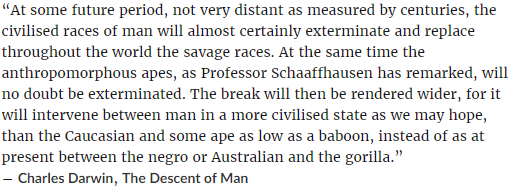
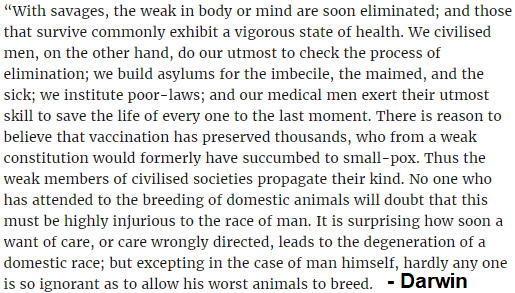
Many people may not know that the “Out of Africa” theory was concocted in an effort to hide the inherent historical racism of Darwin’s theory of evolution. When Darwin fabricated his theory he lived in a time when it was perfectly acceptable to be openly racist. He had nothing to hide by presenting his new theory as praising the white race for being more evolved and pointing out that he thought the darker-skinned people were less evolved. From his work Descent of Man:
Sadly this kind of thinking had real and dire consequences built into the foundation of the theory of evolution. People have chosen to be racist for millennia, but with the advent of the new evolutionary paradigm that was deemed scientifically advanced, people felt they had a scientific justification for mistreating people of different ethnicities. The scientific racism went so far as to actually display an African in a zoo as if he were an animal
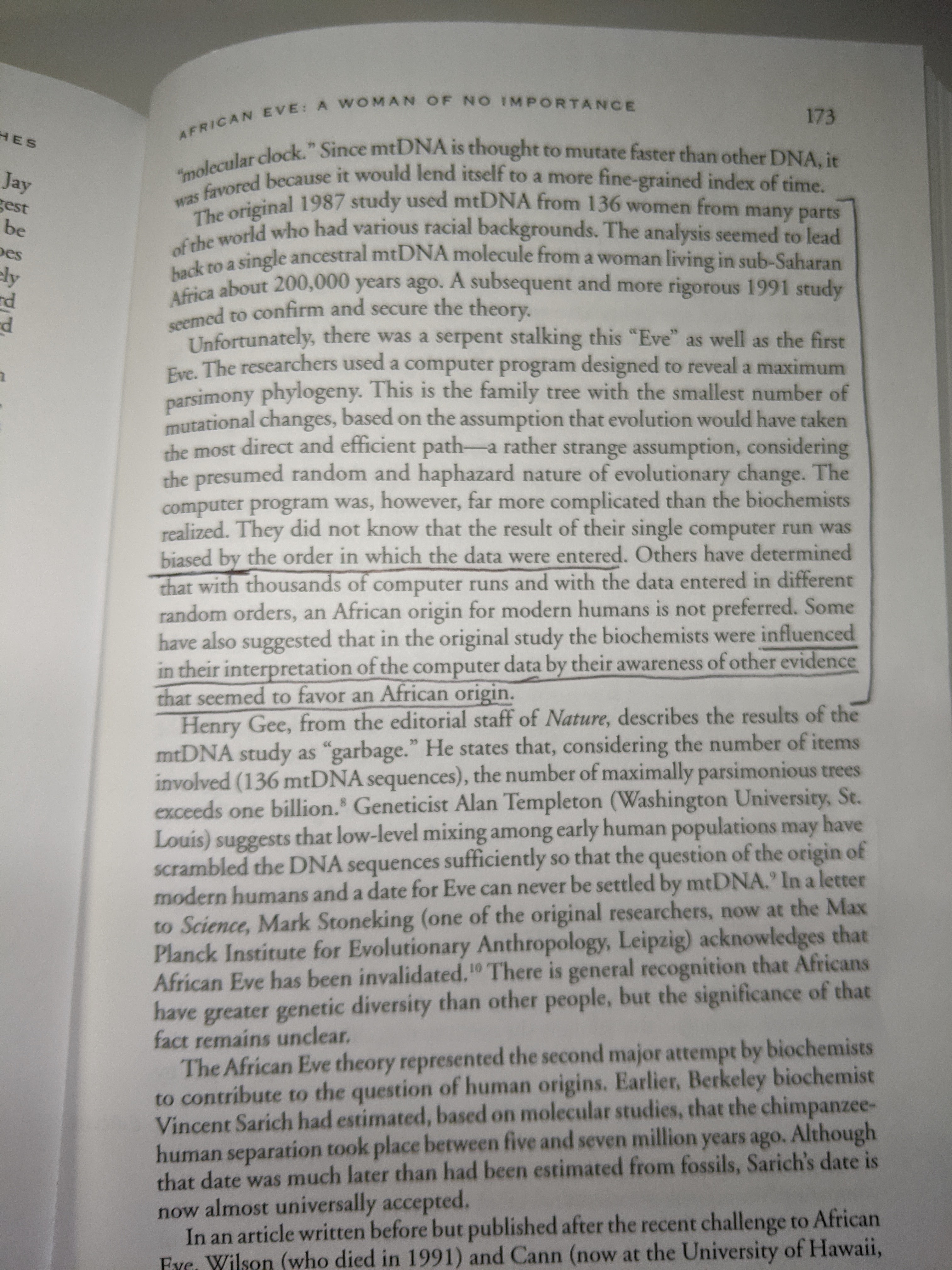
As the 20th century progressed, racism (thankfully) fell out of favor among the scientific elite, but because evolution had vise-like grip on academia, a new story was needed to hide the racism. Enter the “Out of Africa” model. The idea is that since humans were now said to have evolved in Africa first, Africans now had the GREATER claim to being the MOST human of all. Dr. Marvin Lubenow exposes the fabrication in his book, Bones of Contention
Now, what does Tattersall have to say about “Out of Africa”?
The human family was born in Africa, and many millions of years passed before we have any evidence that hominids had managed to escape the continents confines. For a long time it was believed…now though, things are looking a lot more murky; for the initial dispersal out of Africa appears to have occurred as early as 1.8 million years ago, or possibly more
Claims and murkiness. No science there. He follows with “suddenly” “it was felt” and “suggested” before throwing out this beauty:
Shortly before the early age of the Dmanisi was verified in 2000 and 2002, dates had been published from Java that hinted at the very early (1.8-to1.6 million-year) presence of Homo erectus in eastern Asia; together, these dates placed beyond dispute that the hominid exodus from Africa had begun almost immediately following the appearance there of the new hominid body form-vastly earlier than anyone had previously suspected.
“Beyond dispute“…please! Dates from evolutionists are presented as SET IN STONE when they speak to detractors, but as time goes by, the dates are as pliable as jello on a trampoline. New evidence requires evolutionists to constantly revise dates to keep the story from falsification as evidenced by the last line: “vastly earlier than anyone had previously suspected.” Because prior to that point, the evolutionists would have expelled anyone for suggesting the the dates that Tattersall says are “beyond dispute”. This book was published in 2012. As of the time of this blog post, the proposed (Darwinian) dates for the Dmanisi fossils have changed 3 times since 2012. There’s nothing to prevent future discoveries from forcing evolutionists to change these “beyond dispute” dates yet again to keep the theory from extinction
On page 127 he continues
Limited as our speculations have to be, however, the conclusion is inescapable that the invention of the handaxe must be represented-or at least have reflected-a cognitive leap of some kind
Unfortunately for Tattersall, the argument from his entire book hinges on this phrase, which we will see again: “a cognitive leap of some kind”. No evidence of natural selection acting on random mutations to produce cognition…just an interpretation of bones and stones to fabricate a story. This story includes (not science) but ever-increasing speculation:
Must have been
if for no better reason than there was nowhere else for them to iccur
must have been
remains a bit hazy
we have no idea
especially since there is no evidence that more than 1 hominid grade was involved
strongly suggests
suggestion
quite controversial
remains pure speculation
but it is possible
it is quite possible
we have so little supporting evidence
how we interpret it
suggestive
is at least highly suggestive
regrettably unknown to us
just as likely
a scenario
suggests
maybe about a quarter million years ago
perhaps most bizarrely of all
enormous controversy
Chapter 8 The First Cosmopolitan Hominid
Scattered throughout this chapter, we see the continued howls from Tattersall that the fossil record of human evolution is deficient
The systematic picture among fossil hominids of the period around a million years ago remains rather unclear, because relevant fossils in the African center of innovation are few and far between and widely scattered“
On its own the Mauer jaw was a bit puzzling
Dating is rather poor for most of these fossils
we can’t say much about the body structure of Homo heidelbergensis, since bones of the body skeleton are few and far between.
Some 380 thousand years ago the terrace on which Terra Amata lies was an ancient beach, to which a small group of hunters repeatedly returned (alas, without leaving any evidence of themselves)
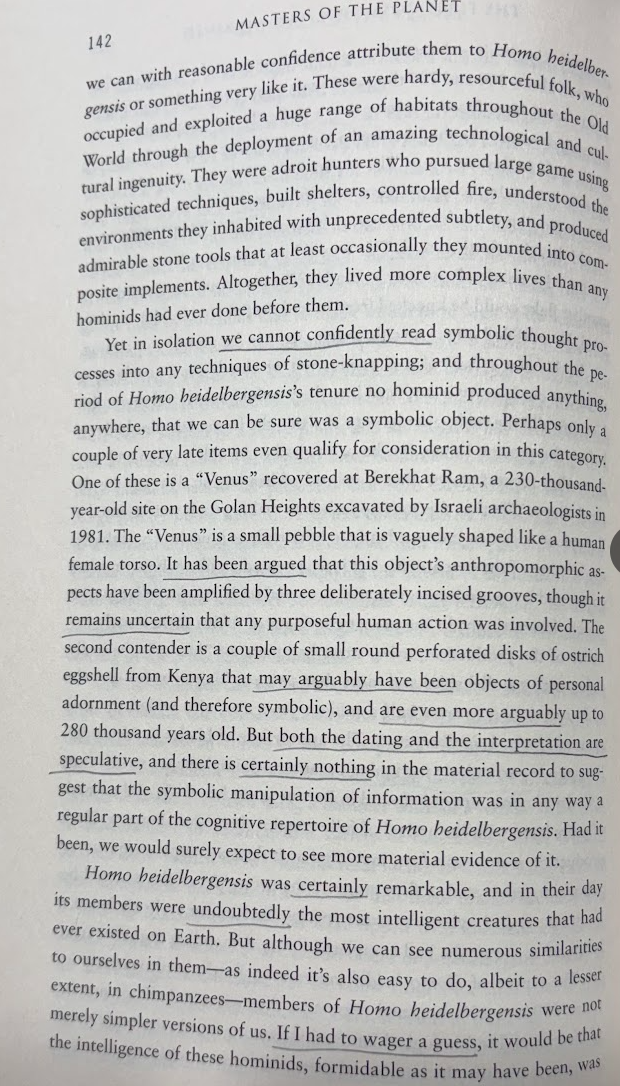
Notice the speculation, uncertainty, arguing, and wagering of guesses on which paleoanthropology is built. Yet, when anyone questions the evolutionary narrative, the rebuttal is inevitably “you’re a science-denier!!!!” In their books and papers, to their evolutionary audiences, they drop their filter and expose the tentative nature of their view. Evolution isn’t built upon mountains of evidence; it’s built upon the predetermined ideology that natural selection acting on random mutations can produce all biological traits.
Chapter 9 Ice Ages and Early Europeans
In chapter 9 Tattersall tells the terrifying tale of intrepid travelers traversing frosty terrain as they transformed from Tanzanian apes into tempered Turks. It’s a great fable, with lots of conjecture.
There is thus no way in which we can realistically think of hominid evolution during the Pleistocene as a matter of steady adaptation. Instead, the story is a much more dramatic one
Ice Age conditions were often tough for the hominid individuals concerned; but never had circumstances been more propitious for meaningful evolutionary change than among our highly mobile, adaptable, and resourceful Pleistocene ancestors. Taken together, this combination of internal and external factors may well account for the amazing rapidity with which hominids evolved during the Pleistocene…rapid evolution…rapidly…quite unexpected…may have been
Propitious?!? You mean lucky? What exactly he means by evolutionary change, he never really says, but the implication is that “change happened, therefore evolution did it! Praise evolution almighty!” Again we see that Tattersall is proposing this strange and unnatural view of ‘rapid evolution’. We’ll see in chapter 14 why he’s pushing so hard for this idea that is so far outside the orthodox teachings of evolution: slow & gradual accumulation of mutations filtered over millions of years by natural selection
And very recent findings have also pointed to something quite unexpected: the possibility that, under fluctuating Pleistocene conditions, new genes may have been introduced into hominid populations by occasional intermixing between closely related and poorly differentiated hominid species
He’s saying that beastiality built humanity. Yuck! Too bad we didn’t end up with the monkey’s prehensile tail or the Orangutang’s strength.
But the problem was that each glacial advance scoured away much of the evidence left behind by its predecessors, and the resulting observations were a nightmare to interpret
No kidding. Your modified theory of evolution has staved off extinction despite the scouring away of much of the evidence. How convenient that the evidence is missing.
chronology is based on modern geochronological and geochemical analyses of long cores drilled through sea-floor sediments, or through the Greenland or Antarctic ice caps.
It is not easy to date a pile of bones at the bottom of a pit
Chapter 9 ends with lots of open questions and plenty of room for open skepticism about the story that we are forced to swallow despite the lack of evidence.
Chapter 10 Who Were the Neanderthals
Maybe we’ll get more answers in chapter 10
we know so little about it due to the effects of repeated glaciation and deglaciation in the region
Again, evolutionists know so little because the evidence is missing…supposedly and conveniently by glaciers. Funny how today, the progressive left (which would undoubtedly include evolutionists) pray to, fight for, and weep for glaciers.
As far as we can tell from a less-than-perfect postcranial fossil record
More lamentations at the dearth of evidence
evolutionary time
What is evolutionary time? How is it different from regular time? The pervasive use of ‘evolutionary’ as an adjective shows how religious is their devotion to the theory. They use evolution as a noun, a verb, an adjective, and adverb…it’s just evolutionary evolution of evolution-like evolvement. And if you’re skeptical of the evolutionary evolutionism by evolutionists, you’re deemed to be a “science-denier”.
Perhaps…appeared to have been…suggested…might have been…might have been…probably too early to know what to make of observations…it is not out of the question…may have had
All of these words of ambiguity appear in the same paragraph
Chapter 11 Archaic and Modern
In this chapter Tattersall talks about evidence of artwork and tools. He tries to build a distinction between what he considers to be archaic fossils and modern fossils. Not much to critique in this chapter
Chapter 12 Enigmatic Arrival
In ch 12, Tattersall intends to build the case that Homo Neanderthalensis is distinct from modern humans – not in phenotype, but only in cognition. He admits several times that the fossils are virtually indistinguishable, but because of the different layers in which the fossils are found, he calls 1 fossil Neanderthal, and the other human. Let’s review
Homo sapiens was emerging
This again is the common lingo among evolutionists. They don’t want to say that it was magic, but their justification for these emergent changes sounds very much like an appeal to magic
Still, this is not the whole story, for as far as Homo sapiens is concerned it appears that the body for was one thing, while the symbolic cognitive system that distinguishes us to greatly from all other creatures was entirely another. The two were not acquired at the same time, and the earliest anatomical Homo sapiens appear right now to have been cognitively indistinguishable from the Neanderthals and other contemporaries
Recognizing species from their bones is often a tough proposition among close relatives: in some cases, much physical diversity may accumulate within a population without speciation occurring, while in others, the bones of members of two species descended from the same ancestor may be virtually indistinguishable. In the absence of a good morphological yardstick we thus can’t be absolutely sure that Aterians or the Jebel Irhoud people would not have been able to exchange genes with anatomically mainstream Homo sapiens.
If nothing else from this book, we see that “recognizing species from their bones is often a tough proposition”, and then when evolutionists cancel/expel/dismiss anyone, who is skeptical of evolution, we see that they are simply protecting their religion. Those presuppositionalists, who read my blog, will recognize the Tattersall’s lament of not having a standard when he says “in the absence of a good morphological yardstick”. By What Standard indeed? Evolutionists can NEVER have absolute surety because some new discovery can (and almost always does) change their whole paradigm.
Chapter 12 finishes out with an overabundance of “maybe”
These tools were more or less identical
probably
spectacularly obscure
One possibility
there is no independent reason to believe that they were around at exactly the same time
other possibilities
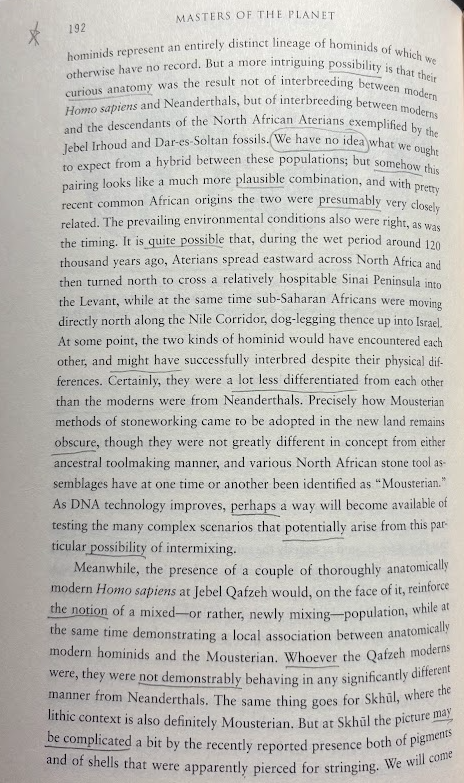
Notice from the screenshot of pg 192 how many underlined words leave the reader with the idea that there’s no reason to hold tightly to the evolutionary beliefs. The following page includes these gems
in light of the frustratingly little we know, it seems reasonable to see the initial excursion of anatomical Homo sapiens out of Africa and into the neighboring Levant as the fortuitous product of circumstance, facilitated or even spurred by a benevolent change in climate…quite likely…But whatever the ultimate identity…tantalizing hints…we have no evidence
Speculation based on fortuitous circumstance (luck). And “benevolent change”?!!? Are you kidding me? There’s no reason to take this paragraph seriously when he proposes that the climate was “benevolent” to the proto-humans. Let’s move on to chapter 13
Chapter 13 The Origin of Symbolic Behavior
In 2013 Living Waters ministries released a documentary titled ‘Evolution vs. God’, and at about the 33 minute mark UCLA professor, Dr. Gail Kennedy remarked “You know the problem with those who are unable to see evolution, I think, is they don’t have imaginations.” Indeed. To believe in evolution, you must have a vivid imagination. Tattersall agrees:
Our ancestors made an almost unimaginable transition from a non-symbolic, nonlinguistic way of processing and communicating…it is a qualitative leap in cognitive state unparalleled in history. Indeed, as I’ve said, the only reason we have for believing that such a leap could ever have been made, is that it was made.
He states that the ONLY reason to believe that humans evolved from their indistinguishable contemporaries is that humans are here. No evidence of this event. No prediction by evolutionists that it could have happened. No other reason whatsoever other than: humans are here. That’s nearly exact wording for an example of the Post Hoc Fallacy.
Some scholars have suggested that the dazzling Cro-Magnon art represented such a break with the past that a recent genetic modification must have been acquired in the Cro-Magnons’ lineage to make all this creativity possible: a modification whose effects were confined to their neural information processing, and were not reflected in the fossil bones which are all the physical evidence we have of them.
Suggestions…must have been. These evolutionary beliefs are thrown into the conclusions without demonstrative evidence. And regarding the evidence, notice from the last highlighted sentence that the EVIDENCE IS MISSING!
Chapter 14 In the Beginning Was the Word
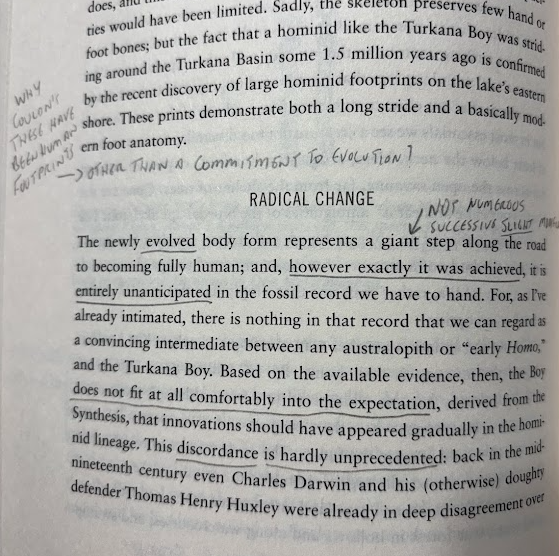
The reason I bought and reviewed this book was the quote just below. When I heard Dr. Christopher Rupe (who himself is a paleoanthropologist) read this quote during his presentation, I had to see it for myself. You can see the whole video from Dr. Rupe here. He reads the quote at about 58 minutes in. I found it on page 207 in Tattersall’s book:
Evolutionists teach that numerous successive slight modifications over millions of years allow creatures to gain new traits to outcompete their unfit counterparts in the struggle for survival. Slow and steady accumulations. But Tattersall is admitting that this kind of evolutions is not supported in the fossil record. He has to invent NEW evolution, and while he doesn’t use the word, notice how easily you could plug in the word miracle as a synonym for each green word below
As I have already observed, this suggests that the physical origin of our species lay in a short-term event of major developmental organization, even if that event was likely driven by a rather minor structural innovation at the DNA level. Such an occurrence is made more plausible by the fact that genetic innovations of the kind that probably produced us are most likely to become “fixed” (i.e., the norm) in small and genetically isolated populations…In other words, conditions in the late Pleistocene would have been as propitious as you could imagine for the kind of event that would necessarily have had to underwrite the appearance of a creature as unusual as ourselves.
Evolutionists say they don’t believe in miracles. They only believe in science…
But notice how they just avoid the word “miracle” with synonyms…and it continues
But the results of this acquisition were revolutionary: in today’s jargon, they were “emergent,” whereby an adventitiouschange or addition to a pre-existing structure led to a whole new level of complexity and function. Exactly when our amazing capability was initially acquired is something we cannot read directly from the fossil record: the paleoneurologists, those specialists who specialize in the form of fossil brains as determined from the impressions they leave inside the cranial vault, cannot even agree in principle if there us any functional significance to the minor external shape differences
Emergent = miracle
adventitious = miracle
Tattersall admits that the fossil evidence is missing…and his field of expertise is looking at fossils. He assumes that SOMEONE SOMEWHERE MUST have the evidence for evolution, it’s just not in his field
some believe
speculation
sometimes it seems like a miracle
The specifics still evade us, and we as yet have no idea what the genetic rearrangement was that gave rise to the unique anatomy of Homo sapiens. All we know for sure is that this event did indeed occur. But it seems overwhelmingly likely that….our new cognitive ability was acquired as a byproduct of the hugely ramifying genetic accident…Happily for us
The speculation and miracles continue. I don’t see any reason to accept the idea that humans evolved by means of natural selection acting on random mutations…the theory of evolution, which is what this book was an attempt to explain
The story-telling continues
I’ve already briefly mentioned the classic example of feathers, which were possessed by the ancestors of birds many millions of years before these modified dermal follicles were ever recruited as essential components of the flight mechanism. Similarly, the ancestors of terrestrial vertebrates had already acquired the rudiments of legs while they were still fully aquatic, and a terrestrial existence was still far in the future. You simply wouldn’t have predicted their future function when they first appeared. What is more, evolutionary novelties often persist if they don’t actively get in the way; and in the case of Homo sapiens the potential symbolic thought evidently just lurked there, undetected, until it was “released” by a stimulus that must necessarily have been a cultural one-the biology, after all, was already in place.
If you read that paragraph and know anything about evolution, you will declare: “That’s not how evolution works!” Evolution is said to work by reproductive fitness. Essentially, this means that whatever new traits that random mutations can provide, natural selection can judge whether or not to preserve that trait by how well it improves the ability to produce more offspring. Partially formed feathers can’t be preserved because there’s no evidence that they provide any increased fitness. It’s not just that these proto-feathers had to improve fitness in a single individual. These non-flight (what evolutionists think were broken dermal follicles) proto-feathers had to get fixed in an entire population of non-flying reptiles (as the story goes) and after millions of years get converted to the supremely well-designed flight feathers that we see today. Remember, there is no evidence that feather-like broken dermal follicles ever existed. But even if we grant that they did, they could not be preserved by natural selection if they didn’t provide a reproductive advantage for an entire population of reptiles! Same with rudimentary legs (stumps). Their wild assertions of stumps and follicles surviving millions of years of natural selection ruthlessly streamlining the phenotypes is absurd and definitely NOT evolution. They are appending a NEW story onto evolution in an attempt to explain the inexplicable. Now Tattersall invents the idea that “symbolic thought” just emerged miraculously even though the components were supposedly there all along too. In their attempt to prove evolution, they have to redefine evolution to include non-evolutionary (or in this case anti-evolutionary) mechanisms
believe
sparking speculation
has done nothing to quell the argument
suggestion
We can expect debate
notion
It’s anybody’s guess
Maybe
maybe
will require a lot more information than we have at present
suggests
almost unimaginable
remains a subject of pure speculation
If you asked an assortment of scientists interested in this question what that stimulus might have been, two clear frontrunners would probably emerge
we can guess
Some scientists believe
This is an attractive idea momentous event
Maybe. Maybe. Maybe
But this has proved a tricky endeavor, for individual words change quite rapidly over time: so rapidly that beyond a time depth of about five thousand years, or ten at the very most, it turns out to be fairly hopeless to look for substantial traces of relationship
5000-10000 years ago? Sounds very much like a biblical timeframe. At least I agree with Tattersall above
In figuring out just what it is that makes our brains special, we always have to keep in mind that our controlling organ is a rather untidy structure that, from very simple beginnings, has accreted rather opportunistically over an enormous period of time. So perhaps we shouldn’t be looking for one single major “keystone” acquisition. Instead, the extraordinary properties of the human brain are likely emergent, resulting from a relatively tiny-and altogether accidental-addition or modification to a complex structure that was already , and exaptively, almost prepared for symbolic thought.
As Darwin admitted in his autobiography: “Can the mind of man, which has, as I fully believe, been developed from a mind as low as that possessed by the lowest animals, be trusted when it draws such grand conclusions?”, Tattersall too is left admitting his belief that the human brain accreted accidentally. Why should an accidental accretion of neurons be trusted to provide reasonable conclusions? Would you trust the results of a calculator that was accidentally thrown together? I wouldn’t, and neither should you.
To sum up, Tattersall is a talented writer, and he is an excellent apologist for evolution. I’m sure he does a great job digging up bones. But I find that his attempt to convince critical thinkers that humans evolved (natural selection acting on random mutations) from lower animals is based – not on evidence – but on a religious commitment to naturalism. Evolution fails to explain the origin of humans.
For other areas where evolution has failed to explain the origin of:
In these series of posts: “Can Evolution Explain…” we have seen that the LOUD and TRIVIAL mantra: “there are mountains of evidence for evolution” rings hollow. What the internet evolutionists believe as gospel because it has passed through the peer-review process, is really just an accumulation of assumptions and artwork. The links to all of my review articles in this series are at the end of this post
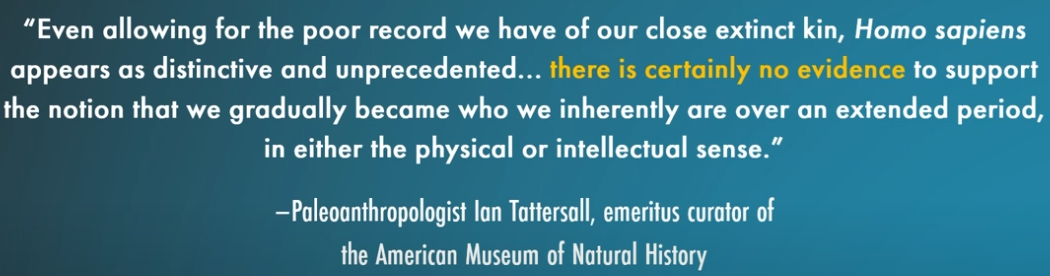
Who would know the story of human evolution best? Dr. Ian Tattersall is regarded as one of the top 5 paleoanthropologists of the last 100 years and has served as the Curator Emeritus in the Division of Anthropology of the American Museum of Natural History. Surely, if the evidence strongly supports the belief that humans are the result of natural selection acting on random mutations from creatures that were not human, we should be able to learn this information from his book, Masters of the Planet – The Search For Our Human Origins. So I bought the book and read it.
Writing a book is a monumental task, and Tattersall is an excellent writer. He has done a great job in his research, and I was never bored reading through his book. Tattersall attempts to make the case that the emergence of language is the defining trait that led to humanity.
As you will see, my contention is with his assumptions, his supposed evidence, and his conclusions. As with the other reviews, Tattersall’s comments will appear in red with my comments in the default black. Any bold or italics in his quotes are added by me to highlight many of his problems. Let’s get to it
perceived in the apes a bestial savagery that served as an unwelcome reminder of humanity’s feared and (usually) repressed dark side
This is the 2nd sentence of the prologue. Right from the beginning, we see the assumption of common ancestry tied to chimpanzees. It is his right to make and state his assumptions, but as we will see, there’s no reason to be persuaded by his assumptions
Most importantly we have learned a great deal about the diversity and behaviors of our precursors on this Earth: certainly enough to allow us to begin speculating with some confidence about how, when, and in what context humankinds acquired its extraordinary habits of mind and communication
This is a common theme. There is speculation based on Tattersall’s basic assumption throughout the book.
Again from the Prologue, Tattersall proposes the idea that instead of natural selection (evolution) designing an “optimal” and predictable brain:
the long and untidy process that gave rise to the human brain…it is the very messiness and adventitiousness of our brains that makes them-and us-the intellectually fertile, creative, emotional, and interesting entities that they and we are
This perspective conflicts with the view of evolution that most of us were taught in school-where. if it was mentioned at all, this most fundamental of biological processes was usually presented as a matter of slow, inexorable refinement, constantly tending toward achieving the perfect.
Tattersall takes the view that instead of the typical evolutionary story of natural selection bending the human brain to be more rational and more optimized, the untidy and random nature of evolution that produced human thought. It’s similar to what Charles Darwin himself said in his autobiography as to why human reasoning (if the result of evolution) ultimately has no logical reason to produce trustworthy thought:
Incredibly, Tattersall inadvertently recognizes the case that Dr. John Sanford made in his magnificent book, Genetic Entropy and the Mystery of the Genome, that natural selection CANNOT preserve or remove traits at the genetic level. Natural selection can theoretically only act against the phenotype, which is why degratory mutations accumulate in the slippery slope towards extinction. Devolution is the norm.
In the end, natural selection can only vote up or down on the entire individual, which is a real mash-up of genes and of the characteristics they promote. It cannot single out specific features to favor or disfavor
Evolution is a myth
And there are yet other reasons for not expecting that evolution should produce tidy perfection. As I’ve already suggested, change can only build on what is there already, because there is no way that evolution can conjure up de novo solutions to whatever environmental or social problems may present themselves
If you didn’t know better, you’d have thought a creationist wrote that paragraph. This is true! Evolution CANNOT conjure up novel traits by means of natural selection acting on random mutations. It was very fulfilling to read this admission from a staunch evolutionist. They DO rely on the idea of miracles to produce new traits and human reasoning, but they have to imagine that nature can benevolently give them these miracles. He gives voice to this in this next section
Of course, it’s also true that not all mutations are equal. Some will have little or no effect on the adult organisms; but a few may have a radical influence on the developmental processes…for all of these reasons we should not expect significant evolutionary change in physical form to happen always, or even usually, in tiny and incremental steps. As we will see, sometimes a very small change in the genome itself can have extensive and ramifying developmental results, producing an anatomical or behavioral gap between highly distinct alternative adult states.
He can’t call them miracles, and he can’t point to any evidence, but he imagines a mutation to have been the magical step from brutish to cognitive ape. There’s no evidence for this, but for his worldview to be true, he has to imagine it. Notice too how to dismisses the standard evolutionary story of “tiny and incremental steps”, which undergirds to the whole theory of evolution in order to make his case for a fantastical unscientific leap in human development. It’s not evolution or science…it’s pure imagination
chapter 1 Ancient Origins
There is much speculation in this chapter, and I’ll list some of the many examples
luckily
as fate would have it
most remarkable
probably
may actually have
Given this reality, it is hardly realistic to expect that we’ll ever find an anatomical “silver bullet” that will by itself tell us infallibly if an ancient fossil is a hominid or not
there’s always an element of human judgment involved
the materials attributed to Orrorin are fragmentary, consisting of some bits of jaw and teeth and several limb bones believed (but not demonstrated) to have belonged to members of the same species
might be
Ar. kadabba is represented only by miscellaneous materials from sites scattered in time and space, and their association in the same species is even less secure than in the case of Orrorin
a lot of subjective judgment
Ardi is a mysterious beast
are not hugely obvious
These elements all add up to a great story, and they may well have been important individually
Presumably
must have
But exactly how and in what precise context the in-line terrestrial foot was acquired remains tantalizingly obscure
This deficit in our knowledge is hugely unfortunate because, given that everything that happened later was dependent on the fateful transition from the trees to the forest floor, it presents us with one of the most fundamental mysteries on all of paleoanthropology
host of questions
Most of the known fossils of this species are teeth and bits of jaws
acquired
acquired
plausible
potential
would have
probable
point to
After the 24 pages of chapter 1, Tattersall has build only a foundation of speculation and story-telling to fill in the canyon-sized gaps. He uses the verb “acquired” several times without any explanation. Just acquired as if the protohuman creatures got a Prime delivery from Amazon. As I have contended from the beginning, chapter 1 was simply a collection of assumptions; no evidence for evolution
Chapter 2 The Rise of the Bipedal Apes
There’s no improvement for the case for evolution in the second stanza
It’s interesting to speculate how differently we might interpret hominid evolutionary history today had the older fossils been discovered first…the order of discovery of our fossil relatives has deeply influenced their interpretations
So often in discussions about evolution, advocates claim that “evolution is science”, but Tattersall – in preaching to the choir – drops the facade to reveal that what is commonly claimed to be evidence is really speculation based on interpretations
But it should never be forgotten that everything we believe today is conditioned in some important way by what we thought yesterday; and some current controversies are caused, or at least stoked, by a reluctance to abandon received ideas that may well have outlived their usefulness
If for 150 years, academia has solely and tyrannically taught evolution as true, it’s no wonder that the last 4 generations of professors believe evolution to be true…and since any evolution dissenters are vehemently removed from academia, there’s no reason to believe that evolutionism will be challenged in the next few generations. Only the most steel-spined critical thinkers do not cave to the pressure from the evolutionists
So, a tolerably complete skeleton from this incredibly remote period in time was an almost unimaginable piece of luck
Given the evolutionary view – millions of years of slow and gradual natural processes – there should be practically no fossils at all. Dead creatures would be exposed to scavenging and decay as they wait for slow accumulation of sediments to protect them such that no creatures should be expected to be preserved as fossils. In any case, the key fossils that should have been available to show the smooth transition of 1 kind of creature to another (the mountains of evidence for evolution) are certainly “missing”. Conversely, since the Bible is true, and there was a global flood about 4500 years ago, we would expect to find billions of dead creatures, buried in water-sorted rock layers all over the Earth. The evidence strongly affirms the Bible, while the evolutionists call the finding of fossils to be “an almost unimaginable piece of luck”
Regarding the Laetoli footprints found in layers which evolutionists believe to be 3.8 million years old (about 3 million years too early to be human footprints)
seems to reflect the way we walk…The feet that made the prints were structured essentially like ours…strikingly modern…remarkably humanlike bipedality
Because of evolutionary assumptions, the Laetoli footprints, although exactly like humans, were dismissed as human ancestors because of the layers in which they were found. Evolutionists did NOT follow the evidence where it leads but have let their preconceived biases color their conclusions. Regarding the A. afarensis fossils from Hadar, Tattersall had this to say:
Frustratingly, it has no foot bones, leaving lots of room for speculation
Speculation indeed
But you need to know that all interpretation of the Middle Awash materials by their discoverers has been conditioned by the underlying belief that the story of human evolution has essentially been a linear one. The idea is that a central lineage gradually transformed under natural selection from one species into the next, until the primitive Ardipithecus had been transmuted into the finely burnished Homo Sapiens
Whether the underlying belief in evolution of some group of evolutionists or the “new” underlying belief in evolution from Tattersall, the underlying belief is clearly just a story. A story that dismisses the revelation of God in the Bible in favor of a naturalistic novel.
Our (human) hands, with their broad palms, long thumbs, and the ability to oppose the thumb to the tips of all the other fingers, are ideally structured to manipulate objects
“Ideally structured”?!!? You mean designed perfectly for their intended purpose by the Creator of the universe.
Chapter 3 Early Hominid Lifestyles and the Interior World
Going through this chapter, I’m again going to point out the ubiquitousness of uncertainty
would have been
would not have been
possibility
unlikely
must have
must have been
possibility
no good evidence
some authorities think
have been made possible
must have been
might well have
while this story…
possibilities
may well have been
may have
may have
possibility
would have been
possibility
suggests
might have been
not at all a sure bet
might have become
if they did
would be
would have
might have
of some kind
Sadly, at present there is much less to say about these ancient precursors than we’d like, although it’s a good bet
Perhaps
probably
would have been
hazy and incomplete
is not something we can hazard with any confidence at this point
seem to
There is no way to answer this question
approximate
presumably
The temptation is to assume…Yet the truth is that we simply cannot know
seemed to indicate
as far as one can tell
plausible
suggest
You can see from this chapter that there is little science going on, but lots of assumption and story-telling. And EVERY chapter is filled with these speculations and story-telling. Where’s the evidence?
Chapter 4 Australopith Variety
In this chapter, Tattersall builds that case in which he believes there is a great deal of variety among creatures that he thinks are not human ancestors. Just a few lines from this chapter that solidify the guessing game that goes into the story of human evolution based on rare and fragmentary fossils
nobody knew…Neither did anybody know exactly how old these early hominids were, although from the accompanying faunas is was guessed…the ankle joint looked fresh…perhaps…This fits nicely with the interpretation…Despite their strikingly different histories of interpretation…early biped species were actively experimenting with ways to exploit their hominid heritage…The unfortunate truth, however, is that this specimen also is so poorly preserved that it is difficult to know what to do with it…The hominid stage was packed with actors, all pushing and shoving for the limelight
Interpreting fossils is just that. Interpretation. To get an evolutionary interpretation of the fossils, one must first believe in evolution and that evolution by means of natural selection acting on random mutations can produce functional cohesive interrelated interdependent systems first. Anyone, who recognizes the truth that evolution cannot do produce systems is not persuaded by the interpretations of the “experts”. Regarding the last sentence of the above quote, these paleoanthropologists don’t actually produce anything that generates income. They rely on the donations of others in the forms of academic grants or benevolence to dig up fossil bones. What better way to generate interest in your work than to claim that you have discovered a human ancestor fossil? Whether the claim turns out self-aggrandizing or ultimately rejected doesn’t matter as long as there is enough interest to fund the next digging season.
Chapter 5 Striding Out
In this chapter, Tattersall tries to build the case that non-human human ancestors are related because of skull shape and bipedality. He focuses mainly on some fossils that have been named Homo Erectus and Homo Ergaster.
People have referred themselves to human since long before anyone had the faintest idea that our species is connected to the rest of the natural world by an extended series of long-vanished intermediate forms
“long-vanished” indeed. And the fossils are STILL missing. It’s why this we all use the term ‘Missing Link’. And notice how evolution by means of common ancestry is ALREADY assumed to be true. He’s made no case for the idea that humans are related to minerals, plants, and fish…just assumed it.
there is not one fossil among all those known in the period before about two million years ago that presents itself as a compelling candidate for the position of direct progenitor of the new hominids to come…This uncertainty is partly due to the fragmentary nature of the evidence…it is difficult to make sense of the abundant but frustratingly incomplete evidence that we have at our disposal
Not one. So, it’s not just a single link that is missing…but hundreds. Thousands. Millions of missing links. It takes critical thinkers (like Christians) to hold the overwhelming proselytizing of the evolutionists at bay long enough to dig deep into their literature like this to uncover their uncertainty and admissions of wild speculation
under the guiding hand of natural selection
I know that Tattersall does not believe in a literal hand of natural selection, but this is the ultimate conclusion of evolutionists. They believe that evolution was unguided. They see the necessity of guidance in forming functional cohesive interrelated interdependent systems, so they reify natural selection as if it is a prescriptive “divine” force rather than just the description of creatures without certain traits being culled. Evolution is inherently religious even though evolutionists despise being reminded of their religious-in-nature claims
Some of you might not believe that evolutionists would be so frank with their admissions with the problems of evolution, but Tattersall clearly thinks he’s ‘preaching to the choir’, and he willingly lets down the facade.
p94 Masters of the Planet
…whether or not “Nature makes jumps.” Darwin focused on slow, incremental change, while Huxley was worried by the many discontinuities he saw in the fossil record-and in nature in general-that were inconsistent with this pattern…as well as in a host of other apparent discontinuities.
Evolutionists teach their theory as if it is the slow and incremental change over time. Single, successive, slight modifications, but Tattersall recognizes the problem with the theory because the fossils don’t show this. The fossils instead show abrupt appearance and then stasis. The Theory of Evolution MUST be slow and gradual, but the evidence is inconsistent with this pattern because of a HOST of discontinuities. So much for the “mountains of evidence for evolution”.
Tattersall released this book in 2012 when almost every evolutionist believed in Junk DNA. He spends a few pages talking about how Junk DNA is what evolutionists would expect if evolution were true. Unfortunately for him (and all evolutionists), the ENCODE project was released between 2013-2015, and completely buried this argument for them.
Strange though: why would a paleoanthropologist spend any time on genetics if his expertise is in fossils? I’ve found this is often the case amongst evolutionists. They believe that since the theory of evolution has staved off extinction this long then SOMEBODY must have the evidence since there’s none in their own field.
On pg 97 he does reveal some evidence, but it’s not for evolution; it’s for devolution
subtle genetic modifications might produce large phenotypic differences…As a result the bottom-livers have lost the spines…The modification is not trivial, involving as it does the elimination of an important part of a complex structure…a small stretch of regulatory DNA has been deleted. This left the basic gene intact to do its essential task, but it has eradicated the development of spines by reducing its activity in a specific area of the body…Most changes on this scale will actually be disadvantageous
You can’t get from bacteria to Bach with this kind of deleterious evolution. He does return to fossils shortly thereafter…sorta
Perhaps the Turkana Boy’s radically new bodily conformation can be attributed to a genetic event of a similar kind…So maybe…Perhaps there simply weren’t any such intermediates-or at least none that we could reasonably expect to find on the coarse time scale that the fossil record represents. Something routine and unremarkable on the genomic level had occurred…it just happened to change the course of hominid history
No fossils. No evidence to record this monumental event that they need to make their case. It’s a grand story filled with ‘maybes’ and ‘perhaps’, but what’s missing is the actual mountains of evidence for evolution
This post has gotten pretty long. Check back next week for Part 2 of the book review
One of the giant problems for those who believe in evolution is the missing evidence for the transition of single-celled organisms into multicellularity. According to the story of evolution there was a single-celled Last Universal Common Ancestor LUCA from whom all biological life descended. No evidence for this supposed LUCA exists, but it is a philosophical place-holder for the theory of evolution to persist. If the theory of evolution is true, at the VERY LEAST, the evolutionists must have some kind of explanation for transition from single-celled creatures into the multi-cellular creatures that we see today
In an online interaction, an evolutionist made the claim that the problem was solved in 2019. Some researchers had their paper pass peer-review, and in they claim that multicellularity evolved in response to predation. At the time of this writing, their paper has been cited 181 times. Commonly, a case gets accepted simply by passing peer review. I’ve not found evidence that the experiments described in their paper have been duplicated anywhere, but it’s reasonable to cross-examine their claims to see how they stack up. This is a very biblical response to their claim:
So, let’s cross-examine, to see if there are any weaknesses in their claims and if their claims hold up to even the mildest of scrutiny:
According to the story of evolution, the algae in question has persisted unchanged for ~310 million years. That’s some pretty amazing longevity (if true). But the researchers from this paper claimed to have observed the evolution of this novel trait in the comparably instantaneous time of 50 weeks…less than 1 year. Despite it being one of the biggest problems for evolutionists, the emergence of multicellularity from single-celled organism, these scientists claim to have taken one of the most stable genotypes (having existed fixed for over 300 million years) and watched it evolve new traits in less time than it takes to complete a cricket tournament (I think…as I’ve never really understood those rules). It’s mind-numbingly absurd to believe that evolution can happen that fast considering the claims of evolutionists themselves and the well-known waiting-time problem. The biggest single leap in evolution from single to multiple cells happened right before the eyes of these researchers in under a year. I’m unpersuaded
They didn’t show that natural selection acting on random mutations (evolution) was able to produce this change, yet they use some form of “evolve” NINETY-SEVEN times in their article. I’ve been told that science is supposed to try to disprove a theory, but it’s clear that these biased researchers were good company-men…sticking with the party-line: evolution only all the time!
This is they key: The evolutionists said that predation was the selection pressure that forced single-cell algae populations into multicellularity, but they did not show that the algae developed new biological code via random mutation that produced this ‘novel’ ability. New code is needed, but evolution does not have that power
The experiments show instead that the ability to aggregate into multi-cellular clumps is a pre-existing trait. The algae were designed to cluster, and the expression of genes for multicellularity is turned off most of the time when not exposed to predation
There is no fossil evidence of unicellular-to-multicellular transition. It is an imagined transition, which evolutionists need for their theory. But it is not supported by any existing evidence.
As already noted, the evolutionists NEED this to imagined transition to be true for their theory to work. So, even though there is no fossil evidence that evolution produced this change, and there is no experimental evidence that natural selection acting on random mutations can build the cohesive interrelated interdependent functional code for transitioning single-celled organisms into multicellular organisms, they will continue to believe it
If you are interested, you can see a more robust examination of the claims of Herron’s paper here.
This is not the only time that I have scrutinized the supposed airtight arguments for evolution:
After posting these “Can Evolution Explain…articles, I inevitably hear evolutionists respond with some form of: “get your paper peer-reviewed and only then can you get your Nobel Prize for disproving evolution. Until then STFU!”
To be clear, these “Can Evolution Explain…” articles are NOT intended to disprove evolution. They are simply meant to analyze the assertions of evolutionists to see whether the subject matter is actually evidence for evolution by their own standards or not. It’s an internal critique. What I find in all of these articles is that what’s been proclaimed as “mOuntAinS oF eVidenCe” for evolution is really just story-telling and assumptions. We’ve seen that this article is more of the same bluster devoid of actual evidence.
There will be no shortage of “papers” that the devout evolutionists will propose that I must analyze. I don’t have the time or the desire to expose EVERY single article, but I do analyze the top authors and the articles that evolutionists THINK are actually evidence as shown above. Hopefully, given the example of my analysis, other Christians will be motivated to expose how the “mOuntAinS oF eVidenCe” for evolution are really massive canyons. These articles are not intended to prove creationism or anything else. They are simply meant to push back against the dominant paradigm rather than just blindly accepting what is being taught. If these works of evolution can survive scrutiny, then so be it, but so far, I’m finding that their claims are impotent.
But let’s walk through the peer-reviewed paper, which an anonymous internet philosopher claims was the ‘silver bullet’ in proving evolution. Here’s some of their musing in red, followed by my commentary in the default black
“The evolution of novel traits necessitates the evolution of novel gene regulatory architecture”
True! Evolution requires evolution of evolution within evolution…all the way down
“coevolve when duplicated genes evolve new regulatory control”
Not just evolution of evolution, but coevolve evolution.
“understanding the features that coordinate gene regulation is particularly challenging in eukaryotes because it involves the simultaneous action of cis- and trans-regulatory factors, chromatin state, and three-dimensional interactions of chromatin, including the precise coordination of enhancers and promoters”
Particularly challenging indeed! Simultaneous action? 3D interactions? Precise coordination? Simultaneous is not one of the expectations or predictions of evolution. Evolution is said to have occurred via numerous successive slight modifications…not simultaneous (undefined, ambiguous) action. Three-dimensional interactions sounds very mysterious…even supernatural. But evolutionists just accept these supernatural interactions as if they were somehow truly part of their theory. And that brings us to “precise coordination”. They claim that natural selection acting on random mutations (the mechanisms of evolution) are unguided and blind. There is again the assumption that nature can somehow provide “precise coordination” though blind, directionless, and purposeless
“most VGs are thought to have evolved through tandem duplication of genes with other physiological functions”
Thought to have evolved? Doesn’t sounds like science
“the evolutionary origins of their regulatory architecture remain poorly understood“
Poorly understood indeed! But I’m sure that won’t keep them from trying to educate us. All of these evolution stories are based on assumptions, and though the actual history (AS THEY CLEARLY ADMIT) remains poorly understood, they still demand complete obedience to their story. No dissent from their narrative allowed
“that may play”
May
“have remained largely unexplored“
Largely unexplored.
“provide an example of how multiple genomic mechanisms may together establish a novel regulatory system”
May. ‘May’ again. No science…just ‘may’
“likely contributed to the evolution of novel regulatory mechanisms”
Likely? I thought we were talking about science, but ‘likely’?
“makes foundational progress toward closing a long-standing gap in our understanding of snake venom systems and their origins”
They are making progress in closing the gap in their understanding. They have not solved the problem…they just claim to have closed the gap. No science. No evidence. Hopium is a powerful drug
If it’s evidence, we should expect to see explicit demonstrations of natural selection acting on random mutations to produce information for biological traits like venom. If it’s not evidence for evolution, we will see words of assumption like perhaps, possibly, may have, likely & suggest intermixed with some clever story-telling. God-deniers tend to make grand claims about the power of evolution, but when their claims have been scrutinized by simply reading the peer-reviewed articles, it’s clear that what they believe to be evidence is actually a collection of assumptions wrapped in the façade of scientific language. The origin is biological traits is a well-known problem for evolutionists, so we’ve seen how these authors tried to handle the problem. They left us with the admission that they made “progress toward closing the gap in their understanding”. Unfortunately for them, the gap is 100 miles wide, and they think they built a 3″ bridge.
This is not the only time I have scrutinized their supposed airtight arguments for evolution:
After posting these “Can Evolution Explain…articles, I inevitably hear evolutionists respond with some form of: “get your paper peer-reviewed and only then can you get your Nobel Prize for disproving evolution. Until then STFU!”
To be clear, these “Can Evolution Explain…” articles are NOT intended to disprove evolution. They are simply meant to analyze the assertions of evolutionists to see whether the subject matter is actually evidence for evolution by their own standards or not. It’s an internal critique. What I find in all of these articles is that what’s been proclaimed as “mOuntAinS oF eVidenCe” for evolution is really just story-telling and assumptions. We’ve seen that this article is more of the same bluster devoid of actual evidence.
There will be no shortage of “papers” that the devout evolutionists will propose that I must analyze. I don’t have the time or the desire to expose EVERY single article, but I do analyze the top authors and the articles that evolutionists THINK are actually evidence as shown above. Hopefully, given the example of my analysis, other Christians will be motivated to expose how the “mOuntAinS oF eVidenCe” for evolution are really massive canyons. These articles are not intended to prove creationism or anything else. They are simply meant to push back against the dominant paradigm rather than just blindly accepting what is being taught. If these works of evolution can survive scrutiny, then so be it, but so far, I’m finding that their claims are impotent.
I’ve been told that natural selection acting on random mutations has enough power to produce every biological trait…including sex. I’ve put these claims to the test several times before each time with the same result…no evidence…just assumptions:
God-deniers believe that numerous successive slight modifications (random mutations)
when culled by the forces of natural selection can explain all biological traits. They do not like to be cross-examined as to how natural selection can preserve non-functioning irreducibly complex systems like biological sex, but they cope with fantastical stories of the mystical powers of evolution. Recently, a God-denier posted a link which he thought provided airtight evidence that evolution is responsible for producing sexual reproduction. Let’s put that article under some scrutiny. If it’s evidence, we should expect to see explicit demonstrations of natural selection acting on random mutations to produce information for sex. If it’s not evidence for evolution, we will see words of assumption like perhaps, possibly, may have, likely & suggest intermixed with some clever story-telling. The God-Denier in question, Finn, has before made grand claims about the power of evolution, but when his claims have been scrutinized by simply reading the peer-reviewed articles, it’s clear that what he believes to be evidence is actually a collection of assumptions wrapped in the façade of scientific language. The origin is sex is a well-known problem for evolutionists, so let’s see how these authors handle the problem. Do they deal with the problem using evidence or assumptions?
Here’s how this works: The quotes from the article are in red italics and then just below/after the quote, I’ll post my analysis in the default black font. I have added bold and underline to key words from the authors throughout, so this is just a note to say that neither the bold nor underline appear in the original article.
I’ll begin with the word count of caveat words. Goodenough and Heitman couch much of their story-telling with words that will give them a certain amount of ambiguity for escape:
“possible and possibly” – 6
“could” – 7
“might” – 16
“perhaps” – 2
“may” – 32
“likely” – 10
“hypothesis and hypothetical” – 5
“suggest, suggests and suggesting” – 16
“evolve” – 14
“evolution” – 82
This should tell you right away that we’re not dealing with any kind of evidentially-founded science here. This is a grand story wrapped in scientific jargon and ambiguous assumptions
“During the course of this evolutionary trajectory, the LECA became sexual“
It just “became sexual”. This is a post hoc fallacy: “sexual reproduction is observed, so evolution must have done it”. It’s absurd
“We propose that the transition to a sexual LECA entailed four innovations: (1) alternation of ploidy via cell–cell fusion and meiosis; (2) mating-type regulation of cell–cell fusion via differentiation of complementary haploid gametes (isogametic and then anisogametic), a prelude to species-isolation mechanisms; (3) mating-type-regulated coupling of the diploid/meiotic state to the formation of adaptive diploid resting spores; and (4) mating-type-regulated transmission of organelle genomes. Our working assumption is that the protoeukaryote → LECA era featured numerous sexual experiments, most of which failed but some of which were incorporated, integrated, and modified. Therefore, this list is not intended to suggest a sequence of events; rather, the four innovations most likely coevolvedin a parallel and disjointed fashion“
This is a long section that shows their proposal, their assumption and ultimately, not just the need for a single marvel of evolution, but multiple (coevolution) simultaneous marvels occurring in geographic proximity. Sometimes, a research (or science fiction writer) can get away with introducing a single unexpected/preposterous idea into a story. But the proposal becomes absurd when the reader is expected to believe numerous preposterous ideas (parallel coevolution of compatible corresponding functional interdependent sexual organs, systems, desires, abilities, and cascading offspring developmental solutions ALL at the same time and in the same place) in a “disjointed fashion”. It doesn’t just stretch incredulity, it mocks the readers as rubes.
“Once these core sexual-cycle themes were in place“
As if these themes could just be assumed to jump into place. It’s not persuasive at all
“That said, the ability to toggle from haploid to diploid and back again is dependent on a mechanism for ploidy reduction, which, in modern eukaryotes, entails meiotic or parasexual processes“
They have identified a NEED for sexual reproduction, but that’s a far cry from showing that numerous successive slight modifications over time can meet that need. Let’s see of either of their proposed processes parasexual or meiotic processes can do the job
“we use as examples modern organisms whose mating-type-based sexual differentiation is already established. In subsequent sections we will consider how sexual differentiation itself might have originated and evolved“
Already established?!?!?? That’s like taking an existing nut & bolt and explaining how an ratcheting wrench evolved by random mutations. If it’s already established, how are you demonstrating how it came about my an accumulation of random mutations?
“One interpretation is that the functions of Spo11 have been reconfigured to play a mitotic, parasexual role. Alternatively, the parasexual cycle of C. albicans could involve some aspects of meiosis (such as Spo11-dependent chiasmata), but given the high rate of aneuploidy (e.g., 2N + 1, 2N + 2) that is generated, it does not produce accurate outcomes, and might be considered something akin to a “parameiosis”“
One interpretation indeed. In a peer-reviewed paper, we’re looking for actual evidence rather than “could have”. Parasexual processes didn’t result in the solid ground they were looking for. What about Meiosis?
“An alternative view is that meiosis arose early, without prior parasexual experimentation, as a means to generate haploid progeny from a diploid progenitor. Early meiosis was likely messy and inaccurate—perhaps only somewhat better than parasexual changes in ploidy—with more accurate mechanisms evolving subsequently“
These are clearly guesses, not evidence. Remember in the definition of natural selection, we noted that only those traits deemed most fit would be preserved. How can natural selection preserve messy and inaccurate processes as more fit than something (asexual reproduction) that works very well? Broken unformed traits cannot be preserved if they do not increase fitness according to the teachings of natural selection
“In either view, the enzymes and machinery for meiosis presumably evolved from a core set of DNA-manipulating enzymes brought in and modified as needed from prokaryotic forebears“
We were looking for evidence in this paper, but we’ve been given “presumably”. But the real focus should be on their claim that evolution can “modify as needed”. This is a wild claim, which it completely opposed to the theory of evolution. Evolution is supposed to be completely unguided with no purpose and no foresight. But they’ve tried to smuggle in the idea that evolution can solve problems with foresight by converting hammers into wrenches. It’s not science. It’s hope in the mystical forces of nature
“Recognition of self is not, of course, a eukaryotic novelty. The widespread occurrence of biofilm formation and quorum sensing in modern bacteria (Vlamakis et al. 2013) and archaea (Koerdt et al. 2010; Frols 2013) suggests that the forebears of protoeukaryotes likely engaged in such self-recognition behaviors as well. Modern prokaryotic systems feature the secretion of lineage-specific extracellular matrix materials and small molecules; their receptor-mediated perception then triggers signal-transduction cascades that modulate growth and metabolism. Hence self-recognition modules presumably existed in the protoeukaryotic gene pool that, with evolutionary tinkering, allowed like-like haploid cell adherence to trigger intracellular signals that elicited the conditions for cell–cell fusion“
Notice all of the assumptions of matter and events from a supposed billion years ago! My favorite line from that paragraph is the reification fallacy -> “with evolutionary tinkering”, as if there’s a little cobbler called Mr. Utionary..Evol Utionary. This ingenious engineer tinkers with mutations and existing proteins to construct cohesive interdependent interrelated complimentary systems of male sexuality and female sexuality from spare parts and a pinch of imagination (evolutionary tinkering). Evolution is supposed to be a “force” without foresight or goals, and yet, when described in these peer-reviewed papers, the evolutionists can’t help themselves but give evolution human-like powers
It’s wildly overstating their case to say that it’s like someone trying to construct an engine for a 2025 BMW M5 with parts available only from 100 AD…without an engineer overseeing the parts manufacturing, the assembly, the planning, or the testing
“Exciting recent studies report adaptive changes that occur in the genomes of such cross-species hybrid yeasts isolated and passaged under laboratory conditions; genome rearrangements arise repeatedly and independently“
Notice their euphoric claims that sex simply arose by chance because they observed the injection of code for an existing trait in one yeast not killing a different yeast. That’s their explanation for the origin of cohesive interdependent interrelated complimentary systems of male sexuality and female sexuality. It’s absurdly optimistic and completely unobserved
“The original self-recognition molecules in protoeukaryotic gametes might have engaged in homotypic interactions, like present-day cadherins that adhere to one another“
Might have?!!?? That’s not very scientific
Their “just-so” stories about how a DNA repair system could simply be repurposed as sexual organs is not science…it’s fiction. Their story lacked any reason to believe the nonsense, but since it is wrapped in a thin veneer of peer-review, it will be swallowed as evidence. Those reading past the headline should be able to clearly see the emptiness of the contents in the article as I’ve shown
Objections
After posting these “Can Evolution Explain…articles, I inevitably hear evolutionists respond with some form of: “get your paper peer-reviewed and only then can you get your Nobel Prize for disproving evolution. Until then STFU!”
To be clear, these “Can Evolution Explain…” articles are NOT intended to disprove evolution. They are simply meant to analyze the assertions of evolutionists to see whether the subject matter is actually evidence for evolution by their own standards or not. It’s an internal critique. What I find in all of these articles is that what’s been proclaimed as “mOuntAinS oF eVidenCe” for evolution is really just story-telling and assumptions. We’ve seen that this article is more of the same bluster devoid of actual evidence.
There will be no shortage of “papers” that the devout evolutionists will propose that I must analyze. I don’t have the time or the desire to expose EVERY single article, but I do analyze the top authors and the articles that evolutionists THINK are actually evidence as shown above. Hopefully, given the example of my analysis, other Christians will be motivated to expose how the “mOuntAinS oF eVidenCe” for evolution are really massive canyons. These articles are not intended to prove creationism or anything else. They are simply meant to push back against the dominant paradigm rather than just blindly accepting what is being taught. If these works of evolution can survive scrutiny, then so be it, but so far, I’m finding that their claims are impotent.







 ApoloJedi