
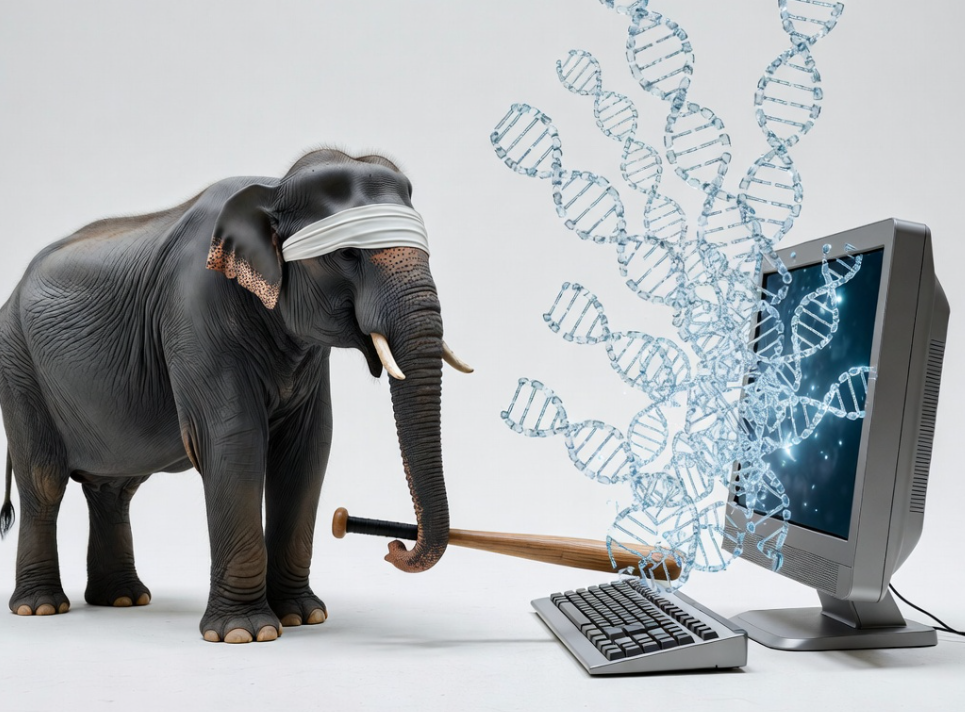
Recently, I posted on X that evolutionists believe the absurd idea that random mutations are responsible for the functional coherent interrelated and interdependent biological code found stored in DNA. I rightly compared this belief to believing that random keystrokes produced all programs
There were 2 main objections:
- “You ignored the contribution of natural selection“
- “Random mutations CAN create biological information“
Let’s address these objections in turn:
Natural selection
What is natural selection? Natural selection is NOT an actual prescriptive force like gravity or magnetism. It is simply a description of the culling of the unfit. Wikipedia describes it as “the differential survival and reproduction of individuals due to differences in the relative fitness endowed on them by their own particular complement of observable characteristics”
There’s an excellent picture that shows clearly how natural selection is described to work. Because of selective pressure, the lighter colored circles tend to be unfit in this particular environment, so the conclusion is that the biological information for the lighter colored circles is LOST in the population.
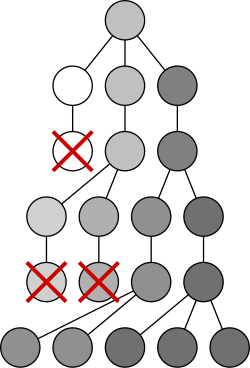
Natural selection has no creative power. It’s simply the description of the loss of information from unfit phenotypes (and their cascading genotype) in a population. Creationists recognize the limitation of natural selection. Some evolutionists hold onto hope that natural selection can somehow provide some kind of creative spark or magical injection of novel traits into the population.
Dr. Jason Lisle gives a fantastic and incredibly detailed description of natural selection in 3 parts shown below:
Now, there are some evolutionists, who do recognize that natural selection is not creative. They do understand that natural selection doesn’t add new information, but they still think that natural selection can take the traits, which are (supposedly) provided by random mutations and fixate them into the species. Their belief comes from the little program that Richard Dawkins proposed in his book “The Blind Watchmaker” called ‘Methinks it is like a weasel’.
The program uses the target phrase “METHINKS IT IS LIKE A WEASEL” from Shakespeare’s Hamlet. While the probability of a monkey randomly typing this 28-character phrase is approximately 1 in 10^40 (virtually impossible), the Weasel program reaches the target in roughly 40–100 generations by:
- Starting with a random string of 28 characters.
- Creating multiple offspring through random mutation (e.g., a 5% chance of changing a letter).
- Selecting the fittest offspring (the one with the most characters matching the target) to become the parent for the next generation.
The problem is that this program does not represent reality at all. Dawkins’s program works such that when a randomly-changed letter appears in the “right” place, it becomes locked and cannot be changed. It artificially assumes both a target and unchangeable spot for the phrase to emerge. The whole program is built on a false understanding of evolution. Yet some evolutionists acknowledge the reality that there is no target in biology. So, right away we know that the program is a complete fraud. It has no basis in biology, but evolutionists still believe the framework that even if random mutations haven’t quite produced an entire biological phrase (akin to methinks it is like a weasel) natural selection can still select for a partially correct phrase. This is completely false.
Natural selection is like a quality control department for a tricycle factory. Quality control cannot add new features to the assembly line. It can only remove poor quality from production. In the same way, natural selection cannot add new biological traits or features. It can only cull the unfit. And it can only SELECT from existing information. Since random mutations cannot produce new code, there is no evolutionary variation from which to chose.
Natural selection DOES happen, but in producing new biological traits, it is completely inconsequential. The REAL issue in this conversation is “From where does the information for new traits arise?”
Random Mutations
Here’s where the fun begins. It is not my intention to provide a full course on random mutations and biological information in this post. There’s plenty of that elsewhere. For purposes of this post, and in accordance with the original claim on X, we will discuss the problem of the evolutionists, who have to assume that since humans share a common ancestor with modern bacteria – that at one time, they believe that all of the biological information for human arms, legs, skeletal system, respiratory system, teeth, eyes, and body hair (along with thousands of other biological traits) did NOT exist within the biological code of the single-celled organism from who we all supposedly descended. We’ll call the original single-celled organism from which all life is supposed to have descended, LUCA (Last Universal Common Ancestor). Now I do not have enough faith in the materialist’s story to believe that such a creature exists, and there is no evidence that such a creature ever existed, but for purposes of this discussion, we’ll grant the simple, information-poor creature.
Let’s get really simple and say that LUCA, having the barest minimum of biological information from which to reproduce and begin this process of evolution had a biological code similar to the simple T-SQL code:
SELECT TOP 10 Name, Address, State, PhoneNumber FROM tbl_Employee WHERE State = ‘TX’ ORDER BY Name
This simple bit of code is likely easy enough to decipher as being able to get the first 10 employees with an address in Texas sorted by name. We’ll assign this simple T-SQL statement as the total code stored in the DNA of LUCA. Since there was not an actual DNA remnant or fossil or any other evidence of LUCA, the evolutionists can’t argue. My analogy grants them far more than they deserve. In our analogy, we know that the code for humans would have to include FAR more biological code. The picture below would represent page 1 of 1000000 of the code that would be required to create a human being. There are variables, loops, if-then-else statements, updates, inserts, qualifiers, system functions, reserved words, temporary tables…the works.
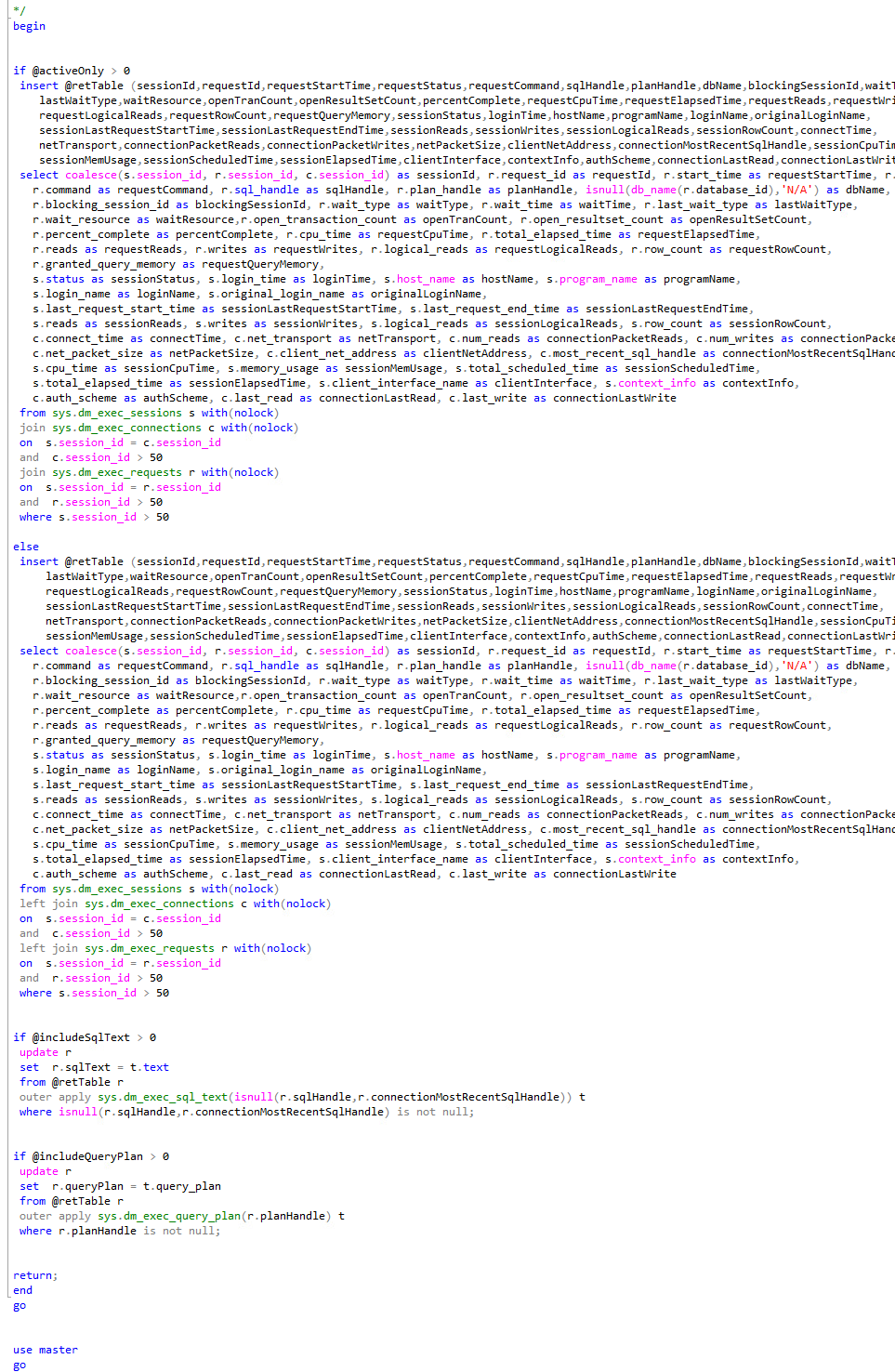
Evolutionists have to assume that somehow the simple original code snippet from LUCA gradually became the more complicated code that we find in humans today. How do they get there? Random keystrokes (random mutations). They have to assume that copying mistakes, duplications, point mutations, and frame shifts were able to get the highly complex code that creates a human. One random copying mistake at a time. It would be like a blindfolded elephant with a baseball bat smashing randomly at the keyboard 1 time every 20 years (1 generation) in the hopes that over millions of years, this type of programming will result in crisp, clean human DNA. It takes a lot of faith for them to believe this, but it’s all they’ve got. Some might argue: “But if the random mutation creates a functional code, then natural selection can preserve it.“

That’s not how programming works. Hoping that randomly smashing keys by a blindfolded elephant once every 20 years doesn’t produce functions, loops, logical qualifiers, or any other kind of design that requires foresight. There’s nothing new for natural selection to preserve. An intrepid evolutionist might suggest: “Well, what if there were a million elephants as part of a population of elephants randomly bashing on a million different keyboards? Surely there would be some functional code in that situation“
Don’t call be Shirley, and no, it would not produce functional code no matter how many elephants and no matter how long they had. It’s categorically impossible in the same way that a perpetual motion machine is impossible.
Another objection is: “What about gene duplication? When there are more copies of a gene, there are more chances that a copying mistake leads to functional code“.
This doesn’t solve the problem in any way. It’s like adding another blindfolded elephant to the keyboard smashing Olympics. No coder. No code. When there are vastly more chances to get gibberish than code from random smashing of keyboards by blindfolded elephants, adding more blindfolded elephants simply adds more chances of accumulating more gibberish.
I’ve even heard some evolutionists smugly declare: “But keyboards don’t make baby keyboards. Are you the same as your parents?!?!? All natural selection needs is variation and reproduction!“
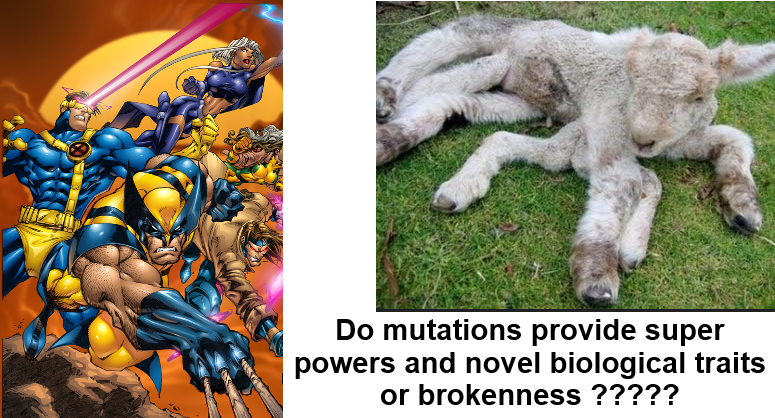
We already addressed natural selection above, and the analogy to parents/children doesn’t help evolution at all. Parents contribute their DNA (both the existing traits and the broken biological code called mutations) to their children. The children can only exhibit the biological traits that their parents provided…plus the degenerative mutations. Over time, these degenerative mutations build up and can lead to serious physical problems. But these degenerative mutations never provide super powers like in the movies about X-men and Avengers. Evolutionists have to BELIEVE that an accumulation of mutations provides ALL novel features ever produced in biology, but the evidence does not support this belief.
We haven’t even gotten into the mathematical impossibility of evolution based on their own beliefs. There just haven’t been enough generations given their timeframe for mutations to become fixed in populations…but that’s a different blog post altogether.
To end this post, we can clearly see that a blindfolded elephant smashing a keyboard with a baseball bat cannot produce the functional coherent interrelated interdependent biological code necessary for the vast array of innovative biological systems that we see today. While the belief in evolution IS VERY POPULAR, it is vacuous in explanatory power. It cannot explain the formation of biological code by an accumulation of random keystrokes.
Objections
In these series of posts: “Can Evolution Explain…” we have seen that the LOUD and TRIVIAL mantra: “there are mountains of evidence for evolution” rings hollow. What the internet evolutionists believe as gospel because it has passed through the peer-review process, is really just an accumulation of assumptions and artwork.
After posting these “Can Evolution Explain…articles, I inevitably hear evolutionists respond with some form of: “get your paper peer-reviewed and only then can you get your Nobel Prize for disproving evolution. Until then STFU!”
To be clear, these “Can Evolution Explain…” articles are NOT intended to disprove evolution. They are simply meant to analyze the assertions of evolutionists to see whether the subject matter is actually evidence for evolution by their own standards or not. It’s an internal critique. What I find in all of these articles is that what’s been proclaimed as “mOuntAinS oF eVidenCe” for evolution is really just story-telling and assumptions. We’ve seen that this article is more of the same bluster devoid of actual evidence.
There will be no shortage of “papers” that the devout evolutionists will propose that I must analyze. I don’t have the time or the desire to expose EVERY single article, but I do analyze the top authors and the articles that evolutionists THINK are actually evidence as shown above. Hopefully, given the example of my analysis, other Christians will be motivated to expose how the “mOuntAinS oF eVidenCe” for evolution are really massive canyons. These articles are not intended to prove creationism or anything else. They are simply meant to push back against the dominant paradigm rather than just blindly accepting what is being taught. If these works of evolution can survive scrutiny, then so be it, but so far, I’m finding that their claims are impotent.
If this kind of internal critique of evolutionism interests you, check out the other articles in the series below
- Can Evolution Explain Altruism?
- Can Evolution Explain Reason?
- Can Evolution Explain Software?
- Can Evolution Explain Software 2.0?
- Can Evolution Explain The Indonesian Mimicry Octopus?
- Can Evolution Explain the Eye?
- Can Evolution Explain Empathy?
- Can Evolution Explain Morality?
- Can Evolution Explain the Human Brain?
- Can Evolution Explain the Origin of Information?
- Can Evolution Explain the Origin of Minds?
- Can Evolution Explain the Origin of Lungs?
- Can Evolution Explain the Origin of Eyes 2.0?
- Can Evolution Explain the Origin of Sex?
- Can Evolution Explain the Origin of Snake Venom?
- Can Evolution Explain the Origin of Multicellularity?
- Can Evolution Explain the Origin of Humans Part 1?
- Can Evolution Explain the Origin of Humans Part 2?


.svg)