Horsing Around

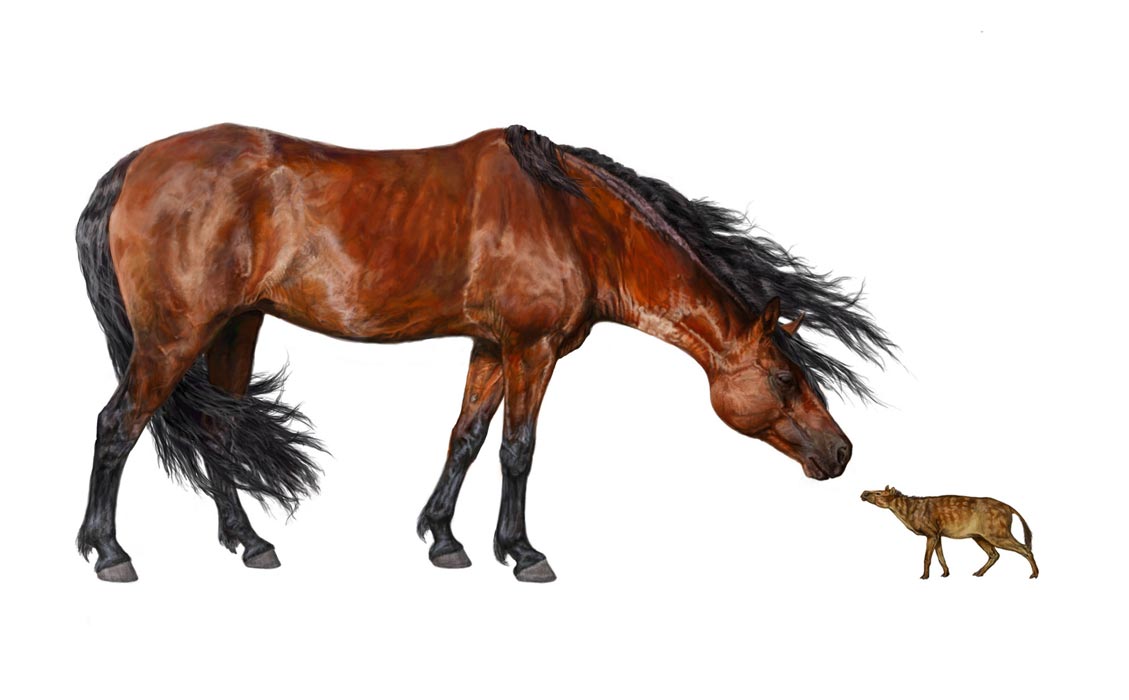
Horse evolution was said to be the most complete evidence for evolution. Now the most recent discoveries are throwing this evolutionary story into chaos.

many museums and popular books have presented a neat series starting from the dog-sized, four-toed ‘dawn horse’ or ‘Eohippus,’ which supposedly lived 50 million years ago. The next creature is usually a larger creature like Mesohippus, which had three toes. The next one was larger still, for example Merychippus, which had two of the toes smaller than the third. Finally, there is the large modern horse, Equus, with only one toe

As the biologist Heribert-Nilsson said, ‘The family tree of the horse is beautiful and continuous only in the textbooks

With the latest understanding of the horse fossils, it is more clear that the horse was created and has been reproducing after its kind just exactly as God decreed in Genesis 1:24-25

horse_evolution

 Back to the Creation Manifesto Outline

Homology is Only Skin Deep

It has been proposed among evolutionists that since different kinds of creatures (humans, birds, whales…) have similar bone structures (5 bones in hand/wing/fin…) that they evolved from a common ancestor. The same observation could be interpreted to mean that these creatures all had a common designer. One of the problems with the idea that similarities among creatures proves a common ancestor has only been revealed in recent times with the analysis of DNA. This problem is manifest when studying the genes that code for similar regions in distinct kinds. An evolutionist would expect the same gene to code for the same appendage if they evolved from one another. But this is not the case. Genes are not conserved as one would expect if evolution were true. The table below illustrates the problems for evolution:

GeneticHomologyDebunked


 Back to the Creation Manifesto Outline

Antibiotic Resistant Bacteria

Antibiotic resistant bacteria. The idea that bacteria have evolved to be resistant to antibiotics is said to be proof of the grand theory of evolution. However, what has really happened it that bacteria do not develop new features that make them resistant. Within a population of bacteria, there are mutants (degenerates) that have lost the functionality that antibiotics attack. If the antibiotic succeeds in killing all of the bacteria that are not resistant, then the resistant strains can reproduce unchecked.

Bacteria have been found in ancient graves or archaeological digs (prior to the invention of modern antibiotics) and there are antibiotic-resistant bacteria. This shows that these bacteria have not evolved new traits since the introduction of modern medicine. They were already in bacterial populations; they are only able to thrive when the non-resistant bacteria are killed off for them.


 Back to the Creation Manifesto Outline

Geologic Column

It is taught in textbooks from elementary school to college that fossil material is sorted consistently by age. It is said that simple organisms are buried first and then fish, then amphibians, then reptiles, then birds, then mammals, and finally mankind. It is taught that since these orders of animals are buried in this manner that the conclusion is that things evolved new traits over time and that the fossil record tracks a consistent and comprehensive history of evolutionary life from a simple common ancestor.

The problem with this education is that it is false. The geologic column does not exist in its entirety anywhere on earth. Many of the “established” layers are buried in the “wrong” order according to the theory. Fossils are buried in the “wrong” layers.

The worldwide flood described in Genesis makes far more sense of the accumulation of sedimentary layers all over the world. Dinosaurs are not buried with humans, not because they did not live at the same time, but because they did not live in the same place. Would you want to live close to dinosaurs? Human fossils are not found buried with coelacanth either, but it is verifiable that humans live contemporarily with coelacanth fish.

It is taught that the lower in the strata an animal is buried, the simpler or earlier it is said to have lived compared to the creatures buried in higher strata. But highly complex creatures have been found in the lowest strata, which is a paradox for evolutionists.


 Back to the Creation Manifesto Outline

Radioactive Dating Highlights Incompatibilities

Radiometric dating. Radiometric dating (RD) is said to be able to provide absolute dates to fossils, rocks, or buried organic materials. There are many problems with the idea that RD provides absolute dates. There are three main assumptions that plague the trustworthiness of RD.

  1. Original quantities of parent and daughter elements. Since RD is a measurement of the ratio of parent to daughter element, it would be important to know how much of each element existed in the sample. But it is impossible to know the original amount, so an assumption of no daughter element is used as the starting point
  2. No contamination. It is assumed that there is never any introduction of either parent or daughter elements into the samples over the years.
  3. Constant decay rates. It is assumed that the decay rate is constant over the years and that nothing can ever change the decay rate. A team of scientists from ICR have published a serious challenge to this assumption as decay rates have been measured to be wildly erratic in many circumstances.

The idea of RD is that something is millions or billions of years old even though no calibration has been done to confirm this process. Many times, items of known age (rocks from Mt. St. Helens, recently deceased animals…) have been submitted for RD testing and have come back with severely incorrect dates. If we cannot trust the dates provided by RD on items of known date, why should we trust RD when it proposes dates for items where the date is not known?

Carbon 14 is particularly troublesome for evolutionists. The half-life of Carbon-14 is about 5700 years. So after approximately 90,000 years one would not be able to measure any Carbon-14. According to pg 282 of Marvin Lubenow’s Bones of Contention, no fossil has ever been uncovered that did not have some Carbon-14 in it. This includes all of the supposedly 600 million year old samples taken from Pre-Cambrian strata. What this tells us is that no fossils are greater than 90,000 years old.

UPDATE: It has recently been shown that outside forces can change the rate at which radioactive elements decay. So much for absolute dates!

 Back to the Creation Manifesto Outline

Not a Monkey’s Uncle after all

Chimp/human similarity. It has been said that humans and chimps have a 98% similarity in their chromosomes. But this is just plain false. For years this percentage of similarity has been intoned by evolutionary scholars based on the assumption of junk DNA. Since most of the DNA in chimps and humans was assumed to be junk, most of the DNA was not compared for similarities. Only a tiny fraction of the DNA was compared for similarities. Now that DNA is known to be useful in multiple dimensions, the similarity of human/chimp DNA has dropped precipitously…to below 70%. If the closest assumed relationship to humans is chimps, but our DNA is significantly different…so different that not enough time has passed since our most recent common ancestor, then humans are not related to chimps.

Another way to see the similarities in humans and chimps is that they have the same designer…like a Chevy 1500 and a GMC Sierra. Same designer…similar appearance. The genetic link of all life is most easily explained with a Biblical view that God would be able to provide a self-replicating food source (plants) and his creation would be able to thrive from its consumption.

If humans were completely different from all other life forms on earth, then what could we consume for fuel except each other? Having similarities with the other creatures and our food source allows for us to consume the same food source or the lower creatures to provide sustenance. Since predation is not an original design feature (prior to sin/death), it would be important that all creatures be able to process the plants/fruits/seeds/roots for sustenance. Therefore, some similarity is expected among each kind of creatures according to a biblical worldview.


UPDATE: The information keeps pouring in that to propagate “the extreme likeness of humans to chimps” idea is completely false.

UPDATE: As more and more information is accumulated and released about the misconception that humans and chimps are 98% related by DNA, the more we find that this misconception is false.

When the genome of one creature is used to construct the genome of another, then we have a serious problem that philosophers call “begging the question.” In other words, evolutionists have produced a chimp genome based on humans and then say it looks similar to the human genome.


 Back to the Creation Manifesto Outline

Junk DNA; Now a Vestigial Theory

Junk DNA. Junk DNA is a term coined back in the 1960s that referred to the portion of the DNA that did not code for proteins. It was believed by evolutionary scientists that the junk DNA was evolutionary leftovers from billions of years of changes within the code. In scientific circles junk DNA was referred to as pseudogenes. In Richard Dawkins book, The Greatest Show on Earth, he declares pseudogenes magnificent evidence for evolution and scoffs at creationists:

What pseudogenes are useful for is embarrassing creationists. It stretches even their creative ingenuity to make a convincing reason why an intelligent designer should have created a pseudogene — a gene that does absolutely nothing and gives every appearance of being a superannuated version of a gene that used to do something — unless he was deliberately setting out to fool us.

Unfortunately (for evolutionists), Junk DNA is a myth. The latest research by both creationist and evolutionary scientists show that all of the DNA code is useful even if it does not code for proteins. In fact, the news is even worse for the theory of evolution since DNA code is now shown to be not just a code in a single dimension, but has usefulness in multiple directions. An analogy for the geeks among us would be to compare DNA to a compressed data file. The compressed data file has functionality and the uncompressed data file has functionality. This further complicates the situation for evolution since any random mutation (copying error) in DNA will affect not just the “compressed file” but also the “uncompressed file.” This makes the theory of evolution as taught staggeringly unlikely to be true.

And since there’s no such thing as junk DNA, it takes away one of the “strongest” evidences for evolution.

As more and more evidence is coming to light regarding genetics, evolution is scrambling for the ever-diminishing shadows. The four major lines of evolutionary assumptions within genetics is rapidly waning:

  1. Homology – Homology is the evolutionary assumption that since different species of animals have similar features, then they must have had a common ancestor. But with the advent of genetics, scientists are finding that the relationships defined by homology are vastly different when DNA is compared.
  2. Absolute Genetic Differences – Chimps and humans are said to have a common ancestor about 6 millions years ago. But since the genetic code for both chimps and humans have been de-coded, the differences are found to be 900,000,000 and growing. The problem for evolutionists is that not enough time has passed for this many differences to have mutated in the genetic code.
  3. Junk DNA – As already covered above, scientists are finding that junk DNA is useful after all.
  4. Shared DNA mistakes – The assumption that if species are related to each other with a common ancestor, they should have shared mistakes in their code is now shown to be just that…an assumption. It relates back to the idea that non-coding portions of DNA were junk, but have now been shown to be functional. Since the “mistakes” have vanished because they are now shown to be worthwhile portions of the DNA, then the assumed history of shared mistakes is also vanishes.

The most complicated storage mechanism in the universe has been discovered to be even more complex than originally thought. It is now even less likely to have emerged naturally

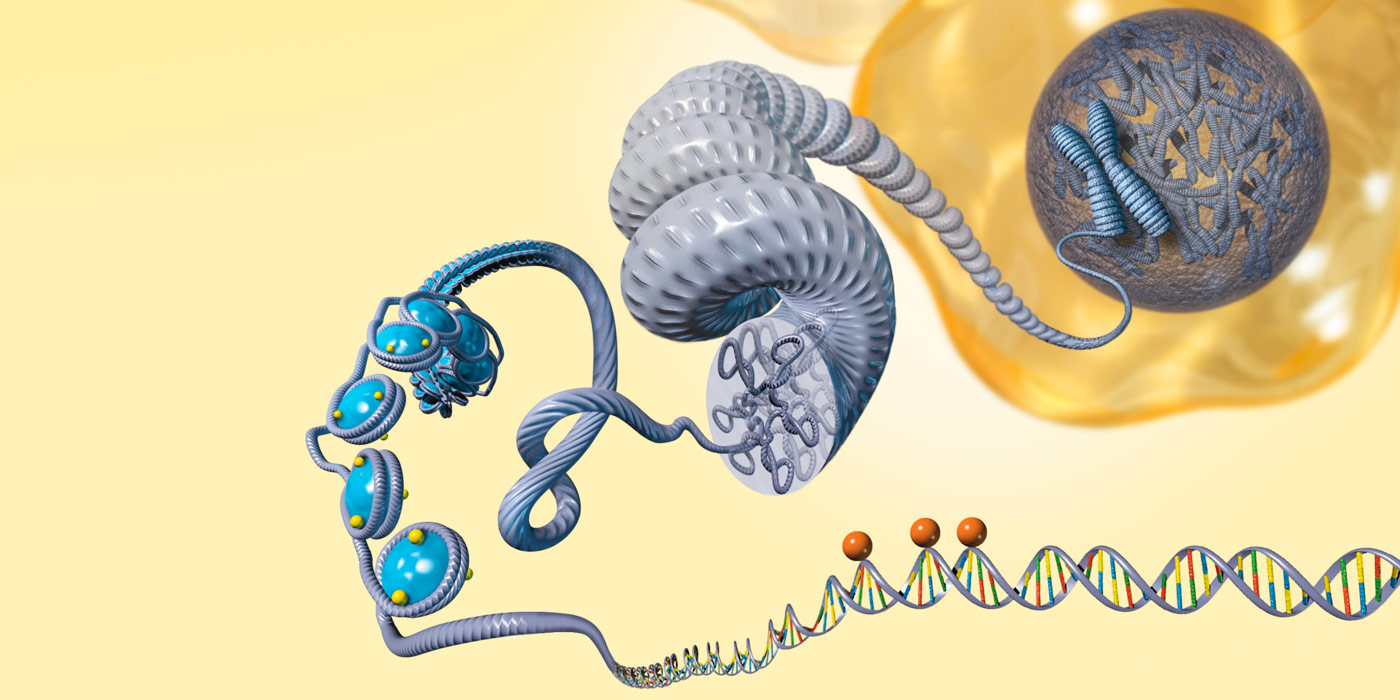
Not only is junk DNA a myth, but the DNA code represents multiple levels of information, which is sometimes known as epigenetics. A more detailed description of epigenetics is available here. This secondary layer of complexity further deepens the problem for evolutionists in explaining the way that genetic mutations affect the “emergence” of new information for building wings, flippers, gills, lungs, echolocation, blood-clotting cascades, or ligaments where once there were none. If random mutations to existing code is supposed to provide the source for new features in creatures, and the existing code has at least two levels of complexity, then a random mutation will be forced to overcome the “scrambling” of both levels to remain viable after natural selection acts on the new code. The problem more than doubles for evolution.

UPDATE: Further research into the collapse of the theory of junk DNA has been published in scientific journals.

It would seem the answer is yes — and evolutionary assumptions helped create the problem.

UPDATE 2: It looks like the ENCODE project continues to make the theory of evolution irrelevant.

If the human genome is indeed devoid of junk DNA as implied by the ENCODE project, then a long, undirected evolutionary process cannot explain the human genome. If, on the other hand, organisms are designed, then all DNA, or as much as possible, is expected to exhibit function. If ENCODE is right, then Evolution is wrong.

 Back to the Creation Manifesto Outline

Stasis, proof of non-evolution

Living Fossils/stasis. Stasis is a term that describes the absence of evolutionary change. It is an unexpected occurrence for evolution, but it is thrown around as though since it has a “scientific” name, that it actually explains something. There are hundreds if not thousands of organisms that are fossilized in soil layers that have been attributed to dinosaur era layers, yet they remain unchanged as we view their living descendants today. Dr. Carl Werner has written a book called Living Fossils, in which he documents fossils of fish, amphibians, reptiles, birds, and mammals. Each of these species are alive today that all have unchanged ancestors who are buried with dinosaurs.

Fossils of modern mammals are found all of the time buried with dinosaur fossils, but the discoverers tend to give the modern mammal fossil a different name even though it is indistinguishable from the modern creature. An example of this would be from a 2005 article in Nature magazine where mammal fossil had been unearthed with a small dinosaur in its belly.  The article describes an animal that looks remarkably like a Tasmanian Devil, but it was given the name Repenomamus robustus as a way to differentiate it from the modern animal. There’s no reason to do this other than to perpetuate the evolutionary story of animals constantly changing in their environments to deal with natural selection pressures.  If no evolutionary changes were seen in Tasmanian Devils for 65 million years, the story would be questionable. But if the animal can be presented as something completely different, then the story can be told again.

Tasmanian Devil or Repenomamus robustus

A more familiar example would be the Coelacanth fish. It is found in fossilized form in layers that evolutionists date to be 400 million years old, and was thought to have gone extinct until the early 1900’s when it was found in fish markets in Madagascar.

Wikipedia lists more than 80 such examples of living fossils. It appears that the more that scientists find, the more they find that animals remain unchanged since their original findings in the fossil record (which this writer attributes to the worldwide flood of Noah’s day.)

Fishing for living fossils

More recently a frilled shark was caught off the coast of Australia. Up until this point, the shark was thought to have gone extinct 80 million years ago. If it has been found alive and unchanged today like the many other examples shown above, what does that say about the “almighty” power of evolution?

Finding fossil tissue that is still intact and unchanged would lead one to believe that the story of millions of years would be questionable. For instance, when scientists discovered tissue and pigments from Mesozoic era layers that are exact replicas of today’s tissue, they couldn’t help but stick with their story of millions of years despite all reason.

The paper includes photos of some of the fossils that are so detailed, they look as if living crinoids were spray-painted with acrylic. The original pigment colors are clearly evident. Wolkenstein doesn’t rule out the possibility older examples will be found; “the occurrence of hypericinoids and related pigments in Paleozoic crinoids cannot be excluded,” he says. Still, finding intact molecules from delicate creatures said to be 240 million years old is remarkable, to say nothing of the fact that they have escaped evolutionary change in all that time.


UPDATE: More unchanged fossils have been unearthed by paleontologists. Bacteria fossils have been uncovered in layers that have been dated by evolutionists to be almost two billion years old that are exact replicas of bacteria that are found alive today. We’ve been told by evolutionists that things change, therefore evolution is true. Now, they are telling us that these bacteria have not changed in two billions years therefore evolution is true. This is a strange contradiction.

UPDATE2: Here’s another list of fossils that have remained unchanged through time

No change…no evolution.

 Back to the Creation Manifesto Outline

Information Theory Sounds Complicated for Evolution

Information Theory. DNA is a code. It contains information that must be transmitted and interpreted. The components of DNA, nucleotides, exist as four “letters” which are guanine, adenine, thynine, and cytosine. The reason that we can call DNA information is that these four letters have no inherent attraction to each other to compose the patterns that we recognize today as having purposeful code within.

Could the proliferation of DNA in all living things be the creative signature of Almighty God?

If you think of it like the little plastic letters with magnets on the back, where kids can put words up on the refrigerator door, you can understand the relationship that these DNA letters have towards one another. In the same way that the plastic toy letters do not have any chemical, magnetic, or other reason to arrange themselves in any particular order, the DNA letters have no reason to arrange themselves in the specific patterns necessary for living things to be coded and reproduced. Without someone specifically arranging the letters to have meaning to the reader (in the case of DNA, the reader would be RNA). The plastic, magnetic letters are attracted to metal objects, but they are not chemically or magnetically predisposed to a particular arrangement, and we find this same situation for DNA letters.

Plastic magnetic letters do not arrange themselves into readable words, phrases, or thoughts without outside guidance.

As a novice software engineer and experienced database administrator, I understand that complex codes for programs must be planned and implemented by intelligent programmers.

This small code sample pulls information out of an ANSI-compliant relational database:

SELECT Name, EmployeeID, BirthDate FROM EmployeeTable WHERE HireDate > ’09-17-2014′;

The compiler would generate an error were this code to change to either of these:

SELEKT Name, EmployeeID, BirthDate FROM EmployeeTable WHERE HireDate > ’09-17-2014′;

SELECT SELECT Name, EmployeeID, BirthDate FROM EmployeeTable WHERE HireDate > ’09-17-2014′;

I would not expect that copying one of my programs over and over millions of times would generate new code that would perfectly complement the existing code. If any changes to the code were to happen because of an error or duplication during copying, I would expect the code to be broken. But this same logic is used by evolutionary thinkers to say that through copying mistakes in DNA, new traits are acquired by organisms that were previously unknown.

Music is another form of information. Would you expect that copying sheet music over and over millions of times would result in perfectly timed bridges to new verses, or would you expect the sheet music to become muddled and unreadable?

How about digital music? Would you expect the copying of mp3 files over and over millions of times to seamlessly add complimentary notes, chords, or verses? Neither should we accept the assumptions of evolutionists that random mutations will create new features in creatures.

UPDATE: Despite their commitment to Deep Time, the science presented by the Discovery Institute in the article and twenty minute video are fantastic. In it, they show how information cannot be generated without intelligent guidance and that random processes destroy information.

[Dr. Axe’s] experiments [while working at Cambridge University] enabled him to estimate that for every DNA sequence that generates a short functional protein of just 150 amino acids in length, there are 10 to the 77th amino acid arrangements that will not fold into a stable three-dimensional protein structure capable of performing that biological function.

One correct sequence for every 10 to the 77th power incorrect sequences!…

To put this in perspective, keep in mind there are only 10 to the 65th atoms in the entire Milky Way galaxy.

Keep in mind that the number, 10^77, is the number for finding a SINGLE protein, so to find the proteins for all of life would require far more and larger numbers. The case for naturalistic evolution is slain by mathematics.

Back to the Creation Manifesto Outline