In yesterday’s post, I discussed several ways to expose the fallacies that God-deniers sometimes use to keep from being exposed when they claim:
“being an atheist simply means that there’s not sufficient evidence for your sky daddy“
It’s not uncommon for them to try to bluster their way to an online argument victory. So listen to their claims and hold them to account for their assertions. When they have to “show their cards”, it’s unsuited 3, 5, 6, 9 and an Uno card. Now sometimes, the God-denier will off an assertion something a little more outrageous like:
“There’s absolutely no evidence for your sky daddy” – AggregateOfInternetAtheists
Let’s look at the serious problems with this incomprehensively lazy assertion:
God-deniers have no slot in their epistemology for absolutes. For God-deniers, in a cosmos made only of matter, there are no absolutes – there’s only particles and aggregations of particles
Is this atheist aware of ALL evidence in the cosmos such that she could assert that “there’s no evidence for God”? The honest atheist would have to admit that they are not privy to all evidence in the cosmos. Conversely, God IS privy to all knowledge/evidence in the universe and He has revealed some of that evidence so that Christians can be certain of those things
Now here’s the really important point: What does evidence for God look like? For someone to say “There’s no evidence for a cobra” – they would have to know what a cobra is like. How would you describe a cobra so that you could definitively say “There’s no evidence for a cobra.” In the same way, for someone to declare “There’s no evidence for God” they would have to know what evidence for God looks like. Press the atheist on this because they are bluffing. As soon as they realize that they cannot sufficiently formulate what evidence for God is like, their bluff is blown.
Don’t be afraid to call the God-denier’s bluff. They are not holding any good cards, and by God’s amazing grace Christians most definitely are. Call their bluff, but do so with gentleness and respect
Be sure to check out the links (blue text) that are saturated throughout this post as most of the “leg-work” was completed by people much smarter than me…for whose work I am very grateful!
Well, I got a new challenge from a God-denier, who made the claim that evolution can even explain the origin of morality. They provided a link to a “scientific” paper , which has been cited 6 times, thinking they could bluster their way through a conversation without being skeptical. But I don’t surrender to bluster so easily. Let’s analyze her claim to see if the professor, who wrote the article, is relying on evidence or assumptions
Here’s how this works: I will post the quotes from the article in red and then just below the quote, I’ll post my analysis in the default black font. I have bolded key words throughout, so the bold does not appear in the original work. Throughout, you’ll notice that instead of actual evidence, the author of the article relies on assumptions. Let’s get started:
The author of this article, Professor Douglas Allchin, begins at a good place, with definitions. First we must start with “What is Morality?” Merriam Webster defines morality as ‘Conformity to ideals of right human conduct’.
How did this peer-reviewed paper define morality?
The first challenge for biologists is characterizing morality in terms amenable to science. Abstract concepts of “right” and “wrong” or virtuous motives and good intentions must be expressed in terms of what can be observed or measured. First, then, biologists address morality concretely as a form of behavior. As such, it fits in a context of other behaviors: foraging, mating and nesting, securing territory, play, grooming, and other social interactions
Bold text is not in the original. Notice how they immediately change the definition from “ideals of right conduct” to a “form of behavior that fits a context”. What context? EVOLUTION. While the actual word is not used, the context of evolution (foraging, mating, nesting, grooming…) is exactly the concepts that evolution is supposed to have solved. Right from the start, they’ve smuggled evolution into the definition. So right from the start, rather than actually showing that evolution can explain the origins of “ideals of right conduct”, professor Allchin imbeds the solution right into the definition.
Conceptualizing morality as a form of behavior opens the possibility of observing it in other species. Indeed, if complex features evolve gradually, one might well expect to find stages of protomorality, incipient morality, or various precursors in organisms besides humans.
Two things with this paragraph:
Remember they defined morality as forging, mating, nesting, grooming & social interacting behaviors. So OF COURSE other species forage, mate, nest, groom and interact. When they define their terms in such a way as it’s just living, then they can claim victory that evolution can explain eating but say “tHat’s mOraLity”
Secondly, humans did not evolve from any modern species. So, you cannot test any modern species for “protomorality” or “incipient morality” at least in relation to human morality. If you want to test other species for human morality, why not celebrate the morality of male lions cleaning house: the new head of the pride, methodically killing the offspring of other males in the pride. Should the evolutionists want to involve other species as tests for morality, they have no objective reason not the start there. Why don’t the atheists want to uphold the thieving, raping, bullying, and exclusion of both intra and inter species interactions in their assertions of evolution’s great power to produce morality? Why would God-deniers NOT consider male lions killing the offspring of other lions as moral?
But which behaviors are “moral”? Here, biologists must proceed cautiously. One cannot even identify the relevant behaviors without a working concept of “right” and “wrong” or of “morality.” Invoking a value judgment threatens to prejudice the whole endeavor. The biologist’s proper approach is thereby indifferent and fluid, contingent on definitions of ethics identified by others. Biologists may encounter multiple conceptions of what is to be explained. Different benchmark definitions may yield separate complementary explanations. Of course, biologists are accustomed to addressing the “same” phenomenon on multiple levels of organization: molecular and cellular, physiological, populational, ecological, and evolutionary. Biologists have, thus, developed a suite of explanations which apply to different aspects of moral behavior.
Indeed. How can they identity behaviors as right or wrong? Notice in the closing sentence, professor Allchin talks about tools: “a suite of explanations” which they will apply preferentially and arbitrarily to different behaviors. We’ll watch this as more and more of the paper is analyzed.
For guidance, then, a biologist turns to moral philosophers. Yet, even after centuries of reflection and debate, philosophers themselves do not agree on core ethical principles for defining “good.” They generally recognize, however, three basic approaches. One approach, consequentialism, focuses on the outcomes themselves. For example, morality is assessed as the greatest good for the greatest number. Good may be defined variously as benefit, happiness, or pleasure.
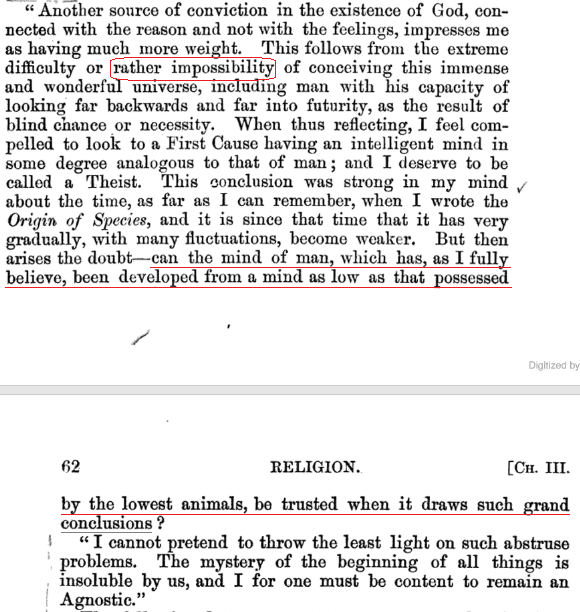
Didn’t these “moral philosophers” also evolve from ancestral simians with supposedly less-evolved morality. Why trust what evolved apes have to say about morality? Charles Darwin recognized this philosophical problem in the 19th century when in his autobiography, he wrote “But then arises the doubt-can the mind of man, which has, as I fully believe, been developed from a mind as low as that possessed by the lowest animals, be trusted when it draws such grand conclusions?” Why should we trust the foundations of their philosophy?
Notice also how the consequentialists define good: Good is whatever is the greatest good for the greatest number. You’ll notice the clear obfuscation of their claim about “good”. How do they know what is truly good? Based on what metric? Over which time period? I wrote about the irrationality of claiming goodness without an objective standard in my article, Empathy is Arbitrary, Inconsistent, and Irrational for Atheists. It applies equally as well for these lab-coats, who want to talk about pragmatism.
Evolution itself does not express or yield values
Nature may seem to exhibit its own values. For example, natural selection may seem to “favor” adaptive traits. Survival and reproduction may seem inherent values because they lead to continuity of the lineage. However, historical facts are distinct from values. Effects do not indicate intentions
This is a good paragraph and I agree with it – because it definitively declares that evolution cannot explain the origins of morality – ideals of right conduct. The title of their article is misleading, but they rationalize their deception with remarkable openness about the inability of evolution to explain ideals/values like that paragraph above. After all, since morality is not objective to them, why should they be honest about their hopelessness from the beginning?
Biological analysis may enrich our understanding of morality, but it is also limited. Science is not able to discover ethical principles in nature, nor to justify them, nor to evaluate them, say, based on evolutionary history, nor even to develop them based on some presumed universal or “objective” principle of “human nature.” Many have tried. All have failed
EXACTLY! Case closed. I appreciate everyone for reading this article which exposes this admission by professor Allchin that evolution is unable to explain ethical principles, justifications, or objective ideals of morality. Should I even continue to evaluate the remaining 7000 words of their article when it is clear up to this point that they have admitted defeat? They do try as this next sentence declares:
Having introduced these caveats, then, let us consider what biologists have discovered about morality as an evolved form of behavior
Caveats indeed. Caveats of the corpse of their case
They continue anyway, although their case is beyond hope:
Behavior that benefits other organisms may sometimes also benefit the individual
Like symbiosis? Symbiosis is a definite falsification of evolution. It’s a strange tact indeed for professor Allchin to highlight one of the most damning observations to evolutionary theory. Perhaps though he meant that cooperation within your own species could help with the evolutionary fitness of the overall species. It stretches credulity that selflessness could be explained by natural selection acting on unguided mutations, but that is the claim they are making. They tried to suggest the kin selection could account for morality in the subsequent paragraphs, but I covered this failed hypothesis in my article, Can Evolution Explain Altruism? When evaluating the “scientific” articles for that post, they proposed a mysterious force called “strong reciprocity”, which had no origin or mechanism. Another failure for the theory of evolution. Professor Allchin tries later in his article to postulate strong reciprocity as a solution. Too bad.
But notice too that he’s done something sneaky here. He just assumed that cooperation (or mutually beneficial behavior) just appeared. He provided no mechanism or origin story for this behavior. Without explanation, he just assumed it was there. In an article that supposedly explains the origin, professor Allchin is short on actual explanations and long on assumptions
In describing the evolution of humans in Descent of Man, Darwin (1871) prominently addressed mental and moral abilities. Following cultural discourse at the time, he focused on what he called the moral sense, or conscience, notably reflected in the emotion of remorse. “Why do we feel moral duty?” Darwin wondered. First, Darwin observed that animals could evolve societies, structured (he assumed) by a social instinct. Second, with multiple instincts, behavior might not always accord with social benefit. But memory, Darwin thought, would help resolve such conflicts as the organism learned to regulate its instincts, making the social instinct primary. Third, the use of language would allow organisms to communicate their needs clearly to one another. Fourth, repetition would lead to habit and a spontaneous sense of what one “ought” to do.
Notice the saturated assumptions in the paragraph. Everything proposed by Darwin was an assumption. None of what he observed was an origin of the creatures, their behavior, or their “structured society”. All of those things were already in existence – so like the modern lab coats, Darwin simply assumed that they evolved. I’ve been told that “extraordinary claims (like evolution can explain morality) requires extraordinary evidence”. There’s no evidence – let alone extraordinary evidence in that paragraph. It (like the rest of the paper) can be summarily dismissed.
In the next 5 paragraphs professor Allchin describes stories of various mammals caring for others of their species as if that is an explanation of evolution’s great power to produce moral behavior. Two things he failed to realize:
Humans did not evolve from any creatures that are currently alive. The best he could assume is that humans and any other mammals share a common ancestor. Professor Allchin, rather than demonstrating common ancestry, simply assumed common ancestry. The very best that professor Allchin could speculate is that both apes and humans experienced an even more impossible assertion: convergent evolution since the hypothetical common ancestor cannot be evaluated for the presence of moral behavior.
The caring/moral behavior already exists in the creatures being described. There’s no step-by-step explanation of the caring/moral behavior being produced by some evolutionary mechanism. Saying that something (moral behavior) exists does NOT explain HOW evolution produced it. It is very common among internet pop apologists for evolution to assert: “x trait exists and evolution did it.” We see from this article where they get it. They are taught to think that way by their deluded lab-coat-wearing priests.
One way to assess foundational human motivation is to observe behavior before possible learning or training. Human infants (age 18 months), for example, frequently help adults in simple problematic tasks in a lab setting—without being asked and without reward…The question remains how such feelings evolved and whether the social environment was relevant historically
The question remains indeed. Everything that professor Allchin has speculated about already exists. Not one word has been dedicated to explaining how evolution was able to produce moral behavior where moral behavior did not exist before. Those reading Allchin’s article with a skeptical mind could just as easily be convinced that since this behavior already exists in “human infants” that these young humans were created in God’s image as moral agents from the beginning. The authors have done NOTHING to persuade a skeptical reader of their stated motive (evolution can explain morality). They just assume it
Neuroimaging studies show significantly that actual moral reasoning involves both emotion and logic
The naturalist author of this paper has complicated his task. Not only has he convinced me that that evolution cannot explain morality, evolution definitely cannot explain reasoning or logic. Rather than trying to just come up with an evolutionary mechanism that can produce moral behavior, now professor Allchin has inadvertently jumped into a philosophical canyon from which he could never hope to explain. Rather the unchanging, abstract, absolute laws of logic and its correct application (reasoning) is explained only in a Christian worldview.
The flexibility afforded by learned behavior allows organisms to respond to local environments, which may change during an organism’s lifetime or vary from organism to organism within the same species. Evolution may thus favor the brain’s potential for behavioral plasticity and for placing “values” on certain responses
Again – no explanation or evolutionary mechanism…but “evolution may…” as if evolution is a concrete entity that actually DOES something. That’s the reification fallacy by professor Allchin. No-no professor!
In addition, learning has the potential to modify, or regulate, innate behavior or dispositions. The psychological level thereby becomes emergent, exhibiting new interactions and properties relatively independent of lower level functions (genetic and physiological) and able in part to influence them
Emergent? This is a common assertion by naturalists when they are unable to actually explain origins. Following is a conglomeration of real/hypothetical conversations with God-deniers:
Christian: “From where did the laws of logic arise in a cosmos made only of particles?”
God-denier: “They are emergent properties“
Christian: “From where did the laws of gravity and physics and chemistry arise?”
God-denier: “They are emergent properties“
Christian: “Can you explain how evolution produced moral behavior?”
God-denier: “They are emergent properties“
Emergent properties offer no explanatory power. It’s just a sciency-sounding moniker for the naturalist, who recognizes that from within his framework, the topic is unexplainable.
Professor Allchin goes on to complain about “cheaters” as obstacles to “sharing behavior” and common good, but in all of the complaining, he never explains how evolution produced moral behavior. Why’s that Professor Allchin?
Organisms may cooperate selectively with reciprocators
I’ve already answered the proposal of reciprocity above and in my article on, Can Evolution Explain Altruism? Giving only to get back (reciprocity) is selfish – not moral or altruistic.
Getting to the end of his rope, Professor Allchin jumps from moral behavior to Might-Makes-Right:
Social organisms may enforce cooperation through rewards and punishment
And AGAIN, professor Allchin simply observes EXISTING behavior – not how evolutionary mechanisms produced it. This article was supposed to explain how evolution could explain morality rather than just pointing to it as he does throughout. It would be like asking: “How did Honda produce that Odyssey minivan?” and having a professor respond: “There’s one over there!!!” All the while, the professor thinks he’s answered the question. Lazy and smug.
Organisms may benefit from social information
May?!?! Isn’t this supposed to be a scientific article? Something that explains the origins of morality by means of evolution?? May indeed!!! And “benefit” – how does one determine what is truly beneficial? By what metric?
I’m not the only one or even the first one or even the best at analyzing the outlandish claims of the Darwinists that evolution can explain morality. Here are some articles from crev.info that show the impotent claims that “eVoLutioN cAn expLaiN moRaLity” to be nothing more than empty bluster:
This isn’t a typical full review of the new content by Amazon, but I’ll include my overall thoughts about the movie
It really is stunning to me to hear God-deniers say. “The worldwide flood recorded in Genesis is impossible.” or “there’s no way the entire globe could have been flooded as recorded in Genesis” or “Noah’s flood? That’s just a fairy tale”. What does that have to do with the movie, Oppy?
At near the 9 minute mark one of the lab coats says: “The two Viking orbiters as they looked down on Mars, they saw…that’s strange. There could be signs of past water flowing. Was Mars once a green world with living things and blue oceans?“
At about 39:45 “We picked the Spirit landing site, Gusev Crater, that looked like it had a huge dried-up riverbed flowing through into it, and we went there hoping to find evidence of past water and past habitability. I mean there has to have been a lake in Gusev Crater at one time. But all Spirit found was this prison of lava rocks.”
“And it turns out that the composition of these little blueberries, was a mineral called hematite, which is a mineral that often forms in the presence of water.”
“From the minerology, from the geochemistry, everything that we needed to come to a reasonable conclusion that there was once water on Mars. It was right there in the walls of Eagle Crater. But this is a very acidic environment. Not a place where life could have developed.”
“So, yes there had been liquid water, but this wasn’t water that you or I would want to drink. It was basically like battery acid.”
“What you really want is nice, flowing, neutral-pH groundwater. And so to go and find a story of habitability, you’ve got to go on a bit of a roadtrip”
“This is a clay that has been intensely altered by relatively neutral pH water, representing the most favorable conditions for biology that Opportunity has encountered”
“Water. Drinkable neutral water once existed on the surface of Mars. And not only was there water, but it could possible sustain ancient microbial life. So that is just revolutionary.”
“It showed us that the ancient Mars was much more suitable to the origin of life.“
“This was the Holy Grail. This is the reason we had gone to Mars. Oppy discovered Mars was a wet world very much like Earth. There were oceans. Water played a huge role in its early history. It completely altered the planet.”
“And Opportunity spent years exploring Endeavor Crater, making incredible discoveries that tell that story of water. So we could go back in time to a planet that might actually have had life.“
“Mars had water. What happened to that water? And can we take the information and understand how that could happen here on Earth? And can we understand our part in that. Are we doing something that can accelerate that here on Earth. Because that’s something that you don’t recover from.”
Are you kidding me? They were able to turn this documentary about a planet with no water, no life, no humans, no fossil fuels into a global warming fear-mongering documentary…like most of the rest of them.
Their motivation was religious in nature (“This was the Holy Grail”), and it’s clear that their research was interested only in finding naturalistic origins of life.
Don’t misinterpret my critiques as a dislike for discovery or research. But what did you notice about their motivation for exploration? Extra terrestrial life. This blind search for life in lifeless places reveals their faith in naturalism. In their search for life, they recognize the need for water. So, in this video, we see over and over these lab-coats share their desire to find water. There’s not a drop of water on Mars.
But a planet (Earth) that is more than 70% covered by water could NOT have had a worldwide flood according to naturalists, and a planet (Mars) with not a single drop of liquid water is assumed to have been flooded in the distant past. The inconsistency and hypocrisy is astounding
Another level of hypocrisy among the God-deniers, is their denouncement of God’s amazing designs in biology. It was clear that the design of the robots was mimicry of the design of the human body. Same height. Same use of binocular vision. Same use of limbs and joints found in human arms. Yet I hear from God-deniers all the time, “humans are designed badly”. It’s a ridiculous claim for God-deniers to say humans are designed poorly when scientists literally mimic the incredible designs by the Almighty to achieve discoveries on other planets.
Overall, the documentary was positive and encouraged people to be involved in engineering solutions and discovery. I support finding engineering solutions and discovery, but motivations and intentions matter. There’s much better motivations for discovery and engineering solutions than the most unsuccessful career path of all time: astrobiology!
Well, Christians, after 2000 years it’s time to pack it up. It was a good run for Christianity, but it’s over. A modern day Chuck confirmed the 19th century Chuck’s theory of evolution with a link to an article that holds the smoking gun for naturalism. “Evidence for evolution is uNdeNiabLe!!!!”.
Here’s the conversation on Twitter that led to the analysis of this peer-reviewed article. I challenged this particular God-denier to produce undeniable proof that creatures lacking a particular trait gained a new trait in an immediately subsequent generation via natural selection acting on random mutations. He posted this link to a peer-reviewed article on ScienceDaily from 2008.
Here are the 3 claims from that article that they assert is a demonstration of new traits that produced by natural selection acting on random mutations that previous generations did not possess:
“Striking differences in head size and shape”
“increased bite strength”
“development of new structures in the lizard’s digestive tracts”
Let’s take their claims one by one to see if it is indeed an undeniable example of natural selection acting on random mutations to produce novel traits
Head Shape and Size
Just from the initial reading of the text, we see that a different size head is not a new trait. Variable sizes in existing structures (head, arms, legs, noses…) is not an example of evolution. In that same way that we see different domestic dogs breeds with different size heads (poodle, St. Bernard) but they are the same species, there is variability in the genes. There are people that are tall and short, big heads and small heads, long arms and short arms…but to claim that this variability within the same species is “evoLuTioN” is ridiculous. They might have helped their case if they had given some measurements before/after, but this vital piece of evidence is missing. The claim that “changes in head size” is an example of evolution is inconsistent, impotent, and unconvincing.
Increased Bite Strength
Again, just reading the text, we see that there is no new trait. I would have liked to go deeper into this radical claim from the authors, but apparently they recognize that their claim of “increased bite strength” as evidence for evolution is extremely weak because they gave no further validation of their assertions. No measurements. No differences. Just a claim. As with the head size claim, there’s no need to speak of this anymore as if it’s part of the “mountain of evidence” in support of evolution, because it’s just empty
New Structures in the Digestive Tract
That leaves the crushing weight of their claim firmly on the shoulders of this last “example of evolution”. Can it support the weight? Let’s see.
Tail clips taken for DNA analysis confirmed that the Pod Mrcaru lizards were genetically identical to the source population on Pod Kopiste
Genetically identical?!??! This is the 1st reason why their claim of “evoLuTioN” holds no water. If the DNA is identical, then there were no random mutations to produce a new trait. This is the fundamental assumption of evolution: At one time, the DNA instructions for traits (arms, lungs, wings, cecal valves…) DID NOT EXIST, but over time, the accumulation of mutations produced functional code that improved a creature’s reproductive fitness in a particular environment. Since there are no genetic differences, there’s no evolution. It is the same species. There are no DNA changes. By itself, this is enough to dismiss this article as “an example of evolution”.
These structures actually occur in less than 1 percent of all known species of scaled reptiles
These structures ALREADY exist in this species of reptiles. The new environment did not PRODUCE these structures. The new environment of the lizards was selection pressure on the lizards such that the existing DNA information for the production of these structures (cecal valves) was made manifest. Since the lizards already carried the instructions in their DNA to produce these structures, then there was no evolution that created these structures. It was the environmental stresses that caused these existing structures to be expressed. See epigenetics for more information. This second nail in the coffin simply ensures that the corpse of their claim cannot be revived
Simple calculations then show that the waiting time to improve one of these six of eight matches to seven of eight has a mean of 60,000 years. This shows that new regulatory sequences can come from small modifications of existing sequence
We have already shown that there were no mutations, BASED ON THEIR OWN ADMISSIONS, but even if we grant the possibility of mutations, the mutation rate is far too slow to have produced that necessary changes that they have proposed. They claim that the new structures appeared in 36 years, but the minimum time for even the smallest beneficial mutation to occur is sixty thousand years. By their own metrics, their claim is refuted.
It looks like the wild claim from the evolutionists was (again) long on assertions and short on evidence. There’s no reason after all to close down Christianity in favor of evolutionism. The claims by these evolutionists is not new or rare. You can see here other claims that evolutionists have made about the amazing powers of evolution are shown to be impotent when analyzed.
The world is filled with magnificent biological designs and interrelated interdependent systems. I’ve been told that natural selection acting on random mutations has enough power to produce everything in biology. I’ve put these claims to the test several times
Well, I got a new challenge from a God-denier, who made the claim that evolution can even account for eyes. They provided a link to a “scientific” paper thinking they could bluster their way through a conversation without being skeptical. But I don’t fall to bluster so easily. Let’s analyze the claim to see if the scientists, who made the claim are asserting based on evidence or assumptions
Here’s how this works: I will post the quotes from the article in red and then just below the quote, I’ll post my analysis in the default black font preceded by a dash. I have bolded key words throughout, so the bold does not appear in the original work. Throughout, you’ll notice that instead of actual evidence, the authors of the article rely on assumptions. And those who are particularly intrepid and can work through this analysis to the end will be gifted with a unique surprise at the end
“Sight is an evolutionary gift”
– Odd choice of words from a scientific journal. Notice how evolution is reified as a magnificent gift-giver. Sounds more like paganism than science
“Life probably first appeared ~3.7 billion years ago”
– Probably?!?!? Indeed
“more likely”
– Aren’t we supposed to be talking about evidence rather than making assumptions?
“The opsin in rhodopsin probablyevolved”
– Probably?!?!? Notice the use of the magic word: “evolved”. Do you care to go into the details? It seems like they missed a step in the explanation and tried to sweep the actual explanation under the “it evolved” rug. Pathetic!
“The passage of such molecules from microbial opsins to metazoan opsins probably came from a common ancestor as these are related, albeit distantly”
– Probably?!?!? Probably is used TWELVE times in the article. It sounds like a collection of assumptions rather than the actual evidence that we were told to expect
“Once an opsin (or the predecessor of the opsins) covalently bonded with retinal, perhaps in a cell with a cilium or two, the slow crawl to an eye began”
– Perhaps?!?! It’s a fine yarn, but the science-sounding veneer is wearing thin
“Perhaps after 35 000 generations, an organism discovered that developing a concave cup instead of a spot produced a more successful and competitive organ for sight”
– I really thought this was going to be a peer-reviewed scientific paper, but it’s just probably after probably followed by reification fallacy. How exactly did the unguided, sightless process of evolution look ahead to discover anything? They don’t know
“As Nilsson and Pelger suggested, from an eyespot to an eyecup to a fully formed camera-style eye could take as few as 364 000 generations, and the production of such an eye in perhaps as short a period as half a million years”
– This is called hedging. Suggested. Could. Perhaps. It’s not even distantly evidence, just speculation
“If one assumes that the eye must provide spatial information to be defined as an eye, then the curvature of a cup would create the first eye, as primitive spatial information would be provided”
– Notice how they just assumed that a critical component of the eye just popped into existence. It was needed, so nature provided. No explanation, just that it would be magically provided
“A cornea, lens, extraocular muscles (EOMs), and ocular adnexa were added as necessary”
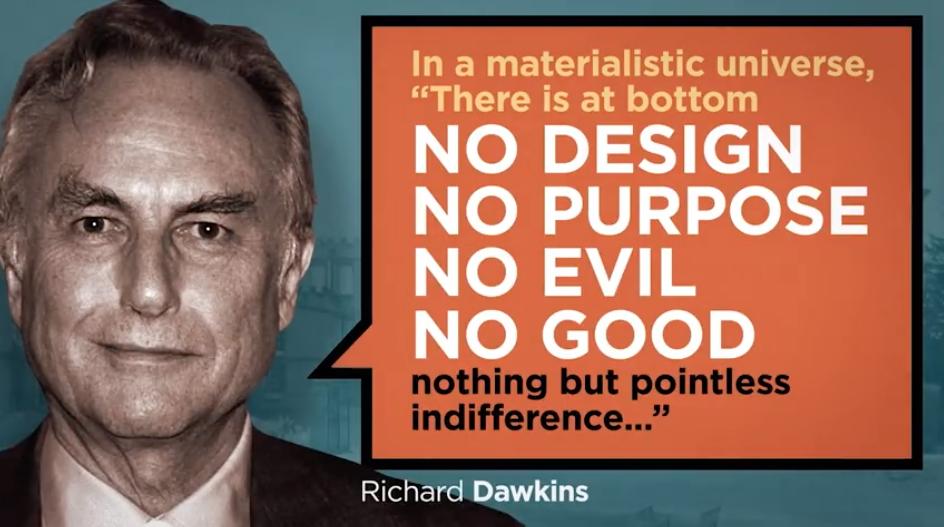
– In a cosmos with no design, no purpose, just blind pitiless indifference, what is necessary? How does the naturalist suddenly assume purpose and necessity? Even worse, the explanation is never given, just “it was necessary – so evolution provided” as if there’s design inevitabilities just waiting out in the ether to be added to biological organisms. It’s a ridiculous assumption by evolutionists
“Multiple such ommatidia would likely have been produced by gene duplication”
– That’s not science. It’s just an assumption wrapped in a façade of scientism
“The morphology of the compound eye would itself evolve”
– Why do they continue to use the magic word: evolve, rather than explaining what happened? Maybe they don’t know so they just say “it evolved”
“Although little is known about its genetics”
– That’s actually optimistic. What exactly do you know AT ALL about its genetics?
“How this organism interprets the image it receives remains a mystery”
– Indeed! Mysteries abound within this “scientific” paper
“These organelles are believed to have originated through ancient symbiosis with a red alga23 or perhaps other protists”
– Believed?!?!? Perhaps?!?!? Yawn. I was hoping to find some evidence in this scientific paper, but they keep giving me their beliefs. In addition to that, symbiosis is a paradox for evolutionists. Symbiosis is an unimaginable coincidence built on another unimaginable coincidence, but since symbiosis is observed, the evolutionist just says: “LooK wHaT nAtuRe diD!”
“convergent evolution”
– This is a term that simply means: “We Darwinists don’t know how/why the same structures emerged in disparate species, but here they are, so nature must have done it twice”. It has no explanatory power…just a sciency-sounding term
“This ancient arthropod probably lived between 600 and 550 mya before the Cambrian explosion”
– Again, we’ll note that we’re dealing with assumptions and not science. The giant pink elephant in the room with which these authors fail to deal, is how did the extremely complicated eyes of the trilobite emerge via natural processes. They have no explanations just the assumption that nature was able to produce these complex eyes. Do you doubt my analysis of this sentence? Check out the very next sentence in the peer-reviewed scientific paper
“This would suggest that eyes were forming well before the Cambrian period but no record of such pre-Cambrian trilobites, or other animals with eyes, exists, at least to date”
– THERE IS NO RECORD (NO EVIDENCE) OF THE EVOLUTION OF THE EYE…just more assumptions. The key to those who claim that there’s a mountain of evidence for evolution is the hope that no one will actually read their peer-reviewed papers. They didn’t count on ApoloJedi skeptically analyzing their claims of evidence…only to expose that this “mountain” is a bottomless crater covered by assumptions
“As discussed earlier, the compound eye began, possibly in a worm-like creature, preceding the trilobites or contemporary to them”
– This sentence is further proof that anonymous internet God-denying keyboard warriors have never read these peer-reviewed scientific papers. They Google search ‘the evolution of the eye’ and post the 1st link in the list. Little do they know that I’m not intimidated by their bluster. I’m literally taking these papers line by line and exposing the sheer blatant assumptions and complete lack of evidence. Because there is no evidence of the evolution of the compound eye of the trilobite, they have to say “the compound eye began”. It just began according to their assumption. No explanation. No evidence. It just began. When did the compound eye begin, evolutionists? “Possibly preceding trilobites or contemporary. We’re not sure” because THERE’S NO EVIDENCE
“There are at least six different models of compound eyes and it would appear that the most likely explanation is that the apposition-style eye came first and radiated into the other forms although this explanation is not completely satisfactory”
– No doubt. There’s at least 6 options, but none of them are satisfactory.
“The octopus evolved later and exhibits a more derived eye that includes a lens, a horizontally oval pupil, and a highly sophisticated system of EOMs”
– Hey evolutionists, how did the compound eye of the octopus come about…the steps…the processes? “It evolved”. Ohhhhhh, that’s not a very compelling explanation for us skeptics of evolution.
“The agnathans are the closest extant relative to the first cephalochordates alive today, so we must rely upon them to help us understand the development of eyes in the early vertebrate lineage”
– Notice the assumption of common decent and since there is no evidence of a step-by-step progression from agnathans to humans, the Darwinists “MUST RELY” on these assumptions in their artwork to show the fabled evolution of the vertebrate eye. Highly suspicious
“The Devonian was an important period”
– To the accidental aggregation of stardust in an amoral purposeless blind pitiless indifferent cosmos, how do you justify what is “important”?
“Some spiders developed excellent eyesight and clever adaptations to squeeze the optics and neurologic equipment into very small spaces”
– Sounds very much like purposeful design rather than natural selection throwing together random mutations into “clever equipment” with efficiency and effectiveness.
“Shubin and his team discovered the fossil of Tiktaalik, which probably represents the transitional form from an aquatic animal to a terrestrial one”
– Probably?!?!? The contrary analysis of Tiktaalik exposes the evolutionary assumptions as impotent
“external eyelids appeared”
– They just appeared! The explanation missed a step or 10,000
“Although our knowledge of dinosaurian vision is limited, we can make some assumptions based on the last common ancestor, indirectly related creatures and extant progeny including direct descendants”
– At least they admitted to making assumptions in this part, but they do fail to admit their assumptions about the ancestors and descendants of dinosaurs. There are no fossils of dinosaur ancestors. The evidence for dinosaur ancestors is completely missing
“We can conclude much of this from the avian lineage as birds are living dinosaurs”
– Not recognizing their own assumptions that birds are the direct descendent of dinosaurs, they try to make their assumptions count as direct evidence. It’s just an assumption, and their conclusions is based on the assumption – not evidence
“It is not known for certain”
– Clearly, but that doesn’t stop the authors from crafting a story filled with assumptions
“The Old World monkeys were separated from the New World monkeys and evolved a third visual pigment”
– There’s that magic “evolved” word again. No details. Just “nature-dun-it” I’ve been told that evolution simply means ‘change’. If indeed evolution just means change, can we substitute ‘changed’ in for ‘evolved’? Here’s what it would look like: “The Old World monkeys were separated from the New World monkeys and CHANGED a third visual pigment”. Maybe not. ‘Evolved’ doesn’t just mean changed. There’s way more magic built into the usage of the term
“This third visual pigment is not the same one as found in fish, reptiles, or birds, and likely represents an error in duplication of the LWL visual pigment”
– Likely. More assumptions. Evolutionists assume that an accumulation of errors (mutations) produced all of life. It’s all they have to work with. But it strains the very limited of common sense to assert that you can gain function from an accumulation of brokenness
“they illustrate visual photopigment evolution in progress”
– Isn’t evolution ALWAYS supposed to be in progress? I guess they have to assert this because observations of fossils show that “abrupt appearance” and “stasis” are the norm. No progress
In their conclusion (for those intrepid readers, here’s your gift from the scientists who authored their paper!):
“We know from computer models, and deductive reasoning, that eyes can evolve quickly”
– No evidence? Just assumptions and intelligently designed (biased) algorithms that assert an evolution of the eye. This can’t be repeated enough: if there were evidence, they would have produced it in this article. But they didn’t. In their concluding paragraph they admit that the evolution of the eye is speculated based on a computer model. And it’s not just that they claimed eyes evolved – but that they evolved QUICKLY. The Grand Theory of Evolution has been taught that it takes lots of time to change creatures from one to another. It’s likely these authors are not familiar with the waiting time problem…although they should be.
As Christians we know that evolution cannot explain the emergence of the eye because it is contrary to what God has revealed in the Bible. But the analysis of the claims of the evolutionists has a purpose beyond just saying (from the Christian worldview) that evolution is in conflict with God’s Word, so evolution isn’t true. This purpose is to see if their claims (from their perspective) is legitimate. Do they indeed have evidence to support their claims? After reading through this article, you can see that their claims are impotent and the definitive answer is NO. There’s no need to be bullied when an evolutionist claims: “There’s a mountain of overwhelming evidence for evolution.” As I’ve done in this series of articles, I say “SHOW ME!” And when we peek behind the curtain, it’s one assumption built on another.
We can trust What God has revealed in his Word about the past, so we can trust Him about the future too
In part 1 and part 2 of the rebuttal to the Tall Friendly Atheist Dad’s objections to my original article: “Can Evolution Explain Altruism” we saw that he objected from the margins and never really addressed the meat of the article. He has shown himself to be verbose and persistent…and friendly. Let’s see if Part 3 of his objection will produce some positive criticism. As before, the tall friendly one will be referred to as TFAD, TFAD’s comments will be in red.
My original post included the line “So, scientists have recognized that it is counter-intuitive to assume that altruism fits within the evolutionary explanations”. And it’s not just scientists. There’s an inherent understanding that a mechanism (evolution) that’s taught as “survival of the fittest”, “red in tooth and claw”, and “culls the weak” has basic problems also explaining sacrificial giving to help the weak survive, empathy, and protecting the weak (even of other species) at the expense of one’s own reproductive success. But TFAD declares:
“This is wrong, as well as completely missing the point. No expert on the subject says that altruism is on the whole incompatible with evolution as a mechanism for human development or advancement. Nay, a cursory Google Scholar search for “evolutionary origins human altruism” brings up over 80’000 results which actually tie human altruism to evolution”
There are so many things with TFAD’s objection to dissect. Best start at the top:
For him to declare someone to be wrong, he would have to have absolute knowledge, but an epistemology which assumes naturalism has no such foundation for the preconditions of intelligibility. This is not just me lazily saying “I’m right and you’re wrong!” He has recognized the deficiency in his own worldview
AND, I am NOT wrong. People that TFAD would recognize as experts (no creationist links below) DO recognize the inherent contradiction of the mechanisms of evolution with altruism. While researchers think they may have answers, the point remains – Altruism is in conflict with evolutionary thought.
For more, just search evolution altruism, and read the abstract. It seems everyone but TFAD recognizes that there is a paradox that needs some sort of explanation
“No expert” – While TFAD did not specifically define expert, it would not take long to infer what he means by expert. Are experts only those who have PhDs? What about PhDs who are Christians? What about PhDs who have different ideological assumptions than you? What about PhDs who are employed by companies that you consider biased? If a person does not have a PhD can they object or point out inconsistencies in a claim/idea? Since TFAD does not have a PhD (or recognized expertise beyond height/friendliness) why is his objection to my exposure of evolutionary deficiency worth considering? This is not to say that education is bad or that there are not people who are highly trained in specific fields. There are. And I am questioning the assumptions, processes, and conclusions of some of those experts because their reasoning (as I have shown) is questionable. People mustn’t be silenced because they do not have fancy letters after their name. No one would consider me an expert in biology, which exposes the inadequacy of the explanations of evolutionists for altruism, since a non-expert (me) has easily shown the flaws in their thinking
TFAD found more than 80,000 results when searching for “evolutionary origins human altruism”, and he interpreted this as “See, evolution explains altruism”. This is what is called prejudicial conjecture. Rather than reading the 80,000 results or even a few of them, he just assumed (with his bias) that all of them are the answer. If we were to use the methodology of TFAD to try to answer the question “Is inflation good for the economy?” Google returns about 269,000,000 results. And following his progression of thought, I could claim “no, it is not! See, there are 269,000,000 articles telling me why.” I’m sure you all see the flaw TFAD’s argument, and it hath a name: prejudicial conjecture.
TFAD proceeds next down the well-worn “rabbit trail” of criticizing presuppositional apologetics again for a few paragraphs. It’s not really part of the discussion, but it gives TFAD warm fuzzies to be critical of philosophies with which he disagrees. But back to the real substance of the ongoing debate
I wrote “Essentially, he told me that science DOES have answers, and I’m ignorant of those answers because I’ve never read them” and TFAD countered:
“Not quite. I never said he was ignorant of the answers because he’s never read them. What I will say is that lousy epistomology (sp) utilising intellectually treasonous theology prevents people with theological blinders on from accepting the fact they could ever be wrong about something, particularly when that something challenges their deeply-held religious convictions. So ApoloJedi is not ignorant because he hasn’t read the answers – he’s ignorant (to use his word) because his chain of logic prevents him from ever being corrected on any topic he sees as contradictory to his theology.”
TFAD again has fallen into the trap of misunderstanding the entire purpose of the original blog post. I used the definitions of the evolutionists. I used the papers and books of the evolutionists. I used the links and assumptions of the evolutionists…all as an internal critique of their explanations of things (altruism) clearly seen. What remains unseen are their assumptions that natural selection acting on random mutations in the struggle for survival can produce behavior that is sacrificial to the reproductive fitness of the giver. TFAD says that I am opposed to “ever being corrected on any topic he sees as contradictory to his theology”. Should TFAD desire to take this path of argumentation, he needs to establish an epistemology with transcendent justification whereby his philosophical foundation is sufficient to correct others. As already shown and as he has already admitted, his philosophical foundation is unable to do so. Even if he does not want to go so deep as to engage in metaphysical foundations (as he really hates presuppositional apologetics), he could at the very least demonstrate (from his own perspective) the necessary evidence that evolutionary mechanisms can produce altruistic behavior in creatures where their direct ancestor did not behave altruistically. This glaring deficiency is what precipitated the original blog post in the 1st place, and TFAD would rather distract and pick at nits than demonstrate actual evidence that would put the whole issue to bed.
Fehr/Fischbacher
When, in my original post, I said “They (Fehr/Fischbacher) clearly recognize the counter-intuitive nature of the claim that evolution can sufficiently account for altruism”, TFAD almost shouted:
“No they don’t! ApoloJedi can quote an abstract, but not read it properly – it said “current gene-based theories” cannot explain, but it did not say evolution on the whole can’t account for it…All they said was that according to current gene-only evolutionary models, no theory sufficiently explains human altruism – hence why they believe the need for a co-evolutionary model that incorporates both genes and culture”
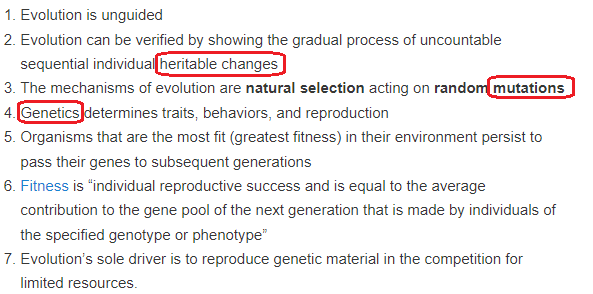
Gene-based theory IS the theory of evolution. Remember bullet points 2, 3, and 4 from the original post
There was nothing about culture, which TFAD now suddenly adds to the mix. TFAD never defines culture, but we can infer that he’s jumped down the Lamarkian rabbit hole of thinking that acquired characteristics can be passed on genetically. Lamarkism, the idea that a weightlifter will produce offspring with higher percentages of muscle or someone who pierces their ears will have offspring with pierced ears, is now generally dismissed, but there are rare exceptions. The theory of evolution is taught that beneficial heritable genetic traits persist while natural selection “weeds out” phenotypes that are unfit.
Moving on -> Many of you are familiar with the term “gaslighting“. TFAD attempts to gaslight the audience by questioning the reader’s understanding of reality. In the original post, I pointed out the redefinition of altruism made by Fehr/Fischbacher when in their definition of a new mysterious force they have defined as “Strong Reciprocity”, they talk about being rewarded for altruistic behavior “Reward? If there is a reward, it’s not altruism. Right from the beginning, they change the definition of altruism from something that is unselfish to appeal to the inherent selfishness”. But TFAD gaslights the reader by saying
“At no point do either of these definitons (sp) nor the SEP definition consider altruism as “doing something beneficial for no thought of reward””
When the very definition of altruism IS “Behavior by an animal that is not beneficial to or may be harmful to itself but that benefits others of its species”. When Fehr/Fischbacher introduce “reward”, they are not longer talking about altruism. But TFAD continues to say that selfish rewards and expecting “fair outcomes” are part of altruism, when we know in reality that altruism has nothing to do with selfishness or expecting fair outcomes. TFAD again tries to distract when he says
“I really don’t care about Merrian-Webster’s definition – I’d much rather use Stanford’s version because it is more academcially (sp) rigorous”
This reminds me of the objection from evolutionists that they have successfully refuted Michael Behe’s example of irreducible complexity in the standard mousetrap. In an analogy, Behe described the necessary components of the standard mousetrap (Model SM) as needing a base, spring, hammer, catch, and trigger all arranged in a very specific ingenious way that these pieces interact to kill mice. The analogy is that a blind/purposeless/atomic process (evolution) cannot produce the standard mousetrap (SM) that we see today, because it requires multiple interacting parts to be assembled in place with all proper tolerances, dimensions, materials, and initial conditions lest it not be preserved for lack of functionality. The evolutionists have said that there are mousetraps (not model SM, but model FF) that do not require the 5 interacting pieces. But that’s not Behe’s claim. Evolutionists have to account for what is seen, which is Model SM. Sure an intelligent objector can theorize Model FF that is designed to catch mice a different way, but Model SM (which is analogously seen today in complex interacting biological systems) is irreducibly complex. So, what TFAD has subtly done is propose a different definition of altruism (like Model FF) in an attempt to distract from evolution’s inability to explain real altruism (Model SM). And just like the evolutionist’s failed attempt to explain away irreducible complexity, TFAD’s attempt similarly fails.
In a last ditch effort to object to my questioning of evolution’s claimed abilities, TFAD distances himself from the very sources that he recommended. He posted a link from Google Scholar that he recommended I should analyze before questioning whether evolution could explain altruism, and Fehr/Fischbacher were 1st in the list.
“And you know why? Because Fehr & Fischbacher are economists with specialisations in human behaviour – not geneticists.”
Now that I’ve pressed back on his claims that evolution can explain altruism, it’s likely that he would not call Fehr/Fischbacher “experts” since they are just economists, even though he recommended them in the 1st place
While TFAD has been less than complimentary about creationist’s understanding of the theory of evolution, we now have to point out the TFAD does not understand the finer points of evolution
“Convergent evolution ain’t no mere assertion – it’s a demonstrable fact. Let’s think about it – if two separate primate species have overlapping characteristics and genetics, where do you think it’s pointing to?”
I had pointed out that the best that modern experiments can do when comparing common traits between widely disparate species would be to speculate that that it was the result of convergent evolution. Now convergent evolution is the description of the observation that two (or more) species that are not evolutionarily closely related have similar structures. An example would be wings. Birds, insects and bats have wings, but they are not closely related according to evolutionists, so evolutionists describe this marvel as convergent evolution. So, when TFAD says it’s demonstrable fact, it’s true that evolutionists have named an inexplicable observation as convergent evolution, but it doesn’t EXPLAIN anything. They could just have easily called it sorcery because those 2 terms have the same level of explanatory power – ZERO. TFAD thinks convergent evolution means “overlapping characteristics”, but as shown, it’s not overlapping traits from evolutionarily closely-related species. And it’s not a mechanism or a process. It’s just the assigned label of a mystery that’s devoid of explanation
Dawkins
Next TFAD takes aim at my analysis of Richard Dawkin’s book, The Selfish Gene. TFAD states:
“I’m curious as to why ApoloJedi chose The Selfish Gene instead of something like much more recent”
The Selfish Gene by RD is, according to the Royal Society, the most influential science book of all time. It has 4 editions, it’s written by the most well-known living evolutionist, and it’s sold over one million copies. The Guardian ranks it as the 10th best non-fiction book of all time. Why would I NOT choose to use one of the most popular science books written by one of the most popular science writers of all time in my article? If I had not, TFAD would have questioned why I DIDN’T use this popular and influential book. As noted in Part 1 of the Altruism Exchange, TFAD will have no end to the number of resources and books that I could have used. “Why not this one? Why not that one? Why not THOSE or THESE?!?!?” Ad infinitum
“Go tell Richard Dawkins that. He’ll be pleased a Creationist has been reading his books. But Dawkins is an expert in biology, not human psychology.”
Again with the “you’re not an expert” accusation. If nothing else, TFAD has shown that he’s the expert on who is NOT an expert. Well, maybe TFAD should go tell Richard Dawkins that despite all of the hours spent researching, writing, and publishing a book that attempts (and fails) to elucidate evolution’s ability to account for evolution, that he’s not an expert. Dawkins’ own words from the opening of his book tell us that he intended to write an account that explains clear examples of altruism via evolutionary mechanisms
Openstax Biology 2e
In his objection to the portion of my post that cited Openstax (the College Biology book), TFAD missed the whole point. In their chapter titled “Altruistic Behavior”, they gave examples and definitions of strong reciprocity and (like me) criticized the notion of a selfish gene being able to explain altruism. With the end of their examples, they proclaimed “Most of the behaviors described above do not seem to satisfy this definition (of altruism).” So they spent all that time trying to compose examples of why altruism is explained by evolution and then admitted, “but those aren’t TRULY altruistic”. And I agree. They were unable to give an accounting of observed altruism via evolutionary mechanisms. TFAD focuses instead on pulling the reader back to his preferred definition of altruism and opining that evolution is true.
TFAD: “Heritable traits that enhance one’s odds of survival – that sounds a heckuva lot like evolution to me”
Yes – heritable traits. But TFAD said that just after he quoted Openstax as saying “These instinctual behaviors may then be applied, in special circumstances, to other species, as long as it doesn’t lower the animal’s fitness.” But remember the definition of altruism? “behavior by an animal that is not beneficial to or may be harmful to itself but that benefits others of its species.” Astute readers will again see the raw contradiction…as I have been contending all along.
In the original article I said “In their first paragraph they invoke a sciency-sounding phrase, kin selection, as if merely naming an observation actually explains it…Kin selection like convergent evolution like strong reciprocity are terms that hide the explanation under the guise of science. People hear “kin selection” and assume, “well, it’s got a fancy name, so someone must have demonstrated that evolution is the only explanation for it.”” TFAD replies
“Got bad news for you, good sir – kin selection is an observed and documented scientific fact…Kin selection, strong reciprocity and convergent evolution are ALL documented phenomena in the scientific literature. Ignore it at your intellectual peril”
I never said kin selection wasn’t observed. I said kin selection doesn’t EXPLAIN altruism…or anything else. Like convergent evolution, kin selection is simply a label. It’s not an explanation. TFAD thinks that because the WhiteLabCoats have placed a label on something, that it has explanatory power, but AS I SAID in the original post, the label gives it no explanatory power.
TFAD put a lot of effort into his objections, and I appreciate the sharpening of thought and communication. But as shown, his objections never quite hit the core of the argument. His strong faith commitment to the theory of evolution prevented him from seeing the contradictions based on my internal critique of evolutionism, and his bias left my original contention completely intact that the theory of evolution cannot explain altruism.
This week, I asked a God-denier to explain how “reasoning” could be explained via natural causes. This God-denier posted a link which was supposed to provide evidence and confirmation that evolution can explain the origins of reasoning. Being the intrepid ApoloJedi that I am, I read through the contents of the article and have analyzed it to see if it could make good on its claims. Of note, I regard this article to be poorly formatted and absent of any explanatory power, so I expect there will be a future blog post entitled “Can Evolution Explain Reason – Part 2?” when a subsequent God-denier doubtlessly posts another wild assertion that naturalistic causes can explain the origins of reasoning.
The article in question has been cited 10 times and accessed over 1000 times and much of it is hidden behind a paywall (remaining unanalyzed). There are 30 notes organized in a list. In the analysis I quote the pertinent piece from the note above in Italics and my comment below each is in Bold. Without further delay, here’s the analysis
Abstract: “I conjecture that reasoning evolved primarily because it helped social hominins more readily and fully align their intentions“ Conjecture indeed
The Primary Naturalist Assumptions include purposelessness and amorality
“first article” Hidden (hidden like evidence for evolution) behind a pay wall
“purpose of reasoning” Purpose/teleology is a concept that is incompatible with the primary naturalist assumptions AND does not explain the origin of reasoning
Nothing in this note explains the origin of reasoning from non-reasoning sources
“argumentative posturing” Assumes that reasoning already exists AND does not explain the origin of reasoning
“moral emotions…loyalty, gratitude, sympathy” Morality is a concept that is incompatible with the primary naturalist assumptions AND does not explain the origin of reasoning
“Imagine…reasons” Imagine indeed AND does not explain the origin of reasoning
“likely” Not evidence AND does not explain the origin of reasoning
“those with a preference for going right will often capitulate by joining the majority” This very clearly shows the absence of reason AND does not explain the origin of reasoning
“The odds of surviving might be enhanced, for example, by keeping mum about a fruit tree discovered while scouting” While evolutionists crone about how empathy drive social advancements, this note is literally contrary to that assumption AND does not explain the origin of reasoning Also, in conflict with Note 14
“team agency” & “team reasoning” & “gestational reasoning” & “group’s collective intent” Purpose/teleology is a concept that is incompatible with the primary naturalist assumptions AND does not explain the origin of reasoning
“giving of reasons counts as a kind of reasoning” Circular. Tautology. Assumes that reasoning already exists AND does not explain the origin of reasoning
“My claim here is that the faculty of reason played—and continues to play—a critical role” Assumes that reasoning already exists AND does not explain the origin of reasoning
“By calling manipulative reasoning…” Assumes that reasoning already exists AND does not explain the origin of reasoning
“collaborative reasoning” & “When reasoning together” Assumes that reasoning already exists AND does not explain the origin of reasoning Also, in conflict with Note 9
Nothing in this note explains the origin of reasoning from non-reasoning sources
“may have been made possible by the prior emergence of basic reasoning aptitudes. The claim is conjectural, but worth further exploration” Conjecture indeed AND does not explain the origin of reasoning
“it is not incorrect to speak of intention alignment as the primary utility or purpose of reasoning” Pragmatism is insufficient AND does not explain the origin of reasoning
“I take it up presently” It IS an important question AND does not explain the origin of reasoning
” ‘mind writing’ involves intentional or deliberate alteration” Assumes that reasoning already exists AND does not explain the origin of reasoning
“The ethical implications of IAM are significant, and well worth exploring” Assumes that reasoning already exists AND does not explain the origin of reasoning
Another article behind a paywall, but the abstract does not explain the origins of reasoning from non-reasoning sources
“if we could be sure that a bee’s nervous system supported something properly described as a mind” Humans did not evolve from bees AND does not explain the origin of reasoning
“complex social practice built atop basic reason-giving propensities” Difficulties with the naturalistic origins brought up AND does not explain the origin of reasoning
Another article behind a paywall, but the abstract does not explain the origins of reasoning from non-reasoning sources
“my aim here is not to decide the question, but make a preliminary case that IAM belongs in the discussion” An introduction to a hypothesis AND does not explain the origin of reasoning
Nothing in this note explains the origin of reasoning from non-reasoning sources
Nothing in this note explains the origin of reasoning from non-reasoning sources
Nothing in this note explains the origin of reasoning from non-reasoning sources
Nothing in this note explains the origin of reasoning from non-reasoning sources
Nothing in this note explains the origin of reasoning from non-reasoning sources
As you can clearly see, this linked article has given us no explanation for the naturalistic origin of reasoning via evolutionary forces. We did see some internal contradictions, and it was strong on assertions, but ended up be short on both evidence and justification
Disclaimer: Because God has revealed in his eternal Word that He has is the Source of reasoning, we know that the answer to the question “Can Evolution Explain Reason?” is most assuredly no. But as has been the case with other posts in this series, I have taken the claims of the naturalists and analyzed them within their own worldview, to see if their claims are valid. And just like the other posts, their claims are shown to be severely lacking.
An anaturalist doesn’t make any positive claims; we simply lack a believe that natural forces can account for purpose, space, time, matter, logic, math, beauty, truth, induction, information, magnetism, nuclear forces, reason, stars, planets, comets, water, life, DNA code, biological sex, biological reproduction, consciousness, minds, morality, justice, hope, love, altruism or the scientific method.
Less broadly, anaturalism is a rejection of the belief that “nature-done-it”. Those who have faith that nature can generate, produce, cause-to-emerge, and substantiate foundational elements of reality can do that if they want, but let’s be honest…don’t call it science. It’s the religion of naturalism and lacks evidence
An anaturalist simply recognizes the utter lack of evidence that nature produced everything. It’s been said that “extraordinary claims require extraordinary evidence“, so if you’ve got an extraordinary demonstration that nature can produce:
…then feel free to present it. Until then, anaturalism is the only rational position. For those naturalists and God-deniers who claim that “nature has no need of the Christian God to explain all of reality”, then the burden of proof lies not on the anaturalist to disprove the power of nature but on the naturalist to provide a rationale for naturalism.
Even worse for the naturalist and God-denier, there is strong empirical support for anaturalism
To finish his book Dr. Ross proposes a way that he thinks will bring resolution to the choice between the “creation-day controversy”. Whether you’ve been following the chapter reviews up to this point or not, you might be able to guess what Dr. Ross proposes as the solution:
Interpretations of Evidence!
Those who have been following along know that he would NOT choose the highest authority – God’s Word.
Given that various creation perspectives are readily testable, a pathway exists for peaceful resolution of creation-day controversies. With so much scientific data and many different biblical creation accounts open for investigation, little basis remains for conflicts or disputes over creation doctrines.
Ross seems deaf to the effects of interpretations when discussing evidence, and I want to return to the last chapter’s review. Ross claimed that he won a debate with biblical astronomer, Danny Faulker because when both he and Ross presented their evidence to the panel of 13 old earthers, the old earthers determined that Ross was correct. I wonder what would happen if Dr. Ross presented his evidence for special creation of each kind of creature over periods of time to a panel of Christians from BioLogos against the evidence presented from a Biologos evolutionist. Is there any doubt that this panel would expel Ross for his heresy against biological evolution? Interpretations of evidence are used to confirm one’s worldview biases and Ross does not recognize the inherent bias that old earthism has had on him since he was very young. Dr. Jason Lisle has tried valiantly to point out the role that biases have played in Dr. Ross’s eisegesis of scripture, but those habits have been ingrained deeply in Ross’s thinking and business model.
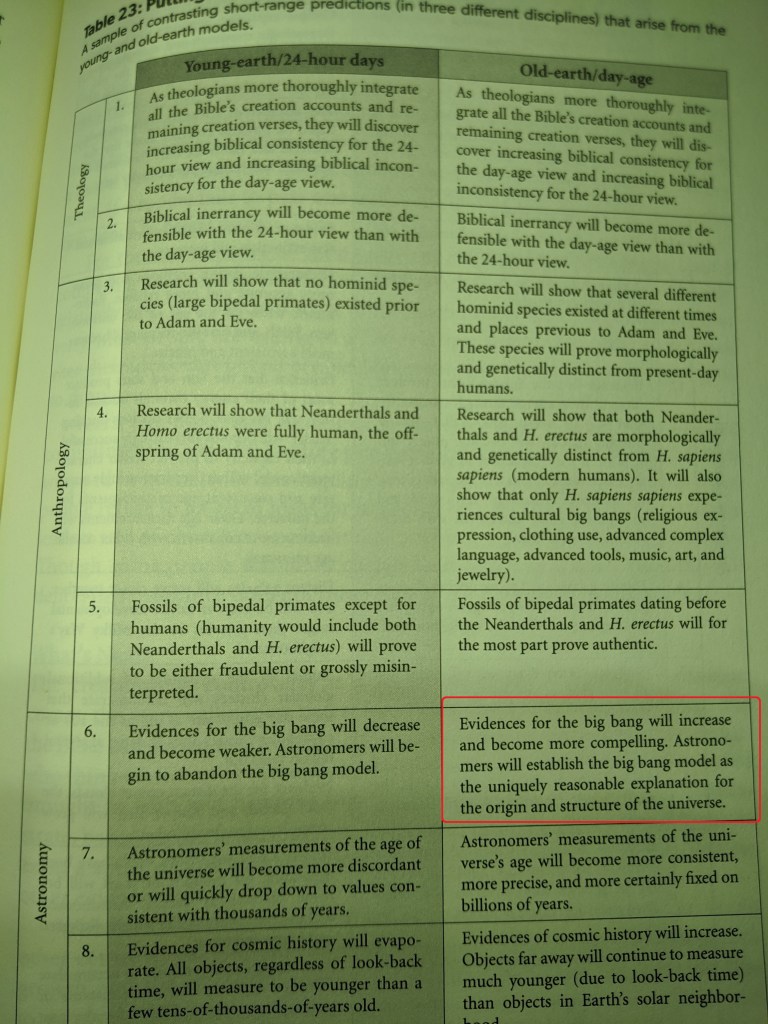
Below is the chart that Dr. Ross includes in his book as a way to resolve the “Creation-day controversy”. He explains that if both the young and old earth predictions get analyzed as more data is discovered and interpreted, that the old earth model will win out. From the biblical creationist perspective, the data from the expected predictions have lined up perfectly to confirm the young earth model. So, while I recognize my young earth bias, I want to point out how since Dr. Ross has written his book, the predictions he makes about the big bang completely unravel
Evidences for the big bang will increase and become more compelling. Astronomers will establish the big bang model as the uniquely explanation for the origin and structure of the universe.
Over the last few years, evidence for the big bang has NOT increased or become more compelling. It has been in massive need of resuscitation and repair
If you’ve learned anything from the review, I hope it is that God’s Word is the authority for the life of the Christian. There’s no need to compromise with the hollow and deceptive philosophies of the world as a way to interpret scripture.
As biblical creationists, we can praise God for the consistent nature of his revelation. We do not have to redefine the words in the Bible to accommodate modern academic paradigms or cultural changes in sexuality or political revolutions as we have seen Dr. Ross do. God’s Word is eternal and we can trust God to keep his word regarding the future since we can trust his revelation from the past.
Throughout Christian history, there have been ideas and theories which the church has to address as unorthodox. Dr. Ross addresses a few of them in the first few pages of chapter 22.
Circumcision. The first century church had to deal with the sign of the old covenant with regards to the gentile Christians. Should gentile Christians be forced to observe the sign of the old covenant? To help answer this question, the Council at Jerusalem convened to make sure there was a resolution that honored the Lord. Later Paul addresses this in his epistles to the churches. The conclusion – “Therefore, the promise comes by faith so that it may be by grace and may be guaranteed to all Abraham’s offspring – not only to those who are of the law but also to those who are of the faith of Abraham.”
Dr. Ross feels that the issue of the age of the earth is synonymous with the issue of circumcision:
The first-century church dealt with a problem roughly analogous to the dispute over the length of the Genesis creation days
While we can agree that Christians do have disagreement over the issue of the length of the creation days, this disagreement is not an issue of salvation. It is an issue of biblical interpretation and as has already been shown Dr. Ross has elevated the modern academic paradigm (which he calls the book of nature) as authoritative over the revealed and eternal word of God. Dr. Ross has exhibited the characteristics of a Christian, so I have no reason to doubt his regeneration. But his teaching regarding death, suffering, thorns, corruption, destruction being part of God’s “very good” creation because of his adherence to the Modern Academic Paradigm is harmful to biblical interpretation in this and future generations.
Dr. Ross next gives a short recap of the International Council on Biblical Inerrancy (ICBI) of 1982 as they discussed the creation-day controversy. They listened to presentations from a biblical creationist and an old earther. When it was complete, the ICBI presented a statement that included the following affirmations
We affirm that any preunderstandings which the interpreter brings to Scripture should be in harmony with scriptural teaching and subject to correction by it.
We deny that Scripture should be required to fit alien preunderstandings, inconsistent with itself, such as naturalism, evolutionism, scientism, secular humanism, and relativism.
We affirm that since God is the author of all truth, all truths, biblical and extra biblical, are consistent and coherent, and that the Bible speaks truth when it touches on matters pertaining to nature, history, or anything else. We further affirm that in some cases extra biblical data have value for clarifying what Scripture teaches, and for prompting correction of faulty interpretations.
We deny that extra biblical views ever disprove the teaching of Scripture or hold priority over it.
We affirm the harmony of special with general revelation and therefore biblical teaching with the facts of nature.
We deny that any genuine scientific facts are inconsistent with the true meaning of any passage of Scripture. We affirm that Genesis 1-11 is factual, as is the rest of the book. We deny that the teachings of Genesis 1-11 are mythical and that scientific hypotheses about earth history or the origin of human it may be invoked to overthrow what Scripture teaches about creation.
The statement from the ICBI has some merit and is generally acceptable. But as shown in the italics above, there are at least 2 phrases that could be misconstrued to accommodate any number of outside authorities over scripture.
The first “We further affirm that in some cases extra biblical data have value for clarifying what Scripture teaches, and for prompting correction of faulty interpretations.”
What cases? Who gets to determine which cases are acceptable? Which interpretations of the extra biblical data?
You can see how there is a massive gap left for those who would like to bring their interpretation into biblical orthodoxy, and since old earthism has until the most recent of times not been included in orthodox thinking, Dr. Ross would very much like for his naturalistic interpretations to be included in orthodox teachings of Christianity. For today’s generation that has been saturated with the naturalistic assumption of billions of years, they might think the church has thought this since the beginning, but it is a very recent addition to modern thinking. Until Hugh Ross wrote his books, virtually all of the church most certainly did not think the universe was billions of years old. As confirmation, the Hebrew year from the date of creation is 5780. So, those who wrote the original text of scripture are in agreement with the biblical creation model that the world is about 6000 old.
The second, “the facts of nature” is a phrase that I have covered throughout this review that is based on a false assumption. It leaves open the question – What is a fact outside of interpretation? Whose interpretation of the “fact” is considered the right one?
Dr. Ross finishes this chapter with the claim that his debate in 2009 with biblical astronomer, Danny Faulker was a win for old earthism. He claimed that 13 astronomers (who are all confirmed old earthers) agreed that the earth is old. It would be the same as if an Armenian and a Calvinist had a debate on which view of soteriology is correct. If the judging panel was 13 Calvinists, they would all determine that the winner was the Calvinist. If the same debate were to have been done in front of 13 biblical creation astronomers, Hugh Ross’s views would have been demonstrated to be impotent in just the same way.
As biblical creationists, we can praise God for the consistent nature of his revelation. We do not have to redefine the words in the Bible to accommodate modern academic paradigms or cultural changes in sexuality or political revolutions as we have seen Dr. Ross do. God’s Word is eternal and we can trust God to keep his word regarding the future since we can trust his revelation from the past.









 ApoloJedi