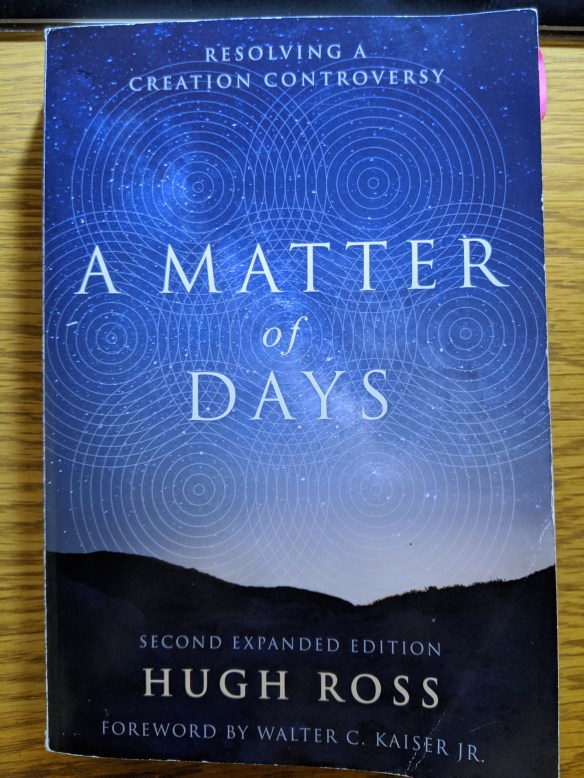
Writing a book is indeed a huge and trying undertaking. Reviewing a book is, by comparison, far easier and is rather painless. So, I will begin my review of A Matter of Days by Dr. Hugh Ross by recognizing the tremendous effort and time that he and his staff put into publishing a high quality book.
For those interested in the topic of biblical creation, theology, origins, science, and biblical interpretation, you will probably appreciate the book. It is 389 pages long including the appendices, notes, index, and biography. It contains 23 chapters.
The overall theme of the book is Dr. Ross building a case for old earthism in contrast to young earth creationism (henceforth to be referred to as biblical creation).
My plan for this review is to take each chapter as a separate blog post and keep track of the entire review in a “table of contents” format for easy navigating. I have purposefully not read any other reviews of this book, so that the contents of this review are entirely of my own reasoning. However, I will link to many outside sources to validate points and allow readers to further investigate points throughout the review. The exception to “other reviews” is part of the analysis of chapter 17. The reason for this is that I am not a practicing professional astrophysicist, and most of that chapter deals with astrophysics. Many of the points Dr. Ross makes in this chapter will need outside resources for proper reviewing.
My hope is that this review drives Christians back to God’s Word to study and grow…so that the believer knows God better and can thus worship Him in spirit and in truth with a fuller understanding of His greatness!
Theologetics.org has just released their free apologetic app (Theo Tab) that is now officially live on Apple & Google platforms (iPhones/iPads and Android devices). They’ve put a huge amount of hard work in this app and all they are asking is that we please share it with our friends!
To view the capabilities and resources that are available on this app just click on this link: https://theologetics.org/
This is really an outstanding Christian Apologetics tool so please take the time to check it out.
I just finished watching this video, so you don’t have to. Contained in it is a motley collection of unsubstantiated claims, irrational homage to ignorance, and an impressive display of hubris by one Professor Dawkins
Watching the video, I tried to take some notes for discussion. While I captured some of the quotes from Dawkins, there’s more than enough irrational rubbish spouted by the good doctor to fill up a shelf at the local library with his contradictions. Dr. Dawkins’ words are highlighted in red.
As you read through this (or watch the video) keep in mind Dawkins signature quote,
The universe we observe has precisely the properties we should expect if there is, at bottom, no design, no purpose, no evil, no good, nothing but blind, pitiless indifference
It is a bold and unsubstantiated claim, but THAT is his epistemic foundation. From this purposeless universe, Dawkins somehow conjures up purpose. From this amoral universe, Dawkins somehow judges religion as arrogant. From this pitiless universe, Dawkins manages to create meaning in empiricistic efforts, and from the indifferent universe, he produces eloquence and courage and a TON OF MONEY from his speaking fees.
Dawkins begins his diatribe by lumping all theism into a single category and throughout the video calls them “arrogant, hubristic, full of presumptuous precision“.
An understanding of modern Darwinism should arm us with courage to fight (what I shall demonstrate) is the hubris of faith
During the Q&A time, I would have loved to have asked Dr. Dawkins, “For the accidental aggregation of stardust in a purposeless universe, with no good, no evil, just blind pitiless indifference, WHAT is arrogance? What is hubris?” There’s just no coming back from his starting point to him giving a rational answer.
We don’t yet have an agreed theory of how the evolutionary theory began in the 1st place.
No kidding. Yet throughout, he tells us the science is settled…and “Those questions have now been definitively answered once and for all by Darwin and his successors”
Nobody knows how the universe must have began
He follows up these quotes with “Theologians invoke the God-of-the-gaps at every opportunity” without realizing how he was firing blanks from his own naturalism-of-the-gaps firearm.
Without letting up on the hypocrisy, Dawkins mocks Islam from 4:40-9:10 and with the sweeping generalization fallacy declares all religion as pointless
How can people bear to live their lives bound by such insanely specific and bossy yet manifestly pointless rules?
Those were magnificently rich words coming from the guy who says the universe is purposeless.
Dawkins then leaves his perceived area of safety, biology, and stumbles blindly into philosophy and morality by saying
It’s not hubristic to state known facts when the evidence is secure. Yes, yes, philosophers of science tell us that a fact is no more than a hypothesis which may 1 day be falsified, but which has so far withstood strenuous attempts to do so. Let’s by all means pay lip service to that philosophical incantation. But muttering at the same time in homage perhaps to Galileo’s [LATIN] the sensible words of Stephen J Gould “In science fact can only mean confirmed to such a degree that it would be perverse to withhold provisional ascent.”
So, what is a fact? He claims it to be like phlogiston, and flat earth, and blood letting, and geocentrism…the current best guess. It’s clear that Dawkins does not understand that science is built upon the philosophy of logic, truth, morality, and induction. These foundational entities are unchanging, abstract, and universal. If like Carl Sagan said, “The cosmos is all that is, or was, or ever will be” then how does the naturalist justify unchanging abstract absolutes? They cannot. To do so, they would have to reject their own presuppositions and argue like a Christian, who can substantiate unchanging abstract absolutes with the immutable, transcendent, absolute Creator. Continuing, Dawkins quotes Gould, who invokes the idea of perversity. How does one determine something to be perverse in a universe with no good and no evil? The contradictions are building up!
But that does not stop him from declaring, without reservation, irrefutable facts:
The universe began between 13-14 billion years ago
Really? What calibration techniques (besides presumptuous extrapolation) can one use to verify this claim? What about recent claims that the universe is now over TWO billion years younger than Dawkins’ FACT claim? Uh-oh. Now that there are competing FACTS. To which arbiter of truth do these naturalists turn in order to solve their 2,300,000,000 year disagreement?
The sun and the planets orbiting it (including ours) condensed out of a rotating disk of gas, dust and debris about 4.5 billion years ago
Really? What calibration techniques (besides presumptuous extrapolation) can one use to verify this claim? What about all of the evidence that limits the earth to being younger than 100,000 years?
We know the shape of the continents and where they were at any named time in geological history and we can project ahead and draw the map of the world as it will change in the future
I’d be very interested in hearing how he would confirm this claim? He speaks of the hubris of religion, but verifying a claim of this magnitude reeks of…what did Dawkins say earlier? Presumptuous precision. It was easy for him to cast this judgment on those with whom he disagrees, but when he invokes presumptuous precision in his own claims, he feels irrationally justified.
As a reminder, Dawkins claims
The universe we observe has precisely the properties we should expect if there is, at bottom, no design, no purpose, no evil, no good, nothing but blind, pitiless indifference
But he persists on in his inconsistency and word-smithing with:
Yet somehow the emergent power of our evolved brains has enabled us to develop the crystalline edifice of mathematics by which we accurately predict the behavior of entities that lie under the radar of our intuitive comprehension
Emergent power? Is that science or story-telling? What mechanism drives and fuels emergent power? Why does Dawkins expect the discovered properties of mathematics to be unchanging, abstract, and absolute in a constantly changing chaotic cosmos made only of matter? Adding to the irrational difficulties of the evolved brain which Dawkins praises, Charles Darwin (in his autobiography) was much less trusting of the reasoning power of the brain if it did indeed evolve from non-reasoning of the “lowest animals”
We are not arrogant not hubristic to celebrate the sheer bulk and detail of what we know through science. We are simply telling the honest and irrefutable truth. And honest as I’ve said is the frank admission of how much we don’t yet know
Whoa! Dawkins, you’ve straying outside your naturalistic boundaries again into the uncharted waters of philosophy and morality. “Honest and irrefutable truth” ????!?!?! Didn’t you remind us earlier that facts are simply the best guesses or today that will undoubtedly be panned by future scientists? And what is honesty for the evolved descendants of algae? He’s now singing the praises of ignorance, but he irrationally has said in other speeches that Christians are the ones, who should be mocked.
What are the DEEP Problems for us: How does the brain physiology produce subjective consciousness? Where do the laws of physics come from? What set the fundamental constants and why do they appear fine tuned to produce us? Why is there something rather than nothing?
Those are deep problems for naturalism indeed. For those with a Christian worldview, these issues are not problems at all, because God has revealed Himself in creation, in the Bible, and in Jesus. So since the One, who knows everything and is eternally faithful, has revealed some history to us, we can be certain of the answers to the questions that his revelation answers. No interpretations of modern paradigms have higher authority that God’s revelation.
The human mind (including my own) rebels emotionally against the idea that something as complex as life and the rest of the expanding universe could have just happened. It takes intellectual courage to kick yourself out of your emotional incredulity and persuade yourself that there is no other rational choice…Which is more probable, the impossible has really happened or that the conjurer has fooled you. You don’t have to understand how the trick was done in order to take the courageous leap of reason and say hard as it is to swallow, I know it’s only a trick. The laws of physics are secure.
The human mind rebels in several ways:
The human mind rebels against the Creator. Being born into sin, the human mind wants very much to be its OWN authority in the rightful place of the Supreme Monarch, Jesus! But through humble repentance, the human mind can instead embrace reality and worship the Creator rather than the created.
The human mind does indeed rebel against the idea that the universe, life, and consciousness emerged from nothing. Dawkins joins Richard Lewontin in refusing to accept the mountains of evidence for God and instead choosing philosophically to suppress the knowledge of God. Confirmation of Romans 1
Our willingness to accept scientific claims that are against common sense is the key to an understanding of the real struggle between science and the supernatural. We take the side of science in spite of the patent absurdity of some of its constructs, in spite of its failure to fulfill many of its extravagant promises of health and life, in spite of the tolerance of the scientific community for unsubstantiated just-so stories, because we have a prior commitment, a commitment to materialism…Moreover, that materialism is absolute, for we cannot allow a Divine Foot in the door – Richard Lewontin
Finally, Dawkins claims that even though he cannot justify the very foundations of science, scientism is the ONLY means for answering deep questions:
If science…can’t answer the deep questions, then nothing can
If you interact with atheists long enough, and you’ll hear them say, “Atheism makes no claims. It’s not a worldview. It is simply: a lack of beliefs in a God.”
To that, I have a few things to say: A rock as a lack of belief in God. Algae has a lack of belief in God. So, it means nothing to say that atheism is a lack of belief in God.
Secondly, Romans 1 tells us that everyone has knowledge of the Creator, but in their unrighteousness, they suppress the truth.
And thirdly, the high priest of Darwin, Richard Dawkins claims atheism to be a worldview:
The contrast between religion and atheism: I want to argue that the atheistic worldview has an unsung virtue of intellectual courage.
Now, he still cannot account for courage, intellect, or the laws of logic by which he could contrast religion and atheism, but he understands that atheism is a worldview. It’s just a bad one.
Dawkins has heard the gospel of Jesus, but he has rejected it. He now leads the deception of others that naturalism can account for reality in the rightful place of the Holy One. He is to be pitied.
Since we can trust what God has revealed to us about history (and HE has confirmed his historical revelation in the person of Jesus), we can be sure of what God has claimed about the future: hope, peace, and rest for those who humbly repent of their rebellion against the Holy One. Praise God for his amazing grace!!!
“In the beginning was the word and the word was with God and the word was God.” John 1:1
During the early church, there was a dispute about the ontology of Jesus Christ. Is Jesus the same essence as God or is he of a similar essence? These two schools of thought divided those who wished to be faithful to what was revealed in scripture about the Redeemer. They used the Greek words ὁμοούσιον (homoousion) and ὁμοιοούσιος (homoiusios) to describe thier respective views.
Homo-ousion – that the Father and the Son are of the same essence. “Homo” meaning same. “Usia” meaning essence, or being.
Homoi-usious – that the Father and the Son are of similar essense. “Homoi” meaning similar.
Now at first glance it may seem that the difference in the two is nonessential banter. Why would there be division about such a seemingly trivial…
When cultural norms, or academic paradigms, or political movements demand that the Bible be redefined to accommodate their pleadings, we must remember that the Bible is the eternal word of God and is authoritative on all matters. Enjoy this blog post from In His Image!
We at In His Image are very much interested in the authority of the Bible. That is what we attempt to uphold on a day to day basis, both in our blogs, and all our audio and visual media. However, there are varying opinions on what constitutes an authority issue. Different people define it in different ways, but to us, it’s far too important to just define and leave on a shelf. So today we’re going to try to define for you what we believe constitutes an authority issue. Let’s dive in.
In order to understand why authority matters, we need to understand what authority represents. For the Christian, the authority we acknowledge as preeminent is that of God the Father, God the Son and God the Holy Spirit. However, we believe that the mechanism by which He speaks to us today is not through spoken word, but written. As…
Note: This is a guest post since by ApoloJedi. He’s a friend of our blog over at Twitter and his blog be found here.
Recently, social media was astir with news that the well-known fact-checking website, Snopes.com had been checking the truthfulness of the well-known satire website, TheBabylonBee.com. Even the NY Times recognized the controversy between the Bee and Snopes. They noted the bias by which Snopes appears to judge the stories subjected to fact-checking.
Hugh Ross continues to redefine scripture in order to accommodate old earthism. This article by In His Image shows the shortcomings of Ross’s assumptions
I recently stumbled across an article in the Christian Post by Dr. Hugh Ross, the founder of the old earth Christian ministry Reasons to Believe. The article was entitled “Does the Bible teach Big Bang Cosmology?” and, predictably for an old earth group, Ross concludes it does. However, his logic is flawed on multiple levels as is his interpretation of Scripture. Since the Christian Post is not exactly friendly to Biblical creationists, it is unlikely a rebuttal article will appear there so I have elected to respond to Dr. Ross and attempt to educate him on his errors.
Ross’s first section is devoted to expounding on why he believes the Bible teaches the Big Bang. However, it is here he pulls a clever sleight of hand. He admits that the Bible does not specifically teach a Big Bang cosmology, but immediately claims that it is compatible with the text of…
“Satan Enters Eden” and “The New Jerusalem” by Gustave Dore
“The Bible says light appeared on the 1st day of creation. However, the sun and stars weren’t created until the 4th day. How can there be light and days with no sun and stars?”
Apologists have different ways of answering this question. I once even considered what’s called the cosmic microwave background. However, through further scripture reading, I believe the Bible has answered this question thousands of years ago.
I believe the “light” in Genesis 1:3 is the Glory of God.
The reason I believe this is because of the parallels in the books Genesis and Revelation. In Genesis we have the creation of the world and the Garden of Eden, God’s temple on earth. We also have the fall of mankind and the curse on man and the rest of creation where God dwelt and communed with man…
This is a concise review of an important book for a culture that is strongly influenced by the materialist religion of evolution.
Behe makes a strong case that evolution is indeed a real concept, but it is not understood by its proponents because the “direction” of the evolution is degenerative…not constructive.
“More cases of loss of religious faith are to be traced to the theory of evolution. . .than to anything else.” –Martin Lings
Review of Michael Behe, Darwin Devolves: The New Science About DNA That Challenges Evolution (New York: HarperOne, 2019), 342 pages, hdbk.
The author of this new book is well known for his earlier works Darwin’s Black Box and The Edge of Evolution. In the former book Michael Behe argued that biological systems, more especially the molecular makeup of incredibly complex structures in the cell, could not have arisen via evolutionary pathways. Natural selection and mutation were simply not capable of building the city-like features that had only recently been discovered. Nor could evolution explain how these structures (like the bacterial flagellum) be constructed as functioning wholes by the processes available to it. The “irreducible complexity” of the structures meant that everything had to be put together at once in just the right way so that the molecular machine would work. Not only this, but in The Edge of Evolution




 Arius of Lybia


 “Satan Enters Eden” and “The New Jerusalem” by Gustave Dore


