In part 1 of my comprehensive book review of preeminent paleoanthropologist, Ian Tattersall’s book, Masters of the Planet – The Search For Our Human Origins, we discussed many of the blind assumptions and uncertainty that attempted to fill the gaps in his lack of evidence for human evolution. As we pick up in Chapter 6, we’ll see much of the same speculation and story-telling
Chapter 6 – Life on the Savanna
He continues in his evaluation of Homo Ergaster
And in the absence of substantial evidence of technological change, we have to fall back on physical and other indirect indicators…these indicators are highly suggestive even though we are hard put to draw specific conclusions
The uncertainty and speculation persists. He’s staying true to the evolutionary story even with the absence of substantial evidence
There is no shortage of ideas; and although there is little evidence to substantiate any of them, a circumstantial case can be built
So much religion. Not so much evidence
Perhaps
may have been more important than the material evidence indicates
suggested
may have been
so it seems likely
Whatever their origin
would have
would not have been
would also have necessitated
possible
It is impossible to know for sure
is thought to have been
seems to be
the assumption
estimate
begs a number of important questions
as to leave lots of room for doubt
in which case there should be more and better evidence of it
almost entirely circumstantial
could have
may have
may have been
and if you are prepared to pile on a few more assumptions
probably
may
we are unable to say much more than this with any confidence
probably
probably
purely hypothetical
has to remain a guess
perhaps
we can’t be entirely sure
fairly sure
only indirectly reflected in the material record
must have
probably
Uncertainty. Assumptions. Speculation
Backing up a little to pages 110 and 111 we see
And we can’t take absence of evidence as evidence of absence. Beyond this, it is fair to point out that there is nothing we know or can reasonably infer about Homo ergaster cognition that would rule out the possibility that these creatures used simple containers
The absence of evidence for evolution is the norm. Evolutionists are excellent story-tellers, and they fill the gaps of this missing evidence with wonderful stories. I’m just not persuaded by their stories
Chapter 7 – Out of Africa and Back
Many people may not know that the “Out of Africa” theory was concocted in an effort to hide the inherent historical racism of Darwin’s theory of evolution. When Darwin fabricated his theory he lived in a time when it was perfectly acceptable to be openly racist. He had nothing to hide by presenting his new theory as praising the white race for being more evolved and pointing out that he thought the darker-skinned people were less evolved. From his work Descent of Man:
Sadly this kind of thinking had real and dire consequences built into the foundation of the theory of evolution. People have chosen to be racist for millennia, but with the advent of the new evolutionary paradigm that was deemed scientifically advanced, people felt they had a scientific justification for mistreating people of different ethnicities. The scientific racism went so far as to actually display an African in a zoo as if he were an animal
As the 20th century progressed, racism (thankfully) fell out of favor among the scientific elite, but because evolution had vise-like grip on academia, a new story was needed to hide the racism. Enter the “Out of Africa” model. The idea is that since humans were now said to have evolved in Africa first, Africans now had the GREATER claim to being the MOST human of all. Dr. Marvin Lubenow exposes the fabrication in his book, Bones of Contention
Now, what does Tattersall have to say about “Out of Africa”?
The human family was born in Africa, and many millions of years passed before we have any evidence that hominids had managed to escape the continents confines. For a long time it was believed…now though, things are looking a lot more murky; for the initial dispersal out of Africa appears to have occurred as early as 1.8 million years ago, or possibly more
Claims and murkiness. No science there. He follows with “suddenly” “it was felt” and “suggested” before throwing out this beauty:
Shortly before the early age of the Dmanisi was verified in 2000 and 2002, dates had been published from Java that hinted at the very early (1.8-to1.6 million-year) presence of Homo erectus in eastern Asia; together, these dates placed beyond dispute that the hominid exodus from Africa had begun almost immediately following the appearance there of the new hominid body form-vastly earlier than anyone had previously suspected.
“Beyond dispute“…please! Dates from evolutionists are presented as SET IN STONE when they speak to detractors, but as time goes by, the dates are as pliable as jello on a trampoline. New evidence requires evolutionists to constantly revise dates to keep the story from falsification as evidenced by the last line: “vastly earlier than anyone had previously suspected.” Because prior to that point, the evolutionists would have expelled anyone for suggesting the the dates that Tattersall says are “beyond dispute”. This book was published in 2012. As of the time of this blog post, the proposed (Darwinian) dates for the Dmanisi fossils have changed 3 times since 2012. There’s nothing to prevent future discoveries from forcing evolutionists to change these “beyond dispute” dates yet again to keep the theory from extinction
On page 127 he continues
Limited as our speculations have to be, however, the conclusion is inescapable that the invention of the handaxe must be represented-or at least have reflected-a cognitive leap of some kind
Unfortunately for Tattersall, the argument from his entire book hinges on this phrase, which we will see again: “a cognitive leap of some kind”. No evidence of natural selection acting on random mutations to produce cognition…just an interpretation of bones and stones to fabricate a story. This story includes (not science) but ever-increasing speculation:
Must have been
if for no better reason than there was nowhere else for them to iccur
must have been
remains a bit hazy
we have no idea
especially since there is no evidence that more than 1 hominid grade was involved
strongly suggests
suggestion
quite controversial
remains pure speculation
but it is possible
it is quite possible
we have so little supporting evidence
how we interpret it
suggestive
is at least highly suggestive
regrettably unknown to us
just as likely
a scenario
suggests
maybe about a quarter million years ago
perhaps most bizarrely of all
enormous controversy
Chapter 8 The First Cosmopolitan Hominid
Scattered throughout this chapter, we see the continued howls from Tattersall that the fossil record of human evolution is deficient
The systematic picture among fossil hominids of the period around a million years ago remains rather unclear, because relevant fossils in the African center of innovation are few and far between and widely scattered“
On its own the Mauer jaw was a bit puzzling
Dating is rather poor for most of these fossils
we can’t say much about the body structure of Homo heidelbergensis, since bones of the body skeleton are few and far between.
Some 380 thousand years ago the terrace on which Terra Amata lies was an ancient beach, to which a small group of hunters repeatedly returned (alas, without leaving any evidence of themselves)
Notice the speculation, uncertainty, arguing, and wagering of guesses on which paleoanthropology is built. Yet, when anyone questions the evolutionary narrative, the rebuttal is inevitably “you’re a science-denier!!!!” In their books and papers, to their evolutionary audiences, they drop their filter and expose the tentative nature of their view. Evolution isn’t built upon mountains of evidence; it’s built upon the predetermined ideology that natural selection acting on random mutations can produce all biological traits.
Chapter 9 Ice Ages and Early Europeans
In chapter 9 Tattersall tells the terrifying tale of intrepid travelers traversing frosty terrain as they transformed from Tanzanian apes into tempered Turks. It’s a great fable, with lots of conjecture.
There is thus no way in which we can realistically think of hominid evolution during the Pleistocene as a matter of steady adaptation. Instead, the story is a much more dramatic one
Ice Age conditions were often tough for the hominid individuals concerned; but never had circumstances been more propitious for meaningful evolutionary change than among our highly mobile, adaptable, and resourceful Pleistocene ancestors. Taken together, this combination of internal and external factors may well account for the amazing rapidity with which hominids evolved during the Pleistocene…rapid evolution…rapidly…quite unexpected…may have been
Propitious?!? You mean lucky? What exactly he means by evolutionary change, he never really says, but the implication is that “change happened, therefore evolution did it! Praise evolution almighty!” Again we see that Tattersall is proposing this strange and unnatural view of ‘rapid evolution’. We’ll see in chapter 14 why he’s pushing so hard for this idea that is so far outside the orthodox teachings of evolution: slow & gradual accumulation of mutations filtered over millions of years by natural selection
And very recent findings have also pointed to something quite unexpected: the possibility that, under fluctuating Pleistocene conditions, new genes may have been introduced into hominid populations by occasional intermixing between closely related and poorly differentiated hominid species
He’s saying that beastiality built humanity. Yuck! Too bad we didn’t end up with the monkey’s prehensile tail or the Orangutang’s strength.
But the problem was that each glacial advance scoured away much of the evidence left behind by its predecessors, and the resulting observations were a nightmare to interpret
No kidding. Your modified theory of evolution has staved off extinction despite the scouring away of much of the evidence. How convenient that the evidence is missing.
chronology is based on modern geochronological and geochemical analyses of long cores drilled through sea-floor sediments, or through the Greenland or Antarctic ice caps.
It is not easy to date a pile of bones at the bottom of a pit
Chapter 9 ends with lots of open questions and plenty of room for open skepticism about the story that we are forced to swallow despite the lack of evidence.
Chapter 10 Who Were the Neanderthals
Maybe we’ll get more answers in chapter 10
we know so little about it due to the effects of repeated glaciation and deglaciation in the region
Again, evolutionists know so little because the evidence is missing…supposedly and conveniently by glaciers. Funny how today, the progressive left (which would undoubtedly include evolutionists) pray to, fight for, and weep for glaciers.
As far as we can tell from a less-than-perfect postcranial fossil record
More lamentations at the dearth of evidence
evolutionary time
What is evolutionary time? How is it different from regular time? The pervasive use of ‘evolutionary’ as an adjective shows how religious is their devotion to the theory. They use evolution as a noun, a verb, an adjective, and adverb…it’s just evolutionary evolution of evolution-like evolvement. And if you’re skeptical of the evolutionary evolutionism by evolutionists, you’re deemed to be a “science-denier”.
Perhaps…appeared to have been…suggested…might have been…might have been…probably too early to know what to make of observations…it is not out of the question…may have had
All of these words of ambiguity appear in the same paragraph
Chapter 11 Archaic and Modern
In this chapter Tattersall talks about evidence of artwork and tools. He tries to build a distinction between what he considers to be archaic fossils and modern fossils. Not much to critique in this chapter
Chapter 12 Enigmatic Arrival
In ch 12, Tattersall intends to build the case that Homo Neanderthalensis is distinct from modern humans – not in phenotype, but only in cognition. He admits several times that the fossils are virtually indistinguishable, but because of the different layers in which the fossils are found, he calls 1 fossil Neanderthal, and the other human. Let’s review
Homo sapiens was emerging
This again is the common lingo among evolutionists. They don’t want to say that it was magic, but their justification for these emergent changes sounds very much like an appeal to magic
Still, this is not the whole story, for as far as Homo sapiens is concerned it appears that the body for was one thing, while the symbolic cognitive system that distinguishes us to greatly from all other creatures was entirely another. The two were not acquired at the same time, and the earliest anatomical Homo sapiens appear right now to have been cognitively indistinguishable from the Neanderthals and other contemporaries
Recognizing species from their bones is often a tough proposition among close relatives: in some cases, much physical diversity may accumulate within a population without speciation occurring, while in others, the bones of members of two species descended from the same ancestor may be virtually indistinguishable. In the absence of a good morphological yardstick we thus can’t be absolutely sure that Aterians or the Jebel Irhoud people would not have been able to exchange genes with anatomically mainstream Homo sapiens.
If nothing else from this book, we see that “recognizing species from their bones is often a tough proposition”, and then when evolutionists cancel/expel/dismiss anyone, who is skeptical of evolution, we see that they are simply protecting their religion. Those presuppositionalists, who read my blog, will recognize the Tattersall’s lament of not having a standard when he says “in the absence of a good morphological yardstick”. By What Standard indeed? Evolutionists can NEVER have absolute surety because some new discovery can (and almost always does) change their whole paradigm.
Chapter 12 finishes out with an overabundance of “maybe”
These tools were more or less identical
probably
spectacularly obscure
One possibility
there is no independent reason to believe that they were around at exactly the same time
other possibilities
Notice from the screenshot of pg 192 how many underlined words leave the reader with the idea that there’s no reason to hold tightly to the evolutionary beliefs. The following page includes these gems
in light of the frustratingly little we know, it seems reasonable to see the initial excursion of anatomical Homo sapiens out of Africa and into the neighboring Levant as the fortuitous product of circumstance, facilitated or even spurred by a benevolent change in climate…quite likely…But whatever the ultimate identity…tantalizing hints…we have no evidence
Speculation based on fortuitous circumstance (luck). And “benevolent change”?!!? Are you kidding me? There’s no reason to take this paragraph seriously when he proposes that the climate was “benevolent” to the proto-humans. Let’s move on to chapter 13
Chapter 13 The Origin of Symbolic Behavior
In 2013 Living Waters ministries released a documentary titled ‘Evolution vs. God’, and at about the 33 minute mark UCLA professor, Dr. Gail Kennedy remarked “You know the problem with those who are unable to see evolution, I think, is they don’t have imaginations.” Indeed. To believe in evolution, you must have a vivid imagination. Tattersall agrees:
Our ancestors made an almost unimaginable transition from a non-symbolic, nonlinguistic way of processing and communicating…it is a qualitative leap in cognitive state unparalleled in history. Indeed, as I’ve said, the only reason we have for believing that such a leap could ever have been made, is that it was made.
He states that the ONLY reason to believe that humans evolved from their indistinguishable contemporaries is that humans are here. No evidence of this event. No prediction by evolutionists that it could have happened. No other reason whatsoever other than: humans are here. That’s nearly exact wording for an example of the Post Hoc Fallacy.
Some scholars have suggested that the dazzling Cro-Magnon art represented such a break with the past that a recent genetic modification must have been acquired in the Cro-Magnons’ lineage to make all this creativity possible: a modification whose effects were confined to their neural information processing, and were not reflected in the fossil bones which are all the physical evidence we have of them.
Suggestions…must have been. These evolutionary beliefs are thrown into the conclusions without demonstrative evidence. And regarding the evidence, notice from the last highlighted sentence that the EVIDENCE IS MISSING!
Chapter 14 In the Beginning Was the Word
The reason I bought and reviewed this book was the quote just below. When I heard Dr. Christopher Rupe (who himself is a paleoanthropologist) read this quote during his presentation, I had to see it for myself. You can see the whole video from Dr. Rupe here. He reads the quote at about 58 minutes in. I found it on page 207 in Tattersall’s book:
Evolutionists teach that numerous successive slight modifications over millions of years allow creatures to gain new traits to outcompete their unfit counterparts in the struggle for survival. Slow and steady accumulations. But Tattersall is admitting that this kind of evolutions is not supported in the fossil record. He has to invent NEW evolution, and while he doesn’t use the word, notice how easily you could plug in the word miracle as a synonym for each green word below
As I have already observed, this suggests that the physical origin of our species lay in a short-term event of major developmental organization, even if that event was likely driven by a rather minor structural innovation at the DNA level. Such an occurrence is made more plausible by the fact that genetic innovations of the kind that probably produced us are most likely to become “fixed” (i.e., the norm) in small and genetically isolated populations…In other words, conditions in the late Pleistocene would have been as propitious as you could imagine for the kind of event that would necessarily have had to underwrite the appearance of a creature as unusual as ourselves.
Evolutionists say they don’t believe in miracles. They only believe in science…
But notice how they just avoid the word “miracle” with synonyms…and it continues
But the results of this acquisition were revolutionary: in today’s jargon, they were “emergent,” whereby an adventitiouschange or addition to a pre-existing structure led to a whole new level of complexity and function. Exactly when our amazing capability was initially acquired is something we cannot read directly from the fossil record: the paleoneurologists, those specialists who specialize in the form of fossil brains as determined from the impressions they leave inside the cranial vault, cannot even agree in principle if there us any functional significance to the minor external shape differences
Emergent = miracle
adventitious = miracle
Tattersall admits that the fossil evidence is missing…and his field of expertise is looking at fossils. He assumes that SOMEONE SOMEWHERE MUST have the evidence for evolution, it’s just not in his field
some believe
speculation
sometimes it seems like a miracle
The specifics still evade us, and we as yet have no idea what the genetic rearrangement was that gave rise to the unique anatomy of Homo sapiens. All we know for sure is that this event did indeed occur. But it seems overwhelmingly likely that….our new cognitive ability was acquired as a byproduct of the hugely ramifying genetic accident…Happily for us
The speculation and miracles continue. I don’t see any reason to accept the idea that humans evolved by means of natural selection acting on random mutations…the theory of evolution, which is what this book was an attempt to explain
The story-telling continues
I’ve already briefly mentioned the classic example of feathers, which were possessed by the ancestors of birds many millions of years before these modified dermal follicles were ever recruited as essential components of the flight mechanism. Similarly, the ancestors of terrestrial vertebrates had already acquired the rudiments of legs while they were still fully aquatic, and a terrestrial existence was still far in the future. You simply wouldn’t have predicted their future function when they first appeared. What is more, evolutionary novelties often persist if they don’t actively get in the way; and in the case of Homo sapiens the potential symbolic thought evidently just lurked there, undetected, until it was “released” by a stimulus that must necessarily have been a cultural one-the biology, after all, was already in place.
If you read that paragraph and know anything about evolution, you will declare: “That’s not how evolution works!” Evolution is said to work by reproductive fitness. Essentially, this means that whatever new traits that random mutations can provide, natural selection can judge whether or not to preserve that trait by how well it improves the ability to produce more offspring. Partially formed feathers can’t be preserved because there’s no evidence that they provide any increased fitness. It’s not just that these proto-feathers had to improve fitness in a single individual. These non-flight (what evolutionists think were broken dermal follicles) proto-feathers had to get fixed in an entire population of non-flying reptiles (as the story goes) and after millions of years get converted to the supremely well-designed flight feathers that we see today. Remember, there is no evidence that feather-like broken dermal follicles ever existed. But even if we grant that they did, they could not be preserved by natural selection if they didn’t provide a reproductive advantage for an entire population of reptiles! Same with rudimentary legs (stumps). Their wild assertions of stumps and follicles surviving millions of years of natural selection ruthlessly streamlining the phenotypes is absurd and definitely NOT evolution. They are appending a NEW story onto evolution in an attempt to explain the inexplicable. Now Tattersall invents the idea that “symbolic thought” just emerged miraculously even though the components were supposedly there all along too. In their attempt to prove evolution, they have to redefine evolution to include non-evolutionary (or in this case anti-evolutionary) mechanisms
believe
sparking speculation
has done nothing to quell the argument
suggestion
We can expect debate
notion
It’s anybody’s guess
Maybe
maybe
will require a lot more information than we have at present
suggests
almost unimaginable
remains a subject of pure speculation
If you asked an assortment of scientists interested in this question what that stimulus might have been, two clear frontrunners would probably emerge
we can guess
Some scientists believe
This is an attractive idea momentous event
Maybe. Maybe. Maybe
But this has proved a tricky endeavor, for individual words change quite rapidly over time: so rapidly that beyond a time depth of about five thousand years, or ten at the very most, it turns out to be fairly hopeless to look for substantial traces of relationship
5000-10000 years ago? Sounds very much like a biblical timeframe. At least I agree with Tattersall above
In figuring out just what it is that makes our brains special, we always have to keep in mind that our controlling organ is a rather untidy structure that, from very simple beginnings, has accreted rather opportunistically over an enormous period of time. So perhaps we shouldn’t be looking for one single major “keystone” acquisition. Instead, the extraordinary properties of the human brain are likely emergent, resulting from a relatively tiny-and altogether accidental-addition or modification to a complex structure that was already , and exaptively, almost prepared for symbolic thought.
As Darwin admitted in his autobiography: “Can the mind of man, which has, as I fully believe, been developed from a mind as low as that possessed by the lowest animals, be trusted when it draws such grand conclusions?”, Tattersall too is left admitting his belief that the human brain accreted accidentally. Why should an accidental accretion of neurons be trusted to provide reasonable conclusions? Would you trust the results of a calculator that was accidentally thrown together? I wouldn’t, and neither should you.
To sum up, Tattersall is a talented writer, and he is an excellent apologist for evolution. I’m sure he does a great job digging up bones. But I find that his attempt to convince critical thinkers that humans evolved (natural selection acting on random mutations) from lower animals is based – not on evidence – but on a religious commitment to naturalism. Evolution fails to explain the origin of humans.
For other areas where evolution has failed to explain the origin of:
This is a response to the online book, The Best Religion For the Task At Hand by Damien Harrison, whose online personality is The Tall Friendly Atheist Dad. Writing a book is a huge task and Harrison should be commended for making the effort to write and publish his book. The book can be purchased for $10.99 Australian here. Should anyone read this review, it should be noted that critiques are of ideas, application (or misapplication) of reason, and not of the author himself
This will be a strange book review as the book that Harrison wrote was in response to an article that Lita Cosner (Sanders) of Creation Ministries International wrote in response to a conglomeration of online videos by God-deniers. So, this is a response, to a response to a response.
You’ll see throughout this response that Harrison is not solely responding to Cosner. He is attacking Christianity at large. I’m not interested in defending any arguments by Cosner, but I will be pointing out throughout that Harrison has no grounds for judging others because of his assumptions on origins and his failed epistemology. There are many times Harrison purposefully mischaracterizes Christian teachings and displays no more than a surface-level understanding of the Bible. You can see his quotes from his book in red italics below with my responses in the default back text
In the Foreword Harrison begins with an uncharitable definition of creationism that only God-deniers hold. It’s not just uncharitable, before taking on her arguments, Harrison has poisoned-the-well. He’s taken Cosner and painted her with a brush of derision so his audience will see her as incompetent
“Creationism – the strand of Christianity that dismisses the findings of numerous fields of science simply because the conclusions reached by the evidence don’t line up with a literal reading of the Bible…Furthermore, creationism is wrong for the reasons it thinks it is correct.”
Those, who hold to creationism (The Bible should be interpreted contextually) do not dismiss findings as is asserted, but are skeptical of the assumptions with which naturalists interpret facts. Harrison is hypocritical and irrational in his thinking, because shortly thereafter, he falsely accuses Cosner of engaging in the poisoning-the-well fallacy
Harrison misquotes her and then falsely accuses her of a fallacy. Costner did NOT poison the well. She presented the case that atheists have no logical ground and linked to an article that explains step-by-step why. It’s not clear why Harrison would leave out that crucial bit of information in his response, but atheists have no logical ground for holding to standards of honesty. It’s not a good start (or a good look) from Harrison to lead off with poisoning-the-well fallacy and then falsely moan when he feels poisoned
This misrepresentation persists. The difference is in the presuppositions. The science is not disputed. To say that what can be known about the distant past (millions of years ago) has the same veracity as arithmetic and physics that can be measured in the present is a false equivocation. We find this conflation in many online discussions and Harrison builds his case upon this false assumption. To assert something to be “wrong”, one must have an epistemology that can justify knowledge, morality, logic…which atheism/naturalism does not. How can the accidental aggregation of stardust declare anything to be absolutely right/wrong?
“To make myself clear, the purpose of this book is not to defame, slander, belittle or impugn any particular person or organisation. Its purpose is to criticise BAD theology by demonstrating how MORALITY and governance based on socially-restrictive theology leads to DETRIMENTAL outcomes on both a personal and societal level.”
We’ll just have to stick around to see if he can indeed make sense of words BAD, MORALITY and DETRIMENTAL. If he maintains his atheistic naturalism, we can expect only an inconsistent sermon about things that he finds icky or personally distasteful since that’s all that atheism can conjure up
“However, I do hope that this book becomes one data point among many in a body of opinion that slowly turns the cultural tide away from beliefs in magic and superstition, and towards a more HUMANE approach to culture and politics.”
Magic? You mean like the naturalistic explanations of the cosmic evolution, dark matter (sciency-sounding moniker for superstition), 1st star, abiogenesis, the emergence of consciousness, the emergence of morality/altruism, the emergence of reasoning from non-reasoning source, purpose… ALL of those are magic for the naturalist since nature does not produce any of those.
Humane? I guess we’ll have to read ahead to see why one clump of cells (Harrison) thinks that other clumps of cells (Cosner) are worth protecting in a universe “that exhibits the properties one would expect if there is at bottom no design, no purpose, no evil, no good, just blind, pitiless, indifference”
It’s rich that Harrison would project his own Nazi propaganda onto Cosner as if Christianity were simply “propaganda”. When in reality Harrison who dislikes the Germans for claiming that “Jews weren’t persons” literally claims that developing humans in the womb are “not really persons”. The irony is completely lost on Harrison when out of 1 side of his mouth he denounces the Nazis then with a forked tongue he uses the Nazi dehumanization of millions and millions of tiny unborn victims
Doubling down on a bad argument, Harrison then poisons the well with a false attribution of “Hitler was a Christian”. His citation of this long refuted fiction is based solely on the top half of his link. Should one venture to the second half of the link, a rational person will see that Hitler loved manipulating the church for his own Darwinistic purposes, but hated the actual teachings of the Bible and Christianity. As long as the term Christian served his propaganda, he was willing to hold the moniker. Harrison would have shown himself to be a diligent scholar rather than something of a propagandist himself by showing the actual scholarly writings of the Nazi leader by Richard Weikart. But his research was as deep as a hair’s breadth and as wide a particle from which he thinks consciousness arose.
P38 “Humanists take an active stance against slavery, genocide and torture and specifically because Humanists understand the needless harm, suffering and risk to life that these things have been shown to cause. When your goal is human well-being, when you know that certain actions result in harm and suffering, and when you have the power to reduce harm and suffering by neither participating in nor endorsing those actions, it’s simple – your morality is already superior to that of the Bible”
Defining the goal would be the appropriate place to start. He stated that the goal of humanists is to reduce harm and suffering of humans. That’s not a bad goal. In fact, most people would agree, but we have to dig a little deeper to see if there are any internal contradictions within this religion and how they handle mutually exclusive situations.
P41 “Bible actively endorses and celebrates things like slavert, genocide, and torture”
What Harrison fails to address is the slavery has existed since sin entered the world. People have treated others cruelly so long as they can get away with it. Outside of God’s revelation there are no justifiable transcendent limitations placed on humanity for how to we should treat one another. Throughout the Pentateuch limits were placed on masters that ultimately ended up being “Love your neighbor”. Outside of Israel, there were no restrictions on indentured servitude or slavery. For a more detailed understanding of the “active endorsement if slavery” see
P45 Harrison takes the least charitable and least contextually-relevant reading of all texts to support his perpetual caricature of Christian theology
P47-48 “If a religious text happens to endorses (insert bad things) … that religious text deserves to be roundly criticised”
Using what transcendent standard should the criticism be based? If those doing the criticism hold the same view (atheism) that has caused more death, suffering, and hatred than any other view, why should that criticism be heeded?
Chapter 4 was the personal incredulity fallacy and essentially said “Since some Christians failed to keep the Sabbath, then Christianity is false.”
It’s a ridiculous chapter
Chapter 5 “Is God a Homicidal Maniac?”
With a title like that, (sarcasm font begin) there’s SURE to be no emotional or inflammatory arguments made by the author (sarcasm font end)
Cosner’s Actual argument: False Atheist Premise: That God routinely orders killing, and for arbitrary reasons”
Harrison criticizes Cosner for moving the goalposts but misquotes her argument leaving out the weightiest element of the argument
Harrison (partially) quoting Cosner “That’s a false premise. God does not routinely order killing”
Notice how Harrison (arbitrarily?) left out the word “arbitrary reasons”. God has never killed anyone for arbitrary reasons.
I have had the privilege of having my writings critiqued by Harrison. One of Harrison’s favorite weapons is to claim: “yOu didN’t QuoTe tHe wHoLe cOnTexT!!!!!!”
It’s a shame that Harrison didn’t bother to apply that critique to himself, but do atheists even have a moral standard by which to make sure they uphold consistency or honesty?
Strawman arguments and uncharitable literalism (ignoring genre/context) persist throughout the rest of the chapter.
In my online interactions with atheists, I hear all the time that the Bible or Scientists, who believe the Bible do not make any testable predictions. Notice how Harrison totally misrepresents Cosner’s arguments:
P73: “Parents will eat their children? Looks like God is endorsing familial cannibalism to me”
Not once did Harrison consider God’s foreknowledge of the future being revealed to Ezekiel even though that is what was clearly being communicated. God has knowledge of the future, and He’s telling Ezekiel that the impending punishment upon the rebellious Israelites will be so severe that they will eat their own family members. God’s knowledge not endorsement, but someone with only a surface-level reading of the Bible wouldn’t know the difference
On p75 Harrison tries to trap Christians on the horns of a trilemma but instead commits the trifurcation fallacy:
Either the Bible does not accurately represent God (fatal to the fundamentalist cause)
Christians believe genocide is morally OK (confirming you need to twist your morals to make Biblical morality acceptable)
God does not actually exist (Rendering the Bible as pure mythology)
Considering that point 2 is false (Since God is the ultimate authority, He cannot commit murder/genocide) and there is at least 1 more option, even though Harrison has taken a class on philosophy, he’s clearly not putting what he learned into practice. There are any number of possible additional options, but 1 of them is 4. God has a sufficient justification to render judgment on a people group. Knowing that the Bible teaches that humans have ALL sinned and no one deserves God’s mercy, it’s not just a people group that can get righteous judgment, but ALL people have rightly earned God’s holy judgment. That ANYONE has received grace is an amazing fact and makes God worthy of praise.
“I know two people does not a religious orthodoxy make, but if Cosner and my Methodist friend combined represent something approaching the norm of Modern Christian theology, then IT CAN ONLY BE SURMISED that not only does Christianity require you to shun more humane interpretations of morality in favour of being compelled to say nice things about God at every opportunity for the rest of your life, but Christianity also requires you to conclude that picking up sticks is treason and that babies need to be killed because they’re potentially dangerous.”
“Bottom line: If you’re not convinced that Christianity requires you to twist your morality to fit in re-read the above paragraph until you are.”
Essentially, Harrison says that if you don’t believe his atheistic caricature of Christianity, re-read his book until you’re convinced his caricature is actual Christianity.
Ch7
Harrison starts off this chapter criticizing Jesus for upholding the laws given to Moses. But again, Harrison does so without a consistent & transcendent standard…just his temporal personal preferences.
Harrison misunderstands Cosner’s assertion that the Christian worldview justifies charity. He then proceeds to say that charity & government programs existed long before the Christian worldview became widespread. This is another of his examples of uncharitable and purposeful misreading to push his agenda. Cosner never said Christianity is the source of all government welfare as Harrison implied. But the Christian worldview is the sole ideology that can justify all human value, so that any charity would be expected. Were naturalism true, why help the weak or unfit? The humanist religion must deny one of their core tenets (survival of the fittest) or redefine it to claim to love charity
P87-88 “If Jesus endorses the Old Testament and was even around when it all happened then Jesus the son is just as answerable as God the father in all human rights violations and war crimes”
Anyone else see the problem with Harrison’s logic? Human rights violations. From where do human rights come? If not from God, then there can be no such thing as human rights! As much as Harrison hates Frank Turek, Harrison is literally stealing from the Christian worldview to argue against it. He does the same thing with the concept of war crimes…as if there is a transcendent standard of morality by which criminals must be judged for crimes. How did a cosmos made only of particles produce transcendent moral standards such that Harrison can pronounce judgment on the Almighty? It’s ridiculous of him
Since God’s nature is the source of human rights (humans are created in his image), God has never violated them. Since the transcendent moral standard comes from God’s unchanging character, He cannot criminally break them. God’s judgment for rebellion is just and since Harrison has no rational standard by which to judge the Almighty, his objection is a dismal failure
P90 Back in his early chapters, Harrison shrieked (incorrectly) that Cosner employed the poisoning the well fallacy…and then promptly poisoned the well against her. In his chapter called “What About Him?” Harrison leads off with the assertion that Jesus is a racist and implies that creationists (and by association with Jesus all Christians) are racist with his line “And let us not forget that Creationist white supremacist groups are still active today in Christian America.”
You’ll notice how Harrison insinuated that white supremacists are creationists (and followers of Jesus) so being a creationist/Christian opens you up to being a racist. He’ll hem and haw with “plausible deniability” and say that’s not what he intended, but the well is poisoned.
Ch8 Here Harrison tries to project his personal temporal preference (which he calls his religion of humanism) onto God. So, Harrison feels justified in condemning God for judging the sin of mankind in the worldwide flood. Does God not have the right to do with his creation as He wills? Why not? I covered this in a separate blog post, Stay in Your Lane. Harrison does not know how to properly do an internal critique. Should he want to correctly show why the Bible is incorrect regarding God’s morality, he must take on the Christian position (for purposes of argumentation) and show how it leads to an inconsistency or an absurdity. But as it is, his objections are just screaming at the air and stomping his feet.
On pg97, Harrison opines loudly and ignorantly about Jesus cursing the fig tree. Lost to Harrison and sadly even most Christians is what Jesus was actually trying to say. For reference, see Isaiah 5. God describes planting a garden and doing everything necessary for it to bear much fruit…to be a delight to the vinedresser. But the vineyard (Israel) fails to be a light to the nations (Isaiah 49). Instead, the vineyard is impotent…worshipping false idols and prostituting itself among the nations. As Jesus enters the last week of his life, He is justly judging Israel (the fig tree) never to bear fruit again because of their wickedness and their upcoming unjust murder of the Messiah (Matt 27:25).
P101 “To sum it up, ending the life of a plant or animal for the reasonable sustainment of life isn’t a bad thing – animals eat plants and animals eat other animals all the time. But killing humans in a fit of rage is a bad thing”
Why? According to atheists, what transcendent standard proclaims this to be true? How do you know? Would it be wrong to kill Trump? Putin? Tucker Carlson? Alex Jones? Hitler?
If humans are simply animals, what’s wrong with animals killing other animals? How do you know? What is the distinction between 1 type of animal and another type of animal with regards to killing? Flush with internal contradictions, the humanist, who has a faith commitment to evolutionism, has no rational justification for calling 1 type of interaction between animals as immoral and any other type of interaction between animals as moral. Only in the Christian worldview can the murder of humans be justifiably shown as immoral.
CH9 Harrison starts ch9 with a plan to “fix” Christianity by taking out God, and simply replacing it with secular humanism. All Fixed! He proclaims that the group of people, who are responsible for building, staffing, and supporting more schools, orphanages, hospitals, charitable donations, mission organizations, and general welfare should become more like the secular religion that has done NONE of that. I did find it interesting that there is one atheist orphanage in the world. So, in all of history and throughout all civilizations, there is only 1 orphanage created in the name of atheism. I do understand that humanism and atheism are not completely synonymous, but there is near complete overlap in their Venn diagrams. The orphanage is on tenuous financial grounds. We’ll see if the humanists can rally with actual financial support rather than just keyboard virtual signaling. But it does make one wonder, if humanists are so bent on helping the suffering, why is the only measurable metric of their actual assistance almost completely missing?
Ch10 Not realizing that Christianity is the explanation for all of history, life, origins and the future, Harrison declares that Jesus or his teachings are unneeded because “It is fair to say that if numerous independent cultures came to the same principles without Jesus (in this case The Golden Rule), it indicates that that The Golden Rule didn’t need a Jesus to make it.” (duplicate “that” in original)
But as Christians, we would expect the Golden Rule to be a worldwide phenomenon since humans are all created in God’s image. All humans know what is right/wrong in general because it is written on our hearts (Rom 2:15). So, his objection stems from an ignorance of the Christian worldview or malevolence against Jesus.
CH11
Why didn’t Jesus teach people about antibiotics? That wasn’t his purpose. Throughout, the book, Harrison’s assumption has been that secular humanism’s goal, so he asks “Is your morality focused on maximising human well-being and reducing pain and suffering by having a rational understanding of the world around you or is your morality simply focused on making sure the feelings of an infinitely great and powerful God aren’t hurt because someone ate shellfish.”
But that is not the standard. The Bible is clear that God’s purposes are to be glorified by saving unworthy sinners. Jesus’ own words tell us why He came into the word. John 12:47. Paul affirms this revelation in his 1st letter to Timothy. Chapter 1 verse 15
Ch12 Harrison leads off with a howler:
“Because Cosner’s morality is based on the will of the supreme intelligence behind the creation of the universe as revealed in the Bible, there should be no possible way I could counter any of her arguments gained from that theology and methodology”
That’s like saying, “if the speeding laws in a country truly were from the state, there would be no way to argue your way out of a ticket with a police officer”
It’s just ridiculous
Next he does do a very good thing by defining terms. Unfortunately, his conclusions end up as temporal preferences rather than actual objective morality
“In my estimation, the essence of morality should be designed by what is universal to the shared human experience – health, wellbeing and personal and economic freedoms”
It’s fine to love your neighbor, and your enemies…in fact, this is the actual Christian position as opposed to what Harrison has been on about. In fact, my article about why Empathy is arbitrary, inconsistent, and irrational for the atheist exposes the utter lack of foundation from which atheists loudly prattle-on about their virtue. So, on which foundation do they stand to prattle-on? Knowing Harrison’s hatred for Frank Turek, atheists are literally stealing their worldview from God in an attempt to make sense of their assumptions.
Getting back to Harrison’s prattling: ”Jehovah’s Witness families have died because of their parent’s belief that…it is better for their child to die…This is an abject failure of theism.”
Did anybody catch what he did there? It’s called a hasty generalization. “Because 1 theistic group did something I don’t like, then ALL theism is an abject failure”
Garrison doubles down on p133 (this is a paraphrase of Harrison’s 7 paragraphs) Westboro Baptist church says mean things, so Christianity is false
On p134 Harrison mocks the Bible as not being God’s Word because “When someone reads the Bible, they are free to interpret the text in any way they see fit”. The inferred point from him then is that if the Bible can be interpreted in many ways, then NONE of them are correct. This is a sweeping generalization, which takes the form: if there are many counterfeits then all are counterfeit.
But Christians do not believe this and the Bible teaches against what Harrison says. The Bible is the revelation of God, and is justification for knowledge being possible at all (2 Tim 2:2, Act 17:11)
P134 Harrison doesn’t think his argument through when he opines about what he believes to be the total flexibility in biblical interpretation
“Case in point: In Isaiah 7:14, the word that is commonly translated as virgin in the verse “.,..the virgin will conceive and give birth to a son…” does not mean virgin – the original Hebrew word almah just meant a young woman of child-bearing age without ant reference to previous sexual activity”
Harrison displays ignorance to the word he has grown to loathe – context. In what context was this Word from the Almighty spoken to Isaiah? The king of Judah, King Ahaz was worried about the imminent invasion from the most powerful army in that area of the world. He was considering a bad alliance and the LORD gave Ahaz the prophecy that the nations he feared would becomes desolate. And the sign would be that an “almah” would give birth to a son. Harrison believes it is likely that the LORD said: “a girl of child-bearing age will bear a son” as if that’s some sort of unusual state of circumstances. As if a girl of child-bearing age had ever had a son before as a sign that the most powerful army in that part of the world would be destroyed. Neither myself nor Harrison are Hebrew scholars, but Harrison’s opinion that God would give a sign that a woman would have a son as a sign from God is a lazy and ill-conceived objection. Because the Hebrew word also means virgin, the context clearly shows the word to hold the meaning that all Bible translators, all Hebrew scholars, and all Christians have known for thousands of years.
The Criteria p135
The crux of Harrison’s argument can be distilled to this 1 thing:
He has a subjective opinion that morality is “In my estimation, the essence of morality should be designed by what is universal to the shared human experience – health, wellbeing and personal and economic freedoms”
Let’s call it morality H. We’ll call Christianity morality C
Harrison claims that H > C based on H as the standard. But this is not a valid comparison. To determine TRUTH, a comparison would need to be done against a transcendent standard (T). Since atheism cannot account for unchanging, abstract, absolutes, the best Harrison can say is “My feelings are better than yours”
The strength of Christianity is that it does make a claim to be a transcendental standard. The unchanging, transcendent, absolute Monarch, who created and upholds creation, has deemed certain behaviors as moral and others as immoral. So like it or not: God’s creation – God’s rules
C = T
Therefore C > H based on the standard of T
Jesus said the greatest commandment (Matthew 22) is this “Love the Lord your God with all your heart and with all your soul and with all your mind. This is the first and greatest commandment. And the second is like it: ‘Love your neighbor as yourself. All the Law and the Prophets hang on these two commandments.”
IN THAT ORDER. So, we as God’s creation and image bearers are to love God supremely and follow this with loving our neighbors (and even our enemies – Luke 6)
P146 “So it turns out that the best religion for the task at hand of helping inform a human-centric morality that increases well-being…is no religion at all”
While his whole book has been building a case against Christianity and for the religion of humanism, his last line of his book rejects his own premise. It’s a fitting end to a book filled with caricatures of Christianity, baseless assertions, and sloppy logic
To finish his book Dr. Ross proposes a way that he thinks will bring resolution to the choice between the “creation-day controversy”. Whether you’ve been following the chapter reviews up to this point or not, you might be able to guess what Dr. Ross proposes as the solution:
Interpretations of Evidence!
Those who have been following along know that he would NOT choose the highest authority – God’s Word.
Given that various creation perspectives are readily testable, a pathway exists for peaceful resolution of creation-day controversies. With so much scientific data and many different biblical creation accounts open for investigation, little basis remains for conflicts or disputes over creation doctrines.
Ross seems deaf to the effects of interpretations when discussing evidence, and I want to return to the last chapter’s review. Ross claimed that he won a debate with biblical astronomer, Danny Faulker because when both he and Ross presented their evidence to the panel of 13 old earthers, the old earthers determined that Ross was correct. I wonder what would happen if Dr. Ross presented his evidence for special creation of each kind of creature over periods of time to a panel of Christians from BioLogos against the evidence presented from a Biologos evolutionist. Is there any doubt that this panel would expel Ross for his heresy against biological evolution? Interpretations of evidence are used to confirm one’s worldview biases and Ross does not recognize the inherent bias that old earthism has had on him since he was very young. Dr. Jason Lisle has tried valiantly to point out the role that biases have played in Dr. Ross’s eisegesis of scripture, but those habits have been ingrained deeply in Ross’s thinking and business model.
Below is the chart that Dr. Ross includes in his book as a way to resolve the “Creation-day controversy”. He explains that if both the young and old earth predictions get analyzed as more data is discovered and interpreted, that the old earth model will win out. From the biblical creationist perspective, the data from the expected predictions have lined up perfectly to confirm the young earth model. So, while I recognize my young earth bias, I want to point out how since Dr. Ross has written his book, the predictions he makes about the big bang completely unravel
Evidences for the big bang will increase and become more compelling. Astronomers will establish the big bang model as the uniquely explanation for the origin and structure of the universe.
Over the last few years, evidence for the big bang has NOT increased or become more compelling. It has been in massive need of resuscitation and repair
If you’ve learned anything from the review, I hope it is that God’s Word is the authority for the life of the Christian. There’s no need to compromise with the hollow and deceptive philosophies of the world as a way to interpret scripture.
As biblical creationists, we can praise God for the consistent nature of his revelation. We do not have to redefine the words in the Bible to accommodate modern academic paradigms or cultural changes in sexuality or political revolutions as we have seen Dr. Ross do. God’s Word is eternal and we can trust God to keep his word regarding the future since we can trust his revelation from the past.
Throughout Christian history, there have been ideas and theories which the church has to address as unorthodox. Dr. Ross addresses a few of them in the first few pages of chapter 22.
Circumcision. The first century church had to deal with the sign of the old covenant with regards to the gentile Christians. Should gentile Christians be forced to observe the sign of the old covenant? To help answer this question, the Council at Jerusalem convened to make sure there was a resolution that honored the Lord. Later Paul addresses this in his epistles to the churches. The conclusion – “Therefore, the promise comes by faith so that it may be by grace and may be guaranteed to all Abraham’s offspring – not only to those who are of the law but also to those who are of the faith of Abraham.”
Dr. Ross feels that the issue of the age of the earth is synonymous with the issue of circumcision:
The first-century church dealt with a problem roughly analogous to the dispute over the length of the Genesis creation days
While we can agree that Christians do have disagreement over the issue of the length of the creation days, this disagreement is not an issue of salvation. It is an issue of biblical interpretation and as has already been shown Dr. Ross has elevated the modern academic paradigm (which he calls the book of nature) as authoritative over the revealed and eternal word of God. Dr. Ross has exhibited the characteristics of a Christian, so I have no reason to doubt his regeneration. But his teaching regarding death, suffering, thorns, corruption, destruction being part of God’s “very good” creation because of his adherence to the Modern Academic Paradigm is harmful to biblical interpretation in this and future generations.
Dr. Ross next gives a short recap of the International Council on Biblical Inerrancy (ICBI) of 1982 as they discussed the creation-day controversy. They listened to presentations from a biblical creationist and an old earther. When it was complete, the ICBI presented a statement that included the following affirmations
We affirm that any preunderstandings which the interpreter brings to Scripture should be in harmony with scriptural teaching and subject to correction by it.
We deny that Scripture should be required to fit alien preunderstandings, inconsistent with itself, such as naturalism, evolutionism, scientism, secular humanism, and relativism.
We affirm that since God is the author of all truth, all truths, biblical and extra biblical, are consistent and coherent, and that the Bible speaks truth when it touches on matters pertaining to nature, history, or anything else. We further affirm that in some cases extra biblical data have value for clarifying what Scripture teaches, and for prompting correction of faulty interpretations.
We deny that extra biblical views ever disprove the teaching of Scripture or hold priority over it.
We affirm the harmony of special with general revelation and therefore biblical teaching with the facts of nature.
We deny that any genuine scientific facts are inconsistent with the true meaning of any passage of Scripture. We affirm that Genesis 1-11 is factual, as is the rest of the book. We deny that the teachings of Genesis 1-11 are mythical and that scientific hypotheses about earth history or the origin of human it may be invoked to overthrow what Scripture teaches about creation.
The statement from the ICBI has some merit and is generally acceptable. But as shown in the italics above, there are at least 2 phrases that could be misconstrued to accommodate any number of outside authorities over scripture.
The first “We further affirm that in some cases extra biblical data have value for clarifying what Scripture teaches, and for prompting correction of faulty interpretations.”
What cases? Who gets to determine which cases are acceptable? Which interpretations of the extra biblical data?
You can see how there is a massive gap left for those who would like to bring their interpretation into biblical orthodoxy, and since old earthism has until the most recent of times not been included in orthodox thinking, Dr. Ross would very much like for his naturalistic interpretations to be included in orthodox teachings of Christianity. For today’s generation that has been saturated with the naturalistic assumption of billions of years, they might think the church has thought this since the beginning, but it is a very recent addition to modern thinking. Until Hugh Ross wrote his books, virtually all of the church most certainly did not think the universe was billions of years old. As confirmation, the Hebrew year from the date of creation is 5780. So, those who wrote the original text of scripture are in agreement with the biblical creation model that the world is about 6000 old.
The second, “the facts of nature” is a phrase that I have covered throughout this review that is based on a false assumption. It leaves open the question – What is a fact outside of interpretation? Whose interpretation of the “fact” is considered the right one?
Dr. Ross finishes this chapter with the claim that his debate in 2009 with biblical astronomer, Danny Faulker was a win for old earthism. He claimed that 13 astronomers (who are all confirmed old earthers) agreed that the earth is old. It would be the same as if an Armenian and a Calvinist had a debate on which view of soteriology is correct. If the judging panel was 13 Calvinists, they would all determine that the winner was the Calvinist. If the same debate were to have been done in front of 13 biblical creation astronomers, Hugh Ross’s views would have been demonstrated to be impotent in just the same way.
As biblical creationists, we can praise God for the consistent nature of his revelation. We do not have to redefine the words in the Bible to accommodate modern academic paradigms or cultural changes in sexuality or political revolutions as we have seen Dr. Ross do. God’s Word is eternal and we can trust God to keep his word regarding the future since we can trust his revelation from the past.
Dr. Ross sent me his book almost a year ago and I finished reading it and annotating it within a few months. So, as I have gone back and read through the chapter again for the book review, I am not really finding anything new. From beginning to end, I have found that Dr. Ross although he claims that the Bible is his highest authority, he sees the modern academic paradigm as the highest interpretive authority and conforms his reading of the Bible to accommodate it.
In his personal testimony, we see evidence of this
I did not converse with a Christian about spiritual matters until I was 27. Studies in science consumed all my time and eventually convinced me, at age 15 that a transcendent God must exist. At the time, I doubted that a God who created a hundred billion trillion stars would care much about frail humans on an insignificant planet…In my first reading of Genesis 1, I saw indications that the creation days were long periods of time
If you teach people that the universe is billions of years old, by the time they are almost 30 years old (as Ross admits that he was) and have been indoctrinated by this mantra, they will try to fit everything they see into that worldview…including the Bible.
These are the parts of the text that Dr. Ross felt there was plasticity which would allow him to redefine the scriptures to accommodate the modern academic paradigm
The timing of Eve’s creation
He does not explain specifically here why he thinks this allows for creation days to be very long periods, but we can infer from a paragraph on the previous page why he thinks this is plausible. “Eve was created on the same day as Adam (the sixth) but not until after Adam took care of several large tasks.”
This sounds like the easily refuted argument that he used from chapter 7, when he claimed that Adam had four careers so the text could not possibly have been talking about a single day. His personal incredulity and injection of outside influence completely discounts Ross’s wild claim
The lack of an evening and morning for the seventh day
Clearly, Dr. Ross sees the importance of the evening/morning pattern when God revealed his creative works for 85% of the creation week. What’s not clear is why Dr. Ross takes the single example of missing morning/evening pattern and creates a rule for it. Dr. Ross’s shallow reading of the text ignores the deeper context and exegesis of Exodus 20 when the days are clearly defined with unmistakable 24 hour boundaries.
The Genesis 2:4 usage of the word “day” in reference to the entire creation week
So, at best, Ross can only say that the Hebrew word for day (yom) can have the colloquial understanding of a week of time…not the billions and billions and billions of years necessary to accommodate the modern academic paradigm. Biblical creationists agree that there is flexibility in the Hebrew word ‘yom’, but exegetically, it must fit the context, and in the context of Genesis 1, we can easily conclude from the text that it is signifying days as we know them today (24 hours).
I was especially intrigued by God’s creation hiatus following the six prolific creation periods.
We should all be intrigued by God’s creation hiatus, but it would be wildly bizarre to assume there were suddenly billions of years injected into the text from that thought
Finally, here was an explanation for the fossil record enigma
There are three things to keep in mind when interpreting scripture: context, context and context. When we view the scripture in context there was unquestionably a global flood that adequately (and more correctly) explains the fossil record…so the enigma is for the old earthist, who must redefine a world-consuming flood to mean a minor middle eastern rain storm and then create epicycles to explain both the text and modern observations
Dr. Ross continues at the bottom of pg242 and top of pg243 with the strange explanation for what it means to love the LORD with all of your mind
Loving God with “all your mind” means looking beyond the most simplistic interpretation of a given text, especially if that interpretation leads to complications and convolutions of other texts…Yet, ironically, a 24-hour creation day interpretation of Genesis 1 (and 2) complicates and convolutes at least aspects of God’s creation story – the sequence of events, the meaning of Adam’s work and words, and the speed of biological development.
Speaking of irony-> Just above Dr. Ross admitted that after almost 30 years of indoctrination in the modern academic paradigm, on his 1st reading of Genesis, his simplistic interpretation was that God created over billions of years…just as he’d been taught his whole life. So, clearly he’s only against OTHER people’s simplistic interpretation of Genesis 1.
Regarding his claim that the biblical creationist’s interpretation of Genesis 1 complicates and convolutes the aspects of the creation story, Dr. Ross AGAIN upholds the modern academic paradigm and demands that the Bible’s reading be conformed to those assumptions.
And as was shown in Chapter 4 and chapter 5 reviews when Dr. Ross attempted to claim that ALL of church history believed in old earthism, he was WRONG. Old earthism is a modern concoction that attempts to dissolve the modern academic paradigm into biblical interpretation, but as we see, they are like oil and water with no ability to mix.
On p244 Ross asks the question
How Did Adam Do So Much?…Similarly, for Adam to have named all of Eden’s animals within a few hours would seem to shrink not just the size but also the bounty of Eden…species
While I already covered Ross’s misunderstanding of scripture in my review of chapter 7, it doesn’t hurt to quickly address his repeated conflation of species and kinds. Kinds ≠ Species. The biblical kind is defined in Genesis 1 simply denoted a creature’s ability to reproduce at the time of creation. Since there have been many mutations, many creatures that were formerly able to reproduce lost the ability to reproduce. This does not mean they were not originally created as the same kind. But what this means is that Kind is more synonymous with the modern scientific distinction of family.
This means that Adam did not have to name millions of species as is claimed by Ross. Adam could have take care of his divinely-appointed job of naming the animals much more quickly by naming animals in groups
At the bottom of p244 Dr. Ross says
Young-earth creationists see as the futility of attempting to integrate Genesis with the scientific paradigm arises from a subtle error in applying a basic interpretive principle “Begin by establishing [not assuming] the point of view.” The result is a scientifically implausible order of creation events”
A few of things with this quote. Dr. Ross projects his own shortcomings in interpretation onto biblical creationists. Firstly, He conflates science with the modern academic paradigm as he has done throughout his book. Young earth creationists have no interest in trying to integrate Genesis with the modern academic paradigm. The observations of today are completely in accord with what we read in scripture. It is the old earthers like Ross, who have undertaken the mission of trying to integrate the modern academic paradigm with scripture. Secondly, the error is on the side of old earthers, who inject their assumptions from the modern academic paradigm into their biblical interpretation. Biblical creationists rather start with the basic interpretive principle that what God revealed in his word is true, so what we observe today is in accord with what He revealed in the Bible. Regarding his quote about the implausible order of creation events, you can see that Ross rejects the order of creation events that God revealed in scripture in order to accommodate naturalist assumptions.
On pg247-248 Ross unsuccessfully attempts to push the inconsistencies of his biblical interpretations with the observations onto biblical creationists.
A few purported conflicts between the Bible [old earth interpretations] and the fossil record have arisen…
The conflicts arise only for the old earther since the catastrophic worldwide flood is the only sufficient explanation for the observations. For the old earther, it is assumed that fossils were buried in the order that the soil-of-the-time was exposed as the top soil and that there were epochs when certain creatures did not exist. Dr Ross believes this imperative, but there are out-of-place (for the old earther) fossils that are discordant with those assumptions.
Genesis 1 gives the order of God’s creative works, but in both Dr. Ross’s posted timeline, which he posted years ago and on p249 we can see that Dr. Ross tries very hard to inject the modern academic paradigm into scripture
There are several problems with his chart, but I want to point out a particularly grievous problem in rows 9 and 10. Ross tells us that God’s last creative work was Adam and Eve, but just prior in row 9, Ross tells us that the Australian aboriginals emerged prior to Adam and Eve. This is both a terrible assumption and racist. Now, I do not believe Ross is a racist, but his views of the modern academic paradigm as an authority over scripture has resulted in a view that has racist implications.
As biblical creationists, we can praise God for the consistent nature of his revelation. We do not have to redefine the words in the Bible to accommodate modern academic paradigms or cultural changes in sexuality or political revolutions as we have seen Dr. Ross do. God’s Word is eternal and we can trust God to keep his word regarding the future since we can trust his revelation from the past.
It was encouraging to read through the beginning of chapter 20 where Dr. Ross identifies the specific points of agreement for biblical creationists and his brand of old earthism, which he calls “day-age creationism.”
Both views emphasize the divinely ordained significance of the human race.
Both assert that humanity is the only spiritual species on Earth.
Both proclaim humanity’s eternal destiny.
Both deny the naturalistic view of humans as the random result of blind processes.
Both declare that all humans arise from a single couple (Adam and Eve) whom God specially created just thousands of years ago.
Sadly, the agreements with biblical creationists is sparse from here on out as Dr. Ross continues the pattern of bringing outside ideas into his biblical interpretation. The rest of chapter 20 is a summary of a book (Who was Adam?) that Dr. Ross wrote with his cohort, Fazale Rana. So, this review will now expand to review THAT book as well. Let’s see what these two have to say about the federal head of humanity Dr. Ross points out the special creation that is mankind and I heartily agree. Humans are unique in the universe because we have been created in the image of God, and for us Jesus came to pay the penalty of sin.
Expressions of worship are the key markers of humanity’s spiritual quality. The universality of worship is evidenced in the ubiquity of altars, temples, and other religious relics.
I agree! Everyone worships something -> Either the Creator or something lesser/unworthy/perverted In the section titled “A Biblical Calendar” Dr. Ross says
Although biblical genealogies provide little or no help in establishing creation dates for the cosmos and Earth, they do provide a rough date for the advent of humanity…Even in the Genesis 5 and 11 genealogies, where the years between the birth dates of the father and the son are given, the chronology is not as tight as it might appear at first glance. Luke 3, for example, inserts at least one generation, namely Cainan, between Shelah and Arphaxad.
I have already dealt with Dr. Ross’s assumptions of “missing generations” when I reviewed chapter 2, but if he insists on continuing to misread scripture, I insist on correcting him. Dr. Ross while giving lip-service to the birth dates of the sons, seems not to understand the significance since he tries to convince the reader that Hebrew words for father and son could denote grandfather/grandson relationship rather than exclusively father/son. But since the age of the progenitor and the number of years between generations are given in the text of Genesis, then the specific relationship is not required to determine the timeline. Dr. Ross’s entire line of thinking is SOUNDLY refuted in this expert video by Dr. Kurt Wise. If you’re interested only in the topic of the trustworthiness of the chronogenealogies, start the video about 22 minutes. What matters here is why he would try to argue with Jesus, when in Mark 10:6 it is recorded that Jesus said “But at the beginning of creation God made them male and female.” Dr. Ross says above that the genealogies in Genesis 5 & 11 “provide little or no help in establishing dates for the cosmos and Earth”, but Jesus clearly says that Adam was created at the beginning of creation. If by “beginning of creation” Dr. Ross means “the end of creation” then there is agreement, but if “the beginning of creation” is to have meaning at all, then Dr. Ross’s beliefs about age are discordant with those of Jesus. The inset on pg237 includes some built-in naturalistic assumptions in place of Biblical interpretation.
Using the relatively accurate dates available for both Abram (Abraham) and Peleg to calibrate the genealogies may help guide some of the guesswork. Biblical and other historical records establish that Abraham lives about 4,000 years ago. Genesis 10:25 says that in Peleg’s time “the earth was divided.” Radiocarbon dating places the breaking of the Bering land bridge (an event that ended human migration from Eurasia to North and South America until the advent of ships) at 11,000 years ago. If life spans recorded in Genesis 5 and 11 are approximately proportional to the actual passage of time, then the dates for Abraham and Peleg would place the flood of Noah’s day roughly 30,000 to 50,000 years ago and the creation of Adam and Eve a few tens of thousands of years earlier.
Let’s look at the several levels of speculation with which Dr. Ross experiments with to see how they hold up:
Speculation 1 – “the earth was divided” means the land masses (Pangea) moved apart. If we look at Genesis 10, the context is describing the formation of the nations based on distinct families and languages. And what is discussed in Genesis 11? The tower of Babel where the single language of mankind is divided from a single language and the people are dispersed across the globe. So, rather than Dr. Ross’s speculation that it is the division of land masses, it fits the context better that the division is of the nations by language from a single people into distinct people groups.
Speculation 2 – “If the life spans recorded in Genesis…are approximately proportional to the actual passage of time” There is speculation here from Dr. Ross that the life spans recorded in Genesis are not really years or are in some way hyperbolic. This calls into question the very revelation of God. Why would he only speculate about the “actual” passage of time here and not in the other places of scripture?
Speculation 3 – “until the advent of ships” By his own admission, Noah built an enormous ship 20,000 – 40,000 speculated years prior to the speculated ending of the land bridge, but Ross doesn’t think mankind could make a boat during that ENTIRE time?!?!? There’s a serious contradiction in his speculation
Speculation 4 – “Carbon dating” I’ve had plenty to say about carbon dating in my review of Chapter 16. That was one of my favorite chapters to review as it exposed many of the cascading assumptions built into Dr. Ross’s rejection of the Bible’s account of a global flood in Genesis 6-9
In the section titled “Historical Calendar” Dr. Ross talks about cultural Big Bang events. Anthropologists have found evidence for several cultural “big bang” events, each reflecting the difference spirit expression makes…Humanity’s arrival also launched the first clothing and jewelry industries. Dates for these cultural big bangs all cluster around 40,000 to 45,000 years ago. It’s telling that on the previous page, he speculates that the flood of Noah’s day was 40,000 speculated years ago and now the cultural big bangs are aligned perfectly with the end of the worldwide flood & the dispersion of people after Babel…the dates are simply inflated to accommodate the imagined dates of the secularists. From a biblical perspective, it makes much more sense that when Noah’s family exited the ark as the only humans on the planet recently flooded and a few hundred years later were dispersed throughout the planet that they took their learned cultures with them. The worldwide flood explains perfectly the dispersion of culture from a single point across the globe. This is especially obvious from the presence of ziggurat pyramids all over the world To finish off the chapter, Dr. Ross jumps into genetics into an attempt to push the dates of Adam and Eve far enough back in time to accommodate his day-age old earthism.
By measuring DNA differences across several generations in different families, geneticists can measure the rates at which mtDNA and Y-DNA mutations occur. Such measures yield dates of 42,000 to 60,000 years ago for the most recent common male ancestor.
Of note, although Dr. Ross has claimed not to believe in the evolution of animals or humans, when we check his footnote (p359) for the source material on his claim above we see that he relies on naturalistic evolution of humans from a common ancestor with chimpanzees to get his numbers:
Population Growth of Human Y Chromosomes: A Study of Y Chromosome Microsatellites,” Molecular Biology and Evolution 16 (December 1999)
But rather than relying on those false assumptions and then re-interpreting the Bible to match them as we have seen Ross do, we should start with the Bible as revealed history and conduct science based on the irrefutable revelation of God as Dr. Marvin Lubenow does on pg 227 of his work, Bones of Contention
As we can clearly see, observations line up perfectly with what God revealed in his word, and this is the correct expectation for us as biblical creationists because God both created everything and revealed his interaction with history in his Word. As biblical creationists, we can praise God for the consistent nature of his revelation. We do not have to redefine the words in the Bible to accommodate modern academic paradigms or cultural changes in sexuality or political revolutions as we have seen Dr. Ross do. God’s Word is eternal and we can trust God to keep his word regarding the future since we can trust his revelation from the past. Back to the Table of Contents


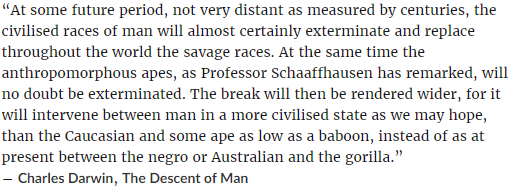
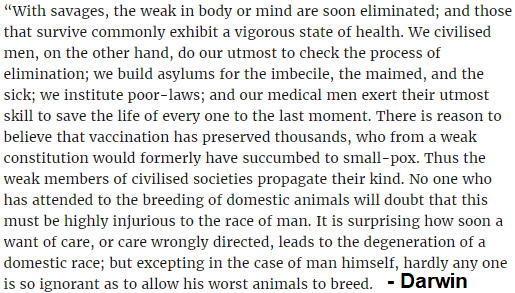
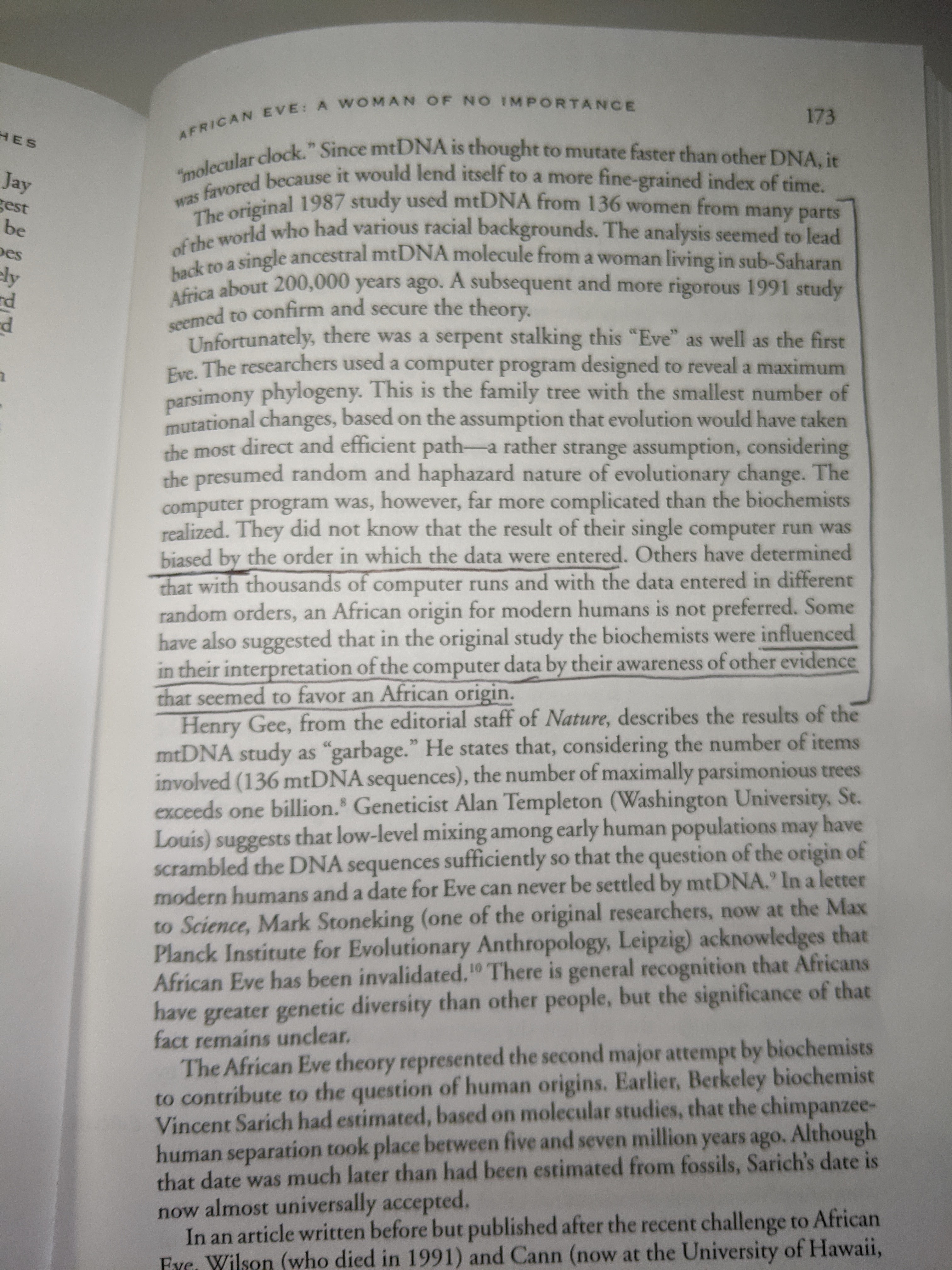
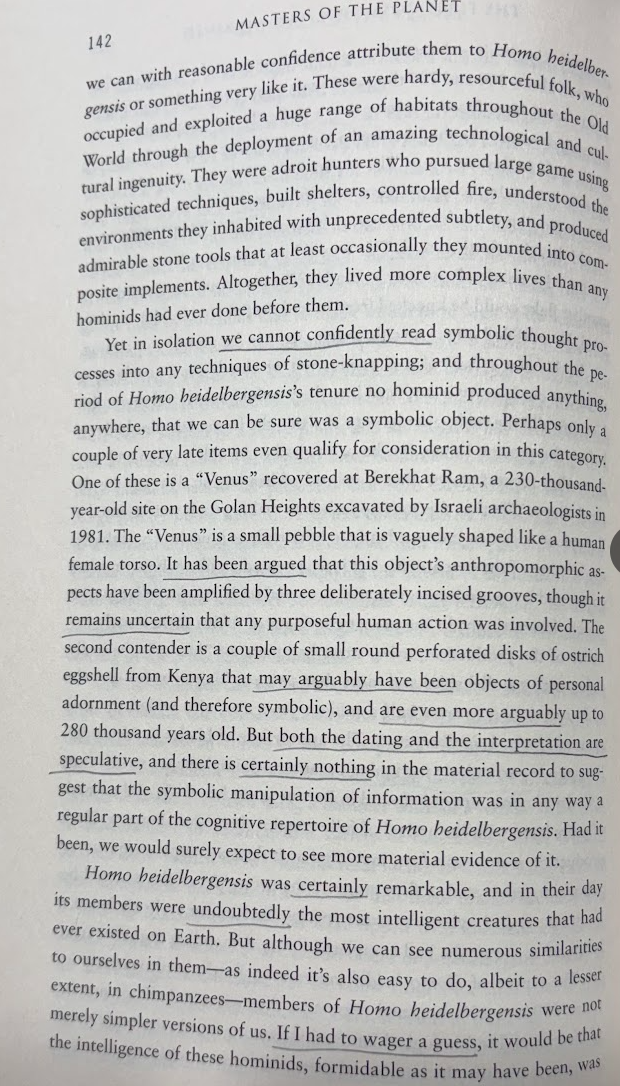
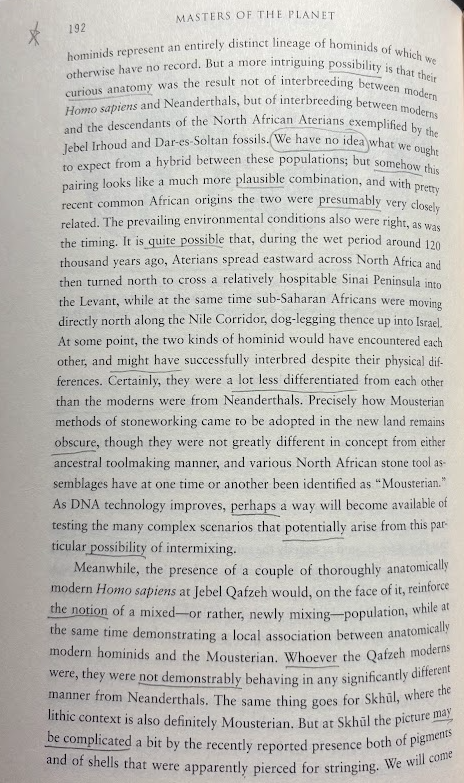
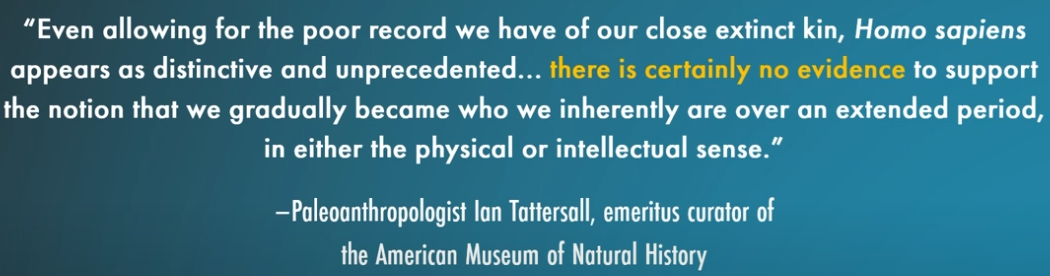


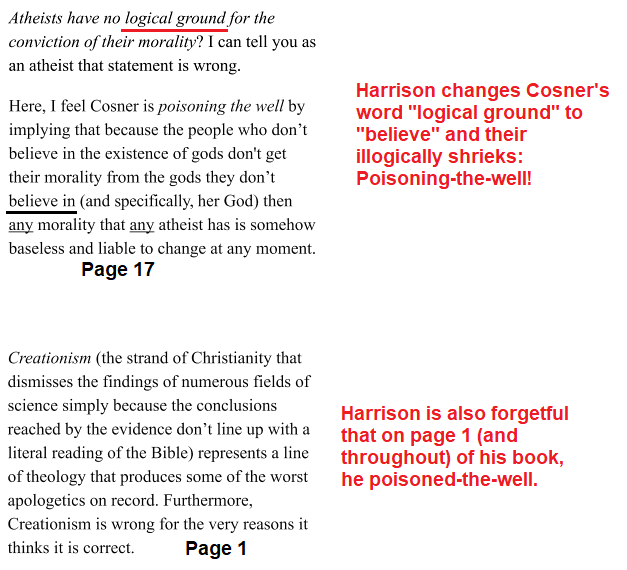
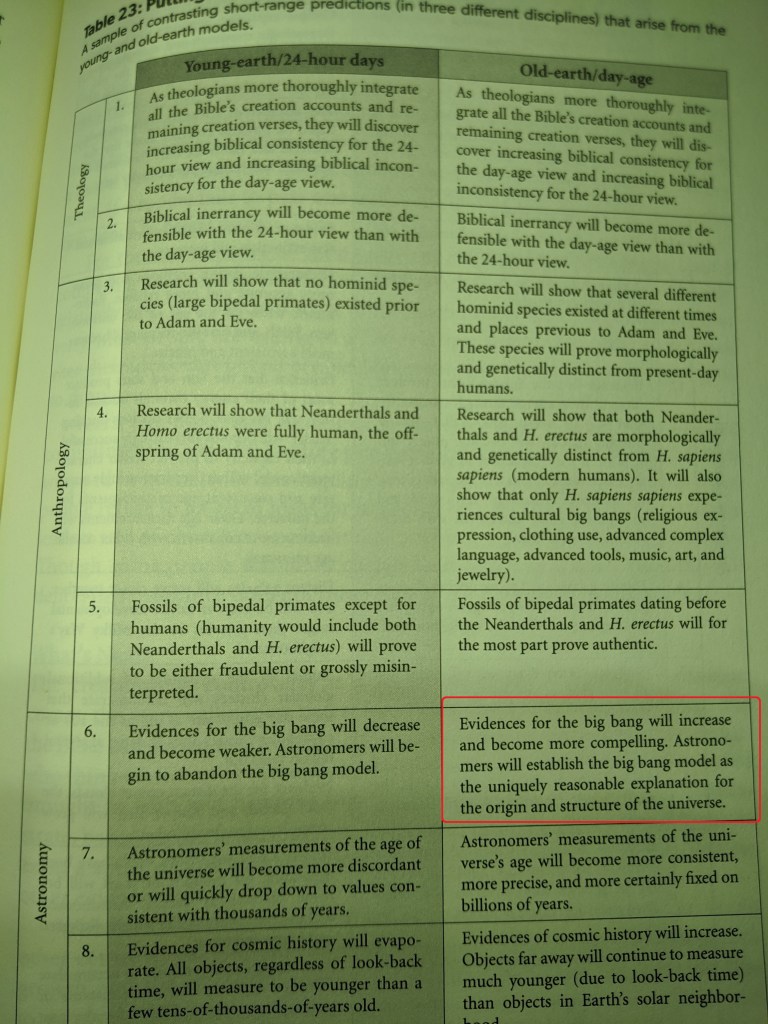



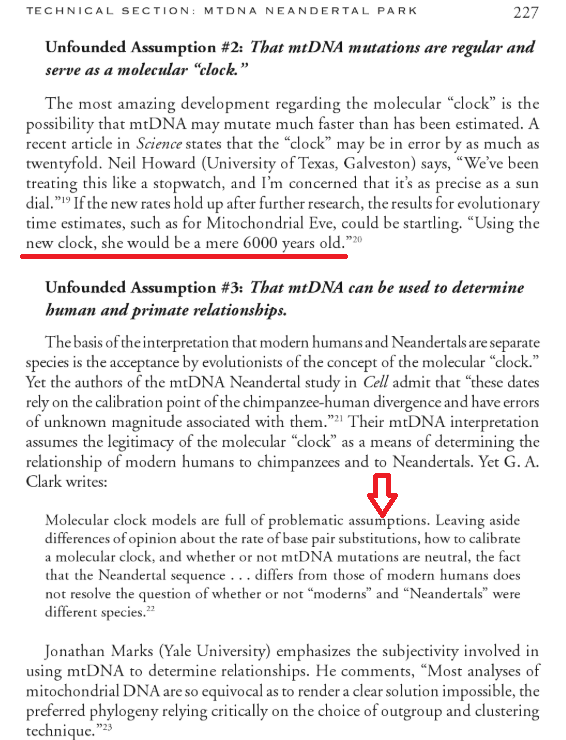
 ApoloJedi