
Is Evolution Compatible with Christianity?

Fitting evolution into Christianity is like forcing a square peg in a round hole

Although much ink and digital pixels have been spilled on a possible answer to this question, what follows will be the definitive answer to the question. No need for anymore searching or endless debate: THIS is it!

Well, perhaps not. Long after I’m gone, I’m sure theistic evolutionists will still be trying to syncretize worldliness into the Bible, but there’s really no need: the Bible is clear – evolution is incompatible with Christianity. Let’s investigate

Definitions

First we need some definitions. What is Christianity? In my personal definition, Christianity is the logical understanding and application of what God has revealed in the Bible. Wikipedia defines Christianity as

This definition will do as there is plenty of overlap between the 2.

Now for the more difficult one. What is evolution? From the various atheists and theistic evolutionists online definition 1 might be something like:

Who could argue with the idea that biological creatures change? No one. Creationists and evolutionists agree that creatures change. Who could argue with the idea that allele frequencies change within a population over time? No one. Creationists and evolutionists agree that allele frequencies change. Who could argue with the idea that you’re not the same as your parents? No one.

Regarding the claim that “evolution is science“, I heartily disagree. Science is the “system of knowledge covering general truths or the operation of general laws especially as obtained and tested through the scientific method.” Creationists agree with this definition of science…in fact it was young earth creationists like Newton, Boyle, Faraday, Joule, Lister, Pascal and Kepler that helped kick start their respective branches of science. A common pejorative from theistic evolutionists to their creationist brothers is “science-denier” as if to impugn a denial of physics, zoology, mathematics, chemistry, magnetology, geology and the like simply because we reject biological evolution. It’s an ad hominem fallacy aimed at discrediting arguments from Christians, who uphold the Bible as the magisterial authority, so that theistic evolutionists can escape from dealing with the arguments themselves. Now, there are *scientists* who believe the whole theory of evolution (defined below), but the scientific method cannot duplicate a dinosaur becoming a bird via natural selection acting on random mutations or a land vertibrate changing into a whale with numerous successive slight modifications. That is all assumed, and since the scientific method cannot repeat this process, evolution (as shown below in Definition 2) is not science. It is an ideology, and as we all well know, it is a tyrannical ideology that suffers no dissent.

Alleles

Sidebar: What is an allele? Wikipedia defines it as “a variant of the sequence of nucleotides at a particular location on a DNA molecule.” An example of an allele would be eye color or blood type. There is variability in the DNA that can produce different eye colors, but not every variant is expressed in each phenotype. Genetics has shown that changes in allele frequency produce different eye colors in different generations due to the existing variability stored within the alleles. Evolutionists love to say that “evolution is simply the change in allele frequency within a population over time.” And creationists agree with this. So what’s the big deal about alleles? Evolutionists believe that alleles have been constructed by an accumulation of random mutations. It’s very much akin to the belief that the operating system that controls the hardware on a phone was aggregated by random keystrokes. Creationists do not grant this origins story of alleles to the evolutionists. Yes, alleles exist. Yes, alleles contain variability, but this variability has existed from the beginning. It has not been cobbled together randomly. Yes, we see the variability of eye colors, hair colors, and blood types because that information ALREADY EXISTS in the genome. Natural selection is a descriptive process of the selecting of existing information for preservation, but this results in a LOSS of information…not the creation of it. Since there is no evidence for the construction of alleles via natural selection acting on random mutations, we (creationists) do not grant the use of alleles to evolutionists. They cannot account for alleles.

Definition 2 of evolution would be: grand theory of evolution, which states that a simple, single-celled, original and common ancestor (and all subsequent descendants) experienced random genetic mutations, and thus, through the process of natural selection, changed into all living creatures, including mankind. This process is said to have taken almost four billion years and requires no intervention from a supernatural or intelligent entity.

So that my detractors do not think I have misrepresented evolution in my shortened definition, here is Wikipedia’s definition of evolution. They too recognize the key elements of

  • single common ancestor of all life (hypothetical as evidence for LUCA is missing)
  • natural selection acting on random mutations is the mechanism
  • billions of years are necessary
  • all biological life including mankind are the result of the natural processes that require no intelligent intervention
  • If we want to determine by Darwin’s own metric of what makes his theory possible (“If it could be demonstrated that any complex organ existed which could not possibly have been formed by numerous successive slight modifications, my theory would absolutely break down”), then all biology must be able to be explained by natural selection acting on random mutations (even though Darwin was unaware of the specifics of mutations, his theory includes the modifications which we now know is mutations)

THIS (definition 2) is what Christians, who accept the Bible, are arguing against when we say that evolution is not compatible with Christianity. Definition 2 focuses on the historical nature of biological life on earth, and has nothing to do with what’s measured/repeatable in the laboratory. Many times, theistic evolutionists join their God-denying colleagues in claiming that evolution is science, but this is the motte-and-bailey fallacy. When Christians rightly voice that evolution is incompatible with Christianity, both theistic evolutionists and their comrades declare with mockery “Evolution is just change! How can you deny change? Are you the same are your parents? You’re driving people away from Christianity if you tell them that they can’t trust science!” Notice below how theistic evolutionist, Bishop, decries the idea that me, a Christian, would question evolution when he defines evolution as science itself…and the atheist ankle-biters snuggle in warmly to those who embrace evolution.

Definition 1 is the motte: an easily defensible position that is uncontroversial. They retreat to the motte and throw rhetorical stones at the Christian “heretics” for denying something obvious. When in reality the Christians, who accept the Bible, are using Definition 2 of evolution, (in this case, the bailey) which is completely at odds with the Bible. Since everyone agrees that change happens, we will no longer consider Definition 1 as part of this article. Henceforth, Definition 2 is the only idea that is considered when referencing evolution.

To elucidate just a bit more about the theory of evolution, we should talk about natural selection, which is a description of the survival of the fittest…or more recently “the differential survival and reproduction of individuals due to differences in phenotype”. Essentially, natural selection is the idea that the those creatures, who are less fit, are removed from the population. Those creatures with the greatest number of offspring are said to have higher fitness. The culling of the less fit is central to the theory. Richard Dawkins employed the phrase “red in tooth and claw” (which arose in Darwin’s day to describe the pitiless indifference of nature) to summarize the cruel behaviors of the doctrine of survival of the fittest. For the fittest to pass on the traits that make them the most fit, the death of their lesser peers must take place, and it takes a great deal of time to get fixation within a species. Death and time are the heroes of evolution

Compatibility

Let’s look at what the Bible says about the past as opposed to what advocates of evolution teach. The chart below shows some of the differences:

The Bible saysThe Theory of Evolution says
3rd day – plants createdbees evolved ~ 114 million years ago
5th day – fish createdfish evolved ~485 million years ago
5th day – birds createdbirds evolved ~60 million years ago
6th day – livestock createdcattle evolved ~15 million years ago
6th day – wild beasts created1st wild beast evolved ~320 million years ago
6th day – original human pair created at the beginning of creationhumans evolved 1-2 million years ago about 13.798 billion after creation unless you believe Dr. Gupta who says the universe is 26.7 billion year old
Days of Genesis 1 are confirmed as calendar days according to Ex 20:9-11Evolution has been ongoing for hundreds of millions of years
Gen 1:29-30 Animals eat only plants. No predationPredation and natural selection have been ongoing since the last universal common ancestor
Animals are to reproduce after their kindThere are no boundaries in reproduction
Sin of mankind brought deathDeath of the unfit over millions or billions of generations brought about mankind. Ever since there has been life, there has been death.
Sin of mankind brought thorns (Gen 3:18)Thorns are found deep in the fossil record and have existed since about 25 million years before mankind existed
1 Cor 15:45 and Gen 3:20 confirm that Adam and Eve were the original human pair from whom all humans descendedBetween 250K and 350K years ago a population of between 1000 and 10,000 (depending on which theory you believe) anatomically modern humans were mostly isolated from populations of erectus and habilis…although there was some interbreeding between the non-human homo populations
Acts 17:26 confirms that all humans are descended from one man, NoahAbout 600K years ago, Homo Heidelbergensis emerged. From this stock along with some cross-breeding with other pre-human hominins produced a population of homo sapiens

Caveats

As a Christian, who accepts the Bible in its literary context and genre to mean that God created the universe in 6 calendar days about 6000 years ago, I recognize that there are Christian brothers and sisters, who disagree strongly with me. They have worked hard to bring into concordance with the Bible, the teachings of evolutionists. So, my caveat is that while theistic evolutionists laboriously strive to harmonize Christianity with evolution, it does not mean that they are not Christians. One is not saved by the quantity of correct information that one believes. One is saved by grace through faith in Jesus Christ our Redeemer alone! This article is intended to show their inconsistencies and failed attempts to ‘put a square peg in a round hole’.

Objections

Let’s now analyze the differences from the table above and the attempted rescue devices that theistic evolutionists employ.

Difference 1: The order of creation in the Bible is different than the order taught by advocates of evolution. The theistic evolutionist is left with 2 choices:

  • “The Bible is not a science textbook. It wasn’t intending to tell us a specific order of creation. It’s just a theological treatise telling us that God is the Creator.“
  • “Since Moses didn’t know about modern science, he could only write from what he knew. And since God’s revelation in the book of nature in evolution is right, we can correct Moses’s ignorance. Moses is just writing poetically as a polemic against pagan creation narratives.“

The 1st attempt at a resolution is both a category error and shows a low view of scripture. I agree that the Bible is NOT a science textbook…it is mostly a history book (although it is so MUCH MORE than a history book), but in questions of history, historical documentation is the better tool for answering than forensics (extrapolation). The assumption exists that science must answer questions about the past, but when we want to know the age of the statue of liberty, Caesar’s crossing of the Rubicon, or the founding of Jerusalem, historical documentation trumps scientific extrapolation every time. The theistic evolutionist might counter with “But those are all examples that exist in human history. What about pre-human history?” And the answer is that there were only 5 calendar days prior to human history according to the Bible, and Jesus confirms that mankind was created at the beginning of creation. Why disagree with Jesus?

The 2nd attempt at a resolution (very much like the 1st attempt) takes a very low view of scripture. As Christians, the Bible is our magisterial authority, but theistic evolutionists would rather take what modern academics are saying and redefine the Bible to bring it into concordance with the modern paradigm. Genesis is written as history. It does not resemble the Hebrew poetry of the Psalms. All of the biblical authors regarded Genesis as history.

Difference 2: The Bible says that the original human pair, Adam and Eve, are the progenitors of the entire human race. Theistic evolutionists (for the most part) do not accept this and are left with 2 choices:

  • “Adam and Eve are just figurative archetypes. Because the science tells us that the genetics requires a population of about 10,000, there’s no way that an original pair could produce all of the variance we see today.“
  • Dr. Swamidass “It’s just a genealogical ancestry…not a genetic one. In this scenario, Adam and Eve are created de novo by God (from dust and a rib, as per Genesis) in a distinct act, separate from the evolved population. Their offspring then intermarry with this outside group, and over time, their genealogical lineage spreads universally.“

In the 1st attempt, we see again the idea that the modern academic paradigm is superior to the biblical text itself. It is a low view of scripture. They ignore what God has said in favor of what the loudest of the lab coats have assumed about the origins of humanity. If you’re interested in what Christian geneticists have said about the claims of the evolutionists, see Dr. Robert Carter’s research and Nathaniel Jeanson’s research.

While a clever attempt, Dr. Swamidass does not take into account the theological problem of death of humans prior to sin or the importance of the Kinsman Redeemer being able to atone for the sins of those to whom He is related. If there were pre-Adamite humans, they would not be eligible for redemption. It’s a low view of scripture and bad theology

Difference 3: The Bible says that the heavens, the Earth, the seas and all that is in them was created in 6 days and that mankind was formed at the beginning of creation. The theistic evolutionist, who vehemently disagrees with what the text says, would say

“Science has determined the age of the universe and the Earth to be 13.8 billion and 4.5 billion years old respectively, so the Bible needs to be interpreted in light of what the science says.“

To argue that this view is NOT a low view of scripture is illogical. Because the theistic evolutionist chooses to uphold the modern paradigm as preeminent as the interpretive authority shows clearly that although scientific paradigms have failed over and over, they’ve been deceived into believing that THIS time, the naturalistic view is correct. Scientific paradigms have been shown to be false time and again. From when the scientific consensus believed in geocentrism, to the time when the scientific consensus believed in phlogiston, to when the scientific consensus believed that blood-letting helped sick patients, to the time when the scientific consensus believed in spontaneous generation, to the time when the scientific consensus believed in an impending ice age in the 1970s, and when the scientific consensus believed that everyone should eat more carbohydrates according to the food pyramid, to the time when the scientific consensus believed that a cloth mask would protect everyone from the most deadly virus in human history…all falsified. But maybe the current tyrannical scientific consensus of evolution with work
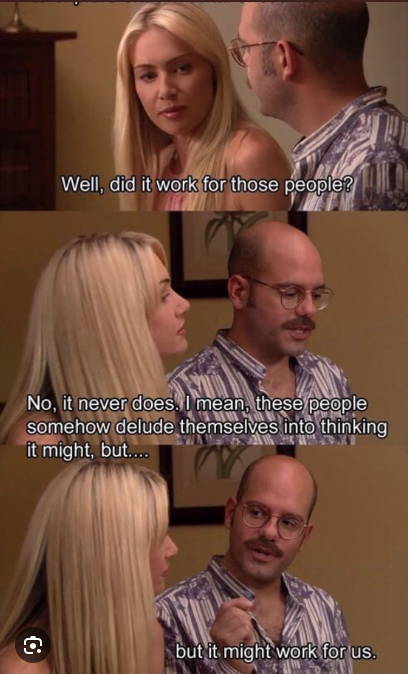
The Bible could not be MORE clear that the days of Genesis 1 are clear 24hr calendar days. While there is flexibility in the Hebrew word for day (yom), we can look at the context of Gen 1 to find the boundaries of the word. Since the context bounds yom by ordinal sequentials and evening/morning (and all biblical examples where both of those exist require the text to be understood as a calendar day) we know that the days of Genesis 1 are calendar days. We also see from Ex 20:9-11 that God expected his people to work for the same amount of time that He did during his creative works before sabbath. Since God’s people were not expected to work for 6 epochs (as would be necessary for evolution), we have confirmation from the Bible itself that God created in six calendar days. Sometimes, the theistic evolutionists want to say that it’s just a pattern, but for that to be true, they have to interpret the same word from the same author to the same audience in the same context be interpreted completely different. It’s bad hermeneutics.

Even John Walton, who is no friend to young earth creationists, open admits on pg 90-91 of his book that the text of Genesis 1 demands that yom must be interpreted as 24hr days.
Difference 4: While the Bible says that prior to sin animals were to be vegetarian only, advocates of theistic evolution would propose the incompatible idea that evolution would never restricted animals to eating only plants.

“Creatures today consume meat, and the fossils recovered in the geologic layers have sharp teeth. So, according to evolution, animals had no dietary boundaries. The Bible must have been talking about something else. It’s not a command. It’s just saying that plants are important to the life cycle.”

Again, their attempt at a reconciliation between the theory of evolution and the Bible takes a low view of scripture. Evolution is their highest authority, so that Bible must be changed to accommodate this view of continual violence, death, misery, and predation prior to the fall into sin. The full refutation of this idea is shown here, but is essentially: since God commanded man not to consume meat in Gen 1:28-30, God gave the same command to animals. We know it was a command because God gave a clear rescinding of his vegetarian command to Noah in Gen 9:2. The theory of evolution remains incompatible with Christianity

Difference 5: The Bible says that animals are to reproduce after their kind. Typically theistic evolutionists and God-deniers have the same lazy responses (although they are not arguments) “Kind isn’t a scientific word” and “kind is just species“. If they attempt to make an argument to reconcile evolution to the Bible, it is only that the men who wrote the Bible were middle eastern goat-herders or some similar pejorative that dismisses the biblical authors as unlearned.

Again, the theistic evolutionary view takes a low view of scripture. In order to try to reconcile their view with the Bible, they intentionally subject the Bible to the modern paradigm of evolution.

Difference 6: The Bible says that the sin of mankind brought death into creation. The Bible also refers to death as “the last enemy to be destroyed”, so it is not a benign cohabiter with life in a “very good” creation. In the story of evolution, death of the unfit for millions or billions of generations brought about mankind. In their view, death is the hero. Theistic evolutionists have a few options in trying to deal with this obvious difference

  • “The sin of mankind only brought about the death of humans. The Bible says NOTHING about the death of animals“
  • “Death is not bad. We have to die to get to heaven“
  • “Physical death has always been a part of creation. Adam’s sin only brought spiritual death“

In bullet point 1, the evolutionist tries to belittle the bloodshed, misery, and death of animals as simply part of the circle of life. This disparagement of God’s creation isn’t as much a low view of scripture but is a low view of animals, animal suffering, creation, and the catastrophic effects of sin itself. Romans 8:20-22 paints a completely different picture than evolutionists would sketch

The effects of sin changed all of creation from one of freedom, peace, and abundant fruitfulness to subjection to futility, groaning, and corruption. Evolution dismisses the curse and effects of sin as merely spiritual. You can see and even more comprehensive rebuttal of this point here.

In the 2nd bullet point, the evolutionist argues that death is not that bad. But this is the exact opposite of what the Bible says. In 1 Cor 15:26 Paul describes death as the “last enemy to be destroyed.” Death (as a curse for sin) is an enemy. The belief of the evolutionist requires them to have a low view of scripture.

In the 3rd bullet point, the evolutionist argues that sin brought only a spiritual death, but this is naive to the fact that Jesus died the most horrendous PHYSICAL death in crucifixion. Theologically, it was his physical death and resurrection that paid for the sins of humanity. Notice the curses for sin: death, suffering, and thorns from Genesis 3. At the crucifixion, Jesus took upon Himself all of these curses to atone for the sins of his people (Isa 53). The Bible rejects the idea that Adam’s sin brought only physical death only to humans

Difference 7: The Bible says that thorns are a curse of the sin of mankind. But according to the evolutionary story, thorns were produced naturally by plants in the ever-escalating warfare between plant reproduction and herbivores. Since thorns are found in geologic layers, which evolutionists believe were buried prior to mankind, evolutionists have to try to resolve the difference. Creationists, who accept the teachings of the Bible, know that thorns are a curse for sin, and that the thorns buried deep are a result of the judgment of the global flood. How do evolutionists try to resolve the difference?

“Thorns aren’t a curse of sin. It’s just an allegory“

Again, evolutionists take a low view of scripture, because they take naturalistic interpretations from today, ignore the effects of the Genesis 6-9 worldwide flood, and redefine the biblical text.

Difference 8: The Bible clearly teaches that Adam and Eve were created directly from God via the dust and Adam’s side respectively. Evolution teaches that a small population (about 10k) of humans evolved traits to become human. To be fair, there are some theistic evolutionists, who hold to the standard evolutionary model for all biological life except humans and believe that God did specially create humanity in Adam and Eve. While they choose to uphold the Bible in this case, it is now destructive to their theory of evolution as the standard (current) model is taught as if it can account for all human traits in the same way that it can supposedly account for all other biological traits. The group that denies special creation of mankind, who accept the theory of evolution in its entirety, have to resolve this difference somehow

“The Bible isn’t a science textbook. It’s just a theological treatise about God being the Creator. He didn’t say *how* He did his creative works. We’re only supposed to know from the Bible that He started everything. There was no initial human pair Adam or Eve. That’s a myth.“

That is a low view of scripture. They mythologize a historical text simply to accommodate the teachings of the modern paradigm. It ignites serious theological problems with who is eligible for salvation through the blood sacrifice of the Kinsman Redeemer, and it incinerates the authority of scripture that teaches an unbroken royal lineage from Adam to Jesus.

Difference 9: The Bible says that there was a global flood and from Noah (the 1 man) and his family of 8, who got off the ark, God created all the nations of mankind (Genesis 10-11). Theistic evolutionists deny the global flood and much like they say in both Differences 2 and 8, they choose to believe the assumptions of evolution at the expense of the Bible. How do they resolve the difference?

“There is absolutely NO evidence for a global flood. Human lineage cannot be traced back to a single man or woman. You misinterpret the text. You think that your interpretation is the same as the Bible itself.“

Denying the global flood of Noah’s day puts theistic evolutionists as allies with the scoffers, who Peter claims will deny that “the world was deluged and destroyed”. It’s less than a low view of scripture; it’s willful ignorance…another term Peter uses. The resolution of difference 9 is much like all of the other differences: take well-understood words and redefine them in accordance with modern sensibilities rather than how the words are used in the text of scripture itself: a low view of scripture

Conclusion

Some theistic evolutionists even declare that “there are no differences between the Bible and the theory of evolution“, but as you can see: the differences are stark, and the attempts to bring resolution destroys the Bible, the theory of evolution, or language itself. THIS is what makes the theory of evolution and Christianity incompatible. Anyone, who might be unfamiliar with the theory of evolution, wouldn’t read the Bible and think “It’s clear in the Bible that God was completely absent from creation and had no interaction with material. Instead He allowed a process of gradual formation over billions of years of death and suffering to produce both the extinct and extant creatures including humans.”

In the same way, no one reads the writings of the evolutionists and concludes, “Clearly there is intricate and purposeful design from the interference of a supreme intelligence seen in every creature. We can see from nature that the supreme intelligence loves humanity and wants humanity to have dominion over the things that he/she made.”

These two opposing stories don’t fit; they are incompatible. Any attempt to bring them into concordance fundamentally changes either the biblical account or the evolutionary account or both. If a theistic evolutionist wants to bring concordance, they must redefine the biblical text, change the order of creation, and change the evolutionary story to say “God-dun-it-differently-than-He-said-but-just-like-evolution-says”. The most common practice among theistic evolutionists is the marginalize the Genesis account by declaring it to be allegory. In much the same way that Michael Scott from the Office shouts out “I declare BANKRUPTCY!!!”, shouting that “Genesis is ALLEGORY!!!” is nothing more than bluster. In fact, it is detrimental to the authority of scripture.

If one can marginalize parts of the Bible as simply allegorical just because it does not comport with modern sensibilities like evolution, then the Bible loses its authority. By the same interpretive principles that theistic evolutionists change the Bible to accommodate evolution, LGBTQ+ people change the Bible to accommodate THEIR perversions. The progressive woke “Christians” also change the Bible to accommodate their racist teachings. Paul warns Christians over and over not to allow trendy worldly philosophies to influence the gospel of Jesus found in His Eternal Word.

So, is evolution compatible with Christianity? Most definitely not

Post Script

With regards to the claim that “there is absolutely no evidence of a global flood“, there is ubiquitous evidence of a global flood. It is true that for over 100 years almost every university has taught that there was no global flood, so it’s no surprise that almost all academics would believe what they’ve been taught. But when one starts with the truth of scripture, which says that there was a flood that covered “all the high mountains under the entire heavens”, the evidence is impossible to ignore. The evidence is literally everywhere!

Debate: The Bible Teaches that Animals Died Before the Fall

In this debate, my Christian friend @CuriousChristianity attempted to argue the positive for this case, and I took the much easier (and biblical) case for the negative

Opening

Americans on average go through 12 years of public school indoctrination in evolution. Those, who go to college and those who get advanced degrees get 4, 6 or 8 more years of deeper indoctrination into the ideas that animals have been dying for millions of years. Even those who don’t get advanced degrees are saturated with movies and tv shows and news bulletins and flyers and conversations among work associates that bloodshed and death are pervasive for the assumed millions of years of evolutionary development. Some would call this science, but it is at the very least a philosophical idea that is deeply ingrained in 21st century thinking. It takes courage and discernment not to drink in and believe the worldly philosophy of evolutionism as a basic assumption. My friend may or may not believe in evolution, but the influence of the philosophies of death for millions of years is both pervasive and assumed in this culture. Many Christians who have been indoctrinated in the philosophy of death for millions of years search for holes in the text of the Bible to see if there is room to insert these outside ideas of death and suffering before the fall into sin. See if in this debate, you can discern how the assumptions of death have influenced the arguments of my friend rather than starting instead with the eternal word of God.

My case will have 3 points: Good, Food and Blood

Good

My friend has the very unenviable task of building the case that the Bible teaches that animals died before the fall of mankind. It is particularly difficult since no where in the Bible will you find death before the fall. He might make some assumptions and you’ll likely hear him try to talk about how good death really is, but please pray for my friend: his case is hopeless

During the creation account in Genesis 1 God declares his creation to be good 7 times and the 7th time, He declared it to be very good. What does the Hebrew word (tove) mean? Those, who hold to the temple inauguration view (like my opponent) will say it means “functional” or “ready”. Does this hold up to a textual analysis from Moses, in the same context to the same audience?

Gen 1:31 “God saw all that He had made, and it was very functional”

Gen 2:17 “But you must not eat from the tree of the knowledge of functional and dysfunctional”

Gen 3:22 “Then the LORD God said, “Behold, the man has become like one of us in knowing functionality and dysfunction”

Of course, this does not make any sense, but this is what the guru, John Walton, would have us believe from p50 of his book The Lost World of Genesis, where he says: “the meaning of the repeated formula ‘it was good’, which I propose refers to functioning properly…functional readiness”

This is the trendy tactic for Walton’s followers to get around the serious problem of animal death. If they can redefine good to have nothing to do with sin/morality or the fall, then they can accept the modern paradigm’s view that animal death has been happening for millions of years (or as they might say “for an unknown amount of time). But if good has to do with the absence of evil or the antithesis of evil/harm/destruction, then those who hold to this view have a serious theological problem.

This word good H2896 tove (tob) is used to describe God Himself at least 27 times in the old testament. Are we to believe Walton’s definition that the Almighty is functional? 40 times in the old testament tove is paired with ra (evil) H7451 as its inverse. And we clearly see from Isa 11:6-9 that the destruction caused by the fall includes predatory destruction. The Apostle Pual picks up this seamless theme in scripture that during creation week there was an absence of corruption but because of the curse of sin “For the creation was subjected to futility, not willingly, but because of him who subjected it, in hope that the creation itself will be set free from its bondage to corruption and obtain the freedom of the glory of the children of God For we know that the whole creation has been groaning together in the pains of childbirth until now.”

If my friend’s case is true, then suffering, cancer, and death are “very good”. But I Cor 15:26 tells us that “the final to be destroyed is death”.

If good is to have any meaning at all, then it cannot include suffering, harm, destruction and death as would be necessary for my friend’s case

Food

Genesis 1:28-29 has 5 commands

  • Be fruitful
  • Fill the earth
  • Subdue it
  • Have dominion over the animals
  • You shall have them (green plants) for good

Gen 1:30 relates the 5th command of God to “every beast of the field, every bird of the heavens & everything that creeps on the earth – everything that has the breath of life”

Predation is shown to be forbidden. Humans SHALL eat the green plants for food & those under man’s dominion shall eat green plants. Why would we assume that those under Adam’s jurisdiction be granted a freedom to consume meat that was denied to humanity?

If you doubt that the Genesis 1 command to eat only the green plants is NOT a command, we can look to the recreation language of God after the global flood in Genesis 9

Gen 9:1-3 “And God blessed Noah and his sons and said to them, “Be fruitful and multiply and fill the earth. The fear and dread of you shall be upon every beast of the earth and upon every bird of the heavens, upon everything that creeps on the ground amd all the fish of the seas. Into your hand they are now delivered. Every moving thing that lives shall be food for you. And as I gave you the green plants, I give you everything. But you shall not eat flesh with its life, that is, its blood”

Again we see the commands of God to be fruitful, fill the earth, subdue it and have dominion over animals. But the 5th command is freed of the restriction of animal consumption. This pattern at the creation and recreation is apparent and even if not in words, is logically denied by my friend. There’s every reason to believe Gen 1:29 is also a command for humans because this command is reversed in Genesis 9. And by deduction, we see that the animals are subject to God’s pre-fall dietary commands as well – to be vegetarian

Blood

The 1st recorded bloodshed in the Bible is the penal substitutionary atoning sacrifice of an animal in the garden by God Himself to cover the sins of Adam and Eve. The skin of this animal was used to cover their nakedness. This picture of the eventual bloodshed of Jesus was represented in the garden by the 1st recorded death of an animal. Without the shedding of blood there can be no forgiveness

Before the fall, God’s creation was very good – completely absent of evil/harm/destruction/predation and God promises that his creation will be restored to a state that is absent of evil/harm/destruction/predation through the redemptive work of Jesus. There was no room for animal death suffering or predation in God’s very good creation prior to the fall. As the writer of Hebrews tells us “Without the shedding of blood there is no forgiveness”. Has there been millions of years of needless suffering, bloodshed, and death in a world that God called very good as Walton tells us? Or as Romans 8 tells us, did the whole of creation become subjected to its bondage to corruption and groaning because of the sin of mankind?

It would be unexpected (according to my friend’s view) for something as meaningless as the bloodshed and death of animals to represent the atoning bloodshed of the Savior. It’s discordant with all of scripture to assume that there was some unknown epoch of meaningless bloodshed/death of animals that suddenly became the picture of Jesus’s redemptive sacrifice. But it is perfectly aligned with the teaching of the Bible that no bloodshed occurred until mankind sinned. The Spirit revealed to the writer of Hebrews how animal death isn’t meaningless as would be the logical result of my friend’s view.

Hebrews 9:13-22 “For if the blood of goats and bulls, and the sprinkling of defiled persons with the ashes of a heifer, sanctify for the purification of the flesh, how much more will the blood of Christ, who through the eternal Spirit offered himself without blemish to God, purify our conscience from dead works to serve the living God. Therefore he is the mediator of a new covenant, so that those who are called may receive the promised eternal inheritance, since a death has occurred that redeems them from the transgressions committed under the first covenant. For where a will is involved, the death of the one who made it must be established. For a will takes effect only at death, since it is not in force as long as the one who made it is alive. Therefore not even the first covenant was inaugurated without blood. For when every commandment of the law had been declared by Moses to all the people, he took the blood of calves and goats, with water and scarlet wool and hyssop, and sprinkled both the book itself and all the people, saying, “This is the blood of the covenant that God commanded for you.” And in the same way he sprinkled with the blood both the tent and all the vessels used in worship. Indeed, under the law almost everything is purified with blood, and without the shedding of blood there is no forgiveness of sins.”

All of the Bible is about Jesus as seen in Luke 24:44-45. The picture of the bloodshed of Jesus was represented in the bloodshed of animals as recorded for the 1st time after Adam/Eve had sinned. There is a gaping theological hole in the argument that rather than there being representative significance to the bloodshed of animals, the bloodshed and death of animals is meaningless because it happened for millions of years prior to the curse of sin. It is an unwitting diminution of the blood sacrifice of Jesus

Closing

As you can see from the video, the Bible does NOT teach that animals died before the fall. You have to appreciate the effort by my friend, but he had an impossible task. The assumptions and speculations he has made are just not found in the text itself.

There is great symmetry between the old and new creation. The Bible has a clear chiastic structure which we can see when looked at as a whole. God’s original good creation was cursed by bondage to corruption and death because of man’s sin. But because of what Jesus has done as the prophets & Revelation reveal, God will restore creation to a state that will be absent of evil and harm. This redemptive plan brings glory to Jesus. The resurrection of Jesus has power to redeem all of creation from its bondage to suffering, corruption and to defeat the last enemy: death.

Be brave and discerning dear Christians. Though the dominant paradigm is saturated with worldly philosophies like evolution and deep time, we need not be captive to this kind of thinking. We have the mind of Christ, and out thinking should be shaped according to Christ’s revelation and for His glory

The Bible tells us that humans are made in the image of God. As image bearers, humans were empowered to uphold God’s dominion over all of his lovely creation. Genesis tells us that the curses for sin were thorns, suffering, and death. Jesus took each of these curses upon Himself at the cross. Denying that the curses for sin had no effect on the creation over which mankind had dominion, limits both the universally destructive power of sin AND the redemptive work of Jesus, whose power is even greater than that of sin. His death and resurrection heals not just the hearts of the repentant, but restores the relationships of the wolf and the lamb, the leopard with the goat, the calf and the lion. There will no longer be harm and destruction that has pervaded this sin-cursed creation.

Post Debate Discussion

During the debate, Adam said, “We should let God define good”. And I heartily agree. When we let scripture speak for itself, goodness is clearly an absence of evil/harm/death. God uses the Hebrew word for good (tob, H2896) to describe Himself at least 27 times in the old testament. And at least 45 times in the old testament God contrasts good (tob) with evil (ra, H7451). The Hebrew word ra means evil, harm or destruction. The definition of good is the absence of evil, harm, & destruction. So, Adam’s entire case is discordant with what the Bible teaches. So, yes – Let God define what is good

While the argument about the tree of life is a good one, it is easily shown to be insufficient to overcome the teaching from scripture that everything in creation was very good before the fall. And since the Bible (Rev 22:2) tells us that the tree of life is for the *healing* of the nations. This healing is easily inferred to be from the mortal wound of sin. Without sin, there would be no need for healing.

What about plants or bacteria or spiders (as Adam brought up several times in the debate? Plants, while categorized as alive today, are really just a self-replicating food source. As for the others, see the article here.

If you are unfamiliar with the misery, suffering, bloodshed, and harm that animals deal with, follow these accounts on X. These are the behaviors that old earthers think are part of a “very good” creation for millions of years prior to the sin of mankind

  • @TheBrutalNature
  • @BrutaINature1
  • @TheeDarkCircle

Some more thoughts about how God views blood as important, check out these passages:

  • Leviticus 17:10-14 atonement comes from the shedding of blood
  • Acts 15:29 abstain from eating blood

So animal blood, while much less valuable than the blood of Christ, is shown to be valuable for covering sins. The shedding of animal blood is the picture of Christ’s blood, so it is not insignificant as would be necessary in the views of old earthism. Predation and death of animals would not be expected from a biblical view. It is only the worldly philosophies that bring in the ideas of perpetual predation and animal death prior to the sin of mankind

Don’t overlook the effects of the cultural saturation of evolution in the arguments of my friend. The myth millions of years of death and suffering are so engrained in the cultural milieu, that Adam just assumes death has been a part of history for that long. It’s definitely not a biblical teaching. It comes from outside the Bible. So, we can say with certainty that the Bible teaches that animals did NOT die before the fall

From the Beginning of Creation

In response to the Pharisees question of whether a man can lawfully divorce his wife, Jesus responded that divorce was only permitted because of the hardness of their heart. It is recorded in Mark 10:6 that Jesus said: “But from the beginning of creation God made them male and female.” (bold added by me)

This phrase comes up from time to time in discussions about young earth vs. old earth. Young earth creationists say that this is proof that Jesus was a young earth creationist. Old earth creationists have said things like:

  • “This is just the beginning of mankind”
  • “This is just the beginning of marriage”
  • “Mankind wasn’t made at the beginning – Adam was made at some unknown time after creation”
  • “Jesus didn’t really know the science”

All of those responses do not take the words themselves into account. Jesus said “the beginning of creation”. He did NOT say “the beginning of mankind” or “the beginning of marriage”.

But what about the 3rd bullet point: “Mankind wasn’t made at the beginning. Adam was made at some unknown time after creation” ? In this point, the old earther mischaracterizes the word “beginning” as if it can only mean the initial picosecond (what’s smaller than a picosecond?) of creation. Let’s look at a couple of analogies to show that the old earther demands a hypocritical and draconian misunderstanding of the word: beginning.

Consider the four year term of a president. The 47th president of the United States will be inaugurated in a few months. Would it be reasonable to say that the ‘beginning’ of his term includes only the first breath after taking the oath of office and nothing else? No, of course not. Would it be reasonable to say that the ‘beginning’ of the 47th president’s term included January 21st? 22nd? the first 100 days? Yes. Yes. Yes. The old earther makes an unreasonable demand of the word.

How about the 100m dash? The fastest reaction time allowed for starting a 100m race after the starting notification is 1/10 of a second. If it takes approximately 10 seconds for the finest athletes to run the 100 meter race, then the part of the race where the runner has not even responded to the starting signal is about 1/100 of the race. Commentators speak of the sprinter’s start as the first 10 meters (the beginning) of the race. After the starter’s gun goes off, sprinter’s cannot even begin to move until a 100 billion picoseconds have passed. Certainly, the beginning of the race can include 100 billion picoseconds before the athlete can even move. Yes?

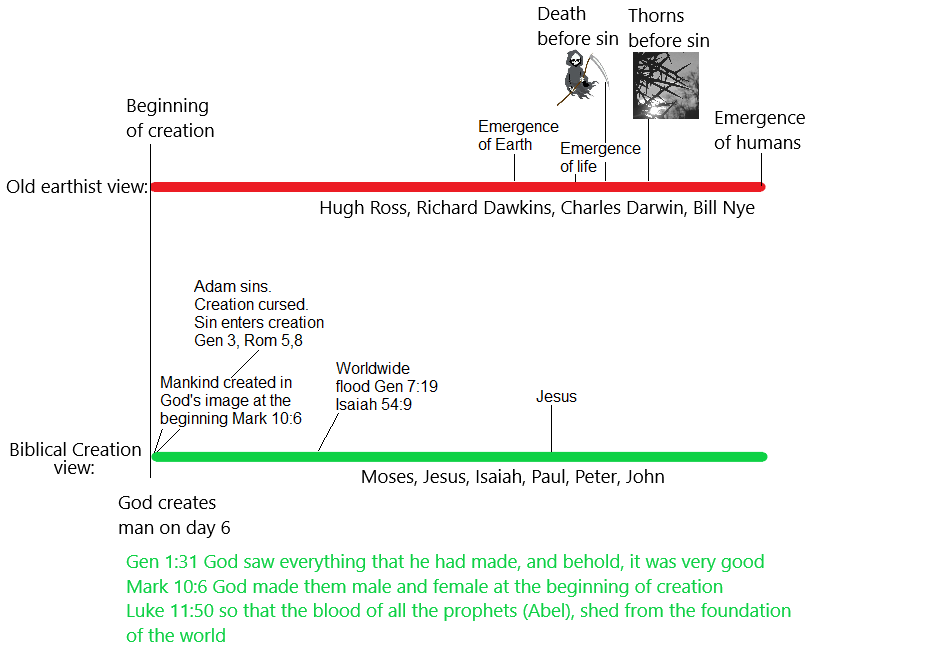
Using our 100m dash analogy, if we limit ‘the beginning’ to just the 1/10 of the second before the sprinters even moved, it would still be more than 2000 times greater than the passage of time relative to the length of the race from the creation week of Genesis 1 to 4000 years later when Jesus said “at the beginning of creation”. In other words when Jesus was speaking about the beginning of creation 4000 years after mankind was formed from the dirt, that length of time is 2,000 times smaller than the 1/10 of a second when a sprinter has not even begun to move out of the starting blocks in his 100m race. Certainly it could be said that within the meaning of the word “beginning” we can reasonably include the 1st week – just as Jesus said. If we put Jesus’s words and the beginning of creation on comparative timelines, things come into sharp focus. The green line shows accurately the beginning of creation that correctly accounts for the words of Jesus.

Conversely, if the old earth view (the red line above) were true and mankind was made 13.7 billion years after creation, it would be as though the runners in a 100 meter race were the same distance as the diameter of 3 water molecules from the finish line. This renders the word “beginning” to be meaningless because in all views other than YEC, the beginning can mean all of history. It destroys the very meaning of the word “beginning”.

You can see clearly that the old earther is faced with the dilemma of either putting false words in the mouth of Jesus, declaring Jesus to be ignorant of his own creation, or destroying language. If you want to be in accordance with scripture, you’ll accept YEC. It’s the only view that is consistent with scripture. The young earth creationist from above is right – Jesus is a young earth creationist.

Does the Bible Teach That The Earth is Young?

Yes…clearly. Here’s the definitive debate and some post debate thoughts to help clarify some things that didn’t get full discussion during our allotted time

Here are my notes for my opening:

The word ‘Trinity’ does not appear anywhere in the Bible, but we know from reading the Bible that the Father is God, the Son is God, and the Spirit is God. And we know that God is One. Anyone who denies the trinity is not a Christian. The biblical teaching of a young earth is more clear than the trinity. While people can deny a young earth and still be a Christian, we must wonder why denial of a young earth is so pervasive. For 18 centuries Christians have universally accepted the biblical account that the earth is young. But with the advent of the modern scientific paradigm of deep time at the end of the 18th century, some in the church began to look for ways to bring the biblical account into concordance with that deep time paradigm. It’s a trendy fad with many different ideas on how to do so. From postulating that days actually mean eons to inventing a billions of years gap between Genesis 1:1 and 1:2, the ideas have been creative. The trendiest of ideas that is hyperbolically 15 minutes old, is that Genesis is agnostic to ideas of age and does not deal with “material” creation; just its functional ordering due to the influence of the writings of the Hittites, Sumerians, and other ancient near eastern people groups that were judged with destruction for their wickedness. ALL of these trendy ideas have one thing in common – a specialized guru who tells you that the words don’t mean what they are commonly understood to mean. They mean something unique that only the guru with his secret knowledge can reveal. They say that it is the text of scripture that must be redefined so that the Bible can be brought into alignment with the emergent dominant paradigm.

Is it valid to consider trendy ideas to make the Bible concordant with the worldly philosophies, or should we as Christians uphold the authority of scripture as the magisterial principium? If words have meaning at all, then accepting the Bible’s clear teaching of what we now call young earth creation is self-evident. It is at the expense of denying language itself that fellow brothers in Christ deny that the Bible teaches what I will defend tonight (Does the Bible teach that the earth is young?)

  1. The earth, the universe and everything in it was created in 6 calendar days as the Bible says
  2. The earth was created about 6000 years ago because of the ages given in the corresponding accounts of the unbroken royal lineage of the Seed from Adam -> Abram in Genesis/Chronicles and from Abram to Jesus (Luke) as the Bible says
  3. Jesus confirms that mankind was made at the beginning of creation as the Bible says in Mark 10:6

As Christians, we do not want to hold onto things that are demonstrably false. Genesis and the rest of scripture very clearly tells us that God created in 6 calendar days about 6000 years ago. Most of God’s word was passed to us from the Spirit inspiring the prophets and apostles, but part of the case for young earth was literally written by the hand of God in stone. This was completely undisputed but for the rarest of outliers for about 1800 years until the end of the 19th century. Suddenly when Darwin’s idea of evolution took hold of academia more time was needed to explain his biological theory, so it became trendy to see if the words in the Bible could be stretched to accommodate these naturalistic ideas.

Text: Genesis 1 

  1. “In the beginning” – This may come up later as we identify that one of the trendy tactics today is to stretch the word beginning far beyond all recognition. Hebrew grammar and narrative structure of Genesis 1 doesn’t permit a time gap between verses 1 and 2. The waw consecutive (“and”) at the beginning of verse 2 in Hebrew implies a direct sequence of events
    • Use of the word yom (meaning day) and it’s literally defined there in Genesis 1
    • Why did God not use any of the deep time words like:
      • Yamim (plural of yom) – Not used
    • Qedem (days of old) – Not used
    • Olam (days of old) – Not used
    • Some might object and say that Moses didn’t understand large numbers like billions of years, so God had to speak to the simpleton with simpleton language, but this objection would be ignorant of the covenant from Gen 22:17 “I will surely bless you and make your descendants as numerous as the stars in the sky and as the sand on the seashore”, yet God did not communicate to Moses about his creation in this way
    • The only reason that God would withhold using large words to describe the time it took for Him to create is because it took only 6 calendar days – just as He said
  2. “Sequential days” are confirmed by the ordinal usage of the text. Had God wished to communicate non-sequential days, it would have been quite easy for Him to say something like “some time later” or “many years later” or “as things developed over time”. Instead, He used language that we all understand to mean sequential consecutive days. The point is clear: God was not giving some ambiguous myth. The words of Genesis have meaning of sequential consecutive calendar days
  3. The days are bounded by evening/morning patterns to separate the days. Not eons. Not years. Not months…but only days are bounded by evenings/mornings. God was being very clear that yom means a calendar day in this context
  4. “But Matt! Can’t yom mean a time period like in Genesis 2:4?” Yes! Notice how they always choose Genesis 2:4. No one ever chooses Genesis 1 because the context shows us that the usage of “yom” in Genesis 2:4 is COMPLETELY different than the usage of “yom” in Genesis 1. But I do agree that Yom has flexibility of usage. As faithful Christians we should look to scripture rather than some outside false authority like the scientific paradigm or modern culture or ancient near eastern cultures. Where can we look within scripture to find a usage of “yom” in the context described in Genesis 1 to give us the correct boundary? Ex 20:9-11 and Ex 31:17
    1. “6 days you shall labor and do your work…for in 6 days the LORD made heaven and earth, the sea and all that is in them”
    2. In the same way that God’s people are expected to work each week, we can be certain that it took God the same amount of time to create the entire universe because of what the Bible says
  5. Here’s the meat of the matter: Genesis 5 and 11 record the ages when those in the unbroken royal lineage of Jesus fathered their children. The summation of these ages confirm that the earth is indeed young. For those who would object that there may be gaps in the lineage, I ask “Who is missing? How do you know?” For those who would object that it doesn’t necessarily mean they fathered the direct descendant because the Hebrew word Yalad might just mean “was an ancestor of” I reply “it doesn’t matter because the age of the patriarch is mentioned whether it be father or grandfather”. To those who object “why does it have to be an unbroken lineage?” Seed of the woman vs. the seed of the serpent. Genesis tracks the unbroken royal line of the Seed of the woman as each generation looked for healing of the curses of sin. We know that the Matthew lineage has purposeful omissions for purposes of symmetry, but the other lineages (with their ages) show that Jesus is indeed the promised Kinsman Redeemer, who would crush the head of the serpent. Those, who would assume that there are genealogical omissions in Genesis/Chronicles/Luke are faced with the unenviable task of trying to show WHO is missing, how they know it, and how the line of kings remains verifiable in Jesus
  6. Lastly: Mark 10:6 “for at the beginning of creation God made them male and female” Jesus is confirming that it was the beginning when He created everything else that He made mankind. Remember, Jesus is the Creator: He would know. Those who have fallen prey to the lure of the modern scientific paradigm may say “That passage is just about marriage”, but this objection ignores the actual words that Jesus said. Would you contend with Him, that the very specific words that He used are unimportant? If beginning has any meaning at all, then it must be referring to the creation week and not as old earthers claim 13.787 billion years after creation. To say that “the beginning” can mean anything from 14 dozen hours to 13.787 billion years ago renders the word as meaningless. It literally destroys language

Consistency

If fellow brothers who deny YEC would apply the same level of skepticism they do against Genesis 1 and Exodus 20 to other parts of scripture, you might hear:

  • “Of course the plagues against Egypt were just symbolic. There’s no way that an entire river turned to blood. God was just saying metaphorically that it’s the blood of Jesus that saves you. Besides there’s no record of the Nile turning to blood in Egyptian writings”
  • “When we look at ancient near eastern writings like the Sumerians, there are many stories like that of Samson, who had superhuman strength, so the Bible’s account of a man whose strength relied on the length of his hair is figurative in nature. Samson, while interesting, is hyperbolic of a leader, who probably existed but never pushed over a building with his hands”
  • “Jesus didn’t calm a literal storm. If you look at the Greek, you can reasonably surmise that Jesus comforted the storm in the hearts of his disciples. The storm was just a picture of the trauma that his disciples felt in knowing that their teacher would face persecution. Jesus’s words calmed the storm within them”

But it’s inconsistent for YEC deniers to declare “God could not have created the earth/universe in 6 days in the recent past…but it’s totally possible for a virgin to bear a child”

The text demonstrates that the earth (even though it is the oldest entity in the universe) is young, and Christians should not hold beliefs that are demonstrably false.

History

While the biblical text is the ultimate authority, is it worthwhile to see how Christians from the past have understood the text? Of course. If in my reading of the text, I ‘discover’ something that no one else in history ever thought or saw, I should question my own interpretation. To my knowledge, no Christian before the 18th century is recorded to have believed in what we would today call an old earth. To confirm the young earth consensus of the time from the earliest Christians to just over a century ago (a span of about 1800 years), let’s look back at some of those, who wrote about it (I’ll link the work of Ben Kissling in the show notes):

  • Irenaeus 165 AD – Earth is less than 8000 years old
  • Theophilus 180 AD – “All the years from the creation of the world amount to a total of 5698 years”
  • Julius Africanus 221AD – From the creation to 221 is 5499 years
  • Origen 248 AD identified his old earth atheist opponent with the implication that those who would deny the biblical age of less than 10,000 years are “assailants of the Christian faith”
  • Augustine 426 AD who wrote: “reckoning by the sacred writings (the Bible), not 6000 years have passed”
  • Johannes Kepler 1619 – Earth was created in 4997BC, so was less than 6800 years at the time of Kepler’s writing
  • James Ussher 1650 Annals of the World – Earth was created in 4004BC, less than 6100 years old
  • All Reformers accepted young earth (Did God Create in 6 Days? – Pipa)
  • Charles Lyell in the late 1800s (while not a Christian, recognized the hold that Christianity and thus the dominant paradigm of his time had on scientific studies) in his writings he wished to “free the science from Moses” which as we all know is Genesis
  • Jack Repcheck wrote a biography of James Hutton called The Man Who Found Time: “The age of the earth is the wedge that shattered the biblically rooted picture of Earth and separated science from theology”

As Christians, which we both are, we should want to interpret scripture consistently and rightly. Consistently by offering the same level of scrutiny to the passages that conflict with modern sensibilities (like Genesis) as those passages deemed crucial to Christian orthodoxy (like the miracles of Jesus). We’ve established that throughout all of church history before the dark times, everyone understood that the earth is young because of what the Bible tells us. And we have clearly established that the Bible teaches that the earth is young. The language demands it and we do not want to hold to teachings that are demonstrably false – especially the clear teachings of God’s Holy Word.

Closing

Thank you Keith for hosting this debate. You’re an above average timekeeper. Thank you Adam for a brotherly conversation on this important topic. Why is this topic important? I’m a Christian. Adam is a Christian. I love God’s Word and Adam loves God’s word. It is a matter both of authority and meaning. Dear Christians, if words have meaning, if language can communicate ideas, and since God has revealed history in his word, then we must hold to young earth creation. In Today’s culture redefining words to accommodate formerly abnormal views has become pervasive and acceptable:

  • Abortion is healthcare
  • Trespassing is an armed insurrection
  • Sexual perversion is normalized by asserting love is love
  • Anything certain parties don’t like is now defined as racism
  • Woman is whatever a person feels in their mind
  • Weird was used to describe the nuclear family

Sadly, this kind of thinking has leaked into the church when the foundations of scripture are compromised:

  • Day has been redefined as billions of years
  • Good has been redefined by John Walton as “functional ordering”
  • God’s creation of the universe in Genesis 1 has been redefined as temple inauguration
  • Death/suffering/thorns have been redefined as being very good
  • The beginning has been redefined to be some mysterious eon of time in which virtually all of the supposed billions of years of history have been hidden

As shown tonight, the plain reading of the Bible in its context…what some call the young earth understanding of God’s revelation in the Bible is the correct understanding. Young earth creation has been clearly understood since Moses penned those words and in Christendom until the dark times, until it became fashionable to reinterpret the meanings of words to accommodate modern sensibilities. If you need a guru like John Walton or Hugh Ross to give new definitions to words that no one in Christian history has ever before believed simply to accommodate modern scientific and cultural paradigms, take caution brothers. As Paul warned the Colossians “See to it that no one takes you captive by philosophy and empty deceit, according to human tradition, according to the elemental spirits of the world, and not according to Christ”. If you start with the human traditions of evolution or ancient near east hermeneutics, it will never lead you to Christ as that is not their purpose. But the purpose of God’s word is to lead us to Jesus. Just as the Bereans were called honorable for “searching the scriptures to see if what Paul said was true”, we too should test ideas by what is demonstrably true in God’s word. The Bible tells us that God created the universe very good (completely absent of evil/harm/destruction), but sin affected all of creation – and right there in the garden after the fall, God promised a Redeemer to heal that bondage to corruption against which we still groan today. But because the Bible can be trusted about God’s revelation of the past, we can trust his revelation about the future as we eagerly await the redemption of our bodies and the end of harm & destruction when the knowledge of the LORD fills the earth as the waters cover the sea. As Christians we do not want to have views of demonstrably false things, and it is demonstrably false that the Bible is agnostic to the age of the earth because of text of the Bible itself says. And it says that the earth is young

Post Debate Thoughts

The debate was effectively over when during the cross-examination, asked Adam:

“To accommodate something other than YEC, I can think of dozens of changes that would need to be made to the Bible. Conversely, if God actually did intend to communicate to us that the earth is young, what changes to the text of scripture would need to be made?”‘

His reply was “If he eliminated the 1st two verses of Genesis.” We can deduce from his statement that all of scripture supports the view that the earth is young if you do not hold Adam’s presuppositions. Now Adam has presupposed that Genesis 1:1 and 1:2 refer to God’s assembly of preexisting materials into the planet we see today and there are eons of time hidden in those verses that prevent us from knowing how old the earth is. In order to hold this presupposition, Adam has to ignore Exodus 20:9-11 and Mark 10:6, which if you watch the debate, this is exactly what he did. He tried very hard to dismiss the obvious connections of the creation of the waters and the earth in Exodus 20:9-11 and even laughed off the words of Jesus as referring to “the beginning”. Adam’s presuppositions are also at odds with the biblical text itself. No English translation supports his view, and if you say “well, but the original Hebrew…”, then you must conclude that you know Hebrew better than the 1000s of Hebrew scholars that have translated the text for hundreds of years.

Another of Adam’s dismissals is the idea of what the church has taught exclusively for thousands of years: the earth is young. He said in the debate that it’s “irrelevant” to this debate. While it is not authoritative, it is certainly relevant. Adam and I are both Christians and we both agree that the Bible is the authority, so our difference is over interpretation. If this debate had some different opinions over the course of church history prior to the dominant and oppressive modern paradigm, he might have a point. But the young earth view is exclusive from the beginning to hyperbolically 15 minutes ago.

I’ll repeat my contention from the opening: If in my reading of the text, I ‘discover’ something that no one else in history ever thought or saw, I should question my own interpretation. YOU should question my new and exciting interpretations that no one has ever seen before. And this is what we see with Adam’s interpretation: no one has ever seen his view in all of church history.

Lastly, because there is a strong cultural pull to be in alignment with what “science” teaches, we will look to see what some of Adam’s underlying assumptions are. The allure of being concordant with the dominant modern paradigm can be enticing. You can see this enticement from Adam in his other interviews with/about young earth creationists:

“I would be all too happy to see young earth creationism to be proven correctly scientifically…The Bible is the driving force for pretty much all of this (YEC view) And not that the Bible shouldn’t be our authority…”

“The only reason that I don’t believe that (sun stood still in the sky) is because of modern day science“

“I’m willing to leave more of those discussions (age of the earth) up to the scientists”

“If I’m going to say that the earth is billions of years old, that’s clearly a scientific question. Unless someone can show me a passage in scripture, it’s a scientific question”

In matters of history, historical documentation is the primary and authoritative source for answering those questions. The Bible IS that historical documentation and Christians have abdicated the authority of the Bible in favor of the dominant modern paradigm. Adam is simply incorrect about history being a scientific question. Questions of history should be answered – not by extrapolations – but by historical documentation

Calling the Bluff 2.0

Photo by cottonbro studio on Pexels.com

In yesterday’s post, I discussed several ways to expose the fallacies that God-deniers sometimes use to keep from being exposed when they claim:

“being an atheist simply means that there’s not sufficient evidence for your sky daddy“

It’s not uncommon for them to try to bluster their way to an online argument victory. So listen to their claims and hold them to account for their assertions. When they have to “show their cards”, it’s unsuited 3, 5, 6, 9 and an Uno card. Now sometimes, the God-denier will off an assertion something a little more outrageous like:

“There’s absolutely no evidence for your sky daddy” – AggregateOfInternetAtheists

Let’s look at the serious problems with this incomprehensively lazy assertion:

  1. God-deniers have no slot in their epistemology for absolutes. For God-deniers, in a cosmos made only of matter, there are no absolutes – there’s only particles and aggregations of particles
  2. Those who deny God cannot account for the preconditions necessary for the concept of evidence.
  3. Is this atheist aware of ALL evidence in the cosmos such that she could assert that “there’s no evidence for God”? The honest atheist would have to admit that they are not privy to all evidence in the cosmos. Conversely, God IS privy to all knowledge/evidence in the universe and He has revealed some of that evidence so that Christians can be certain of those things
  4. Now here’s the really important point: What does evidence for God look like? For someone to say “There’s no evidence for a cobra” – they would have to know what a cobra is like. How would you describe a cobra so that you could definitively say “There’s no evidence for a cobra.” In the same way, for someone to declare “There’s no evidence for God” they would have to know what evidence for God looks like. Press the atheist on this because they are bluffing. As soon as they realize that they cannot sufficiently formulate what evidence for God is like, their bluff is blown.

Don’t be afraid to call the God-denier’s bluff. They are not holding any good cards, and by God’s amazing grace Christians most definitely are. Call their bluff, but do so with gentleness and respect

Be sure to check out the links (blue text) that are saturated throughout this post as most of the “leg-work” was completed by people much smarter than me…for whose work I am very grateful!

Review – A Matter of Days – Chapter 21

Day_UsedOnBlog20200731

A Clear “Day” Interpretation

Dr. Ross sent me his book almost a year ago and I finished reading it and annotating it within a few months. So, as I have gone back and read through the chapter again for the book review, I am not really finding anything new. From beginning to end, I have found that Dr. Ross although he claims that the Bible is his highest authority, he sees the modern academic paradigm as the highest interpretive authority and conforms his reading of the Bible to accommodate it. 

In his personal testimony, we see evidence of this

I did not converse with a Christian about spiritual matters until I was 27. Studies in science consumed all my time and eventually convinced me, at age 15 that a transcendent God must exist. At the time, I doubted that a God who created a hundred billion trillion stars would care much about frail humans on an insignificant planet…In my first reading of Genesis 1, I saw indications that the creation days were long periods of time

If you teach people that the universe is billions of years old, by the time they are almost 30 years old (as Ross admits that he was) and have been indoctrinated by this mantra, they will try to fit everything they see into that worldview…including the Bible. 

These are the parts of the text that Dr. Ross felt there was plasticity which would allow him to redefine the scriptures to accommodate the modern academic paradigm

The timing of Eve’s creation

He does not explain specifically here why he thinks this allows for creation days to be very long periods, but we can infer from a paragraph on the previous page why he thinks this is plausible. “Eve was created on the same day as Adam (the sixth) but not until after Adam took care of several large tasks.”

This sounds like the easily refuted argument that he used from chapter 7, when he claimed that Adam had four careers so the text could not possibly have been talking about a single day. His personal incredulity and injection of outside influence completely discounts Ross’s wild claim

The lack of an evening and morning for the seventh day

Clearly, Dr. Ross sees the importance of the evening/morning pattern when God revealed his creative works for 85% of the creation week. What’s not clear is why Dr. Ross takes the single example of missing morning/evening pattern and creates a rule for it. Dr. Ross’s shallow reading of the text ignores the deeper context and exegesis of Exodus 20 when the days are clearly defined with unmistakable 24 hour boundaries.

The Genesis 2:4 usage of the word “day” in reference to the entire creation week

So, at best, Ross can only say that the Hebrew word for day (yom) can have the colloquial understanding of a week of time…not the billions and billions and billions of years necessary to accommodate the modern academic paradigm. Biblical creationists agree that there is flexibility in the Hebrew word ‘yom’, but exegetically, it must fit the context, and in the context of Genesis 1, we can easily conclude from the text that it is signifying days as we know them today (24 hours).

I was especially intrigued by God’s creation hiatus following the six prolific creation periods.

We should all be intrigued by God’s creation hiatus, but it would be wildly bizarre to assume there were suddenly billions of years injected into the text from that thought

Finally, here was an explanation for the fossil record enigma

There are three things to keep in mind when interpreting scripture: context, context and context. When we view the scripture in context there was unquestionably a global flood that adequately (and more correctly) explains the fossil record…so the enigma is for the old earthist, who must redefine a world-consuming flood to mean a minor middle eastern rain storm and then create epicycles to explain both the text and modern observations

Dr. Ross continues at the bottom of pg242 and top of pg243 with the strange explanation for what it means to love the LORD with all of your mind

Loving God with “all your mind” means looking beyond the most simplistic interpretation of a given text, especially if that interpretation leads to complications and convolutions of other texts…Yet, ironically, a 24-hour creation day interpretation of Genesis 1 (and 2) complicates and convolutes at least aspects of God’s creation story – the sequence of events, the meaning of Adam’s work and words, and the speed of biological development.

Speaking of irony-> Just above Dr. Ross admitted that after almost 30 years of indoctrination in the modern academic paradigm, on his 1st reading of Genesis, his simplistic interpretation was that God created over billions of years…just as he’d been taught his whole life. So, clearly he’s only against OTHER people’s simplistic interpretation of Genesis 1. 

Regarding his claim that the biblical creationist’s interpretation of Genesis 1 complicates and convolutes the aspects of the creation story, Dr. Ross AGAIN upholds the modern academic paradigm and demands that the Bible’s reading be conformed to those assumptions. 

And as was shown in Chapter 4 and chapter 5 reviews when Dr. Ross attempted to claim that ALL of church history believed in old earthism, he was WRONG. Old earthism is a modern concoction that attempts to dissolve the modern academic paradigm into biblical interpretation, but as we see, they are like oil and water with no ability to mix.

On p244 Ross asks the question 

How Did Adam Do So Much?…Similarly, for Adam to have named all of Eden’s animals within a few hours would seem to shrink not just the size but also the bounty of Eden…species

While I already covered Ross’s misunderstanding of scripture in my review of chapter 7, it doesn’t hurt to quickly address his repeated conflation of species and kinds. Kinds ≠ Species. The biblical kind is defined in Genesis 1 simply denoted a creature’s ability to reproduce at the time of creation. Since there have been many mutations, many creatures that were formerly able to reproduce lost the ability to reproduce. This does not mean they were not originally created as the same kind. But what this means is that Kind is more synonymous with the modern scientific distinction of family. 

This means that Adam did not have to name millions of species as is claimed by Ross. Adam could have take care of his divinely-appointed job of naming the animals much more quickly by naming animals in groups

At the bottom of p244 Dr. Ross says

Young-earth creationists see as the futility of attempting to integrate Genesis with the scientific paradigm arises from a subtle error in applying a basic interpretive principle “Begin by establishing [not assuming] the point of view.” The result is a scientifically implausible order of creation events”

A few of things with this quote. Dr. Ross projects his own shortcomings in interpretation onto biblical creationists. Firstly, He conflates science with the modern academic paradigm as he has done throughout his book. Young earth creationists have no interest in trying to integrate Genesis with the modern academic paradigm. The observations of today are completely in accord with what we read in scripture. It is the old earthers like Ross, who have undertaken the mission of trying to integrate the modern academic paradigm with scripture. Secondly, the error is on the side of old earthers, who inject their assumptions from the modern academic paradigm into their biblical interpretation. Biblical creationists rather start with the basic interpretive principle that what God revealed in his word is true, so what we observe today is in accord with what He revealed in the Bible. Regarding his quote about the implausible order of creation events, you can see that Ross rejects the order of creation events that God revealed in scripture in order to accommodate naturalist assumptions.

On pg247-248 Ross unsuccessfully attempts to push the inconsistencies of his biblical interpretations with the observations onto biblical creationists. 

A few purported conflicts between the Bible [old earth interpretations] and the fossil record have arisen…

The conflicts arise only for the old earther since the catastrophic worldwide flood is the only sufficient explanation for the observations. For the old earther, it is assumed that fossils were buried in the order that the soil-of-the-time was exposed as the top soil and that there were epochs when certain creatures did not exist. Dr Ross believes this imperative, but there are out-of-place (for the old earther) fossils that are discordant with those assumptions. 

Genesis 1 gives the order of God’s creative works, but in both Dr. Ross’s posted timeline, which he posted years ago and on p249 we can see that Dr. Ross tries very hard to inject the modern academic paradigm into scripture

ch21p249

There are several problems with his chart, but I want to point out a particularly grievous problem in rows 9 and 10. Ross tells us that God’s last creative work was Adam and Eve, but just prior in row 9, Ross tells us that the Australian aboriginals emerged prior to Adam and Eve. This is both a terrible assumption and racist. Now, I do not believe Ross is a racist, but his views of the modern academic paradigm as an authority over scripture has resulted in a view that has racist implications.

As biblical creationists, we can praise God for the consistent nature of his revelation. We do not have to redefine the words in the Bible to accommodate modern academic paradigms or cultural changes in sexuality or political revolutions as we have seen Dr. Ross do. God’s Word is eternal and we can trust God to keep his word regarding the future since we can trust his revelation from the past.

Back to the Table of Contents

What is Presuppositional Apologetics?

OakwoodSunset

This week I saw in my Twitter feed this claim from an atheist

Presuppositional Apologetics is conversational violence

Some of the subsequent discussion helped me to see that most people, like this skeptic, do not understand what the term means. Many people think it means one of the following

  • I’m right, you’re wrong, that’s the end of it
  • I have blind faith in the deity of my family/culture/choice so I’m right
  • I don’t have any evidence, so I just assume God

This leads many skeptics to wrongly think they have defeated a presuppositional argument with the following fallacies

  • “You have faith in your sky-daddy, but I have evidence”
  • “Your blind faith is simply a result of you being born into a Christian family in America. If you were born in India, you’d be a Hindu”
  • “You have no evidence, so you have to resort to word games”
  • “Presup (presuppositional apologetics) is conversational violence”
  • “I assume FSM/Sasqatch/Allah is the true god, so that has as much validity as your biblegod.”
  • “That’s just word salad. It doesn’t mean anything.”

Definitions – The Place to Start

Those are misconceptions that I’d like to try to clear up in this blog post. Let’s start as basic as we can. What is a presupposition? The Google dictionary says it is

a thing tacitly assumed beforehand at the beginning of a line of argument or course of action.

Presuppostion

A synonym for presuppositions is worldview. A worldview is the way a person sees reality and how they justify it. One’s worldview typically provides answers to these fundamental questions.

  • Where did I come from? What is the origin of the universe/earth/life?
  • Where are we headed? What does the future hold?
  • What is my purpose?
  • How should I behave? What is moral? Is justice/forgiveness possible?
  • How do I know things (epistemology)? What is truth?

We’ll answer these below in analyzing worldview.

What is apologetics?

reasoned arguments or writings in justification of something, typically a theory or religious doctrine

Christians start with the presupposition that there is no higher authority than the One, who knows everything & is eternally faithful, and his revelation in creation, in the Bible, and through the incarnation cannot fail to be wrong. Therefore presuppositional apologetics is

The defense of the truth of Christianity, by analyzing the assumptions of those who would challenge it from a precarious foundation that cannot sufficiently justify the tools (logic, induction, morality) necessary to make a rational objection

Presuppositional apologetics is distinct from other main types of apologetics like

While these methods of apologetics have value to Christians to edify and build up the church, they are not as effective as tools for persuading the skeptic for the 4 reasons shown below. To be clear, there is overwhelming evidence and philosophical corroboration for the truth of God’s revelation, but since God is the Source of truth, no evidence or philosophical authority can refute or be the substantiation for God. God and his revelation are the ultimate authority.

Someone, like me, who thinks presuppositional apologetics gets to the heart of the issue quickly, will not present classical or evidential arguments to a skeptic because

  1. Everyone interprets evidence according to their worldview. So, it is a futile effort to throw evidence back and forth because in an argument since everyone has access to the same evidence. All evidence proves God
  2. We have all been infected by the curse of sin. Even a person’s reasoning is corrupt
  3. God is the ultimate authority. There is no higher authority by which to confirm/refute what He has chosen to reveal.
  4. The skeptic is not the judge of what’s true or false. God is the judge, and presenting evidence to the skeptic makes him/her the judge of whether they think the evidence is sufficient to convince them. This puts the sinner in the judge’s box and God in the place of the defendant.

Everyone has presuppositions. The Christian presuppositions are shown above. The skeptic presupposes that “the cosmos is all there is, ever was or ever will be.” The skeptic is bound by particles

Worldview Test – Presuppositional Scrutiny

So, rather than comparing one’s interpretations of evidences (as an evidential apologist would do), it is more incisive to compare presuppositions/worldviews. A worldview should be both internally consistent and externally consistent. When I say internally consistent, I mean that it should not contain contradictions in trying to provide rational answers to the worldview questions. For example, if someone claims that the flying spaghetti monster is the creator of all things, but then realizes that Sicilians invented spaghetti in about the 12th century, there is an internal contradiction. They cannot both be true because the FSM is made of matter and is supposed to be the source of matter. Internal contradiction. Being externally consistent would mean that the worldview has to account for all of the reality.

Secondly, when looking to test presuppositions, one should look for arbitrariness. Is a claim within a worldview arbitrary? For example, secular humanists claim that morals should be defined by empathy (To be clear, empathy is a good thing and should be considered. Christians can justify empathy by referring to Matt 22:39 2nd greatest commandment.) But considering their worldview, which says that humans are simply accidental aggregations of stardust in a blind pitiless indifferent cosmos, why did they arbitrarily choose empathy as a standard for morality? It is arbitrary, because they could have chosen setting morality to the strongest or smartest or prettiest or cleanest or tallest or fastest…Arbitrary.

When doing presuppositional analysis, test each claim for consistency and arbitrariness.

Testing the Presuppositions of Naturalism

  • Where did I come from? – The cosmos is all that is or was or ever will be. The belief is that at the big bang all matter sprang forth and over billions of years dust coalesced to produce stars, galaxies, planets, life, and humans. It is inconsistent to claim that particles can produce consciousness, justice, logic, math, beauty…
  • Where are we headed? – Ultimately, there is just death and collapse of the cosmos through entropy. If human life is simply the brief interruption of non-consciousness in a universe bound for frozen emptiness, there is no hope. It is inconsistent for the naturalist to assume hope or justice.
  • What is my purpose? – Richard Dawkins says “There is at bottom no design, no purpose, no good no evil just blind pitiless indifference.” There is no purpose in the cosmos. There are internal contradictions here because people act with purpose. People strive to achieve purpose, but since the cosmos cannot provide purpose, it is a quixotic quest to conjure up purpose.
  • How should I behave? What is moral? – Everyone recognizes morality, but in a cosmos made only of particles, it is arbitrary and inconsistent to claim that some behaviors are good and others bad. At end, the naturalist can claim only to prefer one set of behaviors to another since there are no binding morals.
  • How can I know what is true? – For the naturalist, all “knowledge” is provisional. At any moment the current learned paradigm can be replaced by new findings, so there is no path to certainty. A person’s senses and reasoning can only be validated by a person’s senses and reasoning, which is viciously circular. There is also no valid reason to trust one’s senses and reasoning to provide truth since according to naturalism, senses and reasoning were produced by accidental natural forces for survival. It is an internal contradiction then to expect survival tools to provide truth. This does NOT mean that naturalists cannot know things. They do know things, but they cannot justify that knowledge. Because of their epistemic assumptions, their attempt to justify knowledge  will eventually be impaled on one of the prongs of the Münchhausen trilemma.

Building a Positive Case for Christian Presuppositions

  • Where did I come from? – Genesis 1 explains the origins of the universe and humanity
  • Where are we headed? – Because of sin and because of what God revealed about the punishment of sin, those who do not repent of their sin and humbly submit to the authority of Jesus will face condemnation. But those who repent will be resurrected to abundant life
  • What is truth? – Truth is what conforms to the mind of God
  • How should I behave? – According to God’s morals. Because humans have been created in God’s image, we should reflect his character. When we fail to accurately represent God, there is punishment. But God, who is rich in mercy, has made a way to find forgiveness and abundant life through turning away from sin and trusting Jesus, who died and defeated death on our behalf.
  • How can we know the truth? Because God (who knows everything and is eternally faithful) has revealed some things so that we can know them for certain, knowledge is possible. He has revealed Himself in creation, in the Bible, and by the incarnation. These revelations are interdependent and self-authenticating.
    • Jesus is the Creator of all things as attested in the Bible
    • The Bible claims to be the Word of Almighty God. The prophetic claims in the Bible have come true. The Bible claims that “the fear of the LORD is the beginning of knowledge” and “all the treasures of wisdom and knowledge” are in Christ” and “God is the foundation of wisdom and knowledge”. One does not have to believe the Bible to know things, but because people can know things, we know God’s revelation is true. The Bible is the justification for knowledge.
    • God is revealed in creation. Romans 1:18-20
  • How can I know what is true? – Christians do not know everything, but we know One, who does know everything. Because the One, who knows everything and is eternally faithful, has revealed some things in his word, we can be certain that those things are true.

The skeptic may not LIKE the Christian presuppositions, but since they provide both internal and external cohesiveness (and Christianity claims exclusivity), it is the only justified source for knowledge, reason, and logic.

Addressing the Claim of Biblical Contradictions

The skeptic many times says, “But the Bible is full of contradictions!” Let’s see if this is true.

As we have already pointed out, the skeptic has no grounds to complain about contradictions because naturalism cannot coherently justify laws of logic the misuse of which produces contradictions. What is a contradiction? Dictionary.com defines it as “assertion of the contrary or opposite, a statement or proposition that contradicts or denies another or itself and is logically incongruous, direct opposition between things compared; inconsistency.”

Most skeptics think that the following is a logical contradiction in the Bible

“Who was Jesus’ paternal grandfather?” But as shown in the link, it is not a contradiction for several reasons.

The skeptic should familiarize himself or herself with the nature of contradictions, and before accusing the Bible of being filled with them, be familiar with the reasons why there are no contradictions in the Bible.

The skeptic can look here for a primer on mistakes they make when claiming contradictions in the Bible

The skeptic can look here for a list of resolutions for common claims of biblical contradictions

The skeptic could purchase the book, Keeping Faith in an Age of Reason by Dr. Jason Lisle, who addresses the 400 most common claims of biblical contradictions.

Is Presup Conversational Violence?

In the conversation that I mentioned at the beginning of this post, the claim was made that presuppositional apologetics is conversational violence. I responded to him with the questions “Why is conversational violence wrong from the atheist perspective? Doesn’t violence help drive conversational evolution, so that only the fittest arguments persist to the next generation?”

Conversational violence would be expected from the naturalist point of view to be a pressure for selection to weed out bad arguments

He responded

You may be onto something here…An evidential apologist is like the soldier, they ostensibly address legitimate topics like providing evidence for their SN claims. A presup has figured out they can’t play on this field so they instead try to frustrate and weaponize fear (shut mouths like Sye, cause confusion with obscure philosophical conundrums…)

It’s not a terrible analogy, but the conclusion is wrong. Let’s continue the analogy. If truth is the ground being fought over and the bullets are arguments, the presup is doing the opposite of creating conversational violence. Presuppositional analysis is a way to disarm the naturalist because all of his “bullets” require the great Designer. The Christian presuppositional apologist is showing the skeptic that by using his “bullets” to form rational arguments, he is confirming that there are unchanging, abstract, absolute standards like laws of logic, truth, morality and induction which only the unchanging transcendent, absolute Eternal Monarch can justify. Naturalism completely fails to provide sufficient justification for the assumptions needed to create arguments.

Presup disarms the skeptic and causes them to be skeptical of their own claims. A Presuppositional apologist should be ready to share the gospel of repentance and submission to the King when the skeptic’s worldview collapses. Preach the word. Read your Bible and believe your Bible so that the Word pours forth in every conversation. Let the Holy Spirit use the preaching of the Word to convict of sin and of the need for forgiveness through Jesus.

Romans 10:17 “Consequently faith comes from hearing and hearing through the word of Christ.”

For additional resources and greater depth, see

Review – A Matter of Days – Chapter 20

Sunset2

The Significance of Man

It was encouraging to read through the beginning of chapter 20 where Dr. Ross identifies the specific points of agreement for biblical creationists and his brand of old earthism, which he calls “day-age creationism.”

  • Both views emphasize the divinely ordained significance of the human race.

  • Both assert that humanity is the only spiritual species on Earth.

  • Both proclaim humanity’s eternal destiny.

  • Both deny the naturalistic view of humans as the random result of blind processes.

  • Both declare that all humans arise from a single couple (Adam and Eve) whom God specially created just thousands of years ago.

Sadly, the agreements with biblical creationists is sparse from here on out as Dr. Ross continues the pattern of bringing outside ideas into his biblical interpretation. The rest of chapter 20 is a summary of a book (Who was Adam?) that Dr. Ross wrote with his cohort, Fazale Rana. So, this review will now expand to review THAT book as well. Let’s see what these two have to say about the federal head of humanity
Dr. Ross points out the special creation that is mankind and I heartily agree. Humans are unique in the universe because we have been created in the image of God, and for us Jesus came to pay the penalty of sin.

Expressions of worship are the key markers of humanity’s spiritual quality. The universality of worship is evidenced in the ubiquity of altars, temples, and other religious relics.

I agree! Everyone worships something -> Either the Creator or something lesser/unworthy/perverted
In the section titled “A Biblical Calendar” Dr. Ross says

Although biblical genealogies provide little or no help in establishing creation dates for the cosmos and Earth, they do provide a rough date for the advent of humanity…Even in the Genesis 5 and 11 genealogies, where the years between the birth dates of the father and the son are given, the chronology is not as tight as it might appear at first glance. Luke 3, for example, inserts at least one generation, namely Cainan, between Shelah and Arphaxad.

I have already dealt with Dr. Ross’s assumptions of “missing generations” when I reviewed chapter 2, but if he insists on continuing to misread scripture, I insist on correcting him. Dr. Ross while giving lip-service to the birth dates of the sons, seems not to understand the significance since he tries to convince the reader that Hebrew words for father and son could denote grandfather/grandson relationship rather than exclusively father/son. But since the age of the progenitor and the number of years between generations are given in the text of Genesis, then the specific relationship is not required to determine the timeline. Dr. Ross’s entire line of thinking is SOUNDLY refuted in this expert video by Dr. Kurt Wise. If you’re interested only in the topic of the trustworthiness of the chronogenealogies, start the video about 22 minutes.
What matters here is why he would try to argue with Jesus, when in Mark 10:6 it is recorded that Jesus said “But at the beginning of creation God made them male and female.” Dr. Ross says above that the genealogies in Genesis 5 & 11 “provide little or no help in establishing dates for the cosmos and Earth”, but Jesus clearly says that Adam was created at the beginning of creation. If by “beginning of creation” Dr. Ross means “the end of creation” then there is agreement, but if “the beginning of creation” is to have meaning at all, then Dr. Ross’s beliefs about age are discordant with those of Jesus.
The inset on pg237 includes some built-in naturalistic assumptions in place of Biblical interpretation.

Using the relatively accurate dates available for both Abram (Abraham) and Peleg to calibrate the genealogies may help guide some of the guesswork. Biblical and other historical records establish that Abraham lives about 4,000 years ago. Genesis 10:25 says that in Peleg’s time “the earth was divided.” Radiocarbon dating places the breaking of the Bering land bridge (an event that ended human migration from Eurasia to North and South America until the advent of ships) at 11,000 years ago. If life spans recorded in Genesis 5 and 11 are approximately proportional to the actual passage of time, then the dates for Abraham and Peleg would place the flood of Noah’s day roughly 30,000 to 50,000 years ago and the creation of Adam and Eve a few tens of thousands of years earlier.

Let’s look at the several levels of speculation with which Dr. Ross experiments with to see how they hold up:

  • Speculation 1 – “the earth was divided” means the land masses (Pangea) moved apart. If we look at Genesis 10, the context is describing the formation of the nations based on distinct families and languages. And what is discussed in Genesis 11? The tower of Babel where the single language of mankind is divided from a single language and the people are dispersed across the globe. So, rather than Dr. Ross’s speculation that it is the division of land masses, it fits the context better that the division is of the nations by language from a single people into distinct people groups.
  • Speculation 2 – “If the life spans recorded in Genesis…are approximately proportional to the actual passage of time” There is speculation here from Dr. Ross that the life spans recorded in Genesis are not really years or are in some way hyperbolic. This calls into question the very revelation of God. Why would he only speculate about the “actual” passage of time here and not in the other places of scripture?
  • Speculation 3 – “until the advent of ships” By his own admission, Noah built an enormous ship 20,000 – 40,000 speculated years prior to the speculated ending of the land bridge, but Ross doesn’t think mankind could make a boat during that ENTIRE time?!?!? There’s a serious contradiction in his speculation
  • Speculation 4 – “Carbon dating” I’ve had plenty to say about carbon dating in my review of Chapter 16. That was one of my favorite chapters to review as it exposed many of the cascading assumptions built into Dr. Ross’s rejection of the Bible’s account of a global flood in Genesis 6-9

In the section titled “Historical Calendar” Dr. Ross talks about cultural Big Bang events.
Anthropologists have found evidence for several cultural “big bang” events, each reflecting the difference spirit expression makes…Humanity’s arrival also launched the first clothing and jewelry industries. Dates for these cultural big bangs all cluster around 40,000 to 45,000 years ago.
It’s telling that on the previous page, he speculates that the flood of Noah’s day was 40,000 speculated years ago and now the cultural big bangs are aligned perfectly with the end of the worldwide flood & the dispersion of people after Babel…the dates are simply inflated to accommodate the imagined dates of the secularists.
From a biblical perspective, it makes much more sense that when Noah’s family exited the ark as the only humans on the planet recently flooded and a few hundred years later were dispersed throughout the planet that they took their learned cultures with them. The worldwide flood explains perfectly the dispersion of culture from a single point across the globe. This is especially obvious from the presence of ziggurat pyramids all over the world
To finish off the chapter, Dr. Ross jumps into genetics into an attempt to push the dates of Adam and Eve far enough back in time to accommodate his day-age old earthism.

By measuring DNA differences across several generations in different families, geneticists can measure the rates at which mtDNA and Y-DNA mutations occur. Such measures yield dates of 42,000 to 60,000 years ago for the most recent common male ancestor.

Of note, although Dr. Ross has claimed not to believe in the evolution of animals or humans, when we check his footnote (p359) for the source material on his claim above we see that he relies on naturalistic evolution of humans from a common ancestor with chimpanzees to get his numbers:

  • Population Growth of Human Y Chromosomes: A Study of Y Chromosome Microsatellites,” Molecular Biology and Evolution 16 (December 1999)
  • Inferring Human Population Sizes, Divergence Times and Rates of Gene Flow. In that article, the embedded assumption is prominent: “the assumed human-chimpanzee divergence of six million years to obtain the per year estimate of the neutral nucleotide substitution.”

But rather than relying on those false assumptions and then re-interpreting the Bible to match them as we have seen Ross do, we should start with the Bible as revealed history and conduct science based on the irrefutable revelation of God as Dr. Marvin Lubenow does on pg 227 of his work, Bones of Contention

MitochondrialEve_Lubenow
As we can clearly see, observations line up perfectly with what God revealed in his word, and this is the correct expectation for us as biblical creationists because God both created everything and revealed his interaction with history in his Word.
As biblical creationists, we can praise God for the consistent nature of his revelation. We do not have to redefine the words in the Bible to accommodate modern academic paradigms or cultural changes in sexuality or political revolutions as we have seen Dr. Ross do. God’s Word is eternal and we can trust God to keep his word regarding the future since we can trust his revelation from the past.
Back to the Table of Contents

Review – A Matter of Days – Chapter 19

SunsetEnochStomp

Narrow Time Windows

If you haven’t had a chance to see the first 18 chapters of this book review, let me encourage you to go back to the table of contents and browse your way through. 

This is a shorter chapter from Dr. Ross, and in it he makes the claim that naturalistic assumptions are necessary for the age of the universe, the age of galaxies, and the age of planets to support life. 

A universe and a galaxy must reach a particular age before they can support life. Only when a star and a moon are of a particular age is life possible near them. And only when a planet is of a particular age is life possible on it. For intelligent life, the time limitations are dramatically more constrained.

While Dr. Ross has said that he does not hold to biological evolution as taught by the likes of Richard Dawkins, his statements above endorse the naturalistic ideas of 

  • cosmic evolution 
  • chemical evolution
  • galactic evolution 
  • stellar evolution 
  • planetary evolution
  • lunar evolution 
  • terrestrial evolution 
  • environmental evolution 

As we read scripture, we see that none of these naturalistic ideas are compatible with God’s revelation. These evolutionary theories are simply naturalistic mechanisms proposed IN PLACE OF what God did with his supreme power. It’s not that God could not or has not used natural processes to produce results (He has!). The problem is that Dr. Ross has re-interpreted what God actually said He did in the creative process of Genesis 1 to mean something else.

Age Window of the Universe

For biochemical processes to operate, the universe can be neither too hot nor too cold. As the universe expands from the creation event, it cools, like any other system obeying the thermodynamic laws (the greater volume or surface area, the less heat energy there is to go around.)…These conditions must be just right for liquid water to form and remain in significant quantities in just-right locations. As a result, there are only a few billion years in history if the universe’s expansion when a suitable habitat for primitive life is even possible.

The built-in assumptions that the universe has to be a particular age keeps him from being able to view the Bible from the author’s intended message. We see him make these claims about the age of the universe, but he has no other universes or other billions of years of history with which to compare. How can he possibly calibrate his assumptions since there are no other universes when he’s bound by less than 100 years of experience?

I’m particularly critical of the statement above regarding Ross’s assumption of the formation of liquid water. In scripture we read that once God created water out of nothing, the rest of the universe was formed out of that water. But Dr. Ross assumes that water is just another one of the things that nature formed during its chemical/cosmic evolution. In the past, I’ve asked Dr. Ross about why he feels that the flood of Genesis 6-9 is a minor local flood, and he always (irrationally) points me to 2 Peter 2. Sadly, he joins the skeptics when his assumptions keep him recognizing the creative works and the worldwide judgment of those works in 2 Peter 3 “But they deliberately forget that long ago by God’s word the heavens existed and the earth was formed out of water and by water. By these waters also the world of that time was deluged and destroyed.”

So, you can see that Dr. Ross’s claims that water formed naturalistically and that the flood was just a minor local event in the middle east are NOT permitted by scripture as a whole – but particularly by 2 Peter 3:5-6

In addition to the scriptural problems with water, Dr. Ross must somehow overcome the observational problems with his assumptions about water in relation to the moon. The moon could not have formed by any of the naturalistic proposals put forth AND contain H₂O. Yet, the moon contains frozen H₂O

On p230, Dr. Ross makes claims about the chemical evolution

The fusion of most life-essential heavy elements must await the gravitational collapse of gas clouds into giant stars…In fact, two generations of such stars must burn up in order to build a density of heavier elements sufficient to make life chemistry possible.

At best, these are guesses and at worst wild claims since no one has ever observed the process of a star from birth to death let alone TWO generations of stars from birth to death or the effects on elements of these generations. 

Because of the exothermic nature of the heavy elements in chemical formation, there is not a suitable resolution for the evolution of elements with a higher atomic weight than Iron (Fe) at 26.

Notice the superlatives and uncalibrated assumptions in the quote below:

Only in galaxies can the density of heavy elements become great enough to support life chemistry. But even in galaxies the appropriate density of life-essential elements is achieved only at one particular time. When the galaxy is too young, not enough heavy elements have been made in its stars for life chemistry to be possible. When the galaxy is too old, star and planet formation have ceased, and no stars and planets young enough for life chemistry will exist. Life is possible only in galaxies older than about 10 billion years and younger than about 20 billion years.

It’s like saying Adam was too young to speak and name all the animals on the day he was created because only humans older than 2 years old can speak in complete thoughts, and only humans older than ten would be creative enough and with a vocabulary large enough to name all the animals. Ross fills his book with unjustified assumptions at the expense of revelation from God. He continues this pattern into the next paragraph

For life on a planet to be possible, the planet must be warmed by a star that burns at a near-constant brightness and color. For intelligent life to be possible, the star’s flaring activity and X-ray radiation must be minimal…In the first 50 million years after a star as massive as the Sun begins to shine, it burns far too erratically to maintain temperatures suitable for life on an orbiting planet. For the next 500 million years, the X-ray emission is too intense. After that, the flaring activity continues to subside until it reaches a minimum, when the star is 4.6 billion years old.

As if he witnessed and documented this process from beginning to end. But the scriptures tell a different story. On the fourth day God made the sun, moon, planets, and stars. So, Ross’s book is not only in conflict with the Bible, but he has ignored the scientific impossibilities of his yarn about the naturalistic formation of the Sun. The sun would not have been bright enough to provide sufficient heat on the earth a billion years ago when life is thought (by the naturalists) to have emerged. It’s a paradox for old earthists that has no coherent resolution.

Ross’s closing thoughts for the chapter on p233 reveal again his commitment to the modern academic paradigm as his interpretive authority instead of scripture being in the highest place.

A timescale for the universe and Earth of only a few thousand years also contradicts nature, which shows how and why astronomical bodies must be at least a half billion years old to be ready for life.

Ross never concerns himself with conflicts with scripture since he feels free to re-interpret the Bible’s actual text based on the fashionable paradigm that is currently accepted and promoted by the secularists.

As biblical creationists, we can praise God for the consistent nature of his revelation. We do not have to redefine the words in the Bible to accommodate modern academic paradigms or cultural changes in sexuality or political revolutions as we have seen Dr. Ross do. God’s Word is eternal and we can trust God to keep his word regarding the future since we can trust his revelation from the past.


Back to the Table of Contents

Review – A Matter of Days – Chapter 18

IMG_4899Physical Reality Breaks through the Fog

Ross jumps headfirst into both the sweeping generalization fallacy and the strawman fallacy to open ch 18

Many young-creationist leaders declare that their view is reality and that virtually all of what has been discovered in the hard sciences is not what scientists think it is. This apparent antiscience position obscures physical reality in a dense fog

You will notice how Ross equivocates (again) the modern academic paradigm (MAP) with “hard science” and how the MAP is authoritative for him and his ilk.

Virtually all of what has been discovered” ?!?!?!? Ross literally said that biblical creationists have ignored virtually all of what has been discovered. Ross has virtually ignored all of what God has revealed in his word about the global flood, what Jesus said in Mark 10:6, and what Moses etched in stone from the voice of the Almighty in Exodus 20 that the days of Genesis 1 are literal days. 

Galaxies, stars, fossils, dinosaurs, Neanderthals, and many other subjects of scientific inquiry remain cloaked in mystery, supposedly lacking satisfactory explanation. This refusal to acknowledge established data causes many people to dismiss belief in creationism as either complete idiocy or downright deception.

If he had been referring to old earthism, I would agree with him. Old earthism cannot sufficiently explain 

According to geology professor Ian Plimer…Michael Ruse…Murray Gell-Mann

According to Ian Plimer’s wikipedia page: “He has been a critic of creationism…In his book Telling Lies for God: Reason vs Creationism (1994), Plimer attacked creationists in Australia.”

According to Michael Ruse’s wikipedia page: “Ruse takes the position that it is possible to reconcile the Christian faith with evolutionary theory. Ruse is an atheist.”

According to Murray Gell-Mann’s wikipedia page: “As a humanist and an agnostic, Gell-Mann was a Humanist Laureate in the International Academy of Humanism.”

Why would Dr. Ross cite these three God-haters in order to support his old earthism? Ross doesn’t say, but it does not help build a positive case for his old earthism. It is simply more of the same types of shallow attacks against which Ross has spoken. But Ross cares only that these kinds of attacks not be directed at him, not so much when the attacks are directed against his enemies: biblical creationists.

Still on the opening page of ch18, Ross continues:

The age-old power struggle between creationists and scientists began long before Galileo, but in some ways resembles the current conflict..In the early 1600s, Roman Catholic authorities refused Galileo’s invitation to look through his telescope…But the Roman Catholic prelates were afraid that laypeople might follow Galileo’s example and begin to publicly challenge biblical interpretations once taught only by priests, bishops, and cardinals. Laypeople were strongly discouraged from even reading the Bible.

Ross is correct that the struggle between biblical creationists and the modern academic paradigm continues to this day, but again, he has confused the protagonists and the antagonists. Those who hold the academic/political/cultural power are the old earthers like the Romanists of old. And those, who trust God’s Word and are willing to stand solidly thereon are the biblical creationists alongside Galileo. See, Galileo was not persecuted by the Romanists for his views on astronomy; Galileo was harassed by the (then) modern academic/religious paradigm for speaking out against the political/religious power of the day: the Pope. And in much the same way, “how DARE the biblical creationists for speaking out against the academic/cultural powers of today by questioning old age assumptions!!!” 

Of note, the Romanists of today are old earthers. They teach both old earthism and biological evolution, and while Dr. Ross does not openly support biological evolution; he has subjected himself to the modern academic paradigm and demands the same of biblical interpretation.

The idea of a long history of plant and animal decay and death is difficult for some to face. Integrating such a seemingly harsh reality with that of a loving, omniscient, omnipotent God can present a significant emotional and spiritual challenge.

Dr. Ross’s old earth assumptions of millions of years of animal suffering and death has been resoundingly dealt with in ch9 of this book review. So, Christians are not struggling with the integration of animal suffering/death and a loving God – Christians are struggling with the integration of old earthism into the Bible. 

Christian orthodoxy must, however, remain alert to this denial of physical  history and its implications

It’s rich that Dr. Ross would accuse others of denying history when his entire business model is built upon the OUTRIGHT denial of the global flood that is recorded in Genesis 7-9. Dr. Ross is even warned against denying the global flood in 2 Peter 3 when alongside his skeptic allies he is notified: “First of all, you must understand that in the last days scoffers will come…But they deliberately forget that long ago by God’s word the heavens existed and the earth was formed out of water and by water. By these waters also the world of that time was deluged and destroyed.”

Ross whines that old earthers are “persecuted” by biblical creationists but by the comments from earlier in the chapter, he is fine with attacking those who hold God’s Word as the highest authority. By his reasoning (anyone, who claims to be a Christian should be allowed to speak/teach the Bible) we should allow Jehovah’s Witnesses, Romanists, and non-Trinitarians to teach the Bible just because they claim to be Christians?

ch18p223

Doctrine does not divide; Bad doctrine divides

On pg 224 Dr. Ross makes several errors about biblical creationists

According to young-earth creationists leaders…coal, oil, gas, and topsoil are not the remains of thousands of previous generations of life. Nor do coral bands and ice layers demark real years past. Nor does erosion of craters and mountains on Earth, other planets, and moons result from real ongoing natural processes. All these things must be illusions, according to a young-universe creationist perspective.

NOOOOOOOOO!!!!! These things are not illusory. All of those (except the other planets/moons) are the result of the worldwide flood as God described in Genesis 6-9. Dr. Ross shows yet again that rather than making a case against what biblical creationists actually believe and teach, he is content to build up strawman arguments of his enemies and then burn them down with acrimony all while crying that he is the victim of young earth persecution.

He then ratchets up the rhetoric and instead of insisting that young earth creationists have rebelled against just the latest scientific assumptions, he says

The fear that incites such a strong denial of physical reality and cosmic history implications must be addressed.

Now biblical creationists deny physical reality?!?!? 

On pg225 he continues:

If we take the Bible seriously and literally, not basis for such fear (fear that old earthism is true) exists.

What? Literally? He says to take the Bible literally, although he advocates billion year long days, death/disease/thorns prior to sin, a minor flood in the Mesapotamian river valley, and interpretations of the corrupted creation has authority over the eternal word of God. This is why I have trust issues with old earthers. “LITERALLY” he says.

Inigo-Montoya-Meme

Again on pg225 we find that Dr. Ross elevates the interpretations of observations above God’s Word

To question and challenge scientists’ interpretations of new findings may seem intimidating, but it can be done respectfully, on the basis of facts.

No! On the basis of God’s Word. God’s revelation through his eternal Word is the justification for knowledge (Prov 1:7, Hosea 4:6, Isaiah 33:6, Col 2:3). The facts will always support what God has revealed in his Word, but we must remember that your ultimate authority matters!

Perhaps the most tragic aspect of denying nature’s scientifically established characteristics…

Do you see again how he puts the modern academic paradigm as the authority which Ross elevates over scripture? He continues to conflate the interpretations of the modern academic paradigm with actual science.

Four examples of observations and interpretations on which the community of research astronomers and physicists agree are given as follows. Each carries enormous theological significance, which the majority of scientists also acknowledge.”

Let me acknowledge the enormous theological significance of Ross’s interpretations too. And before I share Ross’s 4 examples, let me say that even though we’ve already covered the main theological significance of Ross’s assumptions, I can’t say it enough:

Ross assumes that death/suffering/corruption/thorns are all part of God’s “very good” creation even though they most are specifically mentioned as the RESULT/CURSE of the sin of mankind. Let’s add cancer, disease, pathogenic actions of bacteria/viruses, and predation since we find all of these in the fossil record, which Ross denies is a result of the global flood as recorded in Genesis 6-9. The tragedy for old earthers like Dr. Ross is that they are willing to accept the curses of sin death/suffering/thorns as part of God’s very good character even though they are shown throughout scripture to be the opposite of good.

  1. Science says: The universe is billions of years old
  2. Science says: The universe can be traced back to a single, ultimate, simultaneous origin of matter, energy, space, and time.
  3. Science says: The universe, our galaxy, and the solar system exhibit more than 500 different characteristics requiring exquisite fine-tuning  for life’s possible existence
  4. Science says: Life in complex forms with an optimized ecology originated on Earth suddenly, UNDER HOSTILE CONDITIONS without the benefit of a prebiotic soup or a prebiotic mineral substrate. <bold, capitalization added by book reviewer>

Regarding all four of his examples, science does not say anything. This is a the reification fallacy. He’s given personal or concrete qualities to a concept or process, which is fallacious.

Item 1 cannot be true because of the arguments we have already discussed in scripture and current observations. Item 2 is a hyperbolic overstatement that disregards Genesis 1:1, since God made the Earth at the beginning. I do not have a critique of item 3, but I want you to pay particular attention to the BOLDED and CAPITALIZED phrase in item 4. This phrase is incongruous with and hopelessly opposed to Genesis 1:31 “God saw all that He had made, and it was very good.”

It’s hard to state more clearly that Ross’s ideas and assumptions, while he claims them to in agreement with scripture, are opposed to what God has revealed in his Word.

As biblical creationists, we can praise God for the consistent nature of his revelation. We do not have to redefine the words in the Bible to accommodate modern academic paradigms or cultural changes in sexuality or political revolutions as we have seen Dr. Ross do. God’s Word is eternal and we can trust God to keep his word regarding the future since we can trust his revelation from the past.

Back to the Table of Contents