Review – A Matter of Days – Chapter 7 (part 1)

anchor on boat on body of water

Photo by Alexander Mils on Pexels.com

Anchored in Scripture

I love the title of this chapter. As Christians, we should find solid footing for justifying morality, purpose, and doctrine. Now, let’s see what Dr. Ross has to tell us about being anchored in scripture

The opening paragraph reads:

Genesis 1 records a dramatic story: “within six days” God miraculously Transformed a “formless and void” Earth into a well-furnished home for humanity. He then created two human beings, male and female, to live there. How strange that in the awesome scope of this account the meaning of one word, “day,” should become the focus of ferocity. Is the length of a creation day 24 hours? Or can the word “day” refer to millions of years?

Speaking of “how strange”…how strange is it for someone to read the text of Genesis 1 and be struck with the reflection, ‘I wonder if the word day means millions of years.’ Like we talked about in the introductionregarding the word puddle. If you were to read the poem Wild Peaches by Elinor Wylie which includes the lines

“The autumn frosts will lie upon the grass
Like bloom on grapes of purple-brown and gold.
The misted early mornings will be cold;
The little puddles will be roofed with glass.”

Would one reflect on the word puddle to say, ‘I wonder if the word puddle means a tiny collection of rainwater or billions of cubic miles of water.’ That’s what Dr. Ross is asking us to believe the biblical text suggests as possible. 

Yet these two examples are in the same range of absurdity. For Dr. Ross to (out of nowhere) ask “can the word day refer to millions of years?” means he is NOT anchored in scripture, but has brought his own modern paradigm into his biblical interpretation. Being anchored in scripture means that God’s special revelation is one’s very foundation for knowledge.

Dr. Ross may give lip service to being anchored in scripture, but we can clearly see, his methodology is to bring his own agenda into the interpretation of scripture…making his agenda the anchor.

On pg 65, Dr Ross makes an attempt to discredit the use of the Hebrew word ‘yom’ from meaning ‘a standard day, or single rotation of the earth on its axis’ in Genesis 1.

The Hebrew word yom, translated “day”, is used in biblical Hebrew (as in modern English) to indicate any of four time periods: (a) some portion of the daylight (hours); (b) sunrise to sunset; (c) sunset to sunset; or (d) a segment of time without any reference to solar days (from weeks to a year to several years to an age or epoch).

One can go through scripture and find examples for sections a, b, c and the 1st parts of d. With scripture as our anchor and so that Dr. Ross could have some justification for applying that usage to Genesis 1, where in scripture is there an example where the Hebrew word, yom is used to mean 10 billion years? Included in the box below is a comprehensive listing of the passages in scripture where yom means billions of years

EmptyBox

Then he must have brought that understanding with him into the biblical text since it is nowhere in the Bible.

Maybe Dr. Ross will do better when he tries to explain away the specific context words that define yom to mean a standard day: evening and morning

Some people see the words translated as “evening” and “morning” as evidence that yom refers to a 24-hour period.

This is true. Biblical creationists do see this as a powerful contextual reason to not introduce wild interpretations into the text. He continues

In examining other biblical texts’ occurrences of yom, some people who promote young-earth perspective attempt to make a statistical argument. For example, authors Mark Van Bebber and Paul Taylor wrote, “This phrase [evening and morning] is used 38 times in the Old Testament, not counting Genesis 1. Each time, without exception, the phrase refers to a normal 24-hour-type day.”

That’s not a statistical argument. That’s using the text to interpret the text. If evening and morning are boundaries to a day that is repeated 6 times in Genesis 1, and confirmed 38 other times in scripture without exception, why would you base your entire argument on an unnecessarily imposed outlier?

Another reason that biblical creationists reject old earthism is the sequential nature of the days since the Hebrew words for “the second day, the third day, the four day…” appear in the text. This clearly indicates that the days were ordinals as opposed to cardinals (day 2, day 3, day 4…)

But Dr. Ross fights against this clarity with the following obfuscation

The claim that yom, when attached to an ordinal (second, third, fourth and so on), always refers to a 24-hour period must also be questioned Van Bebber and Taylor have said that 358 out of the 359 times yóm is used in the Bible, outside of Genesis 1 and with an ordinal modifier, it represents a 24-hour day. However, in examining each passage, the reader discovers that only 249 of these usages are the singular form of yom, and all 249 are in the context of human activity or human history. But Genesis 1 speaks of divine activity or natural history apart from, and unrelated to, human activity. Furthermore, no rule of Hebrew usage or grammar requires that when yôm appears with an ordinal it can only mean a 24-hour period.

Again, this is not as helpful to Ross’s case as he would like. Rather than building up his case for why yom can mean billions of years to accommodate his old earthism, he simply asserts that his “50 ton camel” can get through the “eye of the needle” that he claims is left open by Hebrew syntax.

In the following paragraph, Dr. Ross evaluates the writings of theologian Andrew Steinmann, who has shown that the ordinal numbers and evening/morning descriptors of the word ‘yom’ shows them to be standard days, 

Steinmann’s assertions may be interesting, but do they constitute an air tight case? A word-by-word translation of Genesis 1:5b from the Hebrew reads as follows: “And was evening, and was morning day one.” Nothing in this sentence explicitly establishes yom’s duration.

Nothing? NOTHING?!?!?

That WHOLE sentence explicitly establishes yom’s duration. Conversely, how would Dr. Ross suggest God be MORE clear that He created using standard days?

Yet, using Dr. Ross’s own wording I would say “Nothing in this sentence explicitly establishes yom being able to mean 10 billion years.” Nothing in the scripture even comes CLOSE to validating the beliefs of Dr. Ross that ‘yom’ can mean anything close to 10 billion or 5 billion or 1 billion or half a billion years. 

The last sentence of pg 67 reads

In either case, the wording of this verse [Gen 2:4] challenges the assertion that the word “day” (yom) in the creation account can only refer to a 24-hour period.

And yet, the context of yom in Gen 2:4 is different than the context of yom in Gen 1. Biblical creationists agree with Dr. Ross in this sentence. But the meaning of yom in Gen 2:4 is not in dispute. We are discussing the meaning/context of yom in Gen 1. And as we have discussed, the context of yom in Gen 1 (as well as the exegesis of yom in Exodus 20:11, Exodus 31:17) demands that the boundaries of yom be standard 24-hour days. 

Regarding the creation of the sun, moon, and stars on day 4, Ross is incredulous of biblical creationists when he writes on page 69

The problem with such a proposal is that even in a time period as brief as 24 hours, plants (and, indeed, all life) require more than just the equivalent of the Sun’s heat and light. They need everything God established during the first three creation days-a stable planet no longer hostile to life (or “formless and void”). For a stable, hospitable Earth, many specific solar characteristics, especially the Sun’s gravity, must be operational.25 In the absence of the Sun, Earth’s orbital path, rotation, atmosphere, oceans, continents, and water cycle would suffer catastrophic consequences.

Is creation too large a task for God? Are Ross’s insignificant complaints about the timing and order worth considering in light of Colossians 1:16-17?

For by him all things were created, in heaven and on earth, visible and invisible, whether thrones or dominions or rulers or authorities–all things were created through him and for him. And he is before all things, and in him all things hold together.

“In Him all things hold together” Yes, Ross’s complaints of timing and order are insignificant in light of scripture. Especially considering that according to Ross’s beliefs, ecosystems and symbiosis between plants and animals is impossible:

Dr. Ross was verbose in this chapter, and there’s more to analyze, so we’ll pick up the remainder of the chapter 7 review in the next blog post

Back to the Table of Contents

Review – A Matter of Days – Chapter 6

beautiful beauty blue bright

Photo by James Wheeler on Pexels.com

Toward Better Interpretations

As Christians, we should all be like the Berians in Acts 17 – examining the scriptures everyday to make sure that the words spoken are true. Dr. Ross has written words in a book, so we will examine the scriptures to see if what he has said is true. The following is a picture from p53

Ch6

I agree with the bullet point list that Dr. Ross has included. This is a good start, and a point of agreement between biblical creationists and old earth advocates. 

On the same page, Dr. Ross writes 

Second, the Bible also declares that the record of nature is a reliable and understandable means for God to speak to people

He goes on to list Psalm 19:1-4 and Romans 1:18-20 as confirmation of this statement. But what does he mean by “record of nature”?

As already noted in the Introduction and The Creedal Climate, Ross views the record of nature as the 67th book of scripture – with the same authority as the eternal word, so I won’t go into that same rebuttal here. What I will say is that what Ross means is 

record of nature = “the old age interpretation of observations”

But this is NOT true. The record of nature looks exactly as one would expect from a biblical creationist’s perspective.

Ross then raises three reasons why there is a controversy between old and young earth proponents:

  • Language Barriers
  • Human Limitations
  • Inadequate Testing

Language Barrier

In the section on language barriers, he attributes the disagreement between old and young earth views to the English language.

By no coincidence does the creation-day controversy rage most fiercely among English-speaking Christians. Such readers of the Bible may be unaware of the nuances of meaning in the various Hebrew verbs used to describe God’s creative activities in Genesis 1 and 2.

There are English speaking scholars, to whom this topic is quite important, and Dr. Steven Boyd is one such scholar. In his technical paper: Statistical Determination of Genre in Biblical Hebrew: Evidence for an Historical Reading of Genesis 1:1-2:3, Dr. Boyd has determined with 99.9973% accuracy that the text itself is narrative as opposed to poetic. 

NarrativeVsPoetry

While I’m quite sure many English speakers are unaware of nuances in the Hebrew language, I’m not nearly as sure that Dr. Ross is aware that the Hebrew calendar is different from the more common (in the west) Gregorian calendar in use today. The Gregorian calendar year, as I write this is 2020. The Hebrew calendar is calibrated to count years forward from the creation week, and the current Hebrew calendar year is 5780. And while modern Hebrew language is not exactly like the biblical Hebrew, it is easily recognizable as the same language. So, the Hebrew-speaking people, who are more familiar with Hebrew language nuance celebrate 5780 years since creation. So, Dr. Ross, shouldn’t claim authority in the Hebrew language, when the Hebrew calendar strongly supports biblical creation rather than old earthism. 

In the very next sentence, Dr. Ross says of the Hebrew word “yom”:

With so many words in English to describe long time periods (having specific start and end points), many readers don’t realize that in biblical Hebrew only once such word exists.

This is totally false

There are several Hebrew words that describe long time periods

  • Zeman H2165 – appoint time, season (Ecc 1:1)
  • Eth H6256 – time, occurance (Ecc 1:1)
  • Qedem – Ancient
  • Olam – days of old
  • Tor – Generations of days/nights
  • Tamid – Continuation of days
  • Ad – forever
  • Shanah – Year, or in the plural could mean a very long time

Yet, God chose to communicate his creative works as having taken six days, which is a word that has clear meaning both in the Genesis 1 text and confirmed to be ordinary days in Exodus 20:11. To communicate something like what Dr. Ross proposes, God could have chosen to use

  • Any one of those Hebrew words for long time periods as shown above
  • Plural of “yom” in conjunction with a word for a great multitude of days
  • Poetic language of a great magnitude of days like He did with Abram: Gen 15:5 (stars of the sky, sand on the seashore)

But this is not the case. God used the word “yom” and it has definite boundaries of meaning, which do not include billions of years. Nowhere in scripture can we find anything that means what Dr. Ross would like to attribute to the word “yom”. He has no exegetical grounds to make this claim.


Human Limitations

In this section, Dr. Ross tells a story of “more than one young-earth creationist leader”, who is unwilling to study further or have ongoing dialogue. It sounds like he is leaning towards using the sweeping generalization fallacy against ALL young-earth creationists: Since a few think this way, they ALL must think this way. Had he done any reading on the teachings of biblical creationists at ICR, AIG, or CMI, he would know that Bible study is very important to these well-qualified scientists and scholars. 

I wonder if Dr. Ross is willing to reconsider his view based on the rebuttals included herein (or by other faithful Christian scientists/scholars)…or if Dr. Ross’s encouragement for people to “overcome biased and incomplete interpretations” is intended only for his opponents.

Testing Interpretations

In the first part of this section, I am in agreement with Dr. Ross when referring to John Moore’s analysis of creation vs. evolution, where Moore says “(creation) is based on faith” and “(evolution) is based on confirmable evidence.” Dr. Ross writes:

Current culture subscribes to this false dichotomy: facts and faith don’t mix. Yet the Bible claims that faith is built on reasonable evidence. Both the Old and New Testaments emphasize the importance of testing, of making sure the evidence supports the truth claims.

The creation account in Genesis is eye-witness testimony from the Almighty, who knows everything, and is eternally faithful. We can trust his revelation from the historical account in Genesis…so we would expect the observations of evidence to match his revelation. This is exactly what is observed today

Conversely, those who claim that science has disproved the Bible, or in Dr. Ross’s case – forced a radical re-interpretation of scripture to accommodate the modern paradigm, are burdened with conflicting observations:

Ross continues:

Both the and New Testaments emphasize the importance of testing, of making sure the evidence supports truth claims. Moses instructed the Israelites to test individuals who claimed to be speaking or writing under divine inspiration (Deuteronomy 18:21-22). The prophet Malachi quoted God as saying,

“Test me in this” (Malachi 3:10). The apostle Paul urged Christ’s followers, “Test everything. Hold on to the good” (1 Thessalonians 5:21). The apostle John similarly wrote, “Test the spirits to see whether they are from God” (1John 4:1).

I agree, that we should test. The Bible is correct again! Where Dr. Ross stumbles, is the STANDARD by which we are to test. His claims are that we should test against the findings of modern academic paradigms. As Christians, we should test against SCRIPTURE. The standard is God’s special revelation in his eternal Word…not the ever-changing interpretations of observations.

To be fair to Dr. Ross, he does not entirely miss the importance of testing against the scriptures as he writes:

In addition, Luke affirmed the importance of testing by complimenting people in Berea who “examined the Scriptures every day to see if what Paul said was true” (Acts 17:11). The Bereans set an important example for us as they tested Paul’s words and checked his teaching against the law, history, songs, and prophecies preserved through the centuries with confirmed accuracy

Even in that quote, we can see that Ross expects outside sources to be accurate authorities by which scripture can be confirmed. But outside sources (indeed all of creation) must bend the knee to God and his eternal Word.

Later on p57, I find myself again agreeing with Dr. Ross when he pens

History reveals that the scientific method of investigation-a method developed by Renaissance men well-grounded in God’s Word-has its roots in Scripture. Biblical convictions and values, as well as intellectual drive and prowess, gave rise to the scientific age. The modern scientific revolution emerged at both the times and locations of the Protestant Reformation. Scottish theologian Thomas Torrance and an interdisciplinary team of scholars have documented how Christian theology (and Reformed theology in particular) played a critical role in the birth and development of the scientific method that led to amazing advances.

God’s revelation permits and encourages science. Believers need not fear science. ALL truth is God’s truth, and the more that is discovered, the more God’s special revelation is corroborated. The more we can glorify God for his amazing designs

In his section titled “Evaluating Interpretations”, Ross writes

Much of the conflict concerning the creation account comes from the presumption that the biblical teaching on creation resides primarily in Genesis 1 and 2. Christians and non-Christians tend to develop their interpretations of Genesis 1 and 2 without testing them for consistency with the other 21 creation-relevant passages in the Bible.

Ross then includes the chart on the following page:

p59Chart

Since this section is titled evaluating interpretations, let’s evaluate this chart. As Hebrew scholars note, Genesis 1-11 is intended by the author for his readers to see the text as historical narrative and not poetry. The rest of Genesis is also history, but old earthers want to arbitrarily segment Genesis 1-11 as somehow metaphorical in nature to avoid the refutation of their view that comes with consistency. So, Genesis is historical narrative and should be read as intended: history. This is in opposition to the Psalms, which are considered poetic in nature. In Ross’s interpretations, he values Psalm 104 above all other creation-relevant passages because he feels this passage restricts the worldwide flood of Noah’s day to a mere local flood. However, in the same passage that Dr. Ross feels in ironclad proof, Psalm 104 includes these poetic phrases:

  • You (the LORD) are clothed with splendor
  • He wraps Himself in light as with a garment
  • He stretches out the heavens like a tent
  • He lays the beams of his upper chambers on their waters
  • He makes the clouds his chariot and rides on the wings of the wind
  • He makes the winds his messengers, flames of fire his servants

All of these statements are true, but they are not literal. They are poetic and should be interpreted as such. Yet, counter to proper hermeneutics, Dr. Ross re-interprets the historical account of Genesis 6-9 (and Isaiah 54:9 and 2 Peter 3:5-6) based on this graphically symbolic poetry  and mandates that the rest of Psalm 104 is giving historical & chronological accounting. Not good exegesis.

Digging deeper into his chart, Dr. Ross denotes that Genesis 3 tells of the introduction of sin into God’s very good creation. We know that God’s creation (prior to sin) was “very good” because seven times in Genesis 1, God calls his creation “good” and on the pinnacle seventh time, He says “very good.” And we know that animals and humans were mandated to consume fruits, nuts, and vegetables prior to the rebellion of mankind. But Dr. Ross believes there was millions of years death, cancer, suffering, predation and thorns prior to the sin of mankind. Yet, Genesis 3 tells us specifically that the curse of sin is death, suffering, and thorns. How does Dr. Ross get away with such extreme contradictions? He unsuccessfully tries to accommodate death, disease, suffering and thorns as “Very Good” in Chapter 9. We’ll cover more about that in a couple of chapters. But even now, you can see that he simply inserts his own assumptions & definitions into the text in DIRECT OPPOSITION to the actual words to save his old earth theory.

Looking again at the chart, why would Dr. Ross NOT include key creation-relevant verses like Exodus 20:11, Exodus 31:17, Isaiah 54:9, Matthew 23:35, Matthew 24:38-39, & Mark 10:6? Could it be that he avoided them because they refute his old earth theory? We’ll discuss these specific passages in the subsequent chapters when Dr. Ross does finally recognize and try to account for them.


Testability and Predictability

In this section Ross writes a plea to those who are interested in testing opposing creation models. 

One of the most important tests of an interpretive model (detailed interpretation of a particular phenomenon or a related set of phenomena) is how well the model survives vigorous attempts to falsify it and how accurately it ‘predicts’, or anticipates, discoveries.

That’s not an unfair statement, but before considering falsifiability, one must have an ultimate authority. For the Christian, the ultimate authority is God and his Word. So, before any testing of conflicting creation models empirically, the models must be consistent with scripture. As shown and will continue to be shown as the review continues, old earthism fails to be consistent with scripture UNLESS massive redefinitions of key words and passages is performed.

As biblical creationists, we can praise God for the consistent nature of his revelation. We do not have to redefine the words in the Bible to accommodate modern academic paradigms or cultural changes in sexuality or political revolutions as we have seen Dr. Ross do. God’s Word is eternal and we can trust God to keep his word regarding the future since we can trust his revelation from the past.

Back to Table of Contents

Review – A Matter of Days – Chapter 5

The Creedal Climate

building on an island

Photo by Krivec Ales on Pexels.com

In chapter 5, Ross attempts to build a case that the ecumenical creeds produced by historical Christian counsels failed to include any mention of the importance of the Genesis 6 day creation account. He writes:

If all pre-Darwin Christians unanimously and unambiguously held one view on the length of the creation days, evidence for such a position would likely be found in the creedal statements written during the first 1700 years of church history.

What Ross fails to realize here is that one of the purposes of the early Christian creeds  was to identify and resist heresies from becoming malignant in the church. Old Earthism, including death, suffering, thorns, and predation prior to the sin of mankind did not infect the culture or church until the 19th century. So, the authors of the creeds would have seen no need to protect the church from old earthism or its effects. 

In both the 1689 London Baptist Confession of Faith and the The Westminster Confession of faith from 1643 the unambiguous message of chapter IV states:

“It pleased God the Father, Son, and Holy Ghost, for the manifestation of the glory of his eternal power, wisdom, and goodness, in the beginning, to create, or make of nothing, the world, and all things therein whether visible or invisible, in the space of six days; and all very good.” [emphasis mine]

If, like Ross and his disciples declare: death, disease, suffering, predation, and thorns were present in God’s good creation from the beginning (prior to the sin of mankind), what’s the big deal about God’s curse in Genesis 3? Adam could have heard god’s curse and said, “There’s already death, suffering and thorns. Looks like it’s not that big a deal” The Rossians must conclude that God intended death, suffering, predation, and thorns to be very good.

While death, disease, suffering, and predation prior to sin brings either God’s character or the plain meaning of goodness into question, the discovery of fossil thorns in rock layers that old earthers date prior to mankind brings their entire theory into jeopardy.

From the article A Thorny Issue:

To reiterate, Christians who accept the secular millions-of-years interpretation of the geologic layers and the fossils embedded within have to face up to the issue of thorns (and pain, death and suffering) before sin.

But with a correct (biblical) view of thorns, Jesus’ death on the cross takes on greater poignancy. On His head he bore the consequences of the first man’s rebellion against the Creator.

As Ross stated before, the Heidelberg and Belgic confessions did not address the issue of the age of the earth, but on p49 Ross points to Article 14 of the Belgic confession as having special importance. The Belgic Confession says:

“We know him [God] by two means: First, by the creation, preservation, and government of the universe, since that universe is before our eyes like a beautiful book in which all creatures, great and small are as letters to make us ponder the invisible things of God”

Ross changes the phrasing of this section to build a doctrine onto which he constructs the framing of his old earthism

Belgic Confession: “We know him [God] by two means: First, by the creation, preservation, and government of the universe, since that universe is before our eyes like a beautiful book in which all creatures, great and small, are as letters to make us ponder the invisible things of God…All these things are enough to convict men and to leave them without excuse. Second, he makes himself known to us more openly by his holy and divine Word.” [emphasis mine]

Ross Confession: “believers are to treat nature’s record as a beautiful book with the same authority as the Bible.”

The authors of the Belgic Confession clearly did not have the same thing in mind as Dr. Ross. Dr Ross conjures up this doctrine with the claim that it was what the Belgic authors intended. As mentioned before, the creation (which according to Gen 3 & Rom 8) has been subjected to corruption, CANNOT be of the same authoritative supremacy as God’s Holy eternal word. Yet, over and over Dr. Ross elevates his “book of nature” over scripture and changes the definitions of words in scripture to be in accordance with the modern paradigm’s interpretation of observations. 

To end this chapter, Dr. Ross does indeed mention the Westminster Confession of Faith. He attempts to discredit the “young-earth” views of most of the authors, but falls short of his intended smear. Knowing that he was fighting an uphill battle from a compromised foundation, on p51 Ross says, 

In one sense, what the Westminster divines personally believed about the dates for creation remains immaterial.

Except they were clearly in disagreement with Ross’s old earthism

As biblical creationists, we can praise God for the consistent nature of his revelation. We do not have to redefine the words in the Bible to accommodate modern academic paradigms or cultural changes in sexuality or political revolutions as we have seen Dr. Ross do. God’s Word is eternal and we can trust God to keep his word regarding the future since we can trust his revelation from the past.

Back to Table of Contents

Review – A Matter of Days – Chapter 4

gray concrete post tunnel

Photo by James Wheeler on Pexels.com

Wisdom of the Ages

In this chapter, Dr. Ross laments the idea that biblical creationists have published saying that for the balance of church history, the church has taught and believed in a recent creation. Dr. Ross gives examples of scholars from the 1st – 4th centuries that had doubts of the six day creation.

  • Philo – “It is quite foolish to think that the world was created in six days or in a space of time at all.”
  • Justin Martyr- Dr. Ross mentions Martyr, but not why he believes Martyr questioned the teachings of scripture.
  • Hippolytus – from Dr. Ross “most of his writings have been lost. What scholars have recovered gives no explicit indications of what he believed about the duration of the creation days or about the dates for creation beyond his statements that humans have resided on Earth for only several thousand years
  • Eusebius – from Dr. Ross “However, nowhere did Eusebius address the universe’s or Earth’s creation dates or the length of the Genesis days.
  • Ambrose – “Scripture established a law that twenty-four hours, including both day and night of one day should be given the name of day only, as if one were to say the length of one day is twenty-four hours in extent.”

If those are the scholars upon which Ross is relying to build a case that the church has historically held an old earth view in contradiction to the “young earth” view, he is sorely lacking in having built a case to favor his view. Instead of constructing an airtight case that the church has historically held to an old earth view, his outliers didn’t really help his case. 

In deafness to his own plea from chapter 1 not to be disrespectful to those Christians with whom he disagrees, on p42 Dr. Ross is disrespectful to those with whom he disagrees:

Now what man of intelligence will believe that the first, and the second, and the third day, and the evening and the morning existed without the Sun, Moon, and stars?

For an astronomer and astrophysicist, I would have expected Dr. Ross to know that the definition of a day is simply “a single rotation of the Earth on its axis”, but instead he mocks biblical creationists for their understanding of scripture’s teaching that there were days prior to the creation of the sun. This is not a problem at all for biblical creationists. From looking through scripture (2 Cor 4:6, Isa 60:19, Micah 7:8, Rev 21:23), it is not a stretch to say that God provided the necessary light until on day 4, He placed his created light sources in the heavens to bring Him glory. 

The problem is for the old earthers, who must account for billions of years prior to the sun/earth standard for defining a year.

  • How do the old earthers calibrate a year without the emergence of the sun/earth pair that defines a year?
  • What were time units called before the sun/earth combination?
  • How do they know there were almost 10 billion years…or ambiguous time units prior to the stellar objects necessary for the definition of a year actually existed?
  • They have a genuine problem with time, whereas the biblical creationist does not. 

A few pages later on p45, Ross continues his analysis of the early church fathers when he writes:

They wrote long before astronomical, geological, paleontological evidence for the antiquity of the universe, Earth, and life had been discovered.

Since he is trying to build a case that the universe is old instead of young, rather than actually building a case here, he simply states it. This is the fallacy of affirming the consequent.

Chapter 4 was both short in length and short on compelling arguments for Dr. Ross.


Back to the Table of Contents

Why Old Earthism Divides

The debate on the age of the earth has been ongoing for epochs…or at least for 150 years since Charles Lyell worked to “free the science from Moses.” I’ve addressed this particular issue many time before, and while not an issue of salvation, it has great importance for Christians in the area of biblical interpretation. So, while people can still be redeemed and not understand the intricacies of biblical hermeneutics, it is still important for maturing Christians to learn to correctly understand the revelation of God as intended.

hermeneutics

So, if the age of the earth is not an issue of salvation, why does it seem to bring such division? The division comes from how to interpret the Bible. If the Bible is the Word of God, then it should be the epistemic authority. Typically, it is those that are identified as youth earth creationists or biblical creationists that take this view. The Bible is authoritative, and outside sources are subject to what God has revealed. If the Bible is just a collection of loosely-affiliated religious writings then there can be other authorities (culture, scholarly paradigms, other historical documents) that can OVERRULE biblical texts. This is typically how old earth believers tend to view the Bible. They typically say, “We believe the Bible to be true” but then they immediately say, “Genesis needs to be interpreted differently than written because science proves it to be wrong.” See what happens there? They hold interpretations of evidence in authority over scripture, so that the Bible gets re-interpreted when the materialist assumptions of the foundation of the current scholarly paradigm. Below is an example.

Recently, I came across a blog that attempted to build a case that God’s Word can somehow accommodate billions of years and even evolution.

Sadly, this blog post starts out with an equivocation fallacy, and it’s a very common one, so the author, Candice Brown (CB hereafter) is probably just quoting from someone else who uses this particular mantra.

I remained convinced that science and religion were not compatible

The equivocations are that
1) science = old earth or evolution
2) religion = young earth

Bart_Conflate_Science_Evolution

However, science is the systematic study of nature through observation & experiment. So, science is a method, not an entity. Science measures evidence. Evidence is analyzed by people with presuppositions. The combination of presuppositions and science can be used to make conclusions. Someone who has the presupposition that the universe is old will use the tool of science to conclude that the universe is old. How would someone get the assumption that the universe/earth is old? For the last century, all universities have taught that the universe is old because of the work of Lyell, whose stated purpose was to “free the science from Moses”. This quote is a mutiny from the clear teachings of the Bible, which Lyell hated. So, all of today’s professors have been taught that the universe is old. Should someone raise doubts about this, they are figuratively and well as (sometimes) literally expelled from employment and teaching/learning at university.

The forensic scientists at Creation Ministries International, The Institute for Creation Research, and Answers in Genesis understand from God’s revelation in the Bible that God intended for the audience to see his handiwork in history, and the scientific studies seen today confirm this in every respect.

CB continues in her blog post with the idea that the Earth appears to be very old. She’s not wrong. It does look to be thousands of years old. That is a REALLY long time, and the maximum time that can be historically verified. Were the earth to be millions of years old (or older), the mountains would, at the very least, be rounded smooth by wind/water erosion. And if the earth were more than 10 million years old, the continents would have been ground into the sea by wind/water erosion based on current erosion rates.

A common response to the erosion problem by old earthers is “Well, you forget about the concept of continental uplift. As continents collide, the continents are being continually recycled up.” There are reasons that show why this does not help the old earther:

  1. This concept has already been factored into the erosion rates
  2. The fossils are still there. Since the rate of continental erosion limits their age to (at most) 10s of millions of years, then the fossils would have long ago been eroded along with the rest of the sedimentary layers if the recycling of uplift has renewed the continents. Since there are still fossils, the continents are young. Old earthism is falsified.

CB also quotes Reasons To Believe (an old earth organization) saying that humans emerged somewhere around 150,000 years ago. This number is counter to the biblical genealogies in Genesis 5, against the population growth statistics, and against the latest research in genetics, which show an increase in entropy. The latest work in genetics confirms exactly what the Bible revealed in the biblical genealogies that have been repeated in 1 Chronicles 1 and Luke 3. The human genome accumulates hundreds of mutations in each generation that natural selection cannot remove since natural selection works on the phenotype level and not the genetic level. Since humans have not gone extinct, old earthism is falsified.

CB continues with:

In order to dispute this evidence, Christians must make several leaps, such as believing dinosaurs and humans co-existed

The evidence is strongly in favor of humans co-existing with dinosaurs, but most people are unaware of the evidence. The links below are not comprehensive, but provide strong justification for the facts that dinosaurs and humans co-existed in the past.

  1. Dinosaur cave paintings
  2. Brass Dinosaur on Bishop Bell’s tomb
  3. Stegosaurus in Cambodia
  4. While not necessarily man with dinosaur, soft-tissue being found in dinosaur bones falsifies the mantra that the dinosaurs went extinct 65 millions years ago. At most, the bones are only a few thousand years old. The link of this text shows over 100 “ancient” bones that contain soft tissue. Old earthism is falsified again
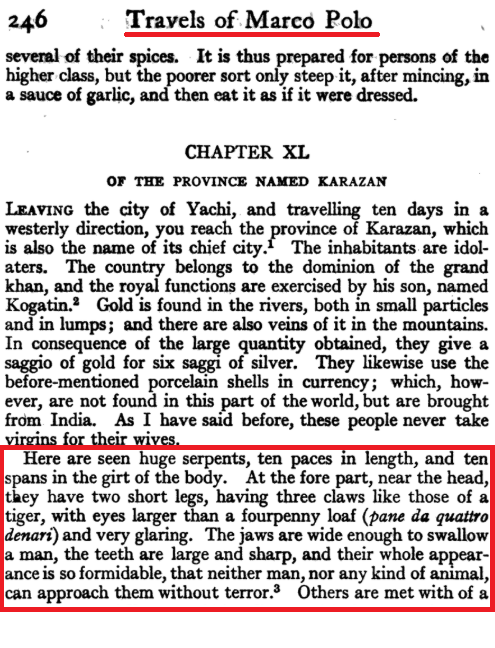
  5. Historical accounts

MarcoPoloDinosaur

CB goes on to dispute the clear teaching of the days in Genesis to be of the 24-hour variety.

Much like the English word love has five meanings in ancient Greek, the Hebrew word yom יום (translated day in Genesis) has four meanings, one of which indicates not a twenty-four hour period, but an age of time

Biblical creationists are well aware of this meaning of the Hebrew word yom, and there are several reasons why the context of Genesis 1 demands they be literal days, and not figurative ones.

  1. The author intended his audience to see the Genesis days as literal days
  2. The days have boundaries (ordinals and morning/evening)
  3. Other scriptures confirm literal days
  4. God spoke to Abraham using analogies for incredibly large numbers, so it’s not that Hebrews were simple people and could not understand numbers greater than 10 as old earthers would contend. Gen 22:17 “I will surely bless you, and I will surely multiply your offspring as the stars of heaven and as the sand that is on the seashore.” To describe a more consistent way that God would have communicated the many epochs of days, were old earthism to be true, would be for Him to have used language where He already shows His intention to communicate large numbers. But He did not. God instead chose to perform his creative works in 6 days as He said.
  5. There are contexts (plurality, modifying words, suffixes) in Hebrew for yom to mean more than a day, but none of these contexts are present in Genesis 1.
  6. There are 2 Hebrew words (zeman – H2165 and eth H6256) for epochs or long indefinite period of time, BUT THESE WORDS ARE NOT USED IN GENESIS 1

The biggest obstacle that old earthers must overcome to inject their biases into the biblical text is to somehow justify the curses of sin (death, suffering, and thorns) as being present in creation PRIOR to the rebellion of mankind. When they insist on this, it becomes an issue about the gospel. Invariably, when I ask old earthers to justify their position on this, I get either “well, it’s only spiritual death” or “I just interpret the Bible differently than you.”

  1. God declared his creation “very good.” Since creation is very good, there could not have been disease, bloodshed, and harm. Isaiah 11 and 65 confirm this. Harm, disease, and bloodshed prior to sin is unbiblical and therefore old earthism is falsified
  2. In Genesis 3:17-19 God said to Adam “Because you have listened to the voice of your wife and have eaten from the tree…to dust you will return.” The curse of sin resulted in both spiritual and physical death. Both Romans 5 and 1 Cor 15 are strong confirmation. So the debate is: Did death bring mankind into the world (old earthism) or did man bring death into the world (YEC). The Bible clearly answers that man’s sin brought death into the world. Death before sin is unbiblical and therefore old earthism is falsified
  3. One of the curses is thorns. Jesus took the crown of thorns upon Himself at the cross to complete taking the curses of sin as our punishment. But if thorns existed prior to mankind as old earthism demands, then what was the curse of sin? There are fossil thorns buried in layers that old earthers “date” as having been made prior to mankind. This view is unbiblical and therefore old earthism is falsified

Biblical interpretation is not an arbitrary function. When people interpret the Bible to mean whatever is popular in culture (homosexuality, old ages, contrary historical documents), then the body of Christ is divided and suffers.

Christians should be united. And the unity should center around God’s revelation in scripture and its fulfillment in Jesus. Jesus confirmed the testimony of Moses (Luke 16) and confirmed the historical nature of Genesis (Mark 10:6). So, God’s people should not be divided about the age of the earth. They should be united around a healthy understanding of the Bible, so that Jesus can be glorified.

We can trust God with our future because we can trust his revelation about the past.

The Eternal Creator is Good!

close up portrait of lion

Photo by Pixabay on Pexels.com

In C.S. Lewis’ timeless tale, The Lion, the Witch and the Wardrobe, a conversation ensues between Susan and a native of Narnia,

Mr. Beaver: “Aslan is a lion- the Lion, the great Lion.”

Susan: “Ooh. I’d thought he was a man. Is he-quite safe? I shall feel rather nervous about meeting a lion.”

Mr Beaver: “Safe? Who said anything about safe? ‘Course he isn’t safe. But he’s good.”

God is good. Here are 27 times in the old testament that speak of the goodness (towb) of the LORD:

  • I Chronicles 16:34
  • II Chronicles 5:13
  • II Chronicles 7:3
  • II Chronicles 30:18
  • Ezra 8:18
  • Nehemiah 2:8
  • Nehemiah 9:20
  • Psalms 23:6
  • Psalms 25:8
  • Psalms 34:8
  • Psalms 52:9
  • Psalms 54:6
  • Psalms 73:1
  • Psalms 84:11
  • Psalms 85:12
  • Psalms 86:5
  • Psalms 100:5
  • Psalms 106:1
  • Psalms 107:1
  • Psalms 118:1
  • Psalms 118:29
  • Psalms 119:68
  • Psalms 135:3
  • Psalms 136:1
  • Psalms 143:10
  • Psalms 145:9
  • Jeremiah 33:11

I’ve mentioned BlueLetterBible.org before, and it’s one of my favorite Bible study tools. Let’s look at the Hebrew word for “good” and see if we can make some connections in other parts of scripture:

GodIsGood

This Hebrew word ‘towb’ is used many times in the old testament, and it is translated as good, better, best, pleasant, excellent, prosperous. Now let’s look at places that pair ‘towb’ with its opposite: “ra” and “ra’a”, which is usually translated as evil, harm, destruction.

GoodEvil

Some examples would be Genesis 31:29

“I (Laban) have the power to harm (ra’) you; but last night the God of your fathers said to me, ‘Be careful not to say anything to Jacob, either good (towb) or bad (ra).'”

I Samuel 24:17

“You (David) are more righteous than I (Saul). You have treated me with goodness (towb), but I have repaid you with evil (ra).”

My purpose in writing this post is twofold:

  1. Remind everyone that the Almighty Creator is the opposite of evil. He is good!
  2. To highlight the contradictions of old earth paradigms in God’s Word.

Without exception all old earth paradigms require that death, disease, suffering, harm, and predation existed prior to the rebellion of Adam and Eve. But as disciples of Jesus, we want to be in agreement with ALL of his eternal Word, so let’s look at the historical narrative in Genesis to see how a proper understanding of  “towb” and “ra” can help us eliminate contradictions.

Seven times in the creation story of Genesis 1, God looked at what He had made and declared, “it was good” (towb – H2896). On the seventh time, when the Creator viewed all that He had made, He declared “it was very good.” The number 7 has symbolic meaning in God’s Word, as it seems to be used for emphasis. So, the fact that God declares his creation good and the 7th time “very good” should accentuate that God wants us to tune in to his super-repetition.

Genesis 1:29-30 God clearly says that He intends his creatures to eat fruits, seeds, and greens rather than engage in predatory behavior, and when we see Isaiah 11:6 and Isaiah 65:25 there is clear evidence that the restoration of the new creation does not include harm, destruction, or predatory behavior.

“Towb” is used to describe the character of God, and God uses “towb” to describe his creation before sin entered it. “Ra” is the opposite of “towb”, and “ra” means harm, evil, and destruction. For old earthers to assume harm, evil, and destruction were part of the “very good” creation prior to sin is not just a contradiction, it actually speaks to the character of the Almighty. Can “towb” include evil, predatory behavior, and destruction?

The Bible says no, and we can trust God’s eternal Word. Old earth paradigms cannot be an acceptable part of Christian thinking because of the contradictions that are raised when one believes harm, destruction, and death were a part of God’s “very good” creation prior to sin…along with many other reasons.

Since we can trust God’s revelation about the past, we can trust Him with our future! Our good God is worthy of praise!!!